Networking Your Way to a Stronger CV: Residency Application Strategies That Work
In residency applications, strong board scores and grades matter—but they rarely tell the whole story. What often separates two similarly qualified applicants is not just what they’ve done, but who knows about what they’ve done and who is willing to vouch for them.
That’s where networking becomes a powerful tool for career development. Strategic, ethical networking can help you:
- Discover research, leadership, and clinical opportunities that directly strengthen your CV
- Obtain high-impact letters of recommendation
- Gain insider insight into specific programs and specialties
- Build professional relationships that support you beyond Match Day
This guide walks you through how to use networking intentionally to enhance your CV for residency, with concrete steps, examples, and phrasing you can use right away.
Why Networking Matters in the Residency Match
Networking in medicine is not about schmoozing or superficial socializing. It’s about building authentic, professional relationships that help you grow—and that, in turn, make your residency application stronger and more competitive.
How Networking Directly Improves Your Residency CV
Effective networking can translate into tangible CV Enhancement across multiple sections of your application:
Stronger Letters of Recommendation (LoRs)
- Faculty who know you well can write specific, detailed letters rather than generic ones.
- Program directors recognize names of well-known letter writers, which can make your application stand out.
More Robust Research and Scholarly Productivity
- Networking connects you with ongoing projects you might never hear about otherwise.
- Collaborations can lead to abstracts, posters, oral presentations, and publications—all high-yield for a CV.
Leadership and Advocacy Roles
- Through professional relationships, you may be invited to join committees, task forces, or interest groups.
- These positions showcase initiative, professionalism, and commitment to your specialty.
Shadowing and Elective Opportunities
- Knowing the right people can open doors to sub-internships, away rotations, or niche clinical experiences.
- These experiences demonstrate depth of interest in a specialty and can generate strong evaluations.
Program-Specific Insight and Fit
- Conversations with residents, fellows, and faculty can help you understand what different programs value.
- You can then highlight the most relevant parts of your CV in your personal statement and interviews.
Networking as Long-Term Career Development
While your immediate goal may be the residency match, your network will continue to serve you throughout training and beyond:
- Future fellowship opportunities
- Multi-center research collaborations
- Job opportunities through word of mouth
- Mentors who support career pivots, academic promotion, or leadership roles
Investing in professional relationships now is one of the highest-yield career decisions you can make.
Laying the Foundation: Building Networking Skills Early
You don’t need to be extroverted to be effective at networking. You do need to be intentional, prepared, and consistent.
Start Early and Start Local
The best time to begin networking is now—whether you are pre-clinical, in clerkships, or already in a research year.
Practical starting points
Join student and specialty interest groups
- Examples: Internal Medicine Interest Group, Surgery Interest Group, EMRA, ACOG medical student sections.
- These groups often host guest speakers, skills workshops, and networking nights.
Engage in community and clinical volunteer work
- Free clinics, health fairs, patient education programs, global health projects.
- You’ll meet physicians, residents, and community leaders who can later serve as mentors or advocates.
Work closely with course and clerkship directors
- Be prepared, engaged, and reliable during rotations.
- Ask for feedback and follow through on suggestions—this builds your reputation.
Using Social Media Strategically for Networking
Social media can amplify your professional presence when used thoughtfully. Treat it as an extension of your professional identity.
LinkedIn: Your Public Professional Profile
Build a polished profile
- Use a professional photo (no scrubs selfies in a messy call room).
- Include a concise headline: “MS3 interested in Internal Medicine and Health Disparities Research,” for example.
- Fill out your education, experiences, presentations, and publications.
Connect with intention
- Add classmates, residents, faculty, and professionals you meet at conferences.
- When sending a connection request, add a note:
“It was great hearing your talk on heart failure management at the IM interest group session today. I’d love to stay connected and learn more about your work.”
Engage with content
- Share your research posters, reflections on rotations, or articles relevant to your career interests.
- Comment thoughtfully on posts rather than just “liking” them.
Twitter / X and Instagram: Following Thought Leaders
Follow credible accounts
- Physicians, program directors, specialty societies, journals, and medical educators.
- Use specialty-specific hashtags (#MedTwitter, #FOAMed, #nephpearls, etc.).
Participate respectfully
- Ask questions about clinical pearls or research articles.
- Share your learning (while strictly maintaining patient confidentiality).
Avoid pitfalls
- Maintain professionalism at all times—assume program directors may see anything you post or are tagged in.
- Use separate private accounts for personal content if needed.
High-Yield Networking in Person: Events, Rotations, and School Resources
Some of the most impactful Professional Relationships are built in person, during shared work and learning experiences.
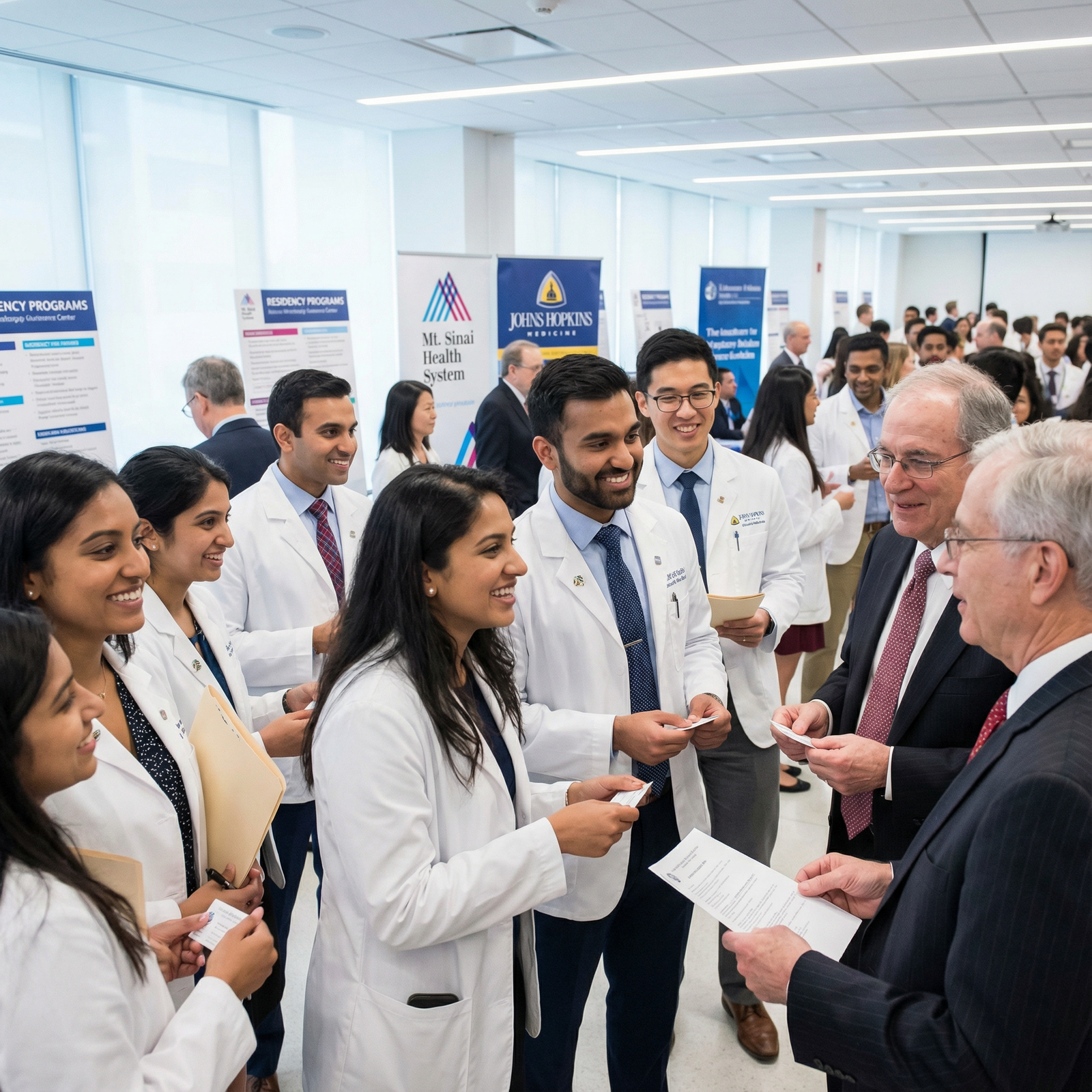
Conferences, Workshops, and Residency Fairs
Conferences aren’t just about lectures—they are one of the best environments for targeted networking and CV enhancement.
Before the event
Set clear goals
- Examples: “Meet at least two faculty in cardiology,” “Explore research fellowships in EM,” or “Ask PDs what they value in applicants.”
Review the program
- Identify speakers and sessions aligned with your interests.
- Look up faculty profiles so you can ask informed questions.
Prepare your “30-second intro”
- Example:
“Hi, I’m Alex, a third-year medical student at [School], really interested in academic internal medicine and medical education. I’ve been working on a project about resident feedback tools.”
- Example:
During the event
- Attend smaller sessions, poster sessions, and workshops where conversation is easier.
- Ask 1–2 thoughtful questions after talks or in the Q&A.
- Introduce yourself to speakers you’re genuinely interested in and keep it brief and respectful.
Sample approach line:
“Thank you for your talk on perioperative risk. I’m a second-year student interested in anesthesia and quality improvement. Do you have any advice on how early trainees can get involved in this type of research?”
After the event
Follow up within 48–72 hours
- Send a short email or LinkedIn message:
“Dear Dr. Smith,
It was a pleasure meeting you at the [Conference Name] cardiology session. I appreciated your insights on resident-led QI projects. As a third-year interested in cardiology and quality improvement, I’d be grateful for any suggestions on how to build relevant experiences during medical school.
Sincerely, [Name]”
- Send a short email or LinkedIn message:
Keep a simple contact log (spreadsheet or note):
- Name, role, where you met, topics discussed, follow-up date.
Maximizing Networking During Clinical Rotations
Your clinical rotations are one of the most overlooked but powerful networking settings.
How to stand out positively
- Come prepared (read about common diagnoses before the rotation starts).
- Be reliable: arrive early, respond promptly, follow through on tasks.
- Show curiosity: ask “why” and “how” questions, not just “what.”
- Offer help: “Is there anything else I can do before I leave today?”
Turning good impressions into professional relationships
Approach a faculty member near the end of a rotation:
“Dr. Lee, I’ve really appreciated working with you on this rotation and learned a lot from your teaching on heart failure. I’m very interested in internal medicine and would love to stay in touch as I’m shaping my residency application. Would it be okay if I reach out in the future for advice—or if any research or QI projects come up that I might help with?”
This kind of respectful, specific request often leads to mentorship, research opportunities, or strong letters later.
Leveraging Your School’s Formal Resources
Most medical schools offer structured ways to build your network and support your Career Development.
Career advising and dean’s offices
- Schedule meetings early (especially if you are considering a competitive specialty).
- Ask who in the department is active in mentoring students or has strong national connections.
Alumni offices and databases
- Many schools maintain searchable directories by specialty, graduation year, and location.
- Reach out to alumni who share your interests or career goals.
Sample email to an alumnus:
Subject: MS3 Seeking Advice on [Specialty] and Residency Applications
Dear Dr. Patel,
I’m a third-year medical student at [Your School], and I found your name through our alumni directory. I’m interested in pursuing residency in [Specialty], and I noticed you completed your training at [Program]. If you have 15–20 minutes, I’d be very grateful for any advice you might have regarding preparing a strong application and exploring this specialty further.Sincerely,
[Name]
[Expected Graduation Year]
From Connection to Collaboration: Strengthening Professional Relationships
Networking is not a one-time interaction; it’s an ongoing process of building trust and mutual respect.
Building Genuine Rapport
The strongest Professional Relationships are based on authenticity and shared interests.
Be curious, not transactional
- Don’t open with “Can you write me a letter?”
- Instead, ask about their work, path, and advice for trainees.
Look for ways to contribute
- Offer help with literature reviews, data entry, drafting abstracts, or organizing events.
- Share useful articles or resources related to their interests.
Respect their time
- Be concise in emails.
- When asking for a meeting, suggest a clear time frame (“15–20 minutes”).
Maintaining Contact Without Becoming a Burden
You don’t need constant communication, but you do need consistent, thoughtful touchpoints.
Check in every 3–6 months
- Update them on your progress: board exams, research acceptance, clinical milestones.
- Ask one or two specific questions rather than a long list.
Share outcomes of their advice
- “Based on your recommendation, I joined the [Specialty] interest group and connected with Dr. X—that’s led to a great QI project. Thank you again for the guidance.”
Acknowledge milestones
- Congratulate mentors when they receive awards, publish major papers, or take on leadership roles (LinkedIn or email).
Using Networking to Unlock High-Impact Opportunities
Once you’ve started building relationships, you can leverage your network strategically to enhance your CV in targeted ways.
Shadowing, Sub-Internships, and Electives
Shadowing and advanced clinical experiences demonstrate sustained interest in a field and can generate powerful letters.
How to ask for shadowing or electives
- Approach a physician who knows you, or was recommended by a mentor:
“I’m very interested in [Specialty] and would like more exposure to the day-to-day work in your field. Would it be possible to shadow you in clinic for a few days, or is there someone you would recommend I contact?”
- Approach a physician who knows you, or was recommended by a mentor:
For away rotations / sub-internships
- Ask upper-level students or alumni what rotations are valued in your specialty.
- Ask residents and faculty for honest feedback on which programs might be a good fit.
Research and Scholarly Projects
Research is one of the clearest ways Networking and CV Enhancement intersect.
Finding research through your network
Let mentors know explicitly:
“I’m looking for opportunities to get involved in research related to [topic/specialty]. If you know of any ongoing projects where a student could help, I’d be very interested.”
Ask residents—they often have projects that need help and can introduce you to faculty PIs.
Maximizing the impact of each project
- Aim for tangible outputs: posters, regional/national presentations, manuscripts, quality improvement implementation.
- Present at local and national meetings to multiply networking benefits.
Leadership, Teaching, and Advocacy Roles
Your network can connect you to roles that show initiative and maturity.
Committees and organizations
- Hospital committees (patient safety, diversity, curriculum)
- National society student sections (e.g., APDIM, ACS, ACEP student branches)
Teaching opportunities
- Ask faculty if you can help lead small groups, OSCE prep, or peer teaching.
- These roles highlight communication skills and professionalism.
All of these experiences should be clearly documented on your CV and can become rich material for interview discussions.
Turning Networking Wins into a Standout Residency CV
Networking is only as valuable as your ability to translate relationships and experiences into a compelling written application.
Where Networking Shows Up on Your CV
Education and Training
- Away rotations or sub-internships obtained through connections.
Research and Publications
- Projects initiated or joined via mentors, residents, or conference contacts.
Presentations and Posters
- Talks, workshops, or conference presentations you gave or co-authored.
Leadership and Service
- Positions in student organizations, national societies, or committees.
Professional Development / Mentorship Section (optional)
- Briefly list formal mentorship programs or longitudinal mentorship relationships:
- “Mentee, Department of Pediatrics Mentorship Program (Mentor: Jane Smith, MD; focus on pediatric cardiology career development).”
- Briefly list formal mentorship programs or longitudinal mentorship relationships:
Letters of Recommendation: The Ultimate Networking Outcome
Thoughtful networking often leads to strong letters. To set your letter-writers up for success:
Ask the right person
- Someone who has directly observed your clinical work, professionalism, and growth.
- Someone enthusiastic about supporting your goals.
Ask the right way
- “Do you feel you know me well enough to write a strong letter of recommendation for my application in [Specialty]?”
- Give them an easy out if they hesitate.
Provide supporting materials
- Updated CV
- Personal statement draft
- Bullet list of key experiences or cases you shared with them
Well-known letter writers who know you well can significantly strengthen your application—this is where long-term Professional Relationships really pay off.
Real-World Examples: Networking in Action
Case Study 1: From Student Group to Publication
Jessica, an MS2, joined her school’s pediatrics interest group and actively helped organize a guest lecture series. After one event, she approached the faculty speaker:
“Dr. Gomez, I really enjoyed your talk on childhood obesity. I’m very interested in pediatrics and community health. Are there any projects you’re working on where a student could get involved?”
Dr. Gomez invited Jessica to join a retrospective chart review project. Jessica:
- Completed IRB training and helped with data collection
- Co-authored an abstract accepted to a national pediatric conference
- Presented the poster and met additional faculty in the field
- Ultimately co-authored a manuscript
By the time she applied for residency, Jessica’s CV included:
- One national poster presentation
- One manuscript under review
- A strong letter of recommendation from Dr. Gomez, who knew her work well
Case Study 2: Conferences and Career Direction
John, uncertain between general surgery and orthopedics, attended multiple regional and national conferences during MS3–MS4. He:
- Introduced himself to speakers after sessions
- Asked residents about lifestyle, training differences, and program cultures
- Followed up with faculty who were involved in medical student education
One surgeon invited John to complete a sub-internship at his institution, where John:
- Worked closely with residents and attendings
- Participated in a small QI project
- Received an outstanding evaluation and a supportive letter
That combination of hands-on experience, tailored CV entries, and strong letters contributed to John matching into a highly competitive surgical residency.
FAQs: Networking and CV Enhancement for Residency Applications
1. I’m introverted and feel awkward networking. How can I still be effective?
You don’t need to be the most talkative person in the room. Focus on:
- Small, intentional conversations (one-on-one rather than large groups)
- Preparation: have 2–3 questions ready before events or meetings
- Listening more than speaking: mentors appreciate interested, thoughtful learners
- Follow-up emails: written communication can be more comfortable and just as effective
Over time, networking feels less like “performing” and more like building genuine professional relationships.
2. How early should I start networking for residency?
Earlier is better, but it’s never too late:
- Pre-clinical years (MS1–2): explore specialties, join interest groups, attend talks.
- Clerkship years (MS3): build relationships on rotations, seek feedback and mentorship.
- Application year (MS4): strengthen existing connections, request letters, and reach out to residents or alumni at programs you’re applying to.
If you’re starting late, focus on deepening a few meaningful relationships rather than trying to meet everyone.
3. How often should I contact mentors or professional connections?
A good rule of thumb:
- Active mentors (research, ongoing projects): every 2–6 weeks or as work progresses
- Career mentors: every 3–6 months with updates and specific questions
- Conference or brief contacts: at least once a year, and again when you have a clear reason (e.g., applying to their program)
Always make your message purposeful: share an update, ask a focused question, or thank them for prior advice.
4. Is it appropriate to network with residents and other trainees?
Absolutely—and it’s highly valuable.
Residents can:
- Give honest insight into program culture and expectations
- Suggest rotations, faculty, or projects to pursue
- Offer practical tips for shelf exams, Step/Level exams, and interviews
Just remember they are often busy. Be respectful of their time, and consider brief messages like:
“I really appreciated your teaching on the wards. If you ever have a project that a student could help with, I’d be happy to contribute.”
5. How can I show networking and professional development on my CV without it looking superficial?
You don’t list “networking” as a bullet point. Instead, you list the results of networking:
- Research and QI projects with clear roles and outcomes
- Leadership positions in student or professional organizations
- Conference presentations, workshops, and invited talks
- Formal mentorship programs or longitudinal mentorship roles (briefly described)
If each item includes your role, impact, and outcome, it will come across as substantive and professional—not superficial.
By approaching networking as a core part of your professional development—not an optional “extra”—you can systematically build a stronger, more compelling residency CV. Start where you are, be intentional, follow through, and allow your professional relationships to guide and amplify your growth on the road to residency.