Preliminary internal medicine (prelim IM) positions are unique in the residency landscape. They’re essential for applicants pursuing advanced specialties—such as neurology, anesthesiology, radiology, dermatology, and others—but they’re also highly competitive and often misunderstood by medical students. A strong, purpose-built CV is one of the most powerful tools you have to stand out.
This guide walks you through how to build a CV for residency that is specifically optimized for a preliminary medicine year—what to include, how to present it, and how to avoid common pitfalls. You’ll learn how to convert your varied experiences into a compelling narrative that program directors can understand and trust.
Understanding the Role of the CV in Preliminary Medicine Applications
Your ERAS application functions as a combined CV and application form, but most programs still request or value an uploaded medical student CV—especially for away rotations, scholarships, letters of recommendation, and sometimes internal screening. Think of your standalone CV as:
- A clean, organized snapshot of your qualifications
- A flexible tool you can adapt for prelim IM, advanced specialties, research positions, and institutional opportunities
- A consistency check: programs will notice if your uploaded CV and ERAS content don’t align
For a prelim IM year, program directors look for slightly different things than categorical internal medicine programs might. They know many prelim residents are headed into another field, so they prioritize:
- Reliability and professionalism (will you be a safe, dependable intern?)
- Clinical readiness (can you hit the ground running on busy medicine services?)
- Teamwork and communication (will you function well on multidisciplinary teams?)
- Evidence of resilience and work ethic (can you handle a demanding year?)
Your CV should foreground experiences that answer these questions clearly.
Core Structure: How to Build a CV for a Preliminary Medicine Year
There’s no single “correct” CV format, but residency programs expect certain core sections in a medical student CV. For a prelim IM–focused CV, a logical structure is:
- Contact Information & Identification
- Education
- Exam Scores & Certifications (optional on CV, mandatory in ERAS)
- Clinical Experience (including rotations)
- Research Experience & Scholarly Work
- Teaching, Leadership & Service
- Awards & Honors
- Skills & Additional Information
The order matters: highlight sections that best support your prelim goals higher on the page.
1. Contact Information & Identification
This should be concise, professional, and at the very top.
Include:
- Full name (matching ERAS and legal documents)
- Professional email (e.g., firstname.lastname@domain.com)
- Phone number with country/area code
- City and state (full address is optional)
- LinkedIn profile or professional website (optional but useful if well maintained)
Avoid:
- Casual email addresses (e.g., “drparty123@…”)
- Including photos (in the U.S., photos go in ERAS, not on a CV)
- Including personal identifiers (marital status, age, religion)
2. Education
List in reverse chronological order.
Include for each entry:
- Degree, institution, city, country
- Dates attended (month/year or year–year)
- Expected graduation date (if still a student)
- Class rank/quartile if available and favorable
- Thesis title (if applicable)
Example:
Doctor of Medicine (M.D.)
XYZ School of Medicine, City, State, USA | 2021–2025
- Anticipated graduation: May 2025
- Class rank: Top 25%
For international medical graduates (IMGs), it’s often helpful to:
- Clarify if the school is FAIMER- or ECFMG-recognized
- Provide a brief explanatory note if your grading system is non-U.S. equivalent
3. Exam Scores & Certifications (Optional on the CV)
In ERAS, USMLE/COMLEX scores are required and prominently displayed. On the CV, you can list them briefly or omit them if you’re concerned about readability (not hiding them—they’re in ERAS—but avoiding clutter).
If you include them:
- Place in a short “Exam Scores & Certifications” section.
- Include only passed exams, with scores if they are strengths.
Example:
USMLE Step 1 – Pass (2023)
USMLE Step 2 CK – 243 (2024)
BLS/ACLS Certified, American Heart Association – Expires 06/2026
For a preliminary medicine year, including BLS/ACLS and any procedural or simulation certifications is helpful; it signals readiness for inpatient work.

Highlighting Clinical Readiness: Rotations and Clinical Experience
Preliminary medicine programs are fundamentally about clinical service, especially inpatient care. Your CV needs to reassure programs that you are:
- Comfortable on busy medical floors and ICUs
- Familiar with common internal medicine conditions
- Able to handle cross-cover, admissions, and night float
4. Clinical Experience Section: Go Beyond “Third-Year Clerkships”
In ERAS, core clerkships appear in transcript and MSPE summaries. On your CV, you can strategically highlight clinical experiences that differentiate you and are particularly relevant to prelim IM.
Consider organizing this section into:
- Core Clerkships (selected highlights)
- Sub-internships / Acting Internships (AIs)
- Away Rotations / Visiting Student Rotations
- Other Clinical Experience (e.g., clinical electives, observerships for IMGs, paid clinical roles)
How to List Clerkships and Sub-Internships
Include:
- Rotation title
- Institution, department
- Dates (month/year)
- 1–3 bullet points emphasizing responsibility, autonomy, and skills
For a preliminary medicine year, sub-internships in internal medicine or closely related areas (ICU, cardiology, oncology) are especially impactful.
Example entry:
Sub-Internship, Internal Medicine
University Hospital, Department of Medicine – City, State | Aug–Sep 2024
- Managed a census of 4–6 patients under resident supervision, writing daily notes, orders, and discharge summaries in EPIC
- Participated in night float admitting shifts, performing initial H&Ps and presenting new admissions to the senior resident and attending
- Assisted in coordination of care with case management and social work for complex discharges
Notice that this goes beyond listing the rotation—it demonstrates functional intern-level work.
For IMGs and Non-Traditional Applicants
If you are an IMG or have significant U.S. clinical experience (USCE) in internal medicine:
- Create a subsection titled “U.S. Clinical Experience – Internal Medicine”
- Distinguish clearly between hands-on experiences (electives, sub-Is, externships) and observerships or shadowing
- Emphasize what you actually did: H&Ps, progress notes, EHR use, patient counseling, team presentations
Example:
Clinical Elective, Inpatient Internal Medicine (Hands-on)
ABC Medical Center, City, State | Jan–Feb 2024
- Performed supervised physical exams and formulated assessment/plan for 2–3 patients daily
- Presented patient cases on rounds and documented progress notes in the EHR
- Collaborated with multidisciplinary teams in discharge planning and follow-up arrangements
Avoid generic descriptions like “observed doctors and learned about the U.S. healthcare system.”
Building Scholarly and Professional Credibility: Research, Teaching, Leadership
Even though a preliminary medicine year is service-heavy, program directors still look for evidence of intellectual engagement and professional development. This is where your research, teaching, and leadership shine.
5. Research Experience & Scholarly Work
You don’t need to be a first-author in NEJM to be impressive. What matters is:
- Sustained involvement
- Clear role and impact
- Relevance (ideally to internal medicine, your advanced specialty, or clinical research generally)
Organize this section into:
- Research Positions / Experiences
- Publications
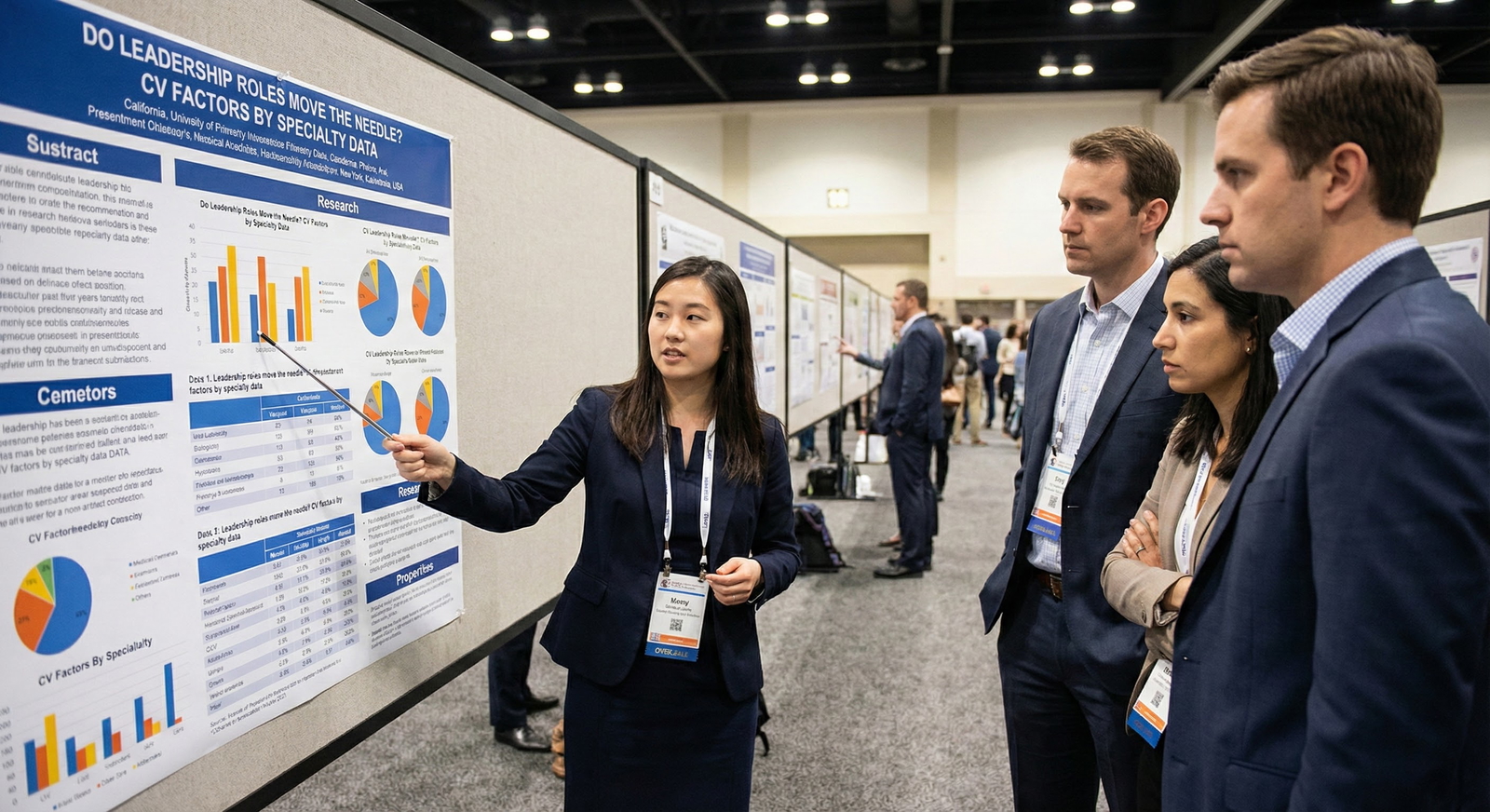
- Presentations & Posters
Research Positions
For each position, include:
- Title (e.g., Research Assistant, Research Scholar)
- Department, institution
- Dates
- 2–4 bullet points focusing on skills and responsibilities
Example:
Research Assistant, Outcomes in Heart Failure Clinic
Division of Cardiology, XYZ University | 2022–2024
- Collected and curated clinical data for a registry of 500+ heart failure patients, ensuring accurate chart abstraction and REDCap entry
- Performed basic statistical analysis (descriptive statistics, logistic regression) in collaboration with a biostatistician
- Co-authored an abstract accepted for poster presentation at the American College of Cardiology (ACC) Annual Meeting 2024
Tie this back to prelim IM by highlighting patient populations and conditions commonly managed by internal medicine services.
Publications and Presentations
List in standard citation format, grouped separately:
- Peer-reviewed articles
- Book chapters
- Abstracts and posters
- Oral presentations
Order them chronologically (most recent first) or by type, but be consistent. Make it easy for a program director to scan and understand your scholarly output in 15–20 seconds.
6. Teaching, Leadership & Service: Signals of a Strong Intern
Prelim programs care deeply about whether you will be:
- A dependable teammate
- A positive presence on the ward
- Able to help teach junior students and collaborate professionally
Use this section to demonstrate those attributes.
Teaching Experience
Think broadly:
- Peer teaching programs
- Anatomy or clinical skills tutors
- OSCE standardized patient programs (as a trainer)
- TA roles in pre-clinical courses
Example:
Peer Tutor, Clinical Skills and Physical Exam
XYZ School of Medicine | 2022–2023
- Led small-group sessions (6–8 MS1 students) practicing fundamental exam maneuvers and patient interviewing
- Provided individualized feedback using standardized assessment rubrics
- Collaborated with faculty to refine teaching cases and checklists
Teaching experience reassures program directors that you can teach medical students as a PGY-1—something many prelims are asked to do on busy services.
Leadership and Service
Include:
- Student organization leadership roles
- Committee memberships (curriculum committee, wellness committee)
- Community service (free clinics, health fairs, outreach programs)
Emphasize:
- Responsibility (did you lead, coordinate, or organize?)
- Scope (how many people, how frequent, what outcomes?)
- Sustainability (did you build something lasting?)
Example:
Co-Director, Student-Run Free Clinic
XYZ School of Medicine | 2021–2023
- Oversaw weekly evening clinic serving ~25 uninsured patients per session
- Managed scheduling of 15–20 student volunteers and 3–4 attending preceptors per month
- Implemented a new triage and follow-up system that reduced missed follow-up visits by 30%
This kind of description directly signals organizational skills, communication, and reliability—all qualities of a strong prelim intern.

Formatting and Presentation: Residency CV Tips That Matter
Content is king, but presentation is your gatekeeper. A clear, professional format makes it easier for programs to see your strengths and minimizes the risk of errors.
7. General Formatting Principles
- Length: For most medical students, 2–3 pages is appropriate; IMGs or applicants with extensive prior careers may reasonably have 3–4 pages.
- Font: Professional, readable (e.g., Times New Roman, Calibri, Arial, 10.5–12 pt).
- Margins: 0.5–1 inch all around.
- Consistency: Uniform dates, headings, bullet styles, and punctuation.
- White space: Avoid text-heavy walls; use spacing and headings to guide the reader’s eye.
Avoid:
- Colors, graphics, or creative/infographic formats
- Personal logos or branding elements (U.S. residency CVs are conservative)
- Tables that may not convert well to PDF
8. Tailoring for a Prelim IM Audience
Your medical student CV may be used for multiple purposes, but when presenting it to prelim internal medicine programs, you can:
- Emphasize internal medicine–related experiences: hospitalist shadowing, IM sub-Is, cardiology, pulmonary, nephrology electives.
- Place prelim-relevant sections (Clinical Experience, Teaching & Leadership) higher than sections that are less immediately relevant.
- Choose bullet points that highlight skills useful in inpatient internal medicine: managing admissions, cross-cover, dealing with acutely ill patients, coordinating care.
Example of tailored bullet emphasis:
Generic:
- Participated in daily rounds and completed assigned tasks
Prelim-optimized:
- Presented daily on new and follow-up patients during multidisciplinary rounds, adjusting management based on evolving clinical status
The second version communicates initiative, communication, and dynamic decision-making—all qualities valued in prelim IM.
9. Avoiding Common CV Mistakes
Program directors and faculty see thousands of applications; certain errors are instant red flags.
Common pitfalls:
- Typos and grammatical errors – Suggest carelessness; always proofread and, ideally, have at least two other people review your CV.
- Inflated roles – Overstating your level of responsibility can backfire in interviews when details are probed.
- Vague descriptions – “Helped with a research project” tells them almost nothing.
- Unexplained gaps – If you have long gaps in education or work, be prepared to explain them in your personal statement or interviews.
- Inconsistencies with ERAS – Dates, titles, and experiences must match. Discrepancies raise concerns about honesty.
A simple test: Could someone who doesn’t know you understand what you actually did from your bullet points? If not, revise.
Strategic CV-Building During Medical School: What to Do in MS1–MS4
If you’re still in training, you can proactively build the CV you want for your future preliminary medicine year. Think longitudinally.
MS1–MS2: Laying the Foundation
Focus on:
- Strong academic performance (helps for both prelim IM and advanced programs)
- Early research involvement in an area of interest (e.g., internal medicine subspecialties, your intended advanced specialty)
- Joining interest groups (Internal Medicine, specialty-specific groups)
- Starting low-intensity leadership roles (class committees, volunteering coordination)
Actionable steps:
- Seek out a mentor in internal medicine even if you plan another advanced specialty; they can guide you toward helpful experiences for a prelim IM year.
- Start one sustained volunteer commitment (e.g., free clinic) rather than many one-off activities.
Core Clinical Year(s): Demonstrating Clinical Strength
Prioritize:
- Strong clinical evaluations in internal medicine and related rotations
- At least one sub-internship in Internal Medicine if possible
- Opportunities to take on teaching roles (e.g., near-peer teaching in skills labs)
- Targeted research or QI projects in inpatient medicine or your advanced specialty
Actionable steps:
- Ask attendings who are strong teachers to observe and later support your teaching and leadership roles—this can translate into strong letters and credible CV entries.
- Pursue a small, achievable QI project during your IM rotation (e.g., improving discharge medication reconciliation) that you can list under scholarly work.
Application Year (MS4/Final Year): Refinement and Alignment
Focus on:
- Finalizing a coherent narrative that links your clinical experiences, research, and career goals
- Ensuring your CV, ERAS, and personal statement tell a consistent story
- Requesting letters from IM attendings who can comment on your readiness for a prelim IM year (even if your advanced specialty is elsewhere)
Actionable steps:
- Have mentors from both internal medicine and your advanced specialty review your CV and offer honest feedback.
- Customize bullet points to better highlight skills most relevant to being a strong intern: communication, reliability, and clinical judgment.
FAQs: CV Building for a Preliminary Medicine Year
1. Do I need a separate CV for prelim IM and my advanced specialty?
Not necessarily. You can usually use a single master medical student CV and tailor how you describe experiences depending on the audience. For internal medicine–oriented contexts (prelim programs, IM away rotations), emphasize IM-relevant aspects—busy inpatient care, teamwork, patient communication. For your advanced specialty, adjust bullet points to highlight specialty-related skills and interests.
2. How important is research on a CV for a preliminary medicine year?
Research is not mandatory for a prelim IM position, but it can strengthen your application, especially at academic programs. What matters most is evidence of clinical competence, professionalism, and work ethic. Even modest research involvement—such as a QI project on inpatient medicine workflows—can help if it’s clearly described and shows initiative.
3. Should I list hobbies and personal interests on my CV?
Including a brief “Interests” section at the end is optional but often beneficial. It humanizes you and can serve as an easy conversation starter in interviews. Keep it concise (1–3 lines) and specific (e.g., “Distance running—completed three half-marathons” rather than just “running”). Avoid controversial topics (e.g., partisan politics) unless they align with clearly professional advocacy roles you’re ready to discuss thoughtfully.
4. How do I handle a weaker academic record or exam score on my CV?
Your CV is not the place to explain weaknesses—that’s better suited for your personal statement or interviews if needed. On the CV, focus on:
- Concrete strengths: clinical performance, sub-I comments, leadership, teaching
- Evidence of improvement over time
- Rich clinical and service experiences that demonstrate resilience and growth
If you choose not to list exam scores on the CV, that’s acceptable; programs will still see them in ERAS. Just ensure no inconsistencies between what you present in your CV and official documents.
By approaching your residency CV as a deliberate, strategic document—rather than a last-minute list of everything you’ve ever done—you present yourself as exactly what preliminary medicine programs want: organized, thoughtful, reliable, and clinically ready for the challenges of intern year.