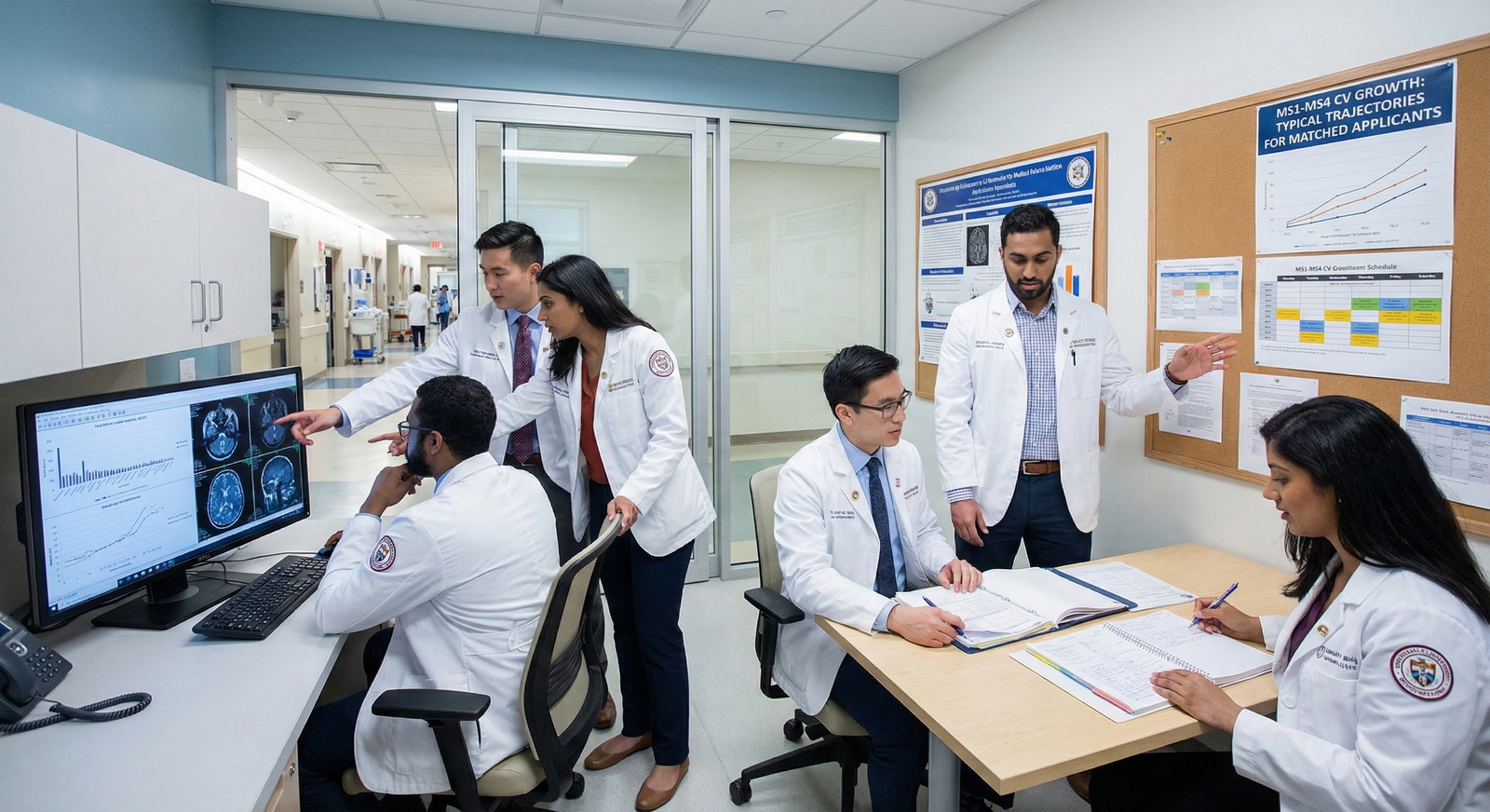
Crafting a strong residency CV is one of the most controllable parts of your residency application. While you cannot change your grades or exam scores at this stage, you can present your experiences in a way that clearly communicates your value, professionalism, and fit for a program. Think of your CV as your professional story in medical education and Career Development—organized, selective, and aligned with your goals.
Below is a detailed guide to revising your CV so it’s not only residency-ready, but a strategic tool for Residency Applications and long-term Professional Growth.
Understanding the Residency CV and Its Role in Your Application
What Is a Residency CV?
A curriculum vitae (CV) is a comprehensive record of your academic, clinical, research, and professional activities. It differs from a traditional job resume by being more detailed, more academic, and usually longer.
For residency applicants, your CV typically includes:
- Education and degrees
- Clinical experiences and rotations
- Research and scholarly work
- Publications and presentations
- Leadership, teaching, and service
- Skills and certifications
- Professional memberships and awards
Why Your CV Matters in Residency Applications
Program directors and selection committees use your CV for several key purposes:
Quick Snapshot of Your Trajectory
Your CV shows your journey through Medical Education—where you trained, what you focused on, and how you’ve spent your time. It helps programs understand your path and progression at a glance.Evidence of Professionalism and Attention to Detail
Inconsistent formatting, typos, and vague descriptions can raise concerns about your reliability and accuracy—critical traits in medicine. A clean, well-organized CV signals professionalism and strong Career Development habits.Context for Your ERAS Application and Personal Statement
Your CV and ERAS entries should be consistent and complementary. The CV provides detail and structure; your personal statement adds meaning and narrative. Program directors often cross-reference them.Interview and Ranking Tool
Interviewers frequently have your CV in front of them during interviews. They may use it to frame questions (“Tell me about this research project” or “How did you get involved in this community clinic?”). A strong CV gives them plenty of substantive starting points.
Core Structure of a Residency-Ready CV
While you can adapt the format slightly based on your specialty or country, most residency CVs follow a standard, predictable order. This makes it easier for program directors to find what they need quickly.
Recommended Section Order
- Contact Information
- Education
- Clinical Experience (including key clerkships, electives, sub-internships)
- Research Experience
- Publications & Presentations
- Teaching & Mentoring (optional but valuable)
- Leadership & Professional Activities
- Honors & Awards
- Certifications & Licenses
- Professional Affiliations
- Skills (Clinical, Technical, and Language)
- Volunteer & Community Service
- Interests (optional, but can humanize your application)
Example Residency CV Layout
[Your Name, MD (or MD Candidate)]
[City, State] (optional)
[Phone Number]
[Professional Email Address]
[LinkedIn Profile or Professional Website (if well-maintained)]
Education
Doctor of Medicine (MD)
[Medical School Name], [City, State/Country]
Expected Graduation: [Month Year]
- Class rank (if favorable and permitted to share)
- Relevant scholarly tracks (e.g., Global Health Track, Medical Education Track)
Bachelor of Science in Biology
[University Name], [City, State/Country]
[Month Year] – [Month Year]
- GPA (if strong and relevant)
- Honors (e.g., magna cum laude, Dean’s List)
Clinical Experience
Sub-Intern, Internal Medicine
[Hospital Name], [City, State]
[Month Year] – [Month Year]
- Independently managed panel of 6–8 patients under supervision
- Performed admissions, daily progress notes, and discharge summaries
- Presented cases at daily team rounds and weekly case conferences
Elective, Emergency Medicine
[Hospital Name], [City, State]
[Month Year] – [Month Year]
- Participated in rapid assessment and triage
- Performed focused histories and physical exams in a high-acuity setting
Research Experience
Research Assistant, Cardiology Outcomes Research Group
[Institution], [Department], [City, State]
[Month Year] – [Month Year]
- Designed data collection tools and abstracted data for a retrospective cohort study of 450 patients
- Conducted statistical analyses using SPSS; co-authored manuscript submitted to [Journal Name]
Publications & Presentations
Peer-Reviewed Publications
- [Last Name Initial], [Initials], et al. “Title of Article.” Journal Name. Year;Volume(Issue):Pages.
Abstracts & Poster Presentations
- [Last Name], [Initials]. “Title of Poster.” Poster presented at [Conference Name], [City, State], [Month Year].
Certifications & Licenses
- USMLE Step 1: Passed [Month Year]
- BLS (Basic Life Support), American Heart Association — Expires [Month Year]
- ACLS (Advanced Cardiovascular Life Support), American Heart Association — Expires [Month Year]
Professional Affiliations
- American Medical Association (AMA), Student Member, [Year] – Present
- Specialty-specific association (e.g., American College of Physicians), Student Member, [Year] – Present
That’s the framework. The next step is turning it into a compelling, polished document.

Key Principles for Strong Residency CV Writing
1. Be Concise, Relevant, and Specialty-Focused
Residency programs often review hundreds of applications in a short period. Your goal is to make their job easier.
Practical guidelines:
- Aim for 2–3 pages for most U.S. residency applicants (longer only if you have substantial research or prior careers).
- Prioritize quality over quantity. A short, strong section is better than a long list of marginal activities.
- Emphasize experiences that support your specialty interest and Career Development path.
- Applying to surgery? Highlight operative exposure, technical skills, and procedural electives.
- Applying to psychiatry? Feature mental health work, communication skills, advocacy, and longitudinal patient relationships.
Example (weak vs strong):
- Weak: “Participated in various health fairs.”
- Strong: “Organized and staffed 6 community health fairs focused on hypertension screening, counseling over 200 patients on lifestyle modification.”
2. Use Clear, Descriptive Section Headings
Program directors often skim the CV first to locate areas of interest.
Replace vague headings like “Experience” with precise, keyword-rich headings that support your goals and SEO-friendly terms such as:
- “Clinical Experience and Clerkships”
- “Research and Scholarly Activities”
- “Leadership & Professional Development”
- “Teaching and Medical Education Activities”
- “Volunteer Work and Community Engagement”
These headings not only help humans but can also align with institutional keyword searches when CVs are filtered or indexed.
3. Tailor Your CV for Different Programs and Specialties
You do not need a completely different CV for every residency program, but small targeted adjustments can be impactful.
What you can adjust:
- Order of sections (e.g., moving Research earlier for research-heavy academic Internal Medicine programs).
- Emphasis within bullet points (e.g., highlighting procedural volume for surgical specialties vs communication and counseling for primary care).
- Optional sections (e.g., adding “Global Health Experience” for programs with that focus).
Example:
For a Family Medicine application:
- Managed continuity clinic patients under supervision, focusing on preventive care, chronic disease management, and motivational interviewing techniques.
For an Emergency Medicine application describing the same experience:
- Evaluated undifferentiated urgent complaints, initiated diagnostic work-ups, and coordinated rapid transitions of care in a busy ambulatory setting.
Same rotation, different emphasis—aligned with residency program priorities.
4. Highlight Leadership, Teaching, and Teamwork
Residency is a team sport. Programs look for evidence that you can function—and eventually lead—within a multidisciplinary team.
Create or emphasize sections such as:
- Leadership & Professional Activities
- Teaching & Mentorship
- Committee Service
Examples of strong leadership bullets:
- “President, Internal Medicine Interest Group — Led a 12-member executive board, organized 8 educational events annually with average attendance of 50+ students.”
- “Chief Tutor, Peer Tutoring Program — Supervised 10 tutors; implemented a feedback system that improved student satisfaction scores from 3.8 to 4.5/5.”
Even small leadership roles count if you clearly explain your responsibilities and impact.
Making Your Residency CV Stand Out: Advanced Strategies
5. Quantify Your Impact Whenever Possible
Specific numbers and outcomes make your experience more concrete, credible, and memorable.
Instead of:
- “Assisted with research projects.”
Use:
- “Collected and managed data for a retrospective cohort of 320 patients, contributing to 2 manuscripts and 1 national conference poster.”
Instead of:
- “Volunteered at a free clinic.”
Use:
- “Volunteered 120+ hours at a student-run free clinic, providing supervised care to uninsured adults and coordinating referrals for 30+ patients.”
Quantification is one of the most effective ways to upgrade your CV Writing from generic to compelling.
6. Use Strong Action Verbs and Clear, Parallel Formatting
Start bullets with concise, impactful verbs that reflect initiative and responsibility:
- Clinical: managed, evaluated, conducted, performed, coordinated
- Research: designed, analyzed, collected, abstracted, authored, presented
- Leadership: led, organized, implemented, facilitated, supervised
- Teaching: instructed, mentored, developed, taught, precepted
Maintain parallel structure:
- Good: “Evaluated patients, presented cases, and documented notes in the EMR.”
- Less ideal: “Evaluated patients, case presentations, and writing notes.”
7. Maintain Clean, Consistent Formatting
Visual clarity is part of Professional Growth and professionalism.
Formatting tips:
- Use a single professional font (e.g., Calibri, Arial, Times New Roman) in 10–12 pt.
- Use consistent date formats (e.g., “Aug 2023 – May 2024” throughout).
- Align locations and dates in the same position across entries (e.g., right-aligned dates).
- Use bullet points rather than dense paragraphs.
- Leave adequate white space; avoid crowded margins.
Before submitting, print your CV or view it as a PDF. If it feels visually overwhelming or messy, adjust spacing and alignment.
8. Align Your CV With ERAS and Other Application Systems
For most U.S. applicants, ERAS is the primary application platform, but many programs will still ask for a separate CV or review it alongside your ERAS entries.
Key points:
- Ensure no contradictions between ERAS experiences and your CV (dates, titles, hours).
- Your CV can include more detail and additional context that won’t fit in ERAS character limits.
- Keep titles and institution names identical in ERAS and your CV to avoid confusion.
For international graduates or those applying outside ERAS (e.g., certain fellowships or international programs), your CV often serves as the central document, so clarity and completeness are even more critical.
9. Keep Your CV Continuously Updated
Think of your CV as a living document that evolves with your Career Development.
Practical habits:
- Update your CV every 3–6 months during medical school.
- Add new roles, presentations, and certifications as they occur.
- Keep a “CV log” (simple document or spreadsheet) with dates, responsibilities, and impacts so you don’t forget details later.
- Save your CV with clear version names (e.g., “Lastname_CV_Residency_2025_v3.pdf”).
This habit also helps you prepare for away rotations, scholarships, research positions, and future fellowship applications.
10. Proofread Ruthlessly and Seek External Feedback
Typos and grammatical errors are a common reason otherwise strong CVs feel less professional.
Proofreading strategies:
- Step away for a few hours, then re-read slowly.
- Read it out loud to catch awkward phrasing.
- Use built-in spellcheck but do not rely on it alone.
- Print and review a hard copy—errors are often easier to spot on paper.
Then, seek feedback from:
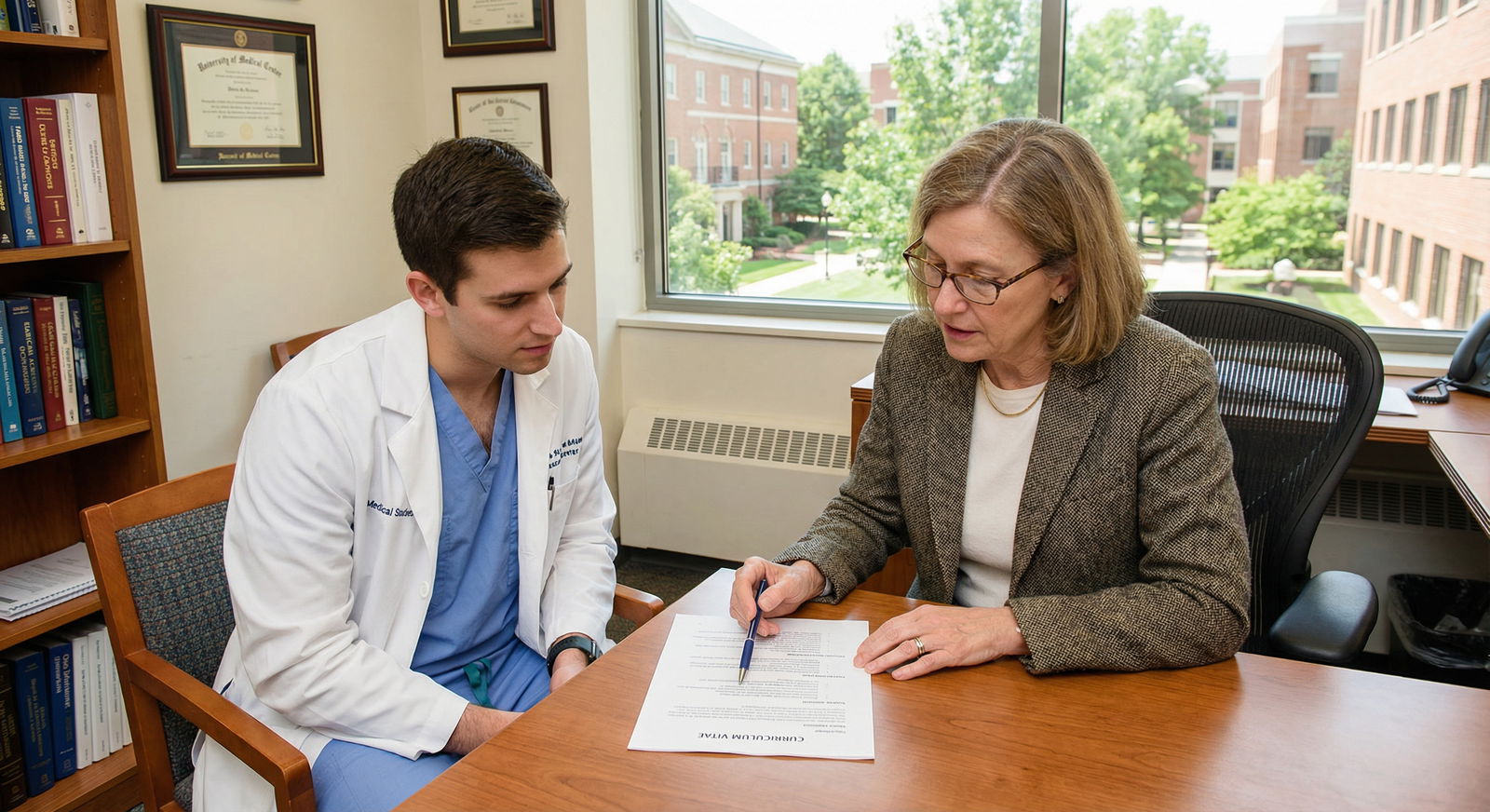
- A faculty advisor or mentor in your target specialty
- Your school’s Career Development or student affairs office
- A senior resident or chief resident who has recently gone through the process
Ask them:
- “Is anything unclear or misleading?”
- “Are there sections that feel too long or too vague?”
- “Does this CV clearly support my choice of [specialty]?”
Case Study: Turning an Average CV into a Competitive Asset
Applicant Profile
Name: Jane Doe
Target Specialty: Internal Medicine
Background: Strong clinical evaluations, moderate research, active in student organizations.
Jane’s CV Before Revision
- 2 pages, but poorly organized:
- Clinical experiences mixed with volunteer work under a general “Experience” heading.
- Research listed without outcomes (“Assisted with research project.”).
- Leadership barely visible:
- Mentioned being “involved” in student groups, but no roles or achievements specified.
- No clear alignment with Internal Medicine:
- Focused on generic activities without highlighting continuity care, communication, or quality improvement.
Key Revisions and Improvements
Reorganized Structure
- Created dedicated sections: “Clinical Experience,” “Research & Scholarly Work,” “Leadership & Professional Activities,” “Volunteer & Community Engagement.”
- Moved Internal Medicine sub-internship to the top of Clinical Experience.
Clarified Roles and Quantified Impact
- Turned “Member, Internal Medicine Interest Group” into:
- “Co-President, Internal Medicine Interest Group — Led planning of 6 case-based teaching sessions annually; increased average attendance by 40% over prior year.”
- Turned “Member, Internal Medicine Interest Group” into:
Strengthened Research Section
- Revised from “Participated in a study” to:
- “Abstracted data from 180 electronic medical records for a study on heart failure readmissions; co-authored abstract presented at [Regional Conference], [Year].”
- Revised from “Participated in a study” to:
Aligned with Specialty
- Highlighted continuity clinic experience:
- “Followed a panel of 12 primary care patients over 6 months, focusing on chronic disease management and patient education.”
- Highlighted continuity clinic experience:
Outcome
With the revised CV:
- Jane received multiple interview invitations from competitive Internal Medicine programs.
- Interviewers frequently referenced her leadership activities and research involvement—indicating that the CV successfully guided the conversation.
- Jane matched into a strong university-affiliated Internal Medicine residency.
The content of her experience hadn’t dramatically changed—but how she presented it did. That’s the power of effective CV Writing and mindful presentation.
FAQs: Residency CVs, Medical Education, and Career Development
1. How long should my residency CV be?
For most residency applicants:
- 2–3 pages is appropriate.
- If you have significant prior careers, advanced degrees, or extensive research (multiple publications, grants), 3–4 pages may be reasonable.
- Avoid padding your CV with marginal activities just to increase length. Brevity plus impact beats unnecessary volume.
If in doubt, ask a mentor in your specialty what length is typical for applicants at your level.
2. Should I use a template for my residency CV?
Templates can be helpful as a starting point, especially for organizing headings and layout. However:
- Avoid overly stylized or graphic-heavy templates—stick to clean, professional formatting.
- Always customize:
- Section order
- Headings (e.g., “Clinical Experience,” “Research & Scholarly Work”)
- Content emphasis for your specialty
Many medical schools or Career Development offices provide specialty-appropriate CV templates—these are often better tailored to Medical Education norms than generic online examples.
3. Do I need to include hobbies and personal interests?
Including a short “Interests” section is optional but often recommended:
- It humanizes you and can create natural interview conversation starters.
- Choose interests that reflect personality, teamwork, perseverance, or wellness (e.g., “Long-distance running,” “String quartet violinist,” “Cooking regional cuisines,” “Community theater”).
Keep it brief (1–3 lines) and genuine. Avoid controversial topics or anything that could be misinterpreted.
4. How should I list my publications and what if they are “in progress”?
Follow a consistent citation format (e.g., AMA or journal style). Separate items into clear categories:
- Published / In Press
- Accepted / In Revision
- Submitted (optional)
- In Preparation (list sparingly and only if realistic and active)
Be honest. Do not label something as “submitted” or “in revision” unless it truly is. Overstating your role or status in scholarly work is a serious professionalism concern.
5. What file format and naming convention should I use for submitting my CV?
Use PDF to preserve formatting across devices. Avoid sending Word documents unless explicitly requested.
Use a professional, clear file name such as:
Lastname_Firstname_CV_Residency_2025.pdfDoe_Jane_InternalMedicine_CV.pdf
This looks professional and helps programs easily identify your file among many others.
Refining your CV is not just about impressing residency programs; it’s a key exercise in reflecting on your Medical Education journey and clarifying your Career Development goals. A well-constructed CV presents your experiences in a way that is accurate, compelling, and aligned with your desired specialty. With thoughtful revisions, consistent updates, and targeted emphasis, your CV becomes more than a list of activities—it becomes a strategic tool for Professional Growth and a strong contributor to your Residency Applications.