Understanding the Vascular Surgery Residency Landscape
Vascular surgery is one of the most competitive surgical fields, especially for the integrated vascular program (0+5). Program directors routinely screen hundreds of applications, and your CV is one of the first—and most durable—impressions you make.
Unlike a generic medical student CV, a vascular surgery residency CV must show:
- Sustained academic excellence
- Tangible surgical interest and exposure
- Evidence of technical aptitude and procedural curiosity
- Commitment to research and scholarly productivity
- Professionalism, reliability, and teamwork
- Longitudinal commitment to vascular disease and patient care
This article will walk you through how to build CV for residency in vascular surgery from M1 to application season, how to present it strategically, and specific residency CV tips tailored to this specialty.
Core Principles of a Strong Vascular Surgery CV
Before we break down sections, it helps to understand what vascular surgery program directors are scanning for when they open your CV.
1. Clarity and Structure Over Flashiness
Vascular surgeons value precision and efficiency. Your CV should reflect that:
- Clean, consistent formatting
- Logical section ordering
- Clear timelines and roles
- No distracting graphics or colors
Think: “well-organized operative note” rather than “graphic design portfolio.”
2. Longitudinal Commitment to Vascular Surgery
Program directors want to see that you didn’t decide on vascular two weeks before ERAS opened. Evidence of sustained interest might include:
- Early vascular surgery shadowing or observerships
- Repeated vascular electives or sub-internships
- Multi-year research projects on vascular topics
- Ongoing involvement in related student organizations
- Progressive responsibility in vascular clinics, QI projects, or labs
3. Depth Over Random Quantity
A residency CV that lists dozens of isolated activities without depth is less compelling than a smaller set of experiences with:
- Clear outcomes (publications, presentations, protocols)
- Leadership roles
- Demonstrable impact on patients, teams, or systems
In vascular surgery, where patients are complex and follow-up matters, program directors value evidence that you can commit, follow through, and complete projects.
4. Alignment With Vascular-Specific Competencies
Vascular surgery programs particularly appreciate:
- Comfort with complex, comorbid patients (e.g., diabetes, renal disease)
- Interest in both open and endovascular techniques
- Familiarity with imaging (CTA, MRA, duplex) and perioperative care
- Experience with multidisciplinary care: cardiology, IR, nephrology, wound care
Whenever possible, shape your experiences and descriptions to highlight these themes.
Strategic CV Content: Section-by-Section Guide
Below is an ideal structure for your medical student CV aimed at an integrated vascular program. You may tailor order slightly, but keep it logical and easy to skim.
1. Contact Information & Professional Summary (Optional)
Contact Information:
Include:
- Full name (matching ERAS exactly)
- Professional email address
- Phone number
- City and state (no full home address needed)
- Optional: LinkedIn or professional webpage if well-maintained
Professional Summary (2–3 lines, optional but useful if tailored):
Example (vascular-specific):
Fourth-year medical student with a strong interest in complex aortic and peripheral arterial disease, >12 months of dedicated vascular surgery research, and multiple first-author abstracts at SVS meetings. Seeking an integrated vascular surgery residency position with robust open and endovascular training.
Use this if it adds clarity; omit if you’re simply repeating generic phrases.
2. Education
List in reverse chronological order:
- Medical school: name, city, state, degree, anticipated graduation date
- Undergraduate institution and degree(s)
- Additional degrees (MPH, MS, PhD), if applicable
You can include:
- Class rank or quartile (if official)
- Honors (e.g., AOA, Gold Humanism, Dean’s List)
- Thesis title (if vascular-related, consider highlighting under “Research” instead)
Example:
Medical University X, MD Candidate
City, State
Anticipated Graduation: May 2026
- Top 10% of class; AOA (elected MS3)
- Distinction in Research (Vascular Surgery)
3. USMLE/COMLEX and Key Academic Metrics (If Allowed)
Some CV templates omit scores, but many applicants include:
- USMLE Step 1 (if reported numerically), Step 2 CK scores
- COMLEX scores (if DO)
- Additional standardized exams if relevant
You don’t need to analyze your scores in the CV; keep it factual. If your Step 1 is Pass only, list as “Pass (MM/YYYY).”
4. Research and Scholarly Activity
For vascular surgery, this section is crucial. Program directors use it to assess:
- Academic curiosity
- Persistence and teamwork
- Ability to contribute to the scholarly life of the department
Break into subsections where appropriate:
4.1 Peer-Reviewed Publications
List in standard citation format (e.g., AMA), reverse chronological order. Bold your name to highlight your role.
Example:
Doe J, Smith AB, Patel K. Endovascular vs open repair outcomes in octogenarians with infrarenal AAA. Journal of Vascular Surgery. 2024;69(4):1234–1242. [Epub ahead of print]
If under review, label as “Submitted” or “In Revision,” with the journal name. Avoid listing “In Preparation” unless it is nearly submitted and can be verified.
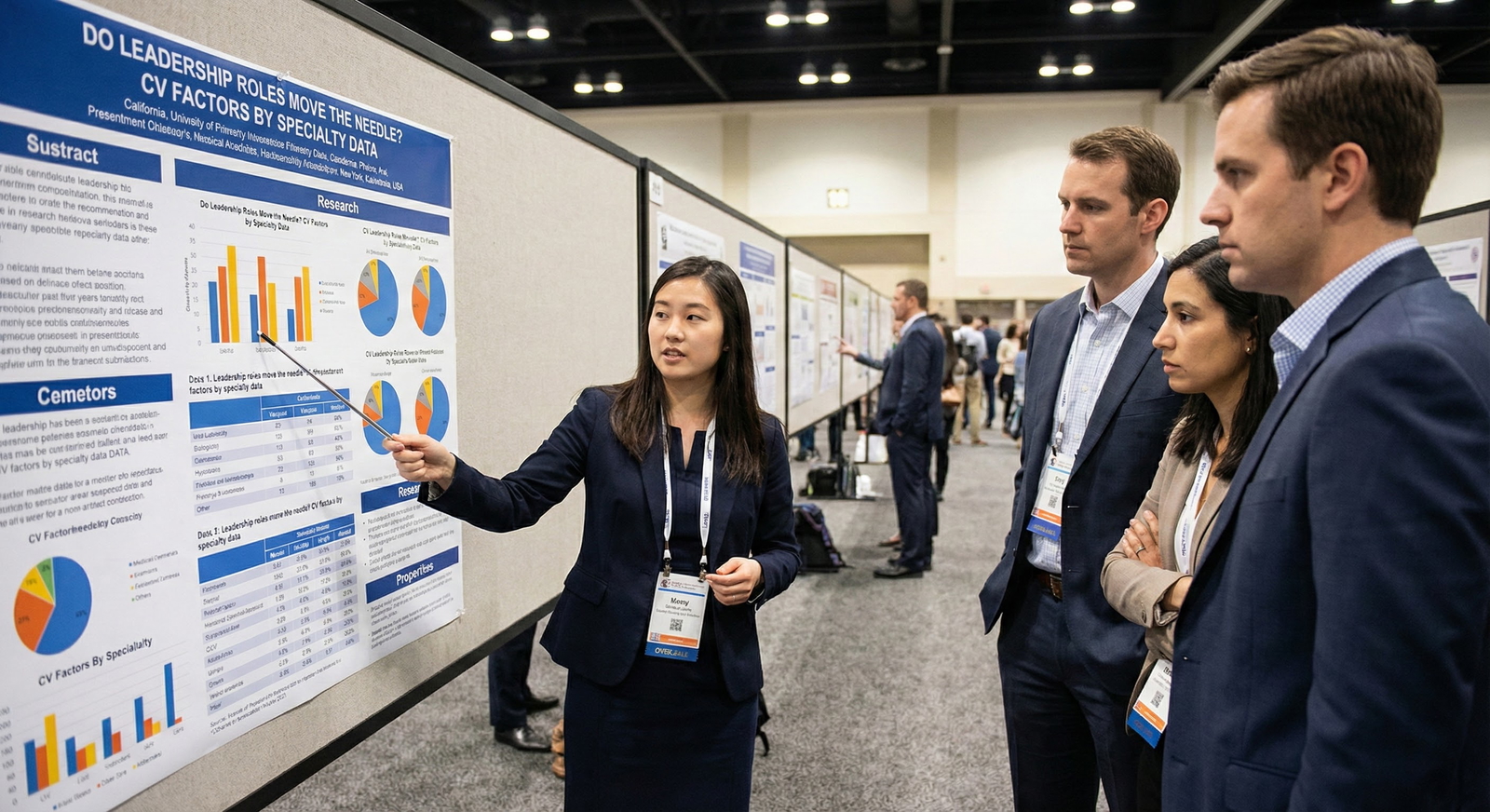
4.2 Abstracts, Posters, and Presentations
Include:
- Title
- Authors (bold your name)
- Meeting name (emphasize vascular-specific conferences: SVS, VESS, regional vascular societies)
- Format (oral vs poster)
- Date and location
Program directors in vascular surgery strongly value national and regional meeting presentations, especially if they show that you are engaged with the vascular community early.
4.3 Research Projects (Especially for Preclinical Students)
If you’re earlier in medical school and don’t yet have publications:
- Describe your role and skills learned
- Align with vascular content when possible (e.g., vascular biology, thrombosis, device development, imaging)
Example:
Clinical Outcomes Research Assistant – Division of Vascular Surgery
Institution Y, City, State | 2023–Present
- Conducted retrospective chart review of 400 patients undergoing femoropopliteal bypass to evaluate graft patency and limb salvage rates.
- Managed REDCap database, performed statistical analysis (logistic regression, Kaplan-Meier curves) under faculty supervision.
- Abstract submitted to the Society for Vascular Surgery 2025 Annual Meeting.
5. Clinical Experience and Electives
This is where you show how your clinical choices support your vascular surgery trajectory.
5.1 Medical School Clinical Rotations (Selective)
You don’t need to list every core clerkship. Instead, highlight:
- Vascular surgery rotations (home and away)
- General surgery sub-internships
- ICU, cardiology, interventional radiology, or other relevant electives
Example:
Vascular Surgery Sub-Internship
Large Academic Medical Center, City, State | 07/2025
- Took primary responsibility for 6–8 vascular inpatients daily under resident supervision, including daily progress notes, pre-op assessments, and post-op management.
- Assisted in open AAA repairs, carotid endarterectomies, bypass procedures, and endovascular interventions.
- Led daily pre-round huddles for the junior team to prioritize consults and floor issues.
For each vascular rotation, highlight:
- Procedural exposure
- Autonomy and responsibilities
- Team interactions and communication roles
5.2 Additional Clinical Experience
Include:
- Longitudinal clinics (wound care, diabetic foot, dialysis access clinics)
- Volunteer experiences involving vascular risk factors (e.g., free blood pressure screenings, peripheral arterial disease screening events)
- Any experience that demonstrates comfort with high-risk, often older patients

Demonstrating Vascular-Focused Commitment: Beyond the Basics
Your CV must tell a cohesive story: “I am someone who has explored vascular surgery thoughtfully and is ready for a demanding integrated vascular program.”
1. Targeted Research Strategy for Vascular Surgery
If you’re early in medical school and asking how to build CV for residency in vascular surgery, focus your research efforts smartly:
- Seek out a vascular surgery research mentor in M1 or early M2
- Ask specifically about projects with realistic timelines to produce abstracts or posters by M3–M4
- Start with manageable projects (chart reviews, QI studies, case series) before large prospective studies
- Learn basic statistics; mention specific analysis skills in your CV (e.g., “SPSS,” “R,” “Kaplan-Meier survival analysis”)
Example of a strong vascular-focused entry:
Research Fellow – Aortic Disease Outcomes
Division of Vascular Surgery, Institution Z | 2023–2024 (Dedicated Research Year)
- Coordinated a multi-center retrospective study of 600 patients with thoracoabdominal aneurysms treated with hybrid open and endovascular techniques.
- Independently extracted imaging data, measured aneurysm dimensions, and assessed postoperative complications.
- First-author abstract accepted for oral presentation at the Vascular Annual Meeting (VAM) 2024.
Even if you don’t take a full research year, show continuity: multiple projects with the same group or theme.
2. Procedural and Technical Exposure
You’re not expected to be a surgeon yet, but program directors like to see curiosity about technical work:
- Document experience in simulation labs (suturing, knot-tying, endovascular simulation)
- Participation in vascular skills workshops (e.g., SVS Boot Camps, institutional vascular simulation days)
- Technical hobbies that demonstrate dexterity can be briefly included (e.g., instrument playing, 3D-printing, model-building) but don’t overemphasize them.
Example CV bullet in “Activities” or “Skills” section:
- Regular participant in weekly vascular skills lab, practicing endovascular wire and catheter manipulation in fluoroscopy-based simulators and open vascular anastomosis models.
3. Professional Societies and Networking
Being visible in the vascular community helps both your development and your CV:
- Join the Society for Vascular Surgery (SVS) as a student member if available
- Participate in student sections of surgical or vascular societies
- Attend local/regional vascular conferences and list attendance when accompanied by poster/oral presentations
Example:
Member, Society for Vascular Surgery (SVS)
2023–Present
- Attended 2024 Vascular Annual Meeting; presented poster on limb salvage outcomes in critical limb-threatening ischemia.
4. Quality Improvement and Systems-Based Work
Vascular surgery is heavily system-dependent (OR access, imaging, anticoagulation protocols, wound care pathways). Highlight projects that show you understand systems of care:
- QI projects to reduce contrast nephropathy
- Standardized order sets for perioperative antiplatelet/anticoagulation management
- Interdisciplinary pathways for diabetic foot care
These can be listed under “Research & QI” or as a separate “Quality Improvement Projects” section.
Leadership, Teaching, and Service: Differentiating Your Application
In a crowded field of high Step 2 scores and solid research, leadership and service often distinguish one vascular surgery applicant from another.
1. Leadership Roles
Strong leadership experience signals your potential as a chief resident and future faculty member. Aim for:
- Positions with real responsibility (budgets, scheduling, program design)
- Roles within surgery or vascular-related organizations if possible
Examples appropriate for a vascular surgery residency CV:
- President, Surgery Interest Group – organized multiple vascular surgery career panels and skills workshops
- Founder, Vascular Disease Awareness Initiative – created community screening events for PAD and carotid disease
When describing leadership, emphasize:
- Scale (numbers of participants, events)
- Impact (measurable outcomes, new initiatives)
- Collaboration with faculty or hospital departments
2. Teaching and Mentorship
Residents teach constantly. Show that you enjoy and are good at it:
- Peer tutoring (anatomy, physiology, surgery shelf review sessions)
- Near-peer mentorship for M1/M2 students, especially in surgery or research
- Teaching assistant roles in anatomy or surgical skills labs
CV bullet example:
Teaching Assistant, Clinical Anatomy (M1 Course)
Medical University X | 2023–2024
- Led weekly dissection sessions for a group of 10 first-year students; emphasized vascular anatomy and surgical approaches to major vessels.
- Developed supplemental handouts on peripheral arterial and venous anatomy.
3. Service and Volunteerism
Vascular surgery deals heavily with underserved, often marginalized populations. Service work that intersects with:
- Diabetes, smoking cessation, obesity
- Rural health, limited access to specialists
- Amputation prevention, wound care
…can be particularly meaningful. Use bullets that show impact and longitudinal commitment, not one-off activities.

Formatting, Style, and Common Pitfalls
Once your content is strong, you need to present it cleanly. This is where many applicants lose points.
1. General Formatting Rules
- Length: 2–4 pages is typical for a strong vascular surgery applicant; more is fine if truly substantive (e.g., multiple publications), but avoid filler.
- Font: Professional and readable (Times New Roman, Calibri, Arial, 10–12 pt).
- Headings: Clear, bold section headings; consistent hierarchy.
- Margins: 0.5–1 inch.
- File naming: “LastName_FirstName_CV_YYYY.pdf” looks professional.
2. Bullet Writing: Strong vs Weak
Weak:
- “Helped with research in vascular surgery.”
- “Assisted in surgeries and cared for patients.”
- “Volunteered in clinic.”
Strong:
- “Abstracted data on 250 patients undergoing carotid endarterectomy, analyzing perioperative stroke and MI rates under different antiplatelet regimens.”
- “First assist in open and endovascular procedures, including fem-pop bypass and iliac stenting; performed skin closure and wound dressing under supervision.”
- “Conducted ABI screenings at community health fairs, identified high-risk patients, and coordinated referral to vascular clinic.”
Use action verbs and, whenever possible, quantify: numbers of patients, number of events, impact metrics.
3. Tailoring for an Integrated Vascular Program vs Fellowship Track
If you’re applying to an integrated vascular surgery residency:
- Emphasize early interest, surgical identity, and willingness to commit to a 5-year trajectory
- Highlight any exposure to both open and endovascular cases, and your comfort with acuity
If you’re a general surgery resident applying for vascular fellowship (or building your CV for future fellowship):
- Emphasize operative case logs relevant to vascular
- Leadership roles as a senior resident or chief
- Independent decision-making in ICU and consult settings
The core structure is similar, but the emphasis shifts from “potential” to “proven capability.”
4. Common Mistakes to Avoid
Inflating roles or authorship
Vascular is a small community; attendings know each other. Misrepresentation can permanently damage your reputation.Overloading with irrelevant activities
If it doesn’t relate to medicine, surgery, professionalism, or meaningful personal development, consider trimming.Typos and inconsistent formatting
Vascular surgeons are detail-oriented. Inconsistent dates, spacing, or style suggest carelessness.Listing skills you can’t back up
Don’t claim “proficiency in R” if you only watched someone else code. You may be asked about it in interviews.Including personal information not needed
Omit age, marital status, photo (unless explicitly requested by a specific program or system), or unrelated social media.
Timeline: Building Your Vascular Surgery CV From M1 to Application
To make this practical, here is a high-yield timeline.
M1–Early M2
Focus:
- Academic foundation and early exposure
- Initial research connection
Action steps:
- Shadow vascular surgeons; track your experiences and reflections
- Join surgery/vascular interest groups; attend specialty talks
- Identify a vascular surgery or closely related research mentor
- Learn basic stats and research methods
CV additions:
- “Shadowing, vascular surgery (observation only, not direct patient care)”
- “Research assistant, vascular outcomes or aneurysm project”
- “Member, surgery interest group (SIG)”
Late M2–M3
Focus:
- Deepening clinical exposure and research outputs
- Building procedural curiosity and professionalism
Action steps:
- Take electives relevant to surgery and vascular (if allowed pre-clinically)
- Continue or expand research; aim for at least one abstract submission
- Participate in skills labs and simulation
CV additions:
- Abstracts/posters from early research
- More detailed roles in ongoing projects
- Participation in student teaching or leadership roles
M4 (Application Year)
Focus:
- Show maturity, leadership, and “ready-for-residency” readiness
Action steps:
- Complete vascular sub-internships (home and away)
- Finalize publications, submit additional abstracts
- Take on visible teaching or mentorship roles
CV additions:
- Sub-I descriptions with responsibility and procedural exposure
- National meeting presentations (SVS/VESS/regional vascular societies)
- Leadership roles at the med school level
Frequently Asked Questions (FAQ)
1. How many vascular surgery publications do I need for a competitive integrated vascular program?
There is no fixed number, but most successful vascular surgery residency applicants have at least:
- 1–2 vascular-related abstracts or posters, and
- Ideally 1–2 published or in-press manuscripts (vascular or general surgery-related).
Quality matters more than raw count. A first-author vascular outcomes paper plus a few strong presentations can be more compelling than many minor middle-author case reports.
2. Can I still match vascular surgery if my research is not exclusively vascular?
Yes. Program directors respect strong research in:
- General surgery
- Cardiology
- Interventional radiology
- Critical care
- Vascular biology/thrombosis/atherosclerosis
Your CV should reflect at least some direct vascular connection (shadowing, electives, QI projects), but your entire scholarly portfolio does not need to be purely vascular.
3. How should I handle a gap or nontraditional path on my CV?
Be honest and clear. Common examples:
- Dedicated research year: label it explicitly and highlight productivity.
- Personal or medical leave: briefly indicate dates without unnecessary details.
- Career change (e.g., prior engineering career): frame it as a strength, especially if related to devices, imaging, or systems engineering.
Your personal statement and interviews, not your CV alone, will give context—but your CV must be accurate and consistent with your story.
4. What’s the biggest difference between a generic medical student CV and one tailored for vascular surgery?
A vascular surgery–focused CV:
- Shows longitudinal interest in vascular disease and surgery
- Highlights technical and procedural engagement (skills labs, sub-Is, research on interventions)
- Reflects membership in the vascular community (societies, conferences)
- Presents research productivity with a tilt toward vascular topics or populations
In other words, a vascular surgery CV doesn’t just say, “I want to be a surgeon”; it shows, over several years, “I have consistently moved toward a future as a vascular surgeon.”
If you’d like, I can next help you draft a structured template CV based on your current experiences, or review specific bullet points and reframe them for vascular surgery residency.