
It is 6:35 a.m. on Day 1 of your first attending job. Your badge works. The EMR already has your name on orders. Your residents are waiting for “Dr. ___” to say something that sounds like leadership.
You do not feel like a leader. You feel like a slightly older resident who somehow has no safety net.
This is the point where a lot of new attendings either:
- Spend 6–12 months anxious, overworked, and politically clueless
- Or
- Spend 100 days deliberately building systems, relationships, and boundaries that make the rest of their attending life a lot easier
I am going to walk you through those first 100 days. Chronologically. At this point you should… style. Integration and survival, not perfection.
Before Day 1: Final Week Prep
If you are already past this, skim and backfill what you can.
By 7 days before start, you should have:
Gotten the logistics in writing
- Start date, FTE, salary, RVU/bonus structure
- Call expectations and backup coverage
- Clinic templates (patients per half day, new vs follow-up)
- Admin time carved out on schedule
Set up your tools
- EMR training done or scheduled on Day 0
- Remote access working (test log-in from home)
- Work email on your phone, with calendar sync
- Malpractice, license, DEA, hospital credentialing confirmed
Created your “Day 1–30” survival toolkit
- Smart phrases / templates for common notes
- Order sets or preference lists (e.g., post-op orders, admission orders, outpatient panels)
- Personal checklist for each clinic / call day:
- Rounding list template
- Pre-op / pre-discharge checklists
- Follow-up task list (lab checks, imaging, callbacks)
-
- One senior attending in your group who actually remembers what being new felt like
- One non-physician “fixer” (nurse manager, lead MA, clinic supervisor) who knows how things really work
If you do not have these yet, put a 30-minute block on your calendar today to email HR/Med Staff for any missing items and to draft 3–5 note templates.
Days 1–7: Orientation and Survival Mode
At this point you should focus on three things only: access, relationships, and not over-committing.
Day 1–2: Get access and walk the territory
Non-negotiables for the first 48 hours:
Make sure your:
- Badge opens every door you need
- EMR login works in every relevant location (clinic, OR, ICU, wards, reading room)
- Order entry and procedure privileges are active
- Dictation / voice recognition is set up
Physically walk:
- Your clinic spaces, including check-in, vitals, nursing station, procedure room
- Wards where your patients will be
- OR / procedural suites
- Radiology and pharmacy if relevant
You are essentially mapping your battlefield. I have seen new attendings lose an hour on Day 3 trying to find the place to drop off paper consents.
Day 3–4: Clarify expectations with your boss
Sit down with your division chief or practice lead. Not a hallway chat. A 20–30 minute focused conversation.
Ask specific questions:
- “What does a good first 3 months look like for you for me?”
- “What metrics are you actually tracking? RVUs? Patient satisfaction? Turnaround time?”
- “Who are the informal leaders here I need to know and respect?”
- “Who do you call when you are stuck—with a clinical decision, with a process problem, with a difficult staff issue?”
Take notes. People forget these conversations and then get blindsided at the first evaluation.

| Step | Description |
|---|---|
| Step 1 | Start Job |
| Step 2 | Secure Access and Tools |
| Step 3 | Meet Boss for Expectations |
| Step 4 | Introduce Self to Core Staff |
| Step 5 | Set Hard Limits on Extra Work |
Day 5–7: Introduce yourself to the people who really matter
Not the CMO. The people who can make or break your days.
At this point you should have introduced yourself to:
- Charge nurses / nurse managers on your key units
- Clinic manager and lead scheduler
- Lead MA or nurse in your clinic
- Front desk / check-in team
- Pharmacy liaison or main pharmacist you will call
- Case managers / social work on your typical units
Keep it simple:
“Hi, I am Dr. __, just joined the ___ service. I will be working here mostly on ____ (clinic days) and on the wards on ____. What is the best way to reach you when we are trying to solve problems quickly?”
And then listen. People will tell you what actually breaks down (discharges after 2 pm, getting transport for imaging, stat lab delays). That is your early roadmap.
Weeks 2–4: Build Routines, Not Hero Moments
By the end of Week 4, you should be out of sheer survival mode and into repeatable patterns.
Week 2: Tighten your clinical systems
You are still slow. That is fine. What is not fine is being chaotically slow.
Focus on:
Pre-visit / pre-rounding structure
- For clinic:
- Block 30–60 minutes before the first patient to preview charts and prioritize complex visits
- For wards:
- Fixed pre-round routine (labs → vitals → overnight notes → imaging)
- Standard rounding order (sickest first, discharges next)
- For clinic:
Note and order efficiency
- Refine your templates:
- One for straightforward follow-up
- One for new complex consult
- One for post-op / discharge
- Build quick orders / order sets for:
- Pain regimens
- DVT prophylaxis
- Common admission profiles in your field (e.g., CHF, COPD, DKA)
- Refine your templates:
Task tracking
- Choose one system and actually use it:
- EMR task list
- Dedicated notebook with one page per patient
- Digital task manager (e.g., Todoist, Notion) that you check twice daily
- Choose one system and actually use it:
You are not trying to be clever. You are trying to be boringly consistent.
Week 3: Start owning your teaching and leadership style
Now your residents and APPs are watching. They want to know what “attending you” looks like.
At this point you should:
Establish your expectations:
- “I want pre-rounds done by 7:30.”
- “I expect you to have a plan, even if it is wrong. We will fix it together.”
- “Please text/call me for X, Y, Z. Put everything else in the EMR.”
Decide how you give feedback:
- Micro-feedback on rounds (“Next time, frame that more concisely.”)
- End-of-week debrief (“Two things you did well, one to work on.”)
Protect your learner’s time:
- Do not use residents as scribes
- Involve them in decisions, not just orders
A lot of burnout starts here—when you either do everything yourself because it is “faster,” or abdicate completely and then clean up messes at 6 p.m.
Week 4: Build early boundaries
You are extremely vulnerable now to becoming the “yes” person.
Your goals by the end of Month 1:
Say no to at least 1–2 non-essential requests:
- Extra committee with no clear purpose
- Random QI project that has failed three times
- “Can you just pick up an extra call weekend permanently?”
Set at least one hard boundary:
- “I do not check my work email after 7 p.m. unless I am on call.”
- “Clinic templates will not exceed X patients per half day for the first 3 months. We can revisit later.”
Clarify your call backup:
- Who you can call at 2 a.m. for backup on a complicated case
- How coverage works when you are post-call and unsafe

Month 2 (Days 31–60): From Surviving to Integrating
Now you know basic workflows. You are not the absolute slowest person in clinic. Good. The next 30 days are about integration into the culture and tightening your clinical decision-making.
Days 31–40: Sharpen clinical decision thresholds
As a new attending, the anxiety now shifts from “Can I get through the day?” to “Am I making good calls?”
At this point you should:
Decide your default thresholds:
- Admission vs discharge for borderline cases in your field
- Conservative vs aggressive management for common diagnoses
- When to get a second opinion or call a subspecialist
Build your “phone-a-friend” list:
- 2–3 attendings you can text or call and say, “Here is the case. This is my plan. Sanity check me?”
- Ideally one in your group and one outside your immediate org for unbiased takes
Debrief your own tough cases:
- Once a week, pick one case and quickly review:
- What I did
- What I liked about the decision pattern
- What I would change next time
- Once a week, pick one case and quickly review:
This is how you compress the learning curve. Not waiting for M&M to tell you.
Days 41–50: Understand the politics and incentives
You are employed. That means there is money, power, and resentment moving around behind the scenes. Ignoring that is naive.
By mid-Month 2, you should understand:
How your group is actually paid:
- Straight salary vs salary + RVU bonus
- Call pay or “baked in”
- How “unfunded work” (teaching, admin, QI) is or is not compensated
Who controls:
- Clinic templates and scheduling rules
- OR block time or procedural slots
- Hiring and firing of staff
- Allocation of support (scribes, APPs, nurses)
Where the landmines are:
- Longstanding tensions between services (e.g., medicine vs surgery, ED vs hospitalists)
- Problem attendings you should avoid entangling yourself with early
You do not need to play games. But you do need to know the game exists.

| Category | Value |
|---|---|
| Direct Patient Care | 45 |
| Documentation/Admin | 30 |
| Teaching | 10 |
| Meetings/Orientation | 10 |
| Personal Learning | 5 |
Days 51–60: Start shaping your reputation intentionally
Your reputation is forming even if you are not aware of it. Nurses talk. Residents talk. Scheduling staff talk. You want that narrative to be accurate and sustainable.
Decide what 2–3 adjectives you want attached to your name:
- “Reliable, calm, teaches well”
- Or “Fast, decisive, available”
- Or “Thorough, kind, good with families”
Then align your behavior:
If you want “reliable”:
- Return pages/texts consistently
- Do not cancel or reschedule clinic/call casually
- Close charts within 24 hours
If you want “teaches well”:
- Take 2–3 extra minutes per case to explain your reasoning out loud
- Ask residents for topics they want to cover each week
If you want “good with families”:
- Be the attending who always sits down for serious conversations
- Use clear, non-jargony explanations, document them, and follow up
You cannot be everything. Choose deliberately.
Month 3 (Days 61–100): Consolidate, Correct, and Plan Forward
By now, the “new doctor smell” is wearing off. Your mistakes count more. Your patterns are becoming habits. This is where strategic adjustment matters.
Days 61–75: Fix the friction points
At this point you should have a short list—in your head or on paper—of things that frustrate you repeatedly.
Common examples:
- Discharges always delayed because of late paperwork or transport
- Clinic overbooked with double/triple bookings on certain days
- EMR inbox overwhelming with non-urgent messages
Pick 2–3 friction points and:
Map the actual workflow
- Who touches the process from start to finish
- Where the bottleneck or failure happens
Talk to the people in that workflow
- “Walk me through what happens now when we try to ___.”
- “What is the most annoying part of this for you?”
Propose one small, testable change
- Example: Standard discharge checklist used on rounds by residents
- Example: No overbooking beyond X patients per session without your approval
- Example: MA or RN filters non-urgent EMR messages into a once-daily batch
The goal is not to fix the entire system. It is to prove—especially to yourself—that you can improve your work environment in small, deliberate ways.

Days 76–90: Get feedback and course-correct
You are overdue for real feedback now. Do not wait for an annual review.
By the end of Day 90, you should have:
Asked your boss for a 15–20 minute check-in
- “We are about three months in. How do you think things are going from your perspective?”
- “Anything you want me to adjust now, while I am still setting patterns?”
- “Are there opportunities I should be saying yes or no to at this stage?”
Gotten informal feedback from residents/APPs
- At the end of a week:
- “What is one thing I do that helps your learning or workflow?”
- “What is one thing I could change that would make your life easier?”
- At the end of a week:
Checked in with nursing leadership
- “You have seen a lot of new attendings come through. Anything you wish I were doing differently on rounds / with orders / with communication?”
You will hear things you do not like. Good. That means you asked the right questions.
Days 91–100: Stabilize your life outside work
The job will expand endlessly if you let it. Around the 3-month mark, many new attendings realize they have not done anything except work, shower, and collapse.
At this point you should:
Audit your weekly schedule:
- How many hours are you actually in the hospital/clinic?
- How many hours at home are you still working (notes, inbox, prep)?
Set explicit “off work” blocks:
- One evening per week where you do not open the EMR
- One consistent block for exercise, family, or something that is not medicine
- A realistic sleep target and lights-out time most nights
Decide your “max acceptable”:
- Maximum number of hours per week you are willing to work long-term
- Maximum number of extra calls or shifts you will pick up per month
You are setting norms for your future self. If your colleagues learn that you will always pick up that extra shift “for the team,” they will keep asking. Indefinitely.
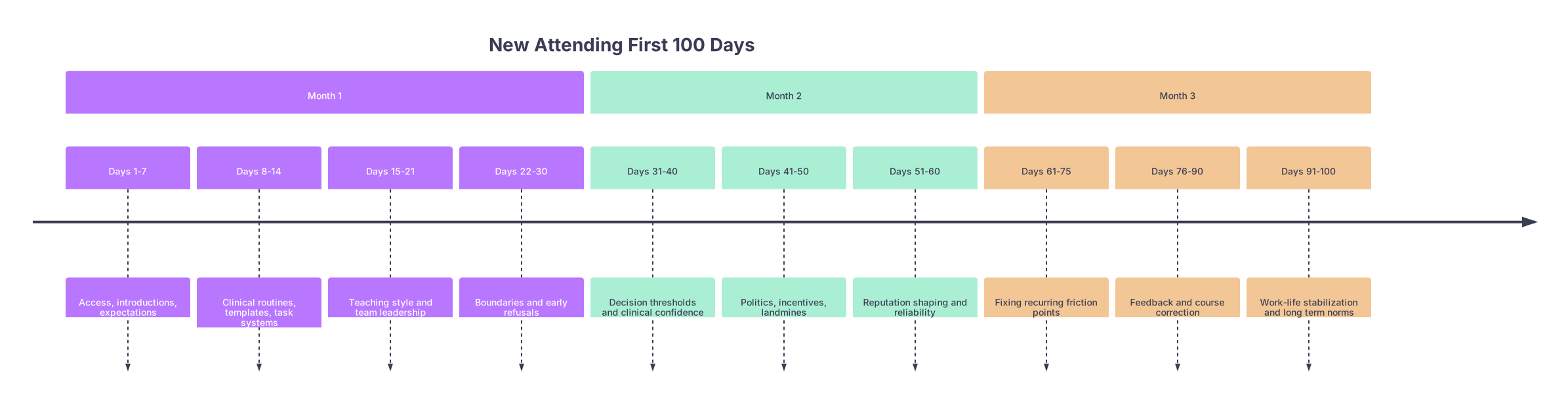
| Period | Event |
|---|---|
| Month 1 - Days 1-7 | Access, introductions, expectations |
| Month 1 - Days 8-14 | Clinical routines, templates, task systems |
| Month 1 - Days 15-21 | Teaching style and team leadership |
| Month 1 - Days 22-30 | Boundaries and early refusals |
| Month 2 - Days 31-40 | Decision thresholds and clinical confidence |
| Month 2 - Days 41-50 | Politics, incentives, landmines |
| Month 2 - Days 51-60 | Reputation shaping and reliability |
| Month 3 - Days 61-75 | Fixing recurring friction points |
| Month 3 - Days 76-90 | Feedback and course correction |
| Month 3 - Days 91-100 | Work-life stabilization and long term norms |
Quick Reference: What You Should Have In Place By Each Milestone
| Timepoint | Non-Negotiables You Should Have |
|---|---|
| End of Week 1 | Access working, key staff met, expectations from boss clarified |
| End of Month 1 | Basic routines, templates, task system, early boundaries set |
| Day 45 | Understanding of payment model, politics, and informal power |
| Day 60 | Clear reputation trajectory, phone-a-friend clinical support list |
| Day 90 | Feedback from boss/staff, 2–3 workflow tweaks implemented |
| Day 100 | Sustainable schedule norms and off-work blocks defined |
What You Should Do Today
Right now—before your next shift—do one concrete thing:
Open your calendar and block 20 minutes in the next 7 days labeled:
“First 100 Days Checkpoint.”
In that block, you will:
- Write down the date you started
- Note which phase above you are in (Days 1–7, 8–30, 31–60, or 61–100)
- List three items:
- One access/operations gap you still need to fix
- One relationship you need to strengthen (boss, nurse manager, colleague)
- One boundary you need to set or protect
That 20-minute block will do more for your integration and survival than any generic “work hard and be nice” advice.