

The fellowship match did not break your career. How you respond to it will.
I have watched residents go unmatched, panic, disappear for a year, and then crawl back into the market with an incoherent story. They struggle. I have also seen others pivot hard, treat it like a business problem, and land excellent first attending jobs that put them in stronger positions than some who matched.
You are in the second group now. Or you will be if you follow a clear playbook.
This is that playbook.
Step 1: Stabilize Your Mindset and Your Timeline
You did not “fail the game.” You just got different data about your positioning in a very specific niche market.
You have two immediate jobs:
- Control the story in your own head.
- Control the actual timeline of your next 12–18 months.
Mental reset (fast, but real)
Give yourself 48–72 hours to be angry, embarrassed, whatever. Then you switch.
Hard line:
- Stop saying “I failed the match.”
- Start saying “I did not match this cycle; I am now repositioning.”
You will repeat versions of that sentence in every conversation for a year. Get comfortable with it.
Decide on your true priorities
Write down, in order of importance, your top 3:
- Geographic priority (e.g., “stay within 2 hours of family”).
- Practice type (academic vs community vs hybrid).
- Procedural/clinical mix (how much of the subspecialty you still want day-to-day).
- Lifestyle (call, nights, weekends).
- Future eligibility for fellowship or niche specialization.
You cannot optimize all of these after an unmatched cycle. You pick two to optimize, and accept tradeoffs on the rest. People get stuck because they pretend they can have all five.
Set a concrete 12–18 month plan
You are not planning your forever job. You are planning your next position.
Broadly, you are choosing between three immediate paths:
- Straight to attending job in your core specialty.
- Transitional role that keeps you close to the subspecialty (e.g., hospitalist with niche focus, non-accredited fellowship, research position with some clinical).
- Reapplication to fellowship with an intentional gap year strategy.
You can combine 1 and 3 or 2 and 3, but pretending you will “see what happens” is how you end up contract-less in November.
Step 2: Diagnose Why You Went Unmatched (Brutally, Not Emotionally)
You cannot pivot intelligently until you understand why programs passed.
And no, “the match is random” is not an explanation. Noise exists, but there are patterns.
Here is how I have residents break it down.
| Primary Issue | Typical Clues | Pivot Implication |
|---|---|---|
| Weak application | Few interviews, generic feedback | Fixable with targeted work |
| Late strategy | Late apps, few programs | Timing and planning problem |
| Program fit mismatch | Strong stats, but no high-tier matches | Need to rebrand and reposition |
| Geographic constraint | Only applied in 1–2 regions | Must loosen geography or expectations |
| Performance flags | Low Step/board, remediation, gaps | Needs narrative management and advocacy |
Get external data, not just your gut
Do this within 2–3 weeks of finding out you did not match:
- Ask 2–3 trusted faculty (ideally including your PD) for 20–30 minutes each.
- Frame it: “I want direct, unfiltered feedback so I can plan my next steps. Please do not worry about hurting my feelings.”
Ask them:
- “If you had to pick one main reason I did not match, what would it be?”
- “Where did my application sit compared to prior matched candidates?”
- “If you were me, what would you fix or emphasize in the next 6–12 months?”
- “Would you feel comfortable calling programs on my behalf for a job?”
When they hedge, push: “If you had to guess, what is the real answer?”
Then consolidate what you hear into 1–2 main issues. Not 7. The point is to decide what you are solving for.
Step 3: Choose a Strategic Pivot Type
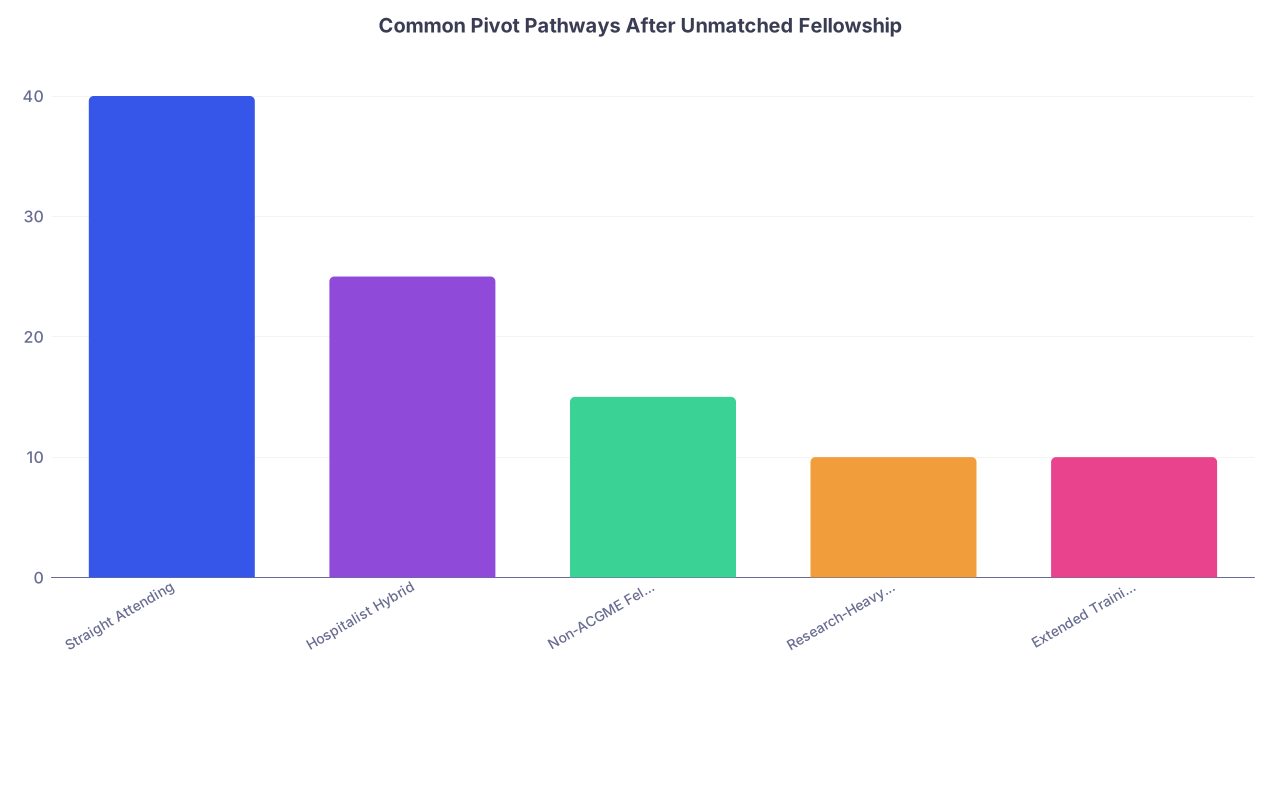
From an unmatched fellowship, there are a few high-yield pivots that consistently work. Let’s map them.
| Category | Value |
|---|---|
| Straight Attending | 40 |
| Hospitalist Hybrid | 25 |
| Non-ACGME Fellowship | 15 |
| Research-Heavy Role | 10 |
| Extended Training (Locums/Temp) | 10 |
These numbers are illustrative, but the proportions reflect what I see most.
1. Straight to Attending in Your Core Specialty
This is the default for many.
Best when:
- Your core residency training is strong.
- You want to start paying off loans and building equity (financial and professional).
- You might or might not reapply to fellowship, but you want flexibility.
Key strategy:
- Look for jobs that allow:
- Maintaining a “subspecialty-leaning” practice (e.g., general cardiology with lots of HF patients).
- Time and support for research or academic involvement if you still care about a future fellowship.
Warning: Do not let recruiters push you into a job that will box you out of the subspecialty entirely if you still want to reapply. A pure 1.0 FTE RVU-churning job with zero academic or niche exposure can make reapplying harder.
2. Hospitalist or Generalist Hybrid Role With a Subspecialty Angle
Examples:
- Pulmonary fellowship miss → ICU-heavy hospitalist job with optional procedures.
- GI fellowship miss → hospitalist with focus on GI consult service coverage.
- Cards fellowship miss → “cardiology hospitalist” roles that exist in many academic centers.
This is a powerful pivot if you:
- Need a job now.
- Still want to stay attractive for future fellowship cycles.
- Want to remain in a teaching/academic environment.
You position it as:
“I am strengthening my clinical base while staying deeply involved in [subspecialty] patients, teaching, and clinical research.”
3. Non-ACGME Fellowship or Additional Training Year
This is NOT always the right move. But sometimes it is.
Best when:
- Your CV is close to competitive and just needs a bump (extra research, niche skills).
- Your PD and subspecialty mentors are genuinely willing to back you.
- You have a very specific reason: e.g., “advanced endoscopy non-ACGME year,” “HF research fellowship,” “stroke research hospitalist year.”
Bad idea when:
- You are just kicking the can down the road because you cannot tolerate “attending” as an identity yet.
- You cannot clearly articulate how the year will materially change your competitiveness.
4. Research-Heavy Role With Clinical Time
For highly academic subspecialties (heme/onc, cards EP, GI, pulm/CC), this can work well.
Watch out: A pure bench research year with no clinical work can make credentialing and skills maintenance trickier. A 0.5–0.8 FTE clinical plus research is often ideal.
Step 4: Rewrite Your Story Before Anyone Else Does
The match outcome is one fact, not your entire narrative.
You must lock in a clean, confident story you can repeat to PDs, chiefs, recruiters, and hiring committees.
Your story needs three parts:
- What happened.
- What you learned.
- Where you are going now.
Constructing a 30-second and 2-minute version
30-second version (for quick conversations):
“I applied for [subspecialty] this cycle, did not match, and after a lot of feedback and reflection I chose to pivot into a [core specialty / hospitalist] role that emphasizes [X and Y]. It lets me use the skills I built in residency and stay involved in [subspecialty] while building a strong foundation as an attending.”
2-minute version (for interviews, networking calls):
- 15–20 seconds: Acknowledge the unmatched outcome plainly.
- 30–60 seconds: What mentors told you + what you realized about your goals.
- 30–60 seconds: How the job you are seeking now fits a logical, mature plan.
Example:
“I went into residency very focused on [subspecialty] and built a lot of my electives and research around it. I applied this year and did not match. After talking frankly with my program director and a few fellowship directors, the consistent feedback was that my application was strong clinically but could benefit from broader, independent attending experience and more sustained scholarly work.
I took that seriously. I still care about [subspecialty], but I also realized I value [teaching / procedures / a certain patient population] more than a narrow fellowship label. So I am looking for a [hospitalist/generalist/attending] position that allows me to take ownership of complex patients, contribute to [X service / Y committee / Z research], and grow as a clinician-educator. If in a few years a fellowship still makes sense, I will have a much stronger foundation. If not, I will be in a role I genuinely enjoy.”
Practice this out loud. You want it to sound like a decision, not damage control.
Step 5: Rebuild Your Job Search From the Ground Up (Not Like a Resident)
You are not applying to fellowship now. The rules and leverage are different.
Define your must-haves and red flags
Get extremely specific:
- Acceptable regions (ranked).
- Minimum base salary (not total comp, because RVU projections are often fiction).
- Maximum acceptable call frequency.
- Dealbreakers: e.g., solo coverage in unsafe settings, unclear partnership tracks, non-competes that block your whole city.
Write these down. Otherwise someone will talk you into ignoring them.
Use more than one channel
You need a multi-channel approach:
Internal network
- Ask your PD: “Which recent grads have jobs they like? Can you connect us?”
- Ask subspecialty faculty: “Do you know any programs hiring generalists or hospitalists interested in [subspecialty]?”
- Email alumni who did something similar. Most will talk if you are direct and respectful.
Cold outreach
- Directly email division chiefs / medical directors with:
- A 3–4 sentence intro.
- 1-page CV.
- 1–2 sentences on why you are interested in their setting.
- Directly email division chiefs / medical directors with:
Recruiters and job boards
- Use them, but do not let them dictate your options.
- When a recruiter calls, your first question is: “Who is the actual employer and what is the exact job description?” If they dodge, move on.
Locums as bridge (selectively)
- Locums can be a decent short-term income and exploration tool if:
- You are not signing restrictive contracts.
- You are intentionally using it to test regions or practice settings.
- Locums can be a decent short-term income and exploration tool if:
Step 6: Fix Your CV and References for the Attending Market
Your fellowship-aimed CV is not the right document for a first attending job.
Tighten the CV for employers
Priorities for employers:
- Can you safely and efficiently manage the patients they see?
- Are you reasonable to work with?
- Will you stay long enough to be worth onboarding?
Your CV should:
- Lead with:
- Education and training.
- Licensure and board status.
- Any leadership, QI, or committee work.
- Put research and abstracts after core clinical experience.
- Use 1 page for most people, 2 pages max if you have substantive content.
Drop:
- Obscure poster titles that do not add clear value.
- Long lists of “interests” that read like filler.
Highlight:
- Specific clinical strengths: “Extensive experience managing complex ICU patients,” “High-volume inpatient service during residency.”
- Teaching roles: resident conference organizer, simulation sessions, etc.
Get your references aligned
You need:
- Program director letter (updated to reflect your unmatched outcome and your strengths).
- 1–2 strong clinical faculty who have seen you run patients independently.
- Optional: A subspecialty mentor if you are still leaning toward that area.
Have an explicit conversation with each:
“I am pivoting into an attending role in [X context]. What could you comfortably say, in writing or by phone, about my readiness to manage [type of patients] and function as a colleague?”
If someone hesitates, do not use them. A lukewarm reference is worse than none.
Step 7: Target Jobs That Let You Keep Optionality (If You Want It)
If you are 100% done with fellowship aspirations, then your focus changes to building the best life you can as a generalist.
If you are 50–50 or higher on reapplying, pick jobs that let you upgrade your CV while paying you.
What “optionality-friendly” jobs look like
These roles often include:
Formal academic title (clinical instructor / assistant professor).
Access to:
- Teaching (residents, students).
- Internal QI projects with publishable potential.
- Data and support for clinical research if you care.
A patient population that overlaps heavily with your intended subspecialty.
Examples:
- Unmatched cards → internal medicine hospitalist at a large academic center, heavy telemetry/CHF population, involvement in cardiology QI.
- Unmatched GI → hospitalist with frequent GI consult exposure, colon cancer screening initiatives, liver disease pathways.
You are looking for jobs where, two years from now, you can say:
“Since finishing residency, I have independently managed X volume of complex patients, taken on leadership in [specific project], and contributed to [publications / QI outcomes] in [subspecialty-adjacent space].”
That reads entirely differently from:
“I worked as a generic hospitalist in three different locums sites and have no track record at any of them.”
Step 8: Negotiate Like a Colleague, Not Like a Trainee
You are now a revenue generator. Act like one.
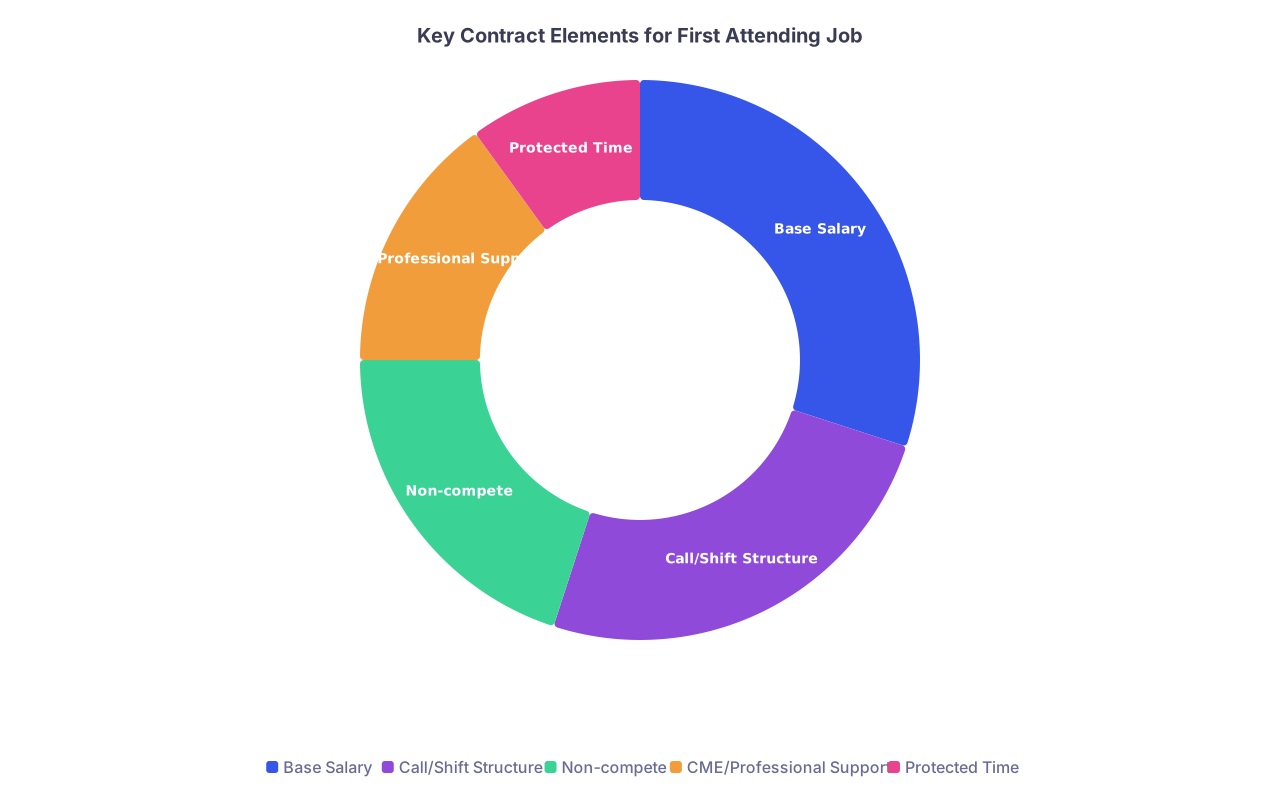
Understand the levers you can pull
Most first-year attending contracts lock the base salary pretty tightly, but you can often influence:
- Call structure and compensation.
- Start date (so you can sit for boards and move sanely).
- CME time and funding.
- Non-compete radius and scope.
- Protected/administrative time for specific projects.
| Category | Value |
|---|---|
| Base Salary | 30 |
| Call/Shift Structure | 25 |
| Non-compete | 20 |
| CME/Professional Support | 15 |
| Protected Time | 10 |
Do not ignore non-competes just because “everyone signs them.” A bad non-compete in your unmatched pivot job can trap you if you want to switch later.
Have a clean, scripted negotiation ask
Example:
“I appreciate the offer. Before I can sign, there are three areas I need to clarify:
- Call responsibilities and whether post-call days are guaranteed.
- Non-compete radius and duration, especially in relation to [city/region].
- Protected time – I would like one half day weekly for teaching/QI, which I am happy to tie to specific deliverables.
If we can get clear, written language on those, I am ready to move forward.”
You are not begging. You are collaborating.
Step 9: Plan the First 6 Months of the New Job Like a Second Residency
The trap: you finally sign a job, show up, get buried in shifts, and 6 months later you have done nothing to stabilise your long-term career.
You avoid that by treating months 0–6 as another structured training period, but with adult money.
Before you start: Build a 6-month checklist
Break it down:
Clinical
- Identify 1–2 senior colleagues who are clinically excellent and willing to be informal mentors.
- Ask to shadow their workflows for a day each early on.
- Set a goal: by month 3 you want to be comfortable with:
- Your documentation templates.
- The consult culture.
- The unwritten rules about admissions, transfers, and discharges.
Reputation
- Volunteer for 1 small but visible task: e.g., help with a guideline review, M&M case prep, or resident teaching session.
- Show up on time, respond to pages, be pleasant. It sounds basic, but half of reputation is not making people’s lives harder.
Future-facing
- Meet with division chief or medical director in month 2:
- “I want to be useful here and also grow professionally. Are there specific needs in [X area] where I can contribute?”
- Pick one project that aligns with your potential fellowship interest or your long-term niche.
- Meet with division chief or medical director in month 2:
Create touchpoints with key people
Schedule these (yes, actually schedule them):
- Month 1: Check-in with your PD or former mentor about how the transition is going.
- Month 2–3: Meeting with a potential academic or QI mentor at the new job.
- Month 4–5: Ask for feedback from your new chief/medical director: “What is going well? What should I adjust?”
You want written proof and verbal narratives that you are thriving in your new role. That will matter for promotions, future jobs, or reapplications.
Step 10: Decide, On Purpose, About Reapplying to Fellowship
Do not drift into or out of a reapplication. Decide.
Use a simple decision checkpoint around 9–12 months into your attending job.

| Step | Description |
|---|---|
| Step 1 | Unmatched Fellowship |
| Step 2 | Start Attending or Transitional Job |
| Step 3 | 9 to 12 Month Checkpoint |
| Step 4 | Commit to current path |
| Step 5 | Assess Competitiveness |
| Step 6 | Delay and strengthen |
| Step 7 | Reapply strategically |
| Step 8 | Still want fellowship? |
| Step 9 | Improved CV and support? |
At 9–12 months, ask three blunt questions
- Do I still strongly want the fellowship, or am I chasing sunk cost?
- Is my application meaningfully stronger now?
- More substantial clinical independence.
- New publications or ongoing projects.
- Strong, updated letters from current leaders.
- Is my current life good enough that I would be truly fine not matching again?
If your answer to #1 is weak, or to #2 is “not really,” then a reapplication might just reopen the same wound.
If your answers are:
- #1: Yes, this still matters to me.
- #2: Yes, I have clearly improved my profile.
- #3: Yes, I have a stable base even if I do not match.
Then you reapply strategically:
- Widen your geographic range.
- Target programs that know your current mentors.
- Make the attending experience the centerpiece of your story: “Here is how being an attending has made me better prepared for your fellowship.”
If you decide no, then stop calling yourself “unmatched.” You are not “an unmatched fellow candidate.” You are “a [specialty] attending who initially considered fellowship.”
Language matters.
Step 11: Don’t Let This One Data Point Define Your Earning Potential
Unmatched does not mean underpaid or stuck.
Plenty of unmatched residents:
- Move into high-acuity community roles and out-earn some subspecialists.
- Lean into niche interests (wound care, addiction, hospital leadership, informatics).
- Become the go-to educator at their site and build secure, respected careers.
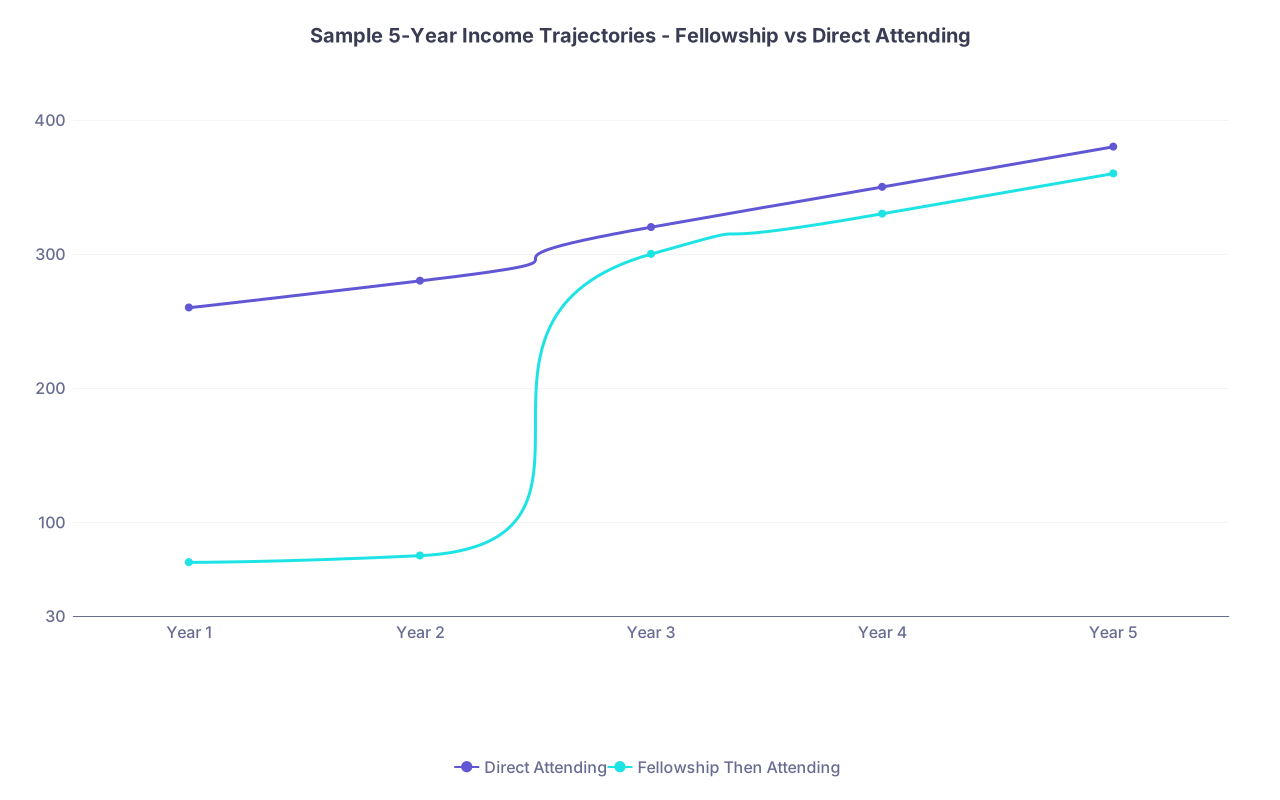
Look at your long game:
- 5-year income trajectory.
- 5-year lifestyle (including night call reality, not brochure copy).
- 5-year growth in autonomy and opportunities.
| Category | Direct Attending | Fellowship Then Attending |
|---|---|---|
| Year 1 | 260 | 70 |
| Year 2 | 280 | 75 |
| Year 3 | 320 | 300 |
| Year 4 | 350 | 330 |
| Year 5 | 380 | 360 |
The point here is not that one path is always better. It is that a missed fellowship cycle does not destroy your life-arc unless you let it paralyze you.
What You Should Do Today
Open a blank document and write three short sections:
My pivot goal for the next 12–18 months
One paragraph. Attending vs transitional role, academic vs community, region.My honest reason for going unmatched
Two bullet points maximum, based on feedback (or the feedback you will seek this week).My 30-second story
Draft the exact words you will say when someone asks, “So what happened with fellowship?”
Then send one email today to your program director or a trusted mentor:
“I want to plan my path carefully after going unmatched in [subspecialty]. Can we schedule 20–30 minutes this week or next for frank feedback and to discuss specific job options?”
You are not fixing your entire career today. You are taking control of the next step.
That is how you pivot from “unmatched fellow” to “solid first attending” with a future you chose, not one that just happened to you.


