

The third month is when the mask comes off.
If your first attending job already feels toxic by month three, believe your nervous system. You are not “just adjusting.” Something is off. And if you handle the next 3–9 months badly, you can set your career back years.
This is a survival playbook for that exact situation: post-residency, first job, three months in, and you’re already doing the mental math of “how long can I stand this without wrecking my CV or my sanity?”
Let’s get concrete.
Step 1: Diagnose What Kind of Toxic You’re Dealing With
You cannot fix what you have not named. And not all toxicity is created equal.
There are roughly four flavors I see again and again:
- Exploitative – unsafe schedules, RVU abuse, bait-and-switch comp
- Chaotic – disorganized, no coverage, systems constantly failing
- Abusive – bullying, gaslighting, intimidation, harassment
- Ethically rotten – upcoding pressure, unnecessary procedures, lousy patient care
You might have more than one. But figure out the primary pattern.
Ask yourself, in plain language:
- What, specifically, makes me dread going in?
- If I had to rank the top three problems, what are they?
- Could a reasonable person fix these with more time, or are they structural?
Write this down. Not in your work email. In a private note or notebook.
Here’s the unvarnished truth:
- Exploitative and ethically rotten cultures rarely reform.
- Chaotic sometimes can be improved if leadership cares and you have leverage.
- Abusive almost never changes without someone leaving or getting fired. Usually you.
Your goal right now is not to “be resilient.” Your goal is to decide:
Am I in “survive and leave” territory, or “fix and reassess” territory?
If you’re unsure, assume “survive and leave.” You can always stay longer. Clawing back a burned-out nervous system is harder.
Step 2: Quietly Start Collecting Data and Documentation
By month three, you should stop giving them the benefit of the doubt and start building your file.
Do not announce this. Do not threaten. Just document.
What to track:
- Schedules and hours worked – screenshots, saved PDFs, or your own calendar entries. Include call, add-on shifts, and “unofficial expectations.”
- Workload metrics – clinic volumes, RVU reports, inpatient caps, number of consults per shift. Save monthly reports when you can.
- Incidents – date/time, who was involved, what was said/done, objective facts, your immediate impact (e.g., “30 patients rescheduled with no notice,” “I was told to see 40 patients in a 1/2 day clinic”).
- Contract deviations – anything that clearly conflicts with what’s in your signed agreement: call frequency, duties, location, comp structure, support promised.
Keep all of this:
- On your own devices/cloud (not employer-owned).
- Backed up.
- Organized roughly by type and month.
You’re not doing this because you plan to sue. You’re doing it because:
- You’ll forget details in six months.
- If you need to negotiate a shift in duties, hard data beats “it feels like…”
- If it gets ugly (board complaint, non-compete fight, hostile exit), this becomes your lifeline.
Does it feel paranoid? Maybe. I’ve seen enough physicians burned because they trusted verbal promises and “family” culture. Trust your notes, not the vibe.
Step 3: Stabilize Yourself Physically and Mentally (Right Now)
You’re not making good decisions if you’re sleep-deprived, inflamed, and resentful. You’re just reacting.
You do not need a full wellness overhaul. You need tactical, bare-minimum stabilizers that keep you functional while you plan your exit or restructuring.
Here’s the minimum viable survival kit:
- Sleep protection rule: Pick 4–5 nights a week where you aim for real, protected sleep. That may mean: no post-call “just one drink,” no charting until 2am, no doomscrolling. Guard those nights like call.
- Food that isn’t garbage: If your current pattern is coffee and crackers until 4pm, change one thing. Maybe it’s a pre-packed protein + fruit in your bag everyday. Boring, repeatable, not aspirational.
- One intentional decompression habit you actually like:
15–20 minutes: walking, lifting, stupid reality TV, journaling. I don’t care what it is as long as it’s not more work and not scrolling your EMR inbox. - Primary care + therapy if you’re spiraling: Don’t self-manage your own anxiety and depression forever. If you’re crying on your commute more than once a week or fantasizing about walking away from medicine entirely, get a therapist who has worked with physicians before.
You’re not weak for struggling. You’re in a rigged environment. Your job for the next few months is to keep your brain online enough to make strategic moves instead of emotional explosions.
Step 4: Map Your Realistic Exit Timelines
You cannot just “walk away tomorrow” without consequences, even if you want to. You have constraints:
- Contract term and any early termination clauses
- Non-competes
- Sign-on or relocation payback
- Visa status (for some of you, the big one)
- Family obligations, housing, kids in school
So you need actual timelines, not vibes.
Pull out your contract. If you don’t have a copy, request it from HR pretending you want it for your records. Then sit down and identify:
- Is there a without cause termination clause?
- What’s the notice period? 60 days? 90? 180?
- What’s the non-compete radius and duration?
- How many miles? What counties? What type of practice?
- What repayment obligations exist?
- Sign-on bonus, relocation allowance, student loan guarantees, tail coverage, etc.
Then create 2–3 possible exit points:
| Scenario | Notice Period | Exit Timing | Main Tradeoff |
|---|---|---|---|
| Fast exit | 60 days | Month 6–7 | Less savings, faster relief |
| Planned exit | 90 days | End of year 1 | Better CV optics, more cash |
| Strategic exit | 120–180 days | Aligned with new job start | Strongest negotiation position |
You’re looking for that sweet spot between:
- Minimizing professional damage (looking flaky with a 3-month job)
- Minimizing emotional and physical damage (staying in a war zone 2–3 years)
For a lot of early attendings in a truly toxic job, the realistic target is: survive 9–18 months, then leave. Enough time to show you weren’t impulsive, not so much that you’re broken.
If your situation is actively unsafe (ethical disasters, true harassment, patient care risks), your timeline accelerates. “CV optics” is not more important than your license or your sanity.
Step 5: Decide Whether to Attempt an Internal Fix
Before you torch the bridge, ask a hard question:
Is this a system that might actually respond if I push?
Signals there’s at least a shot:
- Leadership has acknowledged problems concretely (not just “we’re all stressed”).
- You’ve seen other changes actually implemented in the last year.
- Your department chair or medical director seems to have real power, not just a title.
If you’re in a for-profit machine that’s bleeding staff and keeps saying “we all have to pull together” while adding more shifts, assume they will not fix it. Don’t waste political capital.
If you decide to try, be surgical:
Clarify your top 2–3 asks. Not 10.
Examples:- Reduce clinic template from 24 to 18 for 6 months while I ramp up.
- Cap inpatient list at 15 with NP support above that.
- Protected half-day per week for admin and charting.
Translate them into business language.
“I’m worried about burnout” gets less traction than “I will make more errors and be slower if we keep this up.” Link your asks to:- Safety
- Retention
- Revenue long-term
- Recruitment
Pick your person and timing.
- One-on-one with your direct supervisor, not a group complaint session.
- Not immediately post-call when you’re shaky.
Use clear frameworks:
“I see three major issues: A, B, C. Here is what I think would help: X, Y. Which of these is actually possible in the next 3–6 months?”
Then watch what happens over the next 4–8 weeks.
Red flags: hand-waving, “we’ll revisit this next year,” or weaponized compliments (“you’re one of the strongest, I know you can handle this”).
If nothing changes, believe them. They’ve answered you. Your job becomes survival and exit, not continued negotiation.
Step 6: Quietly Restart Your Job Search (Yes, Already)
By month three, you’re allowed to admit this was a bad match. The market is not what it was in 2015, but you still have options. You just have to be disciplined and discreet.
Do this in order:
Update your CV and basic profile
- Keep this job on it. Starting year and month. Do not lie.
- Keep the description bland: “Hospitalist, Community Hospital,” “Outpatient Internal Medicine – Employed multispecialty group,” etc.
Scrub your online presence
- Lock down social media or make it boring.
- Do not complain publicly about your job. Those screenshots live forever.
Turn on “passive” job search channels
- Recruiters on Doximity, LinkedIn, specialty-specific firms.
- Tell them: “I’m employed but open to opportunities due to poor fit with current position.” That’s enough.
Be surgical about what you want next
Based on what’s toxic now, define what is non-negotiable next:- Max call?
- Max RVU expectations?
- Clinic template limits?
- Culture factors (academic vs private vs employed)?
This is where your month-three misery can actually serve you. You now know what you absolutely can’t live with. Use it.
Step 7: Script How You Talk About This Job (Now and Later)
You will have to explain this short stint. To future employers. To credentialing committees. Maybe even to your current colleagues.
If you babble, overshare, or vent, you will hurt yourself.
So you decide your story now and you practice it until it’s boring.
Core principles:
- Be factual, brief, and non-vindictive.
- No gossip. No naming villains.
- Emphasize misalignment, not drama.
Example scripts:
For future interviews:
“After residency, I joined X Group. I realized within the first several months that the position was not what I’d expected in terms of [workload/call schedule/support]. We had some discussions about whether things could be adjusted, but it became clear the structure wasn’t going to change. I’ve stayed fully committed to my patients and team while I’m there, but I’m looking for a better long-term fit where [insert what you want: sustainable volumes, team support, academic work, etc.].”
If pressed for more:
“To be candid, I underestimated how intense the call burden and patient volumes would be. It’s not about personalities; it’s about the structural demands. I learned a lot about what I need to be effective long term.”
Internally with trusted colleagues:
“I’m finding the pace and support level here isn’t sustainable for me. I’m exploring my options quietly; I’m still showing up and doing my best in the meantime.”
You do not owe anyone the full emotional saga. Keep your dignity and your future references in mind.
Step 8: Protect Your License and Reputation Above All Else
When you’re miserable, cutting corners becomes very tempting. “I’ll just sign that stack without fully reading.” “I’ll let that borderline case slide.” Dangerous game.
You might leave this job in a year. Your license has to last decades.
Non-negotiables:
- Do not falsify documentation no matter what the coding pressure is. If someone is pushing upcoding, document as you actually practice. Use your documentation trail as your shield.
- Do not practice outside your competence because they’re short-staffed. Decline cases/procedures you truly are not trained for. Yes, they’ll be mad. They will not sit with you at a board hearing later.
- Do not vent in writing about colleagues, leadership, or patients in any system that can be discovered: email, EMR chats, texts on work devices.
- Answer credentialing questions honestly later. “Have you ever been asked to resign?” “Have you ever been placed on performance review?” Lying here can sink you. If something like that happens, call a physician attorney early.
If something genuinely scary is happening (pressured to commit fraud, retaliated against for safety reporting, discrimination), that’s when you:
- Talk to a healthcare employment lawyer who actually understands physician contracts and regulatory risk.
- Consider a quiet consult with your specialty society’s legal resources or a physician union, if available.
You are not being dramatic. You are protecting yourself.
Step 9: Short-Term Coping Strategies While You Execute the Plan
You still have to show up tomorrow. Multiple tomorrows. Here’s what I’ve seen actually work for people slogging through a bad first job:
- Shrink your emotional footprint. Don’t volunteer for every committee, task force, or “fun” event. Show up, do the job safely, go home. This is not the year to be the culture hero.
- Find one or two allies, not ten. A senior doc who quietly says, “Yeah, this place burns people out,” can help you reality-check and not personalize everything. But be selective. Oversharing at month three can label you as “the complainer.”
- Define your “bare minimum plus”. Bare minimum: what is needed for safe, ethical care and you keeping your job. Plus: one professional growth thing that matters to you (teaching, one project, one skill). Everything else? No.
- Compartmentalize with intent. On the drive home, have a ritual that signals “done”: a specific playlist, a call to a non-med friend, a 10-minute decompression sit in your car before you walk inside.
And one harsh line:
If you are turning into someone you don’t like—snapping at nurses, cutting corners, numb with patients—take that as an emergency light. You’re adapting to a dysfunctional environment in ways that will follow you. That’s your cue to accelerate your exit.
Step 10: Extract Every Possible Lesson So You Don’t Repeat This
You do not want to live this same story again in two years. So before you leave (or even while you’re still there), you do a post-mortem.
Ask yourself, with zero self-pity and zero self-blame:
- What warning signs were there during interview season that I ignored?
- What specific questions did I fail to ask about schedule, support, and culture?
- Where did I override my gut because I was worried about loans, prestige, or “being grateful”?
Next time, during job search, you’re going to be more aggressive. Concrete examples:
- Ask to talk to an early-career attending in your specialty who joined in the last 1–2 years, alone.
- Ask, “Tell me about the last physician who left. Why did they leave? Where did they go?”
- Ask to see actual clinic templates, call schedules, and RVU expectations in writing.
- Ask, “If I talked to the nurses and front desk staff, what would they say is hardest about working here?”
And then you believe the answers.
One more thing. Track your deal-breakers in writing:
- Maximum number of nights/weekends
- Maximum patients per day
- Minimum support staff ratio acceptable
- Cultural must-haves (teaching, certain procedures, certain flexibility for family)
This is not you being entitled. This is you preventing another slow-motion train wreck.
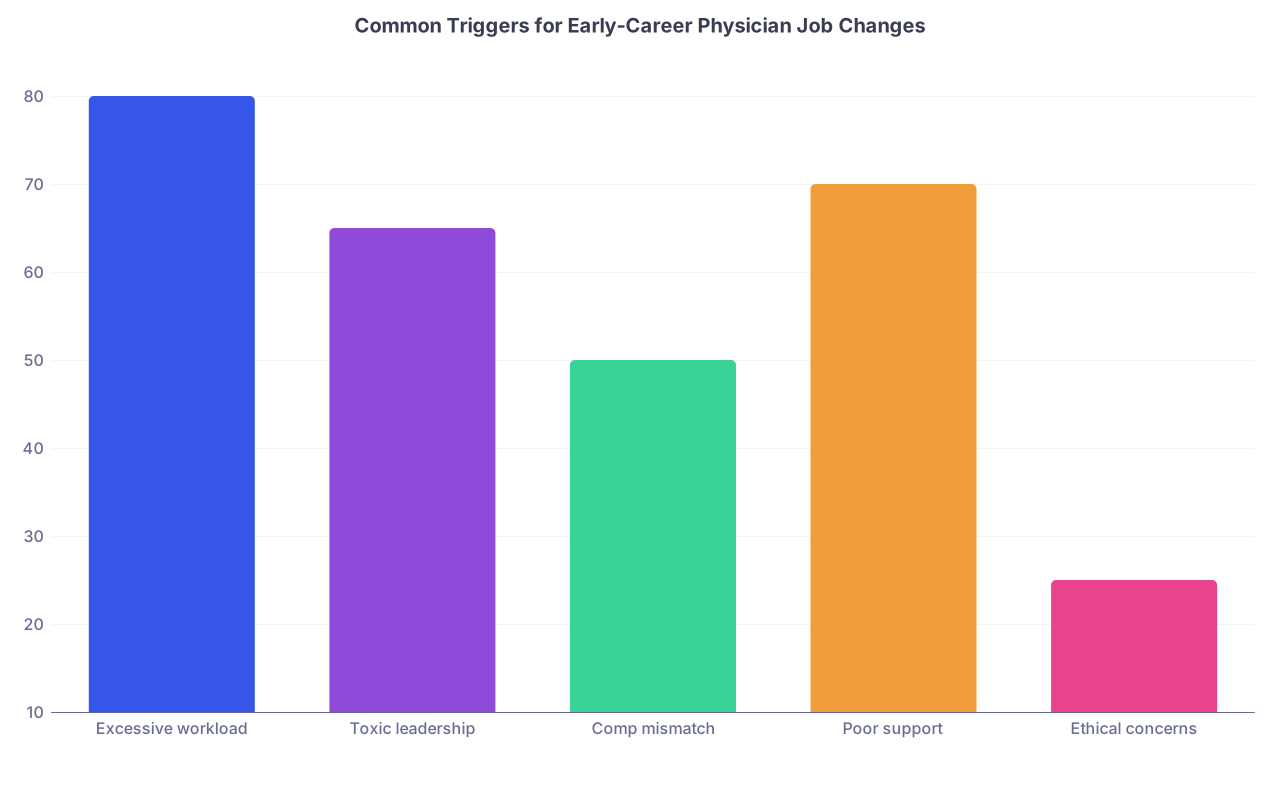
| Category | Value |
|---|---|
| Excessive workload | 80 |
| Toxic leadership | 65 |
| Comp mismatch | 50 |
| Poor support | 70 |
| Ethical concerns | 25 |

| Step | Description |
|---|---|
| Step 1 | Realize job is toxic by month 3 |
| Step 2 | Document issues and patterns |
| Step 3 | Stabilize sleep and mental health |
| Step 4 | Review contract and constraints |
| Step 5 | Meet with leadership with clear asks |
| Step 6 | Plan exit timeline and restart job search |
| Step 7 | Script your story and protect reputation |
| Step 8 | Leave with license and sanity intact |
| Step 9 | Attempt internal fix? |
| Step 10 | Meaningful change? |
The Bottom Line
If your first attending job is toxic by month three:
- Believe what you’re feeling and name the type of toxicity. You are not just “weak” or “not used to being an attending.”
- Shift from survival mode to strategic mode: document, protect your health, map your exit timelines, and restart your search quietly.
- Walk out with your license, reputation, and core self intact, even if the place itself never changes. You can recover from a bad first job. Recovering from letting it break you is much harder.


