

What do you actually do when your attending job evaporates three months before graduation?
You are PGY-3 (or PGY-4, chief year, whatever), you thought your post-residency job was locked in…and then you get the call or email:
“We’ve had some unexpected budget constraints and will unfortunately not be able to move forward with your offer.”
Your stomach drops. You google for help and get generic “network and update your CV” fluff. Useless.
Here’s the real playbook. If your job offer gets pulled late in PGY-3, this is how you stabilize your life, protect your license, and actually get paid on July 1 instead of sitting at home refreshing Indeed.
Step 1: Triage the Damage in the First 48 Hours
First objective: stop the emotional free-fall and get control of the facts.
1. Lock down the paper trail
Do not just accept a phone call and move on. You need documentation.
Ask for it in writing:
“For my records, could you please summarize in writing that the offer is being withdrawn and the effective date?”Pull everything you already have:
- Original offer letter / contract
- Any signed acceptance
- Email threads about start date, salary, relocation, bonuses
- Notes from calls (write them down now while you remember phrases and dates)
Save all of this off your residency email (and off hospital servers). You want personal, durable access.
2. Check your contract for leverage (even if you never signed the “full” one)
I’ve actually seen this: small hospital groups or private practices send a “letter of intent” that includes:
- Start date
- Salary
- Term
- Maybe a signing bonus / relocation
Then they act like it’s meaningless. It might be. It might not be.
Look for:
- Any clause about termination “prior to start”
- Any mention of liquidated damages, relocation, signing bonus repayment
- Conditions precedent (e.g., “subject to satisfactory background checks and credentialing”)
Red flags that might give them an easy out:
- “This is a non-binding letter of intent”
- “Employment is at-will and either party may terminate at any time for any reason”
If you’re not sure how bad (or good) your leverage is, put a pin in that; we’ll come back to lawyers.
3. Do a fast financial reality check
Before we talk about options, you need to know your runway. Pull out a notepad or spreadsheet and do a back-of-the-envelope:
- How much cash do you have?
- Any high-interest debt that’s about to crush you (credit cards, personal loans)?
- Monthly burn: rent/mortgage, loans (or projected payments), car, childcare, basic living
- How long can you survive without a paycheck?
I’m not asking you to build a perfect budget, just get a blunt sense: 1 month? 3 months? 6 months? That number will drive how aggressive you must be.
Step 2: Decide Whether to Push Back or Cut Losses
Everyone asks this: “Can I sue?”
Sometimes: yes. Usually: not worth it for you in real time as a PGY-3 about to graduate.
When to strongly consider legal counsel
You should at least talk to an employment/healthcare attorney if:
- You already signed a full employment agreement with a start date and salary, and there’s no clause letting them back out for vague “budget” reasons.
- You relocated (or were about to) based on explicit promises, and now they’re pulling everything.
- They’re asking you to repay a signing bonus or relocation when they canceled, not you.
- There’s any hint this is about discrimination or retaliation.
Most states have attorneys who routinely do physician contract review. Many will do a short paid consult ($200–$400 often) to say:
- You have no case, move on.
- You might have a small claim.
- You have leverage, here is how to use it.
If your start date was July 1 and it’s April, you don’t have a year to litigate. But you might have leverage for:
- Keeping your signing bonus
- Getting a partial “severance” payment
- Extending health insurance or helping with tail coverage costs
When to cut losses and move fast
If:
- You only had a non-binding Letter of Intent, or
- The contract clearly allows them to back out before start for “any reason,” and
- You’re 2–3 months from graduation
Your best “legal strategy” is usually to stop burning time and pivot to securing a new job. Angry email drafting is not a job search.
Your mindset has to switch from:
“How dare they?” to “How do I get income and maintain my clinical trajectory ASAP?”
Step 3: Stabilize Your Clinical Status and Board Eligibility
There’s something more important than salary: not letting your clinical timeline get weird in a way that hurts licensure or board eligibility.
1. Talk to your PD within days, not weeks
Not to “vent”. To plan.
You say something like:
“My post-residency job just fell through. I’m worried about gaps and credentialing. I’d like your help with concrete options: locums contacts, extra chief months, or temporary hospitalist/nocturnist roles the department knows about.”
Things your PD/program might be able to do:
- Extend you as a junior attending or instructor for 3–12 months (larger academic centers sometimes do this).
- Convert your schedule in the last months to rotations that look good for your target work (extra ICU, extra hospitalist time).
- Put you in touch with alumni who are hiring or know who is.
I’ve seen PDs quietly email: “We have an excellent resident unexpectedly available, can start July 1, no visa issues.” Those emails move mountains.
2. Make sure you’re still meeting your board rules
Read your board’s language (ABIM, ABFM, ABEM, etc.) about:
- Time limit from residency completion to first board exam
- Continuous clinical practice requirements
- Gaps in practice
You do not want:
- A 9–12 month unexplained gap with near-zero clinical work
- To lose eligibility because you didn’t stay active at some minimum level
If you have any gap, plan to:
- Do locums or per diem work that clearly counts as clinical practice
- Document everything (contracts, schedule, log of procedures if relevant)
Step 4: Create an Emergency Job Strategy (Not a Random Job Hunt)
“This sucks, I’ll just start applying on Indeed” is how you spin your wheels for 2 months and end up with nothing.
You need a focused emergency strategy with tiers.
Tier 1: “I just need a paycheck July 1” options
These are roles designed to be filled by someone like you: finishing resident, ready to start, not picky about long-term location or prestige.
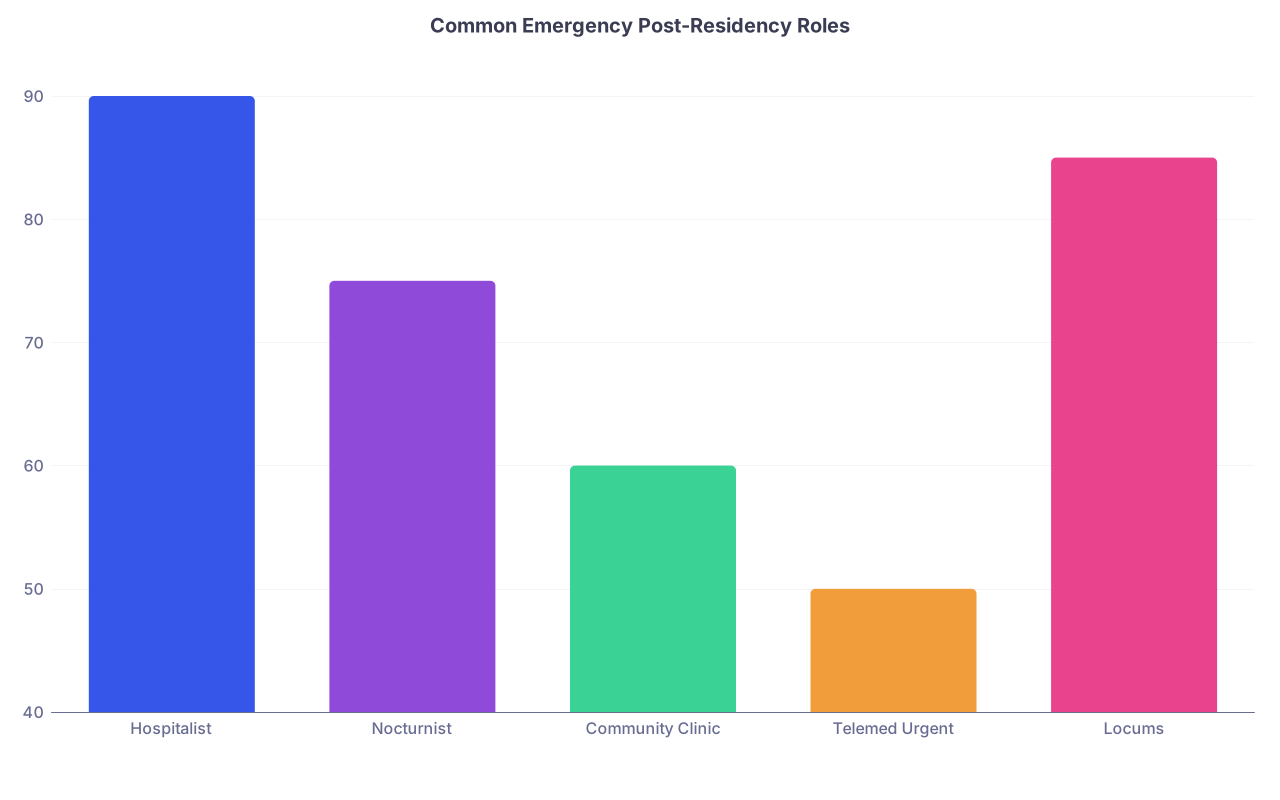
Common short-horizon hires:
- Hospitalist at community hospital
- Nocturnist
- ED staff at lower-volume community sites
- SNFist / post-acute (FM/IM)
- Telemedicine (urgent care / primary care, depending on state)
| Category | Value |
|---|---|
| Hospitalist | 90 |
| Nocturnist | 75 |
| Community Clinic | 60 |
| Telemed Urgent | 50 |
| Locums | 85 |
Consider these as “bridge jobs” for 1–2 years, not your forever career.
You prioritize:
- Start date within 1–3 months of graduation
- Minimal bureaucracy/time-to-credential
- Reasonable pay, not perfect pay
- Acceptable location or commute
Tier 2: Locums as a bridge and pressure release valve
Locums is the emergency safety net almost no one is taught about in residency.
Why it can save you:
- Agencies are used to last-minute PGY-3s whose jobs fell through.
- They can sometimes credential you faster than a big health system hires you.
- Short assignments (2–13 weeks) can fill a gap on your CV and your bank account.
But you must be clear with recruiters:
- Start date (realistic based on license and boards)
- Which states you’re licensed in or can quickly become licensed in
- What you will and will not do (ICU coverage, procedures, nights)
Also: Do not rely on a single agency. Message 2–3 major locums firms the same week and compare offers.
Tier 3: Your “real” or preferred job
If you had your dream job pulled, you’re grieving that loss. Fair. But keep it separate from your immediate scramble.
You can:
- Grab an emergency role (hospitalist, locums, telemedicine)
- In parallel, do a targeted search for the kind of long-term job you wanted originally (academic, subspecialty, big system outpatient, etc.)
Think of it as:
- Job A: stabilizer, pays the bills, keeps CV clean
- Job B: your aligned career move, which may take 6–12 months to land
Step 5: Fix Your Story Before Anyone Asks
You’re going to be asked: “So what happened to your original position?”
If you ramble or sound bitter, you lose offers.
You need a clean, boring, non-dramatic explanation. Something like:
“I had initially accepted a position with a small hospital group that unfortunately lost funding for my role when they renegotiated their system contract. They had to freeze new hires, including mine. It forced me to reassess, and I realized I’m actually quite interested in a more [academic/community/urban/rural]-focused position like this one.”
Short. Factual. No drama. No badmouthing.
Then redirect to:
- Why you’re interested in them
- How fast you can start
- Your specific skills coming out of residency
If you had a non-binding LOI and never fully signed: keep it very high level. No one needs the grim details.
Step 6: Use Your Network Like an Adult, Not Like a Student
This is where a lot of residents choke. You’re used to being evaluated, not asking for help.
Too bad. You need help.
Who to contact in the next 7–10 days
- Program Director
- Associate PDs
- Recent grads (last 3 years) in jobs you’d actually take
- Faculty you’ve worked closely with, especially those with system leadership roles
- Fellowship PD if you were on the fence about fellowship but still considering it
What you actually say (email or text):
“Hi Dr. X, I’m scheduled to finish my [specialty] residency this June. A position I had accepted for July unfortunately fell through for budget reasons, so I’m now looking for hospitalist/ED/outpatient opportunities starting this summer. If you know of any groups or departments that might be looking for someone like me, I’d really appreciate an introduction or contact name. Thanks for any help you can offer.”
Most of them will:
- Feel bad this happened
- Know at least one place that’s short-staffed
- Forward your name
It’s not begging. It’s how adult physicians get jobs.
Step 7: Consider Stopgap Academic or Fellow Roles (Case-Dependent)
Sometimes the smoothest solution is not private practice or community at all.
1-year fellowships or non-ACGME fellowships
You might:
- Extend training strategically (hospital medicine, ultrasound, medical education, palliative, research)
- Buy yourself a year in a structured environment while re-launching a job search
Downside:
- Lower pay
- More training time if you’re already burned out
Upside:
- No gap
- “Story” makes sense: “I chose to deepen skills in X and then moved into practice.”
Junior attending / instructor roles
Academic departments sometimes create “clinical instructor” or “junior attending” slots for graduating residents:
- You staff wards/clinics like an attending
- You get some teaching/responsibilities but with support
- Often 1-year contracts
Ask explicitly: “Do you have any one-year junior attending or instructor roles that open for unexpected situations like this?”
Step 8: Track Licensing, Credentialing, and Time-to-Income
The trap: you accept a “great” job that cannot get you on payroll for 5–6 months. Meanwhile, your savings die.
You want to understand three timelines for every option:
Medical license status
- Already have a state license where the job is? Good.
- Need a new state license? That can be 2–6 months depending on the state.
Hospital credentialing and payer enrollment
- Credentialing: 60–120 days is common.
- Payers (for outpatient-heavy): may add more delay.
First paycheck
- Ask bluntly: “If I sign this month, when do you realistically anticipate I’d be cleared to start clinically and actually get paid?”
| Step | Typical Range |
|---|---|
| New state license | 2–6 months |
| Hospital credentialing | 2–4 months |
| Payer enrollment | 1–3 months |
| Locums onboarding | 1–3 months |
For emergency options, prioritize roles in:
- States where you already have a license, or
- States with faster licensing if you absolutely must move.
Locums often wins here because they’re motivated to move fast and know exactly how long their sites take.
Step 9: Don’t Accidentally Blow Up Your Visa, Loans, or Malpractice
Three high-risk landmines people forget when panicking.
1. If you’re on a visa (J-1, H-1B)
You do not have the luxury of a slow, meandering search.
You must:
- Contact your immigration lawyer ASAP
- Call your GME office’s international office today
- Target jobs that understand and actively sponsor your specific visa needs (usually larger systems or underserved areas for J-1 waivers)
Do not rely on “I’m sure it will be fine.” You need concrete confirmation that any new employer can meet your visa requirements on your timeline.
2. Student loans
If repayment starts right as your job implodes:
- Immediately look at IDR (income-driven repayment) options
- If cash is truly nonexistent, explore forbearance or deferment, but understand the interest hit
- If you were counting on PSLF via a 501(c)(3) employer and now pivoting to private, understand how that affects your plan
You want to avoid 90-day delinquency dings on your credit just because you were paralyzed.
3. Malpractice and tail coverage
If your original job promised:
Occurrence coverage vs claims-made with tail
And now they’re gone, you need to:Confirm whether any tail coverage tied to that job matters for you (usually not if you never started).
For new roles, ask: “Is malpractice occurrence or claims-made? Who pays for tail if I leave?”
Just because your first job vanished doesn’t mean you should walk blind into a terrible malpractice setup in a panic.
Step 10: Emotional Reality and Damage Control
You’re not a robot. This kind of rug-pull is humiliating and enraging.
Attendings will say, “It’ll work out.” They’re not wrong, but that does not help you sleep tonight.
Two practical emotional strategies:
Put a hard limit on rumination time
Give yourself 48 hours to vent, complain, be mad. After that, your job is execution: emails, calls, applications.Separate identity from employment
You passing boards and being a solid clinician is not changed by some CFO slashing FTEs.
If you’re really spinning out:
- Talk to a trusted co-resident or faculty member explicitly for support, not just career help.
- Tap resident wellness or therapy resources. This is exactly the sort of “major life disruption” those programs pretend to serve.
You’re allowed to be pissed. Just do not make career decisions from that state.

| Step | Description |
|---|---|
| Step 1 | Offer Pulled |
| Step 2 | Collect Documents |
| Step 3 | Talk to PD |
| Step 4 | Attorney Consult |
| Step 5 | Move On Quickly |
| Step 6 | Negotiate or Exit |
| Step 7 | Emergency Job Strategy |
| Step 8 | Network and Apply |
| Step 9 | Secure Bridge Job |
| Step 10 | Plan Long Term Role |
| Step 11 | Legal Value? |
Quick 7-Day Action Plan
If you need someone to just tell you what to do this week, here it is.
Day 1–2
- Get written confirmation of offer withdrawal.
- Pull contract and have a quick look for early-termination language.
- Inform your PD and ask for a short meeting.
Day 3–4
- Email 10–20 people: faculty, alumni, co-residents now in practice.
- Reach out to 2–3 locums agencies if you’re open to that path.
- Make a one-page CV if yours is bloated. Highlight “Available July 1”.
Day 5–7
- Apply to 5–10 targeted “emergency-friendly” jobs (hospitalist, ED, community clinics) in states where you’re already licensed.
- If it might be worth it, schedule a 30–60 minute physician contract/healthcare attorney consult.
- Start tracking opportunities in a simple spreadsheet so you’re not just reacting.
Keep your phone nearby. Answer unknown numbers. Yes, it’s recruiters and spam. That’s how most actual leads arrive.
FAQ (exactly 4 questions)
1. How bad is it to have a gap after residency before my first attending job?
A short, well-explained gap (1–3 months) is usually fine, especially if you can say you were:
- Waiting on licensing/credentialing for a specific job, or
- Doing per diem/telemedicine/locums part-time.
A long, empty gap (6–12+ months) with no clinical activity is harder to explain and can raise malpractice and competency questions. If you cannot secure a full-time job immediately, at least secure some form of regular clinical work (locums, urgent care, telemed, per diem) and keep good documentation. Then your story becomes: “I did interim clinical work while searching for the right fit,” which is completely acceptable.
2. Should I tell future employers that the job offer was pulled, or can I just not mention it?
You do not need to volunteer it in your cover letter. But if they ask, “Did you have anything lined up?” or they see it referenced in a letter or conversation, you must be ready with a clean version of the story. Do not lie. Do not say you turned it down if they actually rescinded. Keep it factual and boring: budget, restructuring, funding changes. Then immediately pivot to why their role is actually a better fit. Over-sharing details or sounding bitter is what hurts you, not the fact that an offer was pulled.
3. Is it worth taking a bad-location or imperfect job just to start working, or should I hold out for something better?
If you have strong financial runway (family support, savings, low fixed costs), you can afford to be choosier. If you’ve got rent, kids, loans, and no meaningful cushion, holding out is a luxury you cannot afford. A “B-minus” job in a C-tier city for 1–2 years is far better than a 9-month gap and financial meltdown. You can always change jobs once you have experience and references as an attending. Think of it as a bridge, not your forever home.
4. What if my PD is useless or unsupportive? Am I just on my own?
Some PDs are fantastic advocates. Some are checked out or overwhelmed. If yours is in the second group, you bypass them. You go directly to:
- Associate PDs
- Faculty you trust
- Recent graduates you know personally
- Hospitalist/ED/clinic section chiefs you’ve worked with
You’re not a med student asking for a favor; you are a near-attending colleague saying, “I’m available July 1, here are my skills, here’s what I’m looking for.” If your program leadership truly gives you nothing, that’s annoying but survivable. Your broader network and locums agencies can still get you working.
Open your email right now and draft one message to a faculty member or alum saying your job fell through and you’re available July 1. Hit send today, not next week.


