The worst mistake residents make is treating the job search like a two‑month sprint. It is a 12‑month project. If you compress it, you lose leverage, options, and often tens of thousands of dollars.
I am going to walk you month‑by‑month through what an ideal 12‑month job search timeline looks like for residents approaching completion. This is what I have seen work for people who end up with multiple offers, sane schedules, and contracts they do not regret.
Assume:
- You finish residency on June 30, Year 2
- You want to start your attending job July–September, Year 2
We will start July, Year 1 – exactly 12 months out.
Months 12–10 Out: Quiet Foundation (No One Sees This Work)
Time frame: July–September (PGY last year – 12 to 10 months before graduation)
At this point you should not be aggressively applying yet. You should be getting your house in order.
Month 12 (July): Decide What You Actually Want
You cannot run an effective search if you have no idea what you want. This is where most people cut corners and pay for it later.
By end of Month 12 you should have:
Defined your priorities (on paper, not in your head):
- Clinical mix:
- Inpatient vs outpatient
- Academic vs community vs hybrid
- Call vs no call; nights vs days
- Geography:
- Top 3 cities/regions where you would love to live
- 3–5 “acceptable” backup locations
- Lifestyle:
- Max hours/week you are realistically willing to work
- How many weekends you’ll tolerate
- Career:
- Desire for teaching, research, leadership
- Fellowship vs going straight to attending
- Clinical mix:
Clarified your non‑negotiables:
- Examples I have seen residents write:
- “No more than 1:4 call”
- “No more than 2 weekends/month”
- “Minimum base salary of $260k in Midwest”
- “Must be within 30 minutes of X school district”
- Examples I have seen residents write:
Done a reality check on compensation and demand in your specialty:
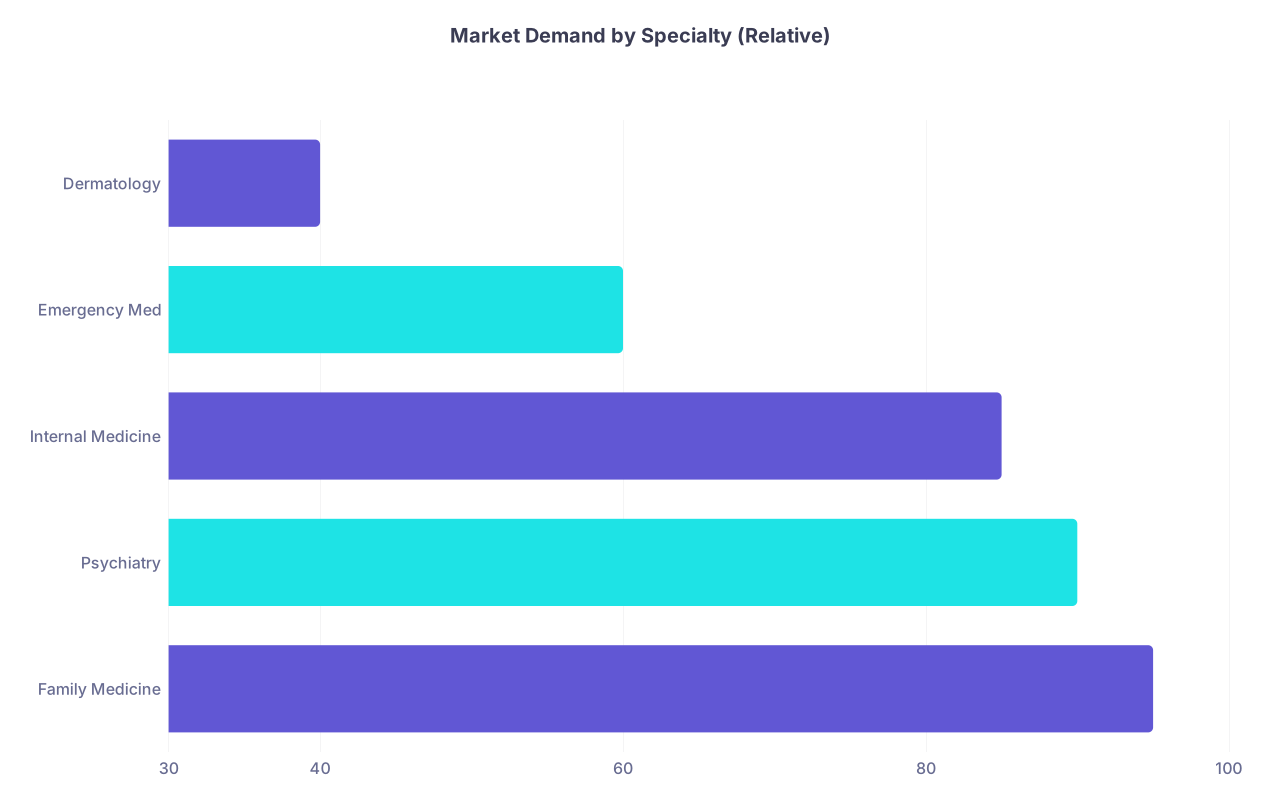
| Category | Value |
|---|---|
| Family Medicine | 95 |
| Psychiatry | 90 |
| Internal Medicine | 85 |
| Emergency Med | 60 |
| Dermatology | 40 |
- Talk with:
- Recent grads from your program (1–3 years out)
- Program leadership who know the local market
- A couple of reputable recruiters (for market intel only, not commitment)
- Look at:
- State medical society job boards
- Specialty society job boards (e.g., ACEP, AAFP, ACP)
At this point you should not be signing anything. You are collecting data and defining the target.
Month 11 (August): Build Your Professional Packet
You will be asked for the same few things over and over. Get them cleaned up once.
By the end of Month 11 you should have:
Updated CV (resident → attending ready):
- One clean, 2–4 page document
- Sections:
- Contact info
- Education & training (residency, medical school)
- Licensure & certifications (USMLE/COMLEX, board eligibility)
- Clinical experience (rotations, moonlighting)
- Teaching, research, QI projects
- Presentations/publications
- No fluff. No high school achievements.
Drafted a basic cover email template:
- 2–3 short paragraphs:
- Who you are (PGYx, specialty, program)
- What you are looking for (location, setting, start date)
- Why you are messaging them specifically
- 2–3 short paragraphs:
Started your reference list:
- Identify 3–5 attendings who:
- Know you well clinically
- Will actually answer their phones
- Are respected in the field (division chiefs, APDs, strong community physicians)
- Ask them verbally: “Can I use you as a reference when I start applying for jobs this fall?”
- Get updated email + cell number for each.
- Identify 3–5 attendings who:
Cleaned your online presence:
- Lock down social media
- Update your LinkedIn (yes, for physicians it still helps, especially in competitive markets)
- Make sure name matches exactly across platforms and CV
At this point you should have a “job packet” you can send out in under 5 minutes.
Month 10 (September): Licensure and Credentials Strategy
The thing that silently kills timelines is licensure. If you are thinking of moving out of state, this month matters.
By the end of Month 10 you should:
Choose 1–2 primary states for licensing (beyond your training state if needed):
- Focus on:
- States where you are likely to live
- States with strong demand for your specialty
- Check if they are part of IMLC (Interstate Medical Licensure Compact) if applicable.
- Focus on:
Map out licensing requirements and timelines:
- Documents needed (transcripts, training verification, exam scores)
- Typical processing times
- Fees
Start at least one additional state license application (if you are serious about moving):
- Especially critical for:
- EM, anesthesia, radiology, surgical subspecialties
- Many systems will not seriously talk until license is “in process”
- Especially critical for:
Check board eligibility and exam timing:
- When you must take boards
- How that interacts with early job start dates
At this point you should have a realistic picture of where you can start work on July 1 without credentialing disasters.
Months 9–7 Out: Market Scan and Light Outreach
Time frame: October–December (9 to 7 months before graduation)
Now you start surfacing. Still not a full blast application period, but you are signaling.
Month 9 (October): Structured Market Research
By the end of Month 9 you should:
- Create a job tracking spreadsheet. Columns like:
| Column | Description |
|---|---|
| Institution/Group | Hospital or practice name |
| Location | City, State |
| Type | Academic, community, private, locums |
| Contact Person | Recruiter or department lead |
| Date First Contacted | Initial email or call date |
| Status | No response, call scheduled, etc. |
| Interest Level (1–5) | Your personal rating |
Set job search “office hours” each week:
- 2 blocks per week, 60–90 minutes each
- No paging, no notes, closed door if you can manage it
- These blocks are for:
- Searching postings
- Sending intro emails
- Updating your tracking sheet
Identify 10–20 target institutions/groups per region:
- Examples:
- Large academic centers (e.g., Mayo, UCSF, Emory)
- Regional systems (e.g., Sutter, Intermountain, Advocate)
- Strong local groups (radiology, anesthesia, EM, hospitalist groups)
- Mark your top 10 “dream” options.
- Examples:
At this point you should know the major players in your regions of interest and have them listed.
Month 8 (November): First Wave of Outreach
This is when you start very targeted, low‑pressure outreach.
By the end of Month 8 you should:
Send 5–10 exploratory emails to top‑priority sites:
- Who to email:
- Department chairs or division chiefs
- Physician recruiters listed on job postings
- Keep it short:
- Introduce yourself
- State graduation date and interest in positions for next summer/fall
- Attach CV
- Who to email:
Take 2–4 informational calls:
- With recruiters or department reps
- Purpose:
- Get early sense of compensation ranges
- Clarify schedule expectations
- Understand their timeline (“When do you usually finalize offers for July starts?”)
Refine your priorities after real‑world input:
- You might discover:
- Some markets underpay severely
- Some “dream” cities are saturated in your specialty
- Academic jobs that look glamorous pay $100k less than high‑functioning community jobs
- You might discover:
At this point you should have started real conversations but are not locked in anywhere.
Month 7 (December): Decide Application Strategy and Volume
By now you have data. You must choose how wide or narrow to cast the net.
By the end of Month 7 you should:
Decide your application volume:
- Competitive specialty or tight geography (e.g., derm in one coastal city):
- 20–30 applications
- Moderate specialty and flexible geography (e.g., hospitalist, FM, IM):
- 10–20 applications
- High‑demand specialties (psych, rural primary care, some hospitalist roles):
- 5–15 serious applications may be enough
- Competitive specialty or tight geography (e.g., derm in one coastal city):
Clarify your “Plan B”:
- If ideal geography fails:
- Will you do 1 year of hospitalist work somewhere less ideal?
- Will you consider locums for the first year?
- Write this down. It calms the back‑of‑the‑mind panic.
- If ideal geography fails:
Confirm reference availability and contact info again.
- People disappear over the holidays and during interview season.
At this point you have a plan: how many jobs, in which categories, with what backup options.
Months 6–4 Out: Main Application and Interview Wave
Time frame: January–March (6 to 4 months before graduation)
This is the core of the job hunt. Your time investment spikes here.
Month 6 (January): Launch Main Wave of Applications
By the end of Month 6 you should:
Send out your first major batch of applications:
- Aim to send 50–60% of your planned total applications this month
- Prioritize:
- Top‑choice geography
- Most competitive or desirable institutions
Respond promptly to every credible reply:
- 24–48 hours max
- Even if you are unsure, schedule the screening call. You need real offers to compare.
Schedule 3–6 screening calls:
- With recruiters, department leads, or practice managers
- Prepare basic questions:
- Schedule, call, weekends
- Compensation model (base + RVU + bonus)
- Expected start date flexibility
- Partnership track (if private group)
Start a simple comparison matrix for offers/interviews:
| Factor | Job A | Job B | Job C |
|---|---|---|---|
| Base Salary | 260k | 300k | 240k |
| Call Schedule | 1:4 | 1:6 | No call |
| Location Fit | 4/5 | 3/5 | 5/5 |
At this point you should have several active conversations and a clear sense of which leads feel promising.
Month 5 (February): On‑Site Interviews and Serious Vetting
This month tends to be intense. You will be interviewing while still doing full‑time clinical work. You must be ruthless with your calendar.
By the end of Month 5 you should:
Complete most of your on‑site or virtual formal interviews:
- Target: 4–8 serious interviews
- Mix of:
- 1–3 “reach” positions
- 2–4 realistic solid options
- 1–2 backup/safety roles
Ask the hard questions in person:
- What happens to physicians who underperform RVUs?
- How are new grads supported in year one?
- What is actual turnover in the last 3–5 years?
- Who covers nights/holidays? How often?
Quietly ask front‑line staff about culture:
- Other residents who rotated there
- Nurses, APPs, techs:
- “How long have you worked here?”
- “Do new docs tend to stay?”
Start informal contract talk:
- You do not need a full offer yet, but you want:
- Ballpark base salary range
- Typical bonus structure
- Usual signing bonus/relocation package in their offers
- You do not need a full offer yet, but you want:
At this point you should have 2–4 frontrunners in your head, even if no formal offers are on paper yet.
Month 4 (March): Offers, Negotiation Strategy, and Second‑Looks
This is where leverage is gained or lost.
By the end of Month 4 you should:
Have at least 1–3 verbal or written offers, or be on the cusp of them.
Schedule second‑look visits (virtual or in‑person) for top 1–3 options if needed:
- Shorter, more focused:
- Meet potential colleagues
- See clinics/ORs/ED
- Discuss schedule in detail
- Shorter, more focused:
Develop a negotiation strategy:
- Decide what to push on:
- Base salary
- Signing bonus
- Call schedule
- Loan repayment
- Protected time
- Decide what you will not risk losing an offer over.
- Decide what to push on:
Start assembling a contract‑review team:
- Physician‑side health care attorney (not the hospital’s lawyer)
- Mentor who has negotiated contracts before
- Possibly a financial planner for big‑picture implications
At this point you should be moving from “Do I like them?” to “Can I build a life here under these specific terms?”
Months 3–1 Out: Contracts, Credentialing, and Exit Plan
Time frame: April–June (3 to 1 months before graduation)
Now we move from “job search” to “landing the plane.”
Month 3 (April): Contract Review and Negotiation
By the end of Month 3 you should:
Have written contracts in hand from top 1–3 choices.
Sit down with an attorney experienced in physician contracts:
- Line‑by‑line review of:
- Non‑compete clauses (radius + duration)
- Termination clauses (with and without cause)
- Compensation model and benchmarks
- Tail coverage for malpractice
- Partnership track details (if applicable)
- Line‑by‑line review of:
Negotiate professionally and clearly:
- Do this once, not in 13 micro‑rounds
- Group your requests:
- Compensation/signing bonus
- Schedule/call
- Bonuses/loan repayment/protected time
- Be ready to walk if the red flags are severe (toxic non‑compete, massive RVU expectations, unclear partnership promises).
Aim to verbally commit to one position by late Month 3.
At this point you are selecting, not still exploring the field.
Month 2 (May): Sign, Start Credentialing, Plan the Transition
This month is about paperwork and logistics. The less you procrastinate, the less pain later.
By the end of Month 2 you should:
Have signed your contract with your chosen employer.
Start credentialing paperwork immediately:
- Hospital privileges
- Payer enrollment (Medicare, Medicaid, major insurers)
- Background checks and verifications
Finalize licensure in the state you will practice:
- If a new state:
- Push to complete any outstanding documents
- Communicate timelines to employer
- If a new state:
Plan your physical move (if relocating):
- Choose approximate move date
- Book movers or storage as needed
- If applicable, time your lease end with job start
Clarify start date and any orientation time:
- Some systems start you 1–2 weeks before you are “on the schedule”
- Make sure start date aligns with when your license and privileges will be active
At this point the pieces are in motion. You have a job. Now you make sure you actually can show up and work on day one.
Month 1 (June): Wrap Up Residency and Prepare for Attending Life
The last month is emotionally heavy and administratively messy. Do not underestimate it.
By the end of Month 1 you should:
Finish all training program requirements:
- Logs, case numbers
- Mandatory evaluations
- Final in‑service or board prep work
Close loose ends at your new job:
- Confirm:
- License active
- Hospital privileges approved
- Payer credentialing on track (you might still be pending some, but employer knows the plan)
- Confirm first‑day details:
- Where to report
- Who to meet
- What to bring
- Confirm:
Decide what you are doing with your gap (if any) between residency end and start date:
- Common patterns:
- 2–4 weeks off for travel/family
- Short locums work (only if credentialing allows)
- Move + quiet time before starting
- Common patterns:
Update references and mentors:
- Tell them where you are going
- Thank them explicitly
- Ask if you can stay in touch for early‑career advice
At this point your focus shifts mentally from “finding a job” to “surviving year one as an attending.”
Visual Overview: 12‑Month Job Search at a Glance
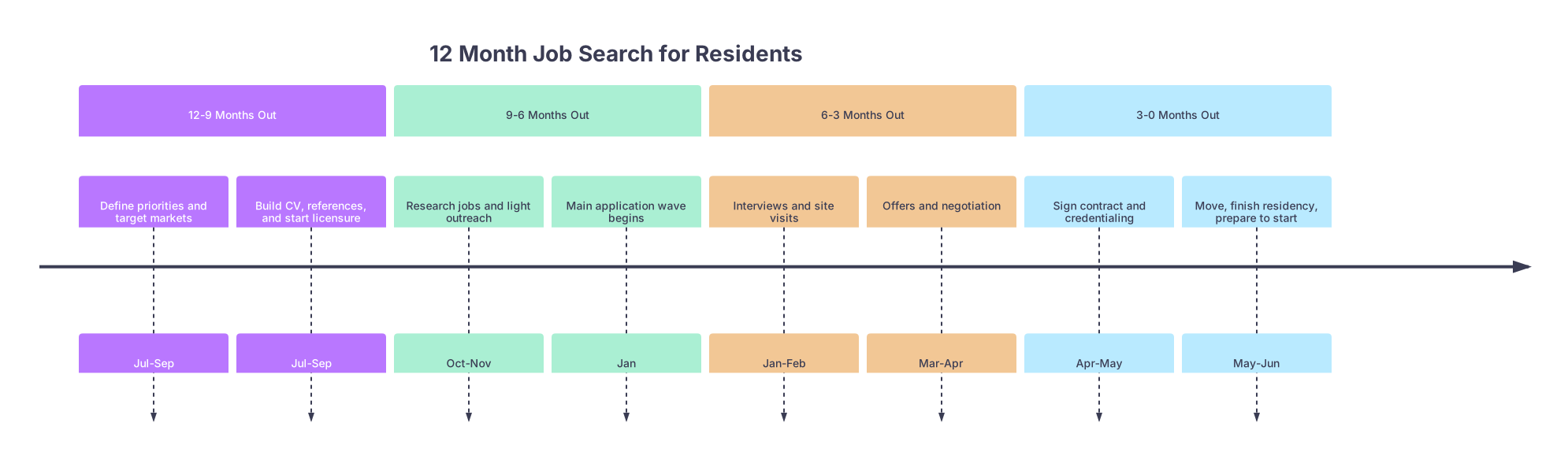
| Period | Event |
|---|---|
| 12-9 Months Out - Define priorities and target markets | Jul-Sep |
| 12-9 Months Out - Build CV, references, and start licensure | Jul-Sep |
| 9-6 Months Out - Research jobs and light outreach | Oct-Nov |
| 9-6 Months Out - Main application wave begins | Jan |
| 6-3 Months Out - Interviews and site visits | Jan-Feb |
| 6-3 Months Out - Offers and negotiation | Mar-Apr |
| 3-0 Months Out - Sign contract and credentialing | Apr-May |
| 3-0 Months Out - Move, finish residency, prepare to start | May-Jun |
If You Are Already Behind This Ideal Timeline
If you are reading this with only 6 months left, you will compress phases:
- 6 months out: Combine Months 12–9 in one intense week: define priorities, build CV, start state license.
- 5–4 months out: Do the main application wave and screening calls.
- 3–2 months out: Focus on interviews and get offers.
- 2–1 months out: Contract review, signing, and credentialing.
You will have fewer options and less leverage, but it is still manageable if you are decisive and organized.
Start now. Today, block 30 minutes on your calendar and do one thing: open a blank document and list your top 5 job priorities and top 3 non‑negotiables. That list will drive every decision for the next 12 months.