
The usual “follow your passion” specialty advice is useless if your body cannot physically survive the job.
If you’re a med student or early resident with a chronic illness, the real question is different: Which specialties are actually livable for me, not just theoretically “lifestyle friendly”? Because “good lifestyle” in Reddit-speak (high pay, fewer weekends) is not the same as “my joints don’t explode after three days of call.”
Let’s walk through how to choose a specialty when your health is a non‑negotiable constraint, not an afterthought.
Step 1: Get Brutally Honest About Your Actual Limits
Before you look at specialties, you have to understand your own “operating manual.” Vague thinking here will wreck you later.
Ask yourself, concretely:
- How many hours can you function before your symptoms noticeably worsen?
- How do you handle sleep deprivation? One bad night? Three in a row?
- Can you stand or walk for long periods? If yes, what’s “long” — 30 minutes? 4 hours?
- How predictable does your schedule need to be for meds, infusions, meals, glucose checks, bathroom breaks, or pain cycles?
- How do flares show up for you: cognitive fog, severe pain, GI issues, migraines, fatigue, motor issues?
Do not answer this based on your “good week.” Answer based on your average and your worst‑case.
Then translate that into specific red lines. For example:
- “I cannot function with more than one overnight shift a week.”
- “I need at least 10 minutes every 4 hours to sit, hydrate, and take meds.”
- “I cannot be on my feet continuously for more than 60–90 minutes.”
- “I need a relatively quiet environment when my migraine threshold is low.”
Write those down. These become your filter. Everything that follows is built on those constraints.
Step 2: Understand What Actually Makes a Specialty “Manageable”
People throw around “ROAD to happiness” (Radiology, Ophtho, Anesthesia, Derm) like a spell. That’s lazy thinking.
For someone with chronic illness, the key dimensions are different:
Night work and call structure
- Frequency of overnight call.
- In-house vs home call.
- How brutal the nights actually are (busy vs mostly sleep).
Physical demands
- Standing vs sitting.
- Fine motor vs gross motor.
- Need for quick physical responses (codes, traumas).
Cognitive load + environment
- Constant interruptions or more controlled workflow.
- Noise, chaos, emergencies vs focused, quiet work.
- Volume and pace of decisions.
Schedule predictability
- Can you plan around infusions, PT, flare cycles, childcare?
- Are hours roughly fixed or all over the place?
Flexibility post‑residency
- Ability to go part‑time.
- Telemedicine options.
- Mix of inpatient/outpatient you can dial up or down.
That’s the framework you actually care about.
Here’s a quick at‑a‑glance comparison for some commonly “lifestyle” specialties from a chronic-illness standpoint:
| Specialty | Nights/Call (Residency) | Physical Demand | Post-Training Flexibility |
|---|---|---|---|
| Dermatology | Low, mostly home call | Low | Very high (clinic-based) |
| Radiology | Moderate nights early | Low (seated) | High (telerad, shifts) |
| Pathology | Very low | Very low | High (predictable hours) |
| Psychiatry | Moderate, depends site | Low | High (outpatient, tele) |
| PM&R | Moderate | Low–moderate | Medium–high (mix settings) |
This isn’t perfect, but it gives you a starting map.
Step 3: Specialties That Often Work Well With Chronic Illness
Let’s get specific. I’ll focus on specialties that, in practice, I’ve seen work for trainees with autoimmune disease, chronic pain, migraine, diabetes, POTS, IBD, etc.
Dermatology
If you can get in, derm can be very friendly long term.
Residency reality:
- Typically clinic-heavy, daytime hours.
- Some call, but usually not brutal. Often home call and relatively manageable.
- Procedures are mostly done standing, but you’re not running to codes.
Good for:
- Conditions that can’t handle chronic sleep deprivation.
- Predictable medication schedules.
- People who need regular infusion days or appointments.
Watch out for:
- The competitiveness. If your illness impacted your grades, you may have to be strategic: strong Step 2, targeted research, mentorship.
- Standing for procedures. You may need a stool or sit for some procedures—this is reasonable but you must advocate early.
Radiology
Radiology is underrated for trainees with chronic physical limitations.
Residency reality:
- You are mostly sitting. Monitors, dark rooms, less walking.
- There are night float blocks and call, which can be rough, but they are typically consolidated and predictable.
- Acute care imaging (ER nights) can be cognitively intense but not physically demanding.
Good for:
- Mobility issues.
- Chronic pain that worsens with standing.
- Conditions that can tolerate blocks of nights if you can sleep well on off days.
Watch out for:
- Long stretches of screen time can aggravate migraines or visual issues.
- The early years can still be demanding with call and high reading volume.
Post-training:
- Teleradiology and shift-based work can be very flexible.
- You can target outpatient-only or lower-acuity practices.
Pathology
Path is one of the most physically forgiving specialties, but you need to actually like it.
Residency reality:
- Very little night work. Call is usually home call and mostly for critical results or transfusion issues.
- Work is mostly seated: microscope, grossing specimens, sign-out.
- Hours tend to be more predictable than most.
Good for:
- Fatigue, POTS, musculoskeletal problems.
- Anyone who just cannot do chronic night shifts or high-adrenaline chaos.
Watch out for:
- Some grossing can be physically tiring if you’re standing at the bench—ask about accommodations (anti-fatigue mats, seating options).
- Social isolation can exacerbate mood disorders. If you need daily team interaction, choose practice settings accordingly.

Psychiatry
Psychiatry is often the first thing people suggest, sometimes for the wrong reasons. But done right, it can be a strong fit.
Residency reality:
- Early years can include inpatient work and nights, but not as brutal as surgical fields.
- Physical demand is low—most of the day is sitting, talking, writing notes.
- Some programs have tough call schedules; others are more humane. Massive variation.
Good for:
- Conditions that flare with physical exertion more than cognitive load.
- People who need regular breaks to snack, hydrate, or take meds.
Watch out for:
- ED psych coverage can mean unpredictable nights.
- Emotional load is real. If your illness affects mood or energy, this can cut both ways.
- Safety concerns. If you have physical limitations, you need a program that takes staff safety seriously and has good support.
Post-training:
- Outpatient practice is extremely flexible.
- Telepsychiatry is very viable and can be done from home.
- You can set schedule length (half days, 3–4 day weeks, etc.).
PM&R (Physical Medicine & Rehabilitation)
This one is very context-dependent but worth considering.
Residency reality:
- Mix of inpatient rehab, consults, and outpatient clinics.
- You do walk around and see patients, but you’re not in surgeries all day.
- Call exists but usually not as intense as medicine or surgery.
Good for:
- People who want more patient interaction and procedures, but not OR-level demand.
- Those interested in pain, musculoskeletal medicine, disability care—your experience can be a strength here.
Watch out for:
- Inpatient rehab units can require a lot of walking between rooms and floors.
- Some subspecialties (e.g., interventional spine) are more physically demanding.
Step 4: Specialties That Are Tricky but Not Impossible
Some fields are not “lifestyle” on paper but can work with careful planning and the right job later.
Outpatient-Focused Internal Medicine or Family Medicine
Residency:
- The inpatient years are rough. Long days, call, nights, cross-cover.
- If your illness cannot tolerate unpredictable nights at all, this will be a problem.
- However, some community programs are less intense than big academic centers.
Post-training:
- You can build a very manageable outpatient-only practice: 3–4 days/week, no hospital work, minimal call shared in a big group.
- Telemedicine and hybrid clinics are expanding.
This route is for you if:
- You can white-knuckle 3 hard years with real support and accommodations.
- Your disease is reasonably well-controlled and can survive that upfront hit.
I’ve seen residents with Crohn’s, RA, Type 1 diabetes, and lupus do this. The key was:
- Strong program director support.
- Scheduled infusion days built into rotation schedules.
- Strategic picking of electives to avoid the worst call blocks when flares were common.
Anesthesiology and Emergency Medicine
Let me be blunt: if your chronic illness is destabilized by nights, adrenaline surges, or sleep loss, these are risky. But I’ve seen them work in very specific scenarios.
Anesthesia:
- Physically: a lot of standing but also some sitting during cases.
- Nights and call are real in residency.
- Post-training: you can sometimes move to ambulatory surgery centers with more regular hours and limited call.
Emergency Medicine:
- Shift-based, which some people with chronic illness actually like—clear on/off times.
- Nights and circadian disruption are baked in.
- Physically mobile, on your feet a lot.
These fields are only viable if:
- Your illness is very stable.
- You tolerate nights decently.
- You’re realistic about possibly needing to move to a slower ED or niche job later.
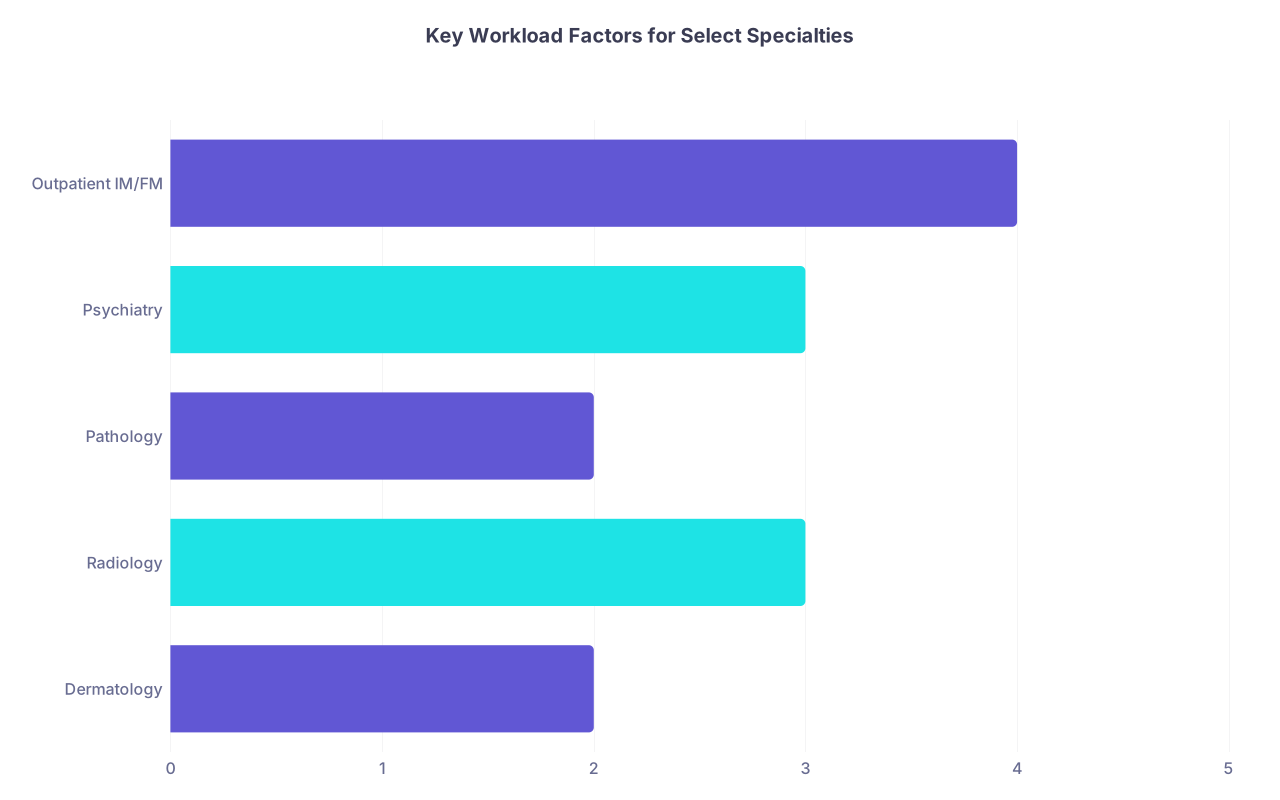
| Category | Value |
|---|---|
| Dermatology | 2 |
| Radiology | 3 |
| Pathology | 2 |
| Psychiatry | 3 |
| Outpatient IM/FM | 4 |
(Scale 1 = very light / predictable in residency, 5 = very heavy / unpredictable. Crude but useful mental model.)
Step 5: Red-Flag Specialties if Your Illness Is Moderately to Poorly Controlled
Let’s talk about the ones that are usually a bad idea if your disease has real limitations.
I’m not saying it’s impossible. I’m saying the default is “you will suffer,” and you need a very strong reason to take that on.
- General surgery and most surgical subspecialties (ortho, vascular, neurosurg, ENT)
- Long OR cases, standing, heavy call, early mornings, physically demanding.
- OB/GYN
- Mix of clinic, OR, and L&D call. Nights, emergencies, physical work.
- Combined programs with heavy inpatient components (med-peds, some EM/IM).
If:
- You flare badly with sleep loss,
- Or your joints, back, or stamina are limited,
- Or you need very predictable med schedules,
then signing up for 5–7 years of surgical training is like driving a car with a cracked engine block across the desert. Could it make it? Maybe. Does it often end in disaster? Also yes.
Step 6: How to Vet Programs When You Have a Chronic Illness
You’re not just picking a field. You’re picking a culture.
Here’s how to actually evaluate if a residency will keep you alive and functioning.
1. Quietly Ask Current Residents Targeted Questions
Do not ask, “Is it a good lifestyle?” That gets you garbage answers.
Ask:
- “How are nights structured? Night float vs 24s vs q4 call?”
- “How much flexibility have people had for medical appointments?”
- “Has anyone taken medical leave or had accommodations? Did the program support them?”
- “Are there residents with kids or other big life responsibilities? How are they treated?”
If a resident lowers their voice and says, “Off the record…” — listen very carefully.
2. Pay Attention to Their Reaction When You Mention Health (Strategically)
You don’t have to disclose your diagnosis to everyone. But you can float test balloons:
- “I have a chronic health condition that sometimes requires predictable clinic visits. How have you supported residents who needed schedule flexibility?”
- “What’s the process for getting accommodations if needed?”
Watch their face. Their first 2 seconds tell you everything.
Defensive, vague, or dismissive answers are a warning sign. Concrete answers like, “We’ve had residents with X who needed Y, and here’s how we handled it” are gold.
3. Talk to GME or Disability Services Before You Sign
Every hospital that hosts residents has a GME (Graduate Medical Education) office and a disability/accommodations office. They exist for a reason.
Ask about:
- Past accommodations for trainees.
- The process and timeline for setting them up before residency starts.
- How they handle flare-related leave or intermittent FMLA.
If they seem confused that a resident would ever need accommodations, that tells you what you need to know.
Step 7: Legal and Practical Reality of Accommodations
You’re protected more than you think, but you still have to be smart.
- You are generally covered under disability law if your condition substantially limits major life activities.
- Programs must provide reasonable accommodations, which could include:
- Scheduled breaks.
- Ergonomic equipment, stools, or chairs in clinic/OR.
- Adjusted call schedules during flares.
- Time for medical appointments.
Reasonable does not mean:
- Exempting you from all nights in EM.
- Making another resident cover half your shifts continuously without a plan.
You want to propose accommodations that:
- Allow you to meet core requirements.
- Are logistically possible.
- Are documented and agreed upon in writing.
Do not rely on “verbal promises” from a PD. Leadership changes. Memories change. Paper does not.
Step 8: Contingency Planning: If Your Body Forces a Pivot
Sometimes, despite all the planning, your disease changes the rules mid-game. Flares get worse. A new diagnosis appears. A surgery doesn’t fix what it was supposed to.
You need a mental backup plan from day one. Not because you’re weak. Because you’re realistic.
Examples:
- Starting in IM with an eye toward outpatient primary care, but keeping psych or path in the back of your mind if wards become unsustainable.
- Beginning anesthesia but being honest with yourself about whether a switch to psych, PM&R, or radiology would be necessary if nights wreck you.
- Using elective time to explore lower-intensity fields—even if only as data gathering.
Residency changes are hard but they happen more than people admit. Especially with health issues. If you’re noticing your body crumbling in PGY-1:
- Document symptoms and impacts.
- Talk early to your PD and GME, not when you’re already failing rotations.
- Reach out to mentors inside and outside your program. Quietly.
You’re not trapped.
Step 9: A Few Realistic Scenarios and What I’d Do
Scenario A: You Have Well-Controlled Crohn’s with Occasional Flares
You can function most days but need infusion days every 6–8 weeks and flares knock you down 3–5 days a couple times a year.
Viable specialties:
- Derm, radiology, psychiatry, path, PM&R.
- Outpatient-focused IM/FM with a clear “I’m going outpatient only later” plan.
Key moves:
- Pick programs that schedule residents far enough in advance so you can plan infusions on elective/clinic blocks.
- Make sure GI care is accessible near your residency.
- Ask specifically how they handle residents who need infusion days or intermittent leave.
Scenario B: You Have POTS and Chronic Fatigue, Standing is Brutal
You can sit and think clearly, but prolonged standing or rapid position changes trigger symptoms.
Top choices:
- Radiology.
- Pathology.
- Psychiatry (with attention to how often you’re running around inpatient units).
- Some very outpatient-heavy derm or allergy/immunology later on.
Avoid:
- Surgery, OB/GYN, EM, anything OR-heavy.
- IM/FM with heavy inpatient residency unless you’re unusually stable.
Negotiation:
- Ask about stools/ergonomic setups in clinic or reading rooms.
- Build in predictable rest breaks.
Scenario C: You Have Severe Migraine with Visual Aura and Light Sensitivity
You’re functional most days, but bad migraines can take you out for 24–48 hours, especially with sleep loss or bright lights.
Better fields:
- Psychiatry (especially outpatient).
- Pathology (quiet, controlled environment).
- Some outpatient IM/FM.
Approach radiology with caution:
- Screen time and dark rooms can be migraine triggers for some, relief for others. You need to test this on rotations.
You’ll need:
- A program that doesn’t treat occasional sick days as moral failure.
- Flexibility in coverage when a migraine knocks you out.
Final Reality Check
Three things to keep in your head as you make this choice:
Your body is not optional equipment. No specialty is worth sacrificing your baseline functioning or shaving decades off your life. Ignore anyone who glorifies “pushing through” as a long-term strategy.
Field choice and program choice both matter. A “good” lifestyle specialty in a toxic, rigid program will wreck you. A moderately demanding field in a humane, flexible program might be survivable.
You’re allowed to design a career for the long game. Think beyond residency. Many specialties that are rough in training can lead to very manageable attending jobs—if your body can survive the training. Be honest about whether it can.
Pick the specialty that lets you do good medicine without destroying the only body you will ever have. That’s not weakness. That’s strategy.