
The myth of the “chill” specialty collapses the moment you look at compensation per hour. Some of the most relaxed-feeling careers on paper are underpaid for the time you give them. Others are shockingly efficient: fewer hours, solid pay, low stress. The data is very uneven.
You are not choosing a specialty. You are choosing a lifetime hourly rate plus a lifestyle pattern. And those two do not always move together.
Below, I am going to treat specialties like an analyst would treat different business units: revenue, hours, margins, risk. No romance. Just numbers.
The core math: compensation per hour, not salary
Most med students obsess over the wrong metric: total annual income. The right metric for lifestyle is simple:
Compensation per hour = total annual compensation ÷ total annual work hours
Two internists both earning $280,000 are not the same if one is working 55 hours per week plus call and the other is working 40 hours with no weekends.
To keep this grounded, I will use consistent assumptions:
- Data anchor: recent Medscape Compensation & Lifestyle Reports, AAMC reports, and large survey datasets through ~2023–2024.
- Hours: Typical attending full-time (not a unicorn 0.6 FTE arrangement).
- Scope: U.S. practice, mostly outpatient or “lifestyle” branded specialties.
- “Chill” filters: lower acute mortality pressure, more predictable schedules, fewer emergent night calls.
We will walk through a handful of specialties commonly labeled “lifestyle friendly” and compute approximate dollars per clinical hour. Numbers are rounded. You are not signing a contract off this article; you are calibrating your expectations.
To get oriented, here is a comparison snapshot.
| Specialty | Annual Pay (\$k) | Hrs/Week | Hr/Year | \$/Hour |
|---|---|---|---|---|
| Dermatology | 520 | 40 | 2,000 | 260 |
| Radiology (Diagnostic) | 520 | 45 | 2,250 | 231 |
| Anesthesiology | 470 | 45 | 2,250 | 209 |
| PM&R (Physiatry) | 340 | 45 | 2,250 | 151 |
| Psychiatry | 310 | 45 | 2,250 | 138 |
| Outpatient Neurology | 320 | 50 | 2,500 | 128 |
These are not perfect, but they are directionally accurate. The ratios matter more than the exact dollar.
Who actually wins on dollars per hour?
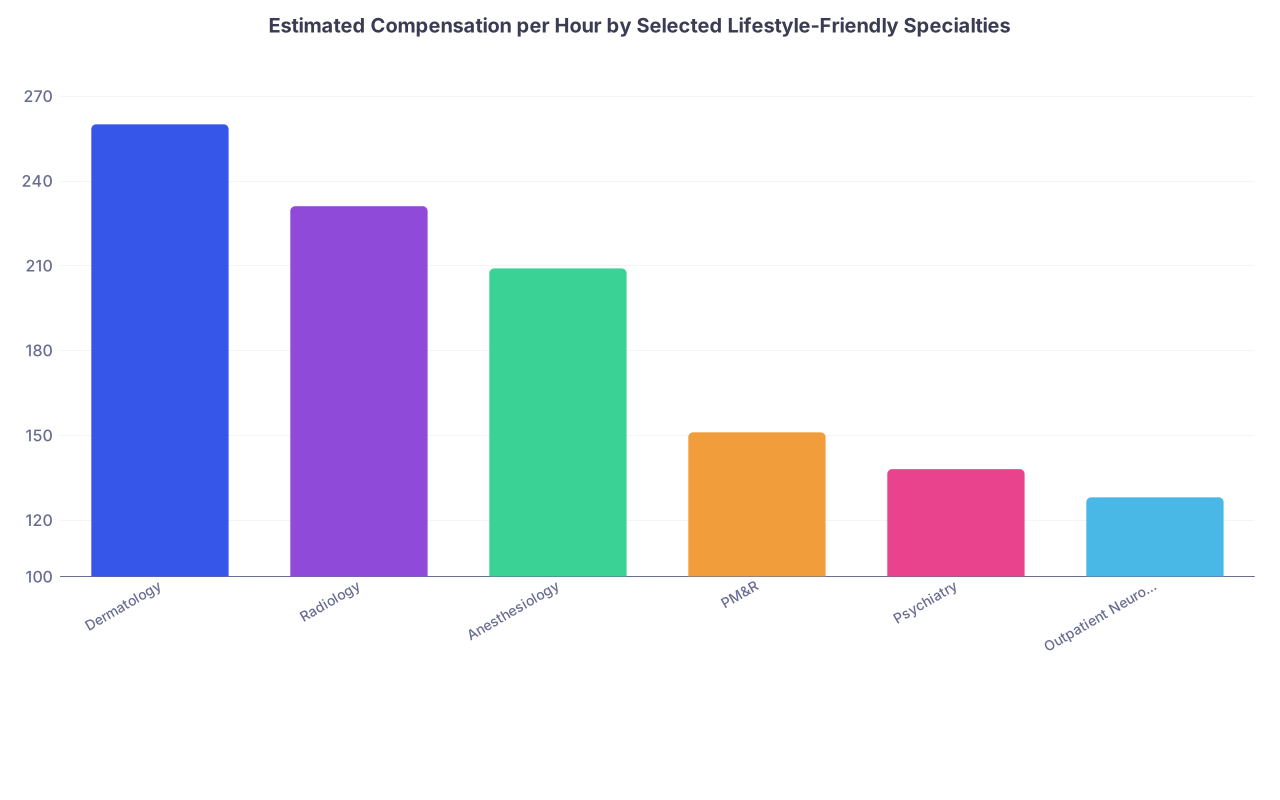
Let us isolate compensation per hour for specialties most students call “chill,” and visualize it.
| Category | Value |
|---|---|
| Dermatology | 260 |
| Radiology | 231 |
| Anesthesiology | 209 |
| PM&R | 151 |
| Psychiatry | 138 |
| Outpatient Neurology | 128 |
Looking at the bar chart, three clear tiers appear:
- Tier 1 – Elite pay per hour: Dermatology, Diagnostic Radiology, Anesthesiology
- Tier 2 – Reasonable pay per hour, softer lifestyle: PM&R, Psychiatry
- Tier 3 – Marginal on pay per hour: Outpatient Neurology (and several similar cognitive fields)
So when someone tells you “psychiatry is chill, derm is chill, neurology is chill,” they are blending very different economic realities.
Now let us unpack each group with some real numbers and lived details.
Dermatology: the lifestyle benchmark
Dermatology is the specialty everyone whispers about during third year like it is a cheat code. In this case, the stereotype is not far off.
Typical data points:
- Annual compensation: $450k–$600k+ in private practice; academic can be lower ($300k–$400k), high-producing private equity or cosmetic-heavy can be higher.
- Work hours: ~35–45 hours/week, minimal nights, rare true emergencies.
- Call: Usually phone-only, low volume, often shared widely across a group.
Using conservative assumptions:
- $520,000 / year
- 40 hours/week × 50 working weeks = 2,000 hours/year
Comp per hour ≈ $520,000 ÷ 2,000 = $260/hr
What the data shows about lifestyle:
- Predictability: Clinic-based, scheduled. No 2 a.m. STEMIs. Very rare “you must come in now” situations.
- Cognitive load: Intense pattern recognition and procedure volume, but relatively low acute emotional burden (you are not running codes).
- Leverage: Strong ability to shift mix toward cosmetics and procedures where per-hour reimbursement is even higher.
But there is a cost you already know: derm is one of the most competitive matches. You pay in Step scores, research, and stress front-loaded in your training years.
From a pure “hours vs. dollars” perspective, dermatology is likely the best lifestyle-adjusted ROI in medicine, if you can get in and if you tolerate outpatient clinic density.
Diagnostic Radiology: high leverage, controllable stress
Radiology is another quiet lifestyle monster. The average resident does not fully grasp how efficient the time-to-money ratio can be until they see a reasonable community radiology group contract.
Typical data points:
- Annual compensation: $480k–$600k in private practice, sometimes higher with telerad or partnership; academic radiology often lands $350k–$450k.
- Work hours: Many full-time radiologists cluster around 40–50 hrs/week. Night coverage can be shift-based.
- Call: Trade-off between overnight shifts and comp. Telerad: often all nights, but compressed schedules.
Let us take conservative numbers:
- $520,000 / year
- 45 hours/week × 50 weeks = 2,250 hours/year
Comp per hour ≈ $520,000 ÷ 2,250 ≈ $231/hr
Key lifestyle factors the numbers do not show directly:
- Flexibility of location and setting: Teleradiology allows work-from-anywhere setups, which is a huge lifestyle perk. That does not show in pure dollars/hour but matters.
- Shift work model: Some groups do 7-on/7-off or similar blocks. Those weeks can be brutal, but the off weeks are real. Calculated per calendar hour awake, many radiologists feel “richer in time” than clinic-based docs.
- Burnout pattern: Not from nights and codes, but from volume pressure and staring at a PACS all day. Different kind of fatigue.
For someone who wants high compensation per hour without continuous face-to-face clinic grind, radiology is near the top of the lifestyle spectrum, assuming you tolerate dark rooms and high throughput.
Anesthesiology: high pay per hour, but the devil is in call structure
Anesthesiology looks similar to radiology on paper, but the hour mix is a bit messier because of OR schedules and call. Still, the per-hour economics are strong.
Typical data points:
- Annual compensation: $450k–$550k (community), academic somewhat lower.
- Work hours: 40–55 hrs/week, depending on call, OR volume, and whether you cover trauma or hearts.
- Call: Highly variable. Some groups do 1:8 or 1:10 call, others heavier. Post-call days can be protected or eaten by late cases. That is where lifestyle falls apart in some groups.
Using moderate assumptions:
- $470,000 / year
- 45 hours/week × 50 weeks = 2,250 hours/year
Comp per hour ≈ $470,000 ÷ 2,250 ≈ $209/hr
But the hourly number alone is misleading here unless you look at time fragmentation:
- Early starts (05:45–06:30) limit family morning routines.
- OR days are long, and add-on cases expand the tail of your shift.
- Even with fewer total hours than some surgical specialties, the schedule feels more invasive.
So anesthesiology lines up as a high comp, moderate-to-high intensity lifestyle. Far from the worst in medicine. Not truly “chill” unless you find a very civilized group or a niche (office-based anesthesia, GI centers, etc.) with limited call.
Psychiatry: lifestyle friendly, but not a financial powerhouse
Psychiatry is the default answer when students say “I want chill.” The question is whether you are comfortable with what the spreadsheet shows.
Typical data points:
- Annual compensation: roughly $280k–$340k for general psychiatry (non-locums, non-extreme rural), with higher outliers for inpatient, call-heavy, or high-RVU clinics; lower in highly academic roles.
- Work hours: Often 40–50 hours/week. Many psychiatrists have more control over scheduling than almost any other specialty.
- Call: Depends heavily on practice setting. Pure outpatient with no inpatient duties: often no meaningful call.
Let us choose:
- $310,000 / year
- 45 hours/week × 50 weeks = 2,250 hours/year
Comp per hour ≈ $310,000 ÷ 2,250 ≈ $138/hr
Pure numbers: you are earning close to half per hour compared with a dermatologist in many regions.
However, you can often engineer:
- 4-day workweeks without destroying income.
- High telehealth fractions of your schedule.
- Lower emotional “adrenaline” stress (though chronic exposure to severe mental illness is its own load).
Where psychiatry wins is consistent control over calendar and location. Where it clearly loses, from a pure finance standpoint, is dollars per hour relative to competitiveness and training effort. If your priority is (1) low physical strain and (2) geography flexibility and (3) predictable days, the trade may be acceptable.
PM&R (Physiatry): underrated lifestyle, mid-tier economics
Physical Medicine & Rehabilitation flies under the radar for many students, yet it quietly offers one of the more balanced trade-offs.
Data snapshots:
- Annual compensation: ~$320k–$370k for many general physiatrists; more if you do interventional pain or specialized procedures.
- Work hours: 40–50 hours/week are typical.
- Call: Varies wildly. Inpatient rehab with weekend rounds vs outpatient MSK clinic with essentially no real call.
Using mid-range parameters:
- $340,000 / year
- 45 hours/week × 50 weeks = 2,250 hours/year
Comp per hour ≈ $340,000 ÷ 2,250 ≈ $151/hr
Two “data quirks” here:
- Interventional pathways (pain, EMG-heavy, procedures) can push compensation per hour much higher, sometimes approaching anesthesia territory if you move into pain management, at the cost of more procedures and possibly more call.
- Pure rehab/clinic roles can end up closer to psychiatry on dollars/hour but with more team and system coordination stress.
From a lifestyle lens, PM&R offers:
- Generally lower acute mortality stress.
- Collegial, team-based environments.
- Room to lean into or away from procedures.
Economically, it sits middle of the pack. You will not be broke. You will not be in derm or radiology league either, unless you pivot into lucrative subspecialties.
Outpatient neurology: cognitive load high, pay per hour surprisingly modest
Neurology is often sold as “intellectual, clinic-based, and not as crazy as neurosurgery.” All true. The danger is that you conflate “clinic-based” with “well-compensated and chill.” The data does not back that up.
Rough benchmarks:
- Annual compensation: ~$300k–$350k is realistic for many full-time outpatient neurologists in non-elite markets.
- Work hours: 45–55 hours/week is very common once you include documentation, calls, and follow-ups.
- Call: Outpatient-heavy jobs can still have call for stroke consults or inpatient coverage, depending on how your group is structured.
Let us set:
- $320,000 / year
- 50 hours/week × 50 weeks = 2,500 hours/year
Comp per hour ≈ $320,000 ÷ 2,500 = $128/hr
And that number is generous if you end up in a busy group with heavy hospital consults.
The qualitative side:
- Cognitive complexity: High. Neurodiagnostics are non-trivial, and the emotional weight of progressive conditions (ALS, dementia, MS) is real.
- Throughput pressure: Many clinics double-book, and neurology visits are not quick. If you care about doing a careful neuro exam, you will feel the squeeze.
So outpatient neurology fails the strict “chill and efficient” test. It is cognitively punishing and not particularly impressive on compensation per hour relative to IM subspecialties like cardiology or GI, both of which out-earn neurology while being at least equally demanding.
It is a good fit if you genuinely love neuro. It is a bad fit if you think it is an easier, well-paid branch off of internal medicine. The hourly math does not support that story.
How “hours” really work: scheduled, unscheduled, and hidden time
Pure hours/week averages hide several realities that matter for your lived lifestyle:
- Scheduled clinical time – what your contract shows (e.g., 36 hrs/wk patient contact).
- Non-clinical but required time – notes, prior auths, patient messages, meetings.
- Unscheduled emergencies or call – nights, weekends, late add-on procedures.
Students tend to only see #1.
Take two physicians both labeled “40 hours/week” on paper:
- Dermatologist: 32 hrs of clinic, 8 hrs of protected admin. Almost no emergencies.
- Neurologist: 36 hrs of clinic, 4 hrs of “admin,” but actually doing 10–12 hrs of patient messages and charting outside of that block.
Officially, they look identical on an HR spreadsheet. Actual lived experience? Very different.
This is why specialties like derm and radiology so often surface at the top of lifestyle lists: the non-clinical load is more compressible and predictable, and true emergencies are rare.
Psychiatry and PM&R sit between derm and neurology. Documentation load is heavy, yes, but the ability to control your panel size and scheduling levers is higher.
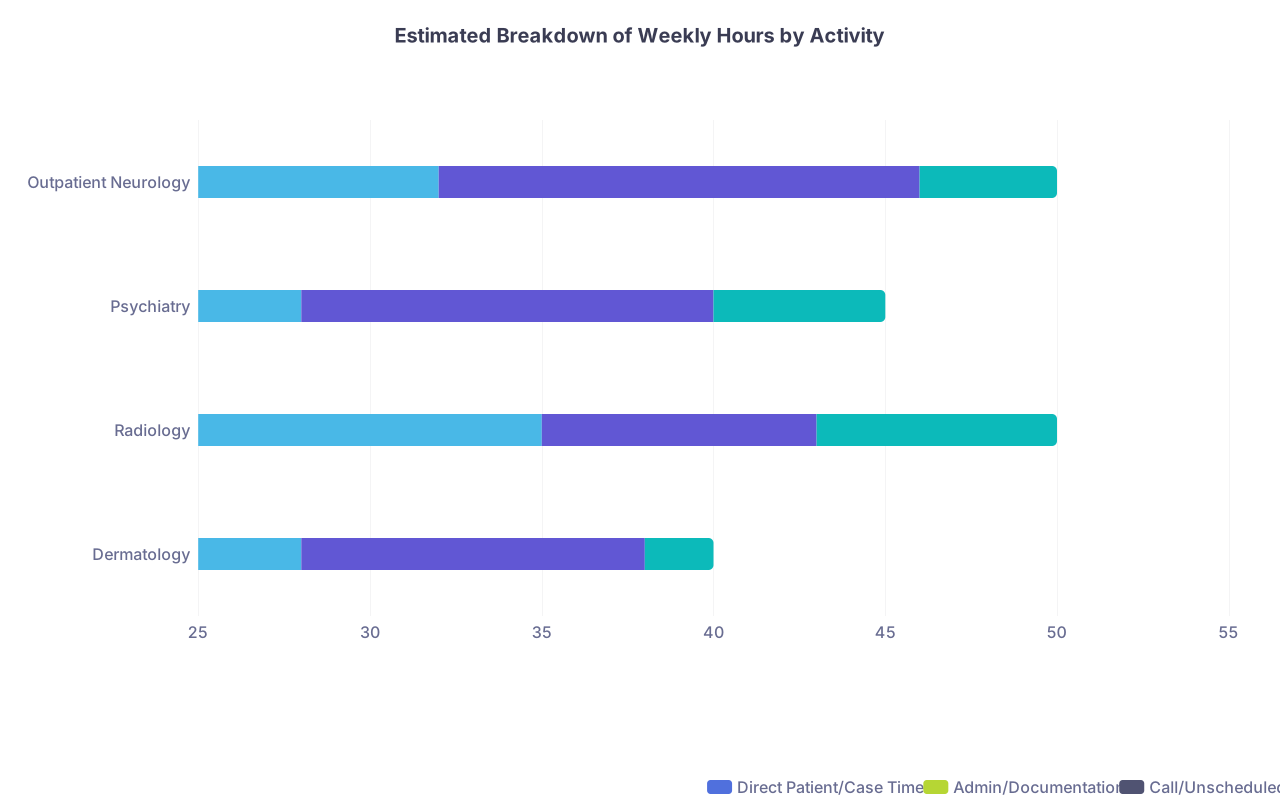
To make the difference concrete, here is a hypothetical breakdown.
| Category | Direct Patient/Case Time | Admin/Documentation | Call/Unscheduled |
|---|---|---|---|
| Dermatology | 28 | 10 | 2 |
| Radiology | 35 | 8 | 7 |
| Psychiatry | 28 | 12 | 5 |
| Outpatient Neurology | 32 | 14 | 4 |
Do not chase “40 vs 45” in isolation. Look at how those hours are distributed across direct care, paperwork, and unpredictable intrusions into nights and weekends.
Residency vs attending life: the misleading “it gets better” narrative
One more subtle trap: many “chill” specialties still have brutal or at least very busy residencies, with the promise that life improves afterwards. The improvement is not uniform.
Quick residency lifestyle snapshot:
| Specialty Residency | Typical Hours/Week | Call Type |
|---|---|---|
| Derm | 45–55 | Mostly home, consults |
| Diagnostic Radiology | 55–65 | Night float rotations |
| Anesthesiology | 60–70 | In-house, busy OR nights |
| Psychiatry | 55–65 (PGY1–2) | Inpatient call early |
| PM&R | 55–65 | Inpatient rehab call |
| Neurology | 60–70 | Stroke, ICU, wards call |
You are paying a residency “lifestyle tax” up front to access a better (or at least different) attending lifestyle curve later.
What I have seen repeatedly:
- Radiology and derm: residency is real work but fairly rational; attending life is significantly better and more controllable.
- Psychiatry and PM&R: residency is harder than attending life, but the pay bump afterward is modest per hour. The real win is autonomy and setting.
- Neurology and anesthesiology: residency intensity is very high; attending improvement is meaningful but not enough to label them “chill” unless you deliberately design a low-acuity practice.
The decision framework: how to think like an analyst, not a romantic
You do not need a PhD in econometrics. You need a basic framework and consistent inputs.
Here is a simple mental flow I would use.

| Step | Description |
|---|---|
| Step 1 | Start - Choose Priorities |
| Step 2 | Consider Derm or Radiology |
| Step 3 | Consider Anesthesia or PMR |
| Step 4 | Consider Psychiatry or Low Call Outpatient |
| Step 5 | Target Derm or Rad with Research |
| Step 6 | Consider Mid Tier with Good Groups |
| Step 7 | Evaluate Call Structure and Group Culture |
| Step 8 | Accept Lower Pay per Hour for Flexibility |
| Step 9 | Income or Lifestyle First |
| Step 10 | Competitive Profile Strong |
Translate that into actual decision variables:
- Target compensation per hour: Are you aiming for $200+/hr, $150–$200/hr, or are you comfortable with $120–$150/hr in exchange for other benefits?
- Tolerance for call and nights: Genuine or performative? Many students say they hate call, then go into fields where call is baked in.
- Cognitive and emotional load preference: Do you handle chronic progressive illness well? Do you want quick, largely reversible problems? Do you hate ambiguity?
Once you pick your “income vs lifestyle” lane, your list narrows very fast.
Example:
If you tell me you want:
- $200+/hr
- Minimal nights and weekends
- Predictable days
- Some procedural work but not high-adrenaline
I will tell you to focus relentlessly on derm and radiology, with maybe select anesthesia jobs that are heavily outpatient/ASC-based.
If you say you want:
- Low emotional acute intensity
- 4-day workweeks
- Telemedicine options
- You are fine with $130–$150/hr
Then psychiatry, some PM&R roles, and specific outpatient-only jobs (endocrinology, allergy, etc.) enter the picture. Neurology? I would be more cautious, given the current compensation vs complexity profile.
Trade-offs that do not show on the spreadsheet
A few non-monetary variables shift the effective “value” of each hour:
- Geography leverage: Radiology and psychiatry are easy to practice in lower COL markets or via tele modalities. $130/hr in a cheap Midwest city can feel richer than $200/hr in Manhattan.
- Part-time viability: Some specialties penalize part-time heavily (overhead, call coverage). Psychiatry, derm, and radiology tend to support 0.6–0.8 FTE paths much more gracefully.
- Burnout trajectory: Chronic stress from worsening dementia or chronic pain (neurology, PM&R, psychiatry) is different from the acute OR adrenaline of anesthesia. Same hours, different toll.
You are not just maximizing hourly pay. You are maximizing the utility of each hour over 30–40 years. That is where highly flexible, modular specialties like derm, radiology, and psychiatry quietly dominate long-term life satisfaction surveys, even when absolute dollars diverge.
Key takeaways
- On hard numbers, dermatology and diagnostic radiology clearly dominate the “chill specialties” for compensation per hour, with anesthesiology close behind but with more disruptive call.
- Psychiatry and PM&R offer genuinely better control over time and setting, but at a mid-tier hourly rate; you are explicitly trading money for flexibility.
- Outpatient neurology and similar cognitive fields feel “lifestyle” on the surface, but the actual dollars per hour vs cognitive and emotional load make them mediocre choices if your primary goal is a chill, well-compensated life.
Decide which trade-off you are willing to live with. Then align your specialty choice with the actual data, not the hallway mythology.