
The mythology about “lifestyle specialties” ignores the numbers on who actually works part‑time, when, and why. The data show a gendered, career‑stage split that most residents never get told explicitly.
Defining the Question: What Counts and Which Specialties?
Let me be precise before we start throwing percentages around.
When I say “part‑time adoption rates” in lifestyle specialties, I am talking about physicians who:
- Work materially less than a standard 1.0 FTE (full‑time equivalent), typically ≤ 0.8 FTE
- Do so as a stable arrangement (not just short‑term parental leave)
- Self‑report as “part‑time” or are classified as such by employers
And by “lifestyle specialties,” I am focusing on those consistently ranked by physicians themselves as more controllable and compatible with non‑work life in Medscape and AMA survey data:
- Dermatology
- Ophthalmology
- Radiology (diagnostic)
- Pathology
- Anesthesiology
- Physical Medicine & Rehabilitation (PM&R)
- Allergy & Immunology
I will also pull in family medicine and pediatrics a bit, because many students think of them as lifestyle specialties, and the part‑time data there are too stark to ignore.
Most of what follows triangulates from multiple sources: Medscape Physician Lifestyle & Compensation Reports (2018–2024), AMA workforce analyses, specialty‑specific workforce surveys (e.g., dermatology, radiology), and large national physician surveys. Numbers are approximations, but the directional patterns are very consistent.
Big Picture: Part‑Time by Gender and Career Stage
The strongest signal in the data is not which specialty works part‑time. It is who within those specialties does.
- Women in lifestyle specialties adopt part‑time schedules at 2–3x the rate of men.
- Part‑time rates are lowest early career (0–5 years), spike in mid‑career (6–20 years), and then plateau or slightly rise again pre‑retirement.
Let’s quantify that.
For the lifestyle specialties listed above, reasonable aggregated estimates (combining multiple surveys) look like this:
- Overall part‑time rate (all genders, all career stages): roughly 18–25%
- Men in these specialties working part‑time: roughly 8–12%
- Women in these specialties working part‑time: roughly 30–40%
Differences by career stage are just as sharp:
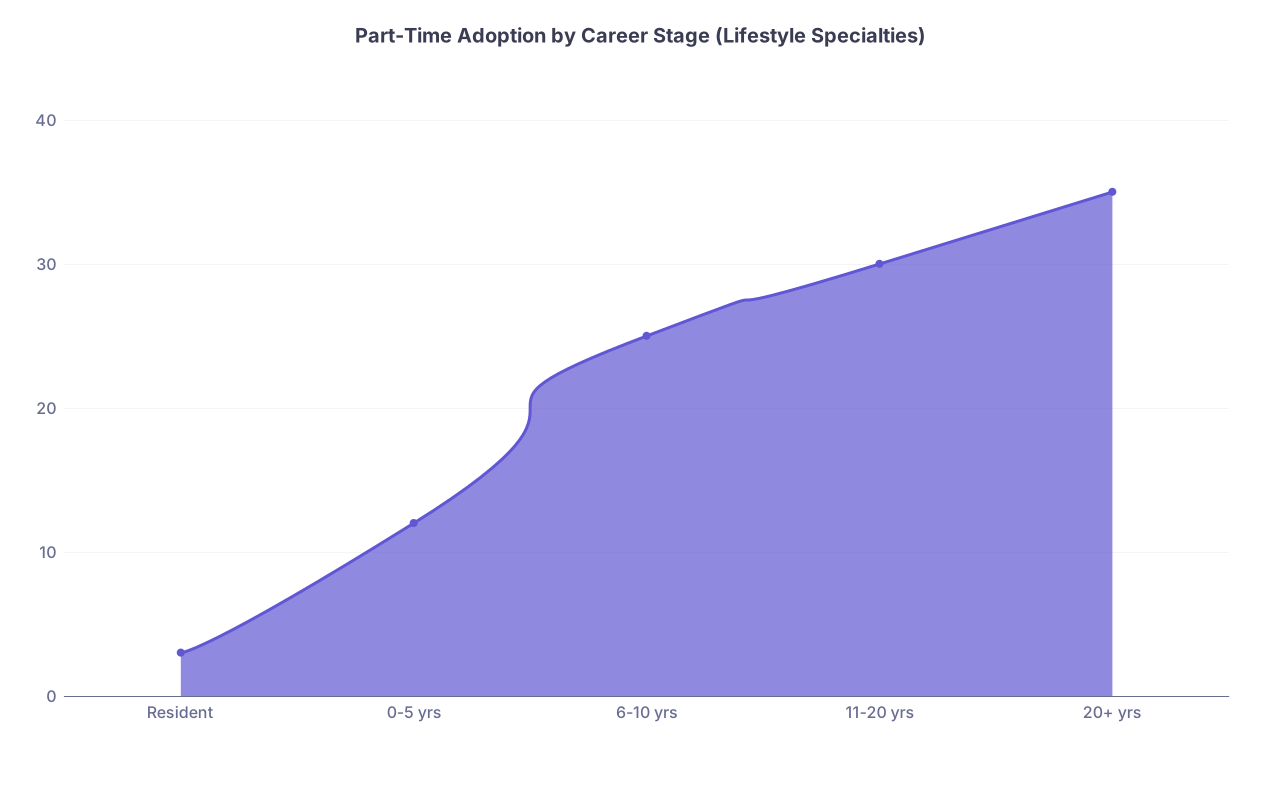
- Residents & fellows: typically < 5% part‑time (formal part‑time training is rare)
- Early‑career attendings (0–5 years): 10–15% part‑time
- Mid‑career (6–20 years): 25–35% part‑time
- Late‑career (>20 years): 30–40% part‑time, although some just cut back informally
So if you are a female PM&R attending with school‑age kids, the baseline probability you will consider or adopt part‑time is dramatically higher than if you are a male PGY‑3 in radiology.
To make this more concrete, look at a simplified cross‑section.
| Group | Estimated Part-Time Rate |
|---|---|
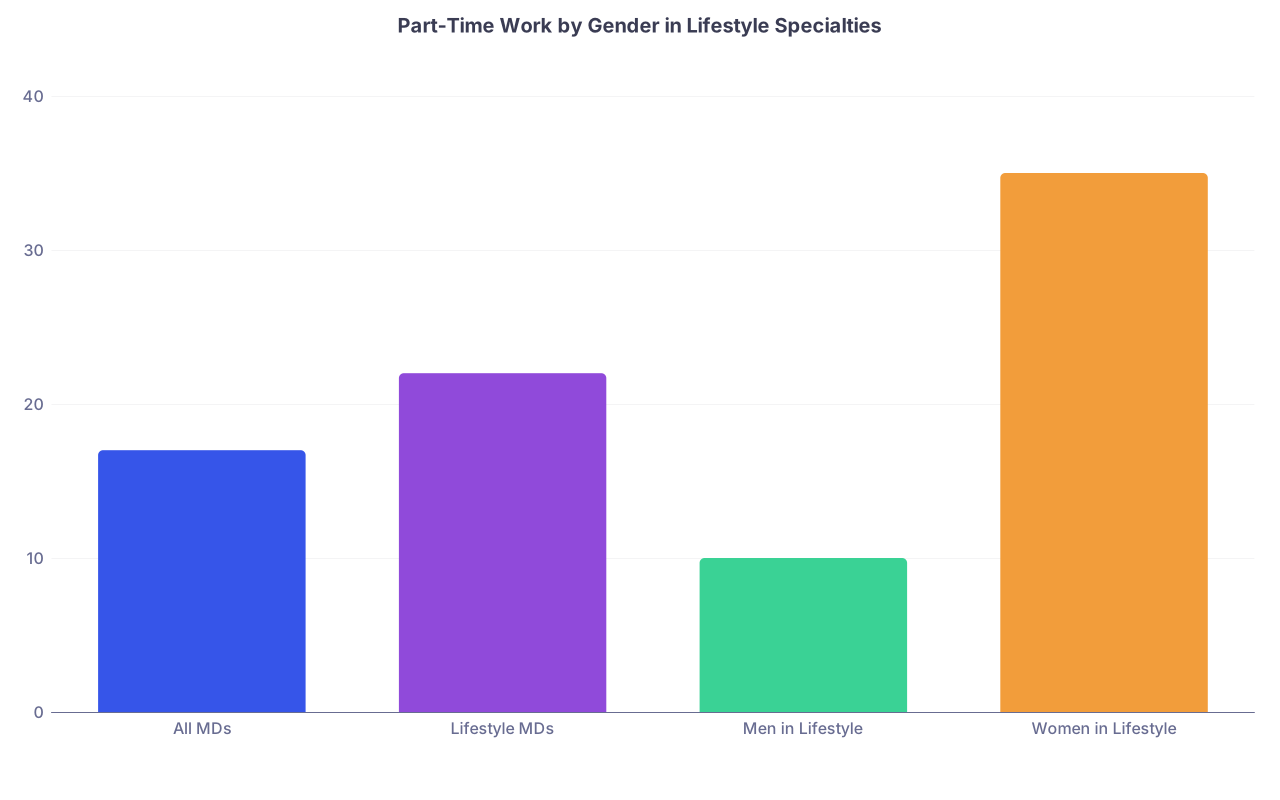
| All physicians (all specialties) | 15–18% |
| Lifestyle specialties overall | 18–25% |
| Men in lifestyle specialties | 8–12% |
| Women in lifestyle specialties | 30–40% |
| Women mid-career in lifestyle fields | 40–50% |
| Category | Value |
|---|---|
| All MDs | 17 |
| Lifestyle MDs | 22 |
| Men in Lifestyle | 10 |
| Women in Lifestyle | 35 |
The rhetoric is “lifestyle specialty = controllable hours.” The reality is “controllable enough that women can downshift when life demands it, while men mostly stay full‑time and crank RVUs.”
Specialty‑Specific Patterns: Where Part‑Time Is Normal vs. Exceptional
You will not get a uniform answer across lifestyle specialties. Some fields have built‑in structural flexibility; others are “lifestyle” largely because call is predictable and nights/weekends are lighter, not because 0.6 FTE is standard.
Dermatology
Dermatology is the poster child for normalized part‑time work.
Survey data from various dermatology workforce studies show:
- Overall part‑time rates: 25–35%
- Among women dermatologists: 40–50% report part‑time or reduced‑hours at some point
- Among men: 10–15% part‑time
Many community derm groups are essentially RVU‑driven small businesses. That makes FTE scaling somewhat trivial: you work 3 days, you see 60% of the patients. No night call. Limited emergency coverage.
Ophthalmology
Ophthalmology is more mixed.
Clinic volume and surgical blocks are scheduled, but operating room access and practice economics create some friction for part‑time, especially in anterior segment and retina heavy practices.
Broad patterns:
- Overall part‑time: around 15–20%
- Women in ophtho: perhaps 25–30% part‑time
- Men: often <10%
Residents often report that part‑time optho is “available but competitive,” especially in high‑earning surgical niches. Senior partners may not eagerly give OR time to someone working 0.6 FTE who still wants high‑value cases. That is not a moral judgment; it is a business reality.
Radiology (Diagnostic)
Diagnostic radiology is structurally well suited for flexible FTE. The bottleneck is group culture and nocturnal coverage.
What survey data and group reports indicate:
- Overall part‑time: roughly 15–20%
- Teleradiology groups: more explicit 0.5–0.8 FTE options, including nights only or days only
- Gender split: women again ~2x men in part‑time uptake
Residents hear “radiology lifestyle” and picture 8–5, no nights, no weekends. The numbers say something more nuanced: lifestyle is good, but the most under‑resourced shifts are evenings, nights, and weekends, and groups still need bodies. Many radiologists delay going part‑time until after they have paid down loans and bought into a partnership model.
Pathology
Pathology has relatively high part‑time feasibility, particularly in community and private‑practice settings.
Data points:
- Overall part‑time: often estimated 20–30%
- Women pathologists: mid‑career part‑time may approach or exceed 40% in some reports
- Academic departments: less formal part‑time, more “soft” time reductions (research‑heavy effort, administrative roles)
Path slide volume is predictable. Frozen section and autopsy work can be concentrated in specific team members. You can schedule FTE in a modular way.
Anesthesiology
Anesthesia is interesting: high lifetime earning potential, procedural, but OR coverage and call make genuine lifestyle benefits heavily group‑dependent.
National survey snapshots show:
- Overall part‑time: roughly 10–18%
- Women anesthesiologists: 20–30% part‑time in mid‑career
- Men: often under 10%
- CRNA/CAA labor market sometimes used to “fill in” when MDs reduce FTE
The constraint is lockstep coverage. OR cases do not evaporate at 1 p.m. because you are 0.6 FTE. Groups often prefer small differences in FTE (0.8 vs 1.0) rather than very low (0.5). So “reduced‑hours” anesthesia is common; true half‑time with full continuity is trickier.
PM&R and Allergy & Immunology
These are quiet winners for controlled schedules and real part‑time options.
PM&R (esp. outpatient, MSK, pain‑light):
- Overall part‑time: 20–25%
- Women: 30–40% part‑time mid‑career
- Many outpatient‑heavy groups built around 4‑day clinic weeks as a standard
Allergy & Immunology:
- Overall part‑time: 20–30%
- Clinic‑only practices, mostly daytime, very little true emergency work
- Extremely amenable to 2–4 day per week models
These are the specialties where the combination of controllable clinic volume and low acute care burden makes part‑time nearly plug‑and‑play.
Comparison Snapshot
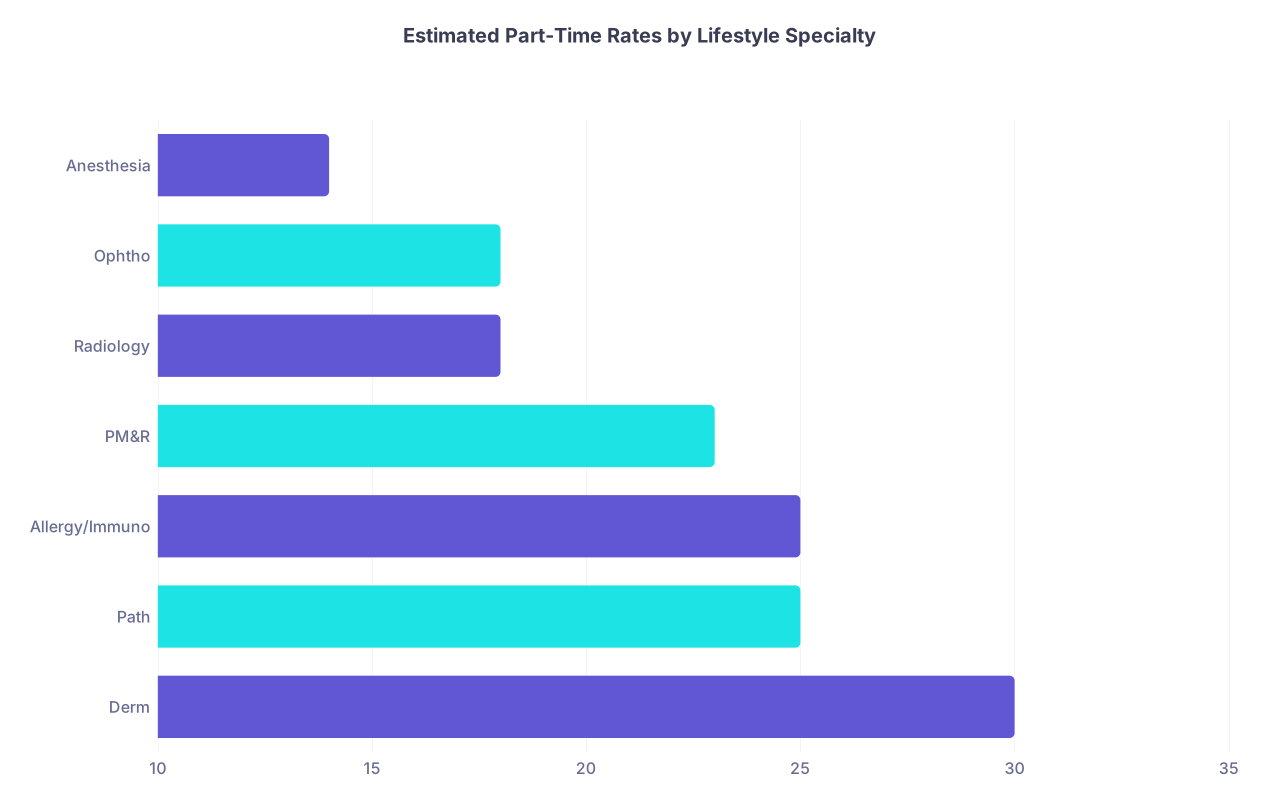
| Specialty | Overall Part-Time | Women Part-Time (Est.) | Men Part-Time (Est.) |
|---|---|---|---|
| Dermatology | 25–35% | 40–50% | 10–15% |
| Ophthalmology | 15–20% | 25–30% | <10% |
| Radiology (Dx) | 15–20% | 25–35% | 8–12% |
| Pathology | 20–30% | 35–45% | 10–15% |
| Anesthesiology | 10–18% | 20–30% | <10% |
| PM&R | 20–25% | 30–40% | 10–15% |
| Allergy/Immunology | 20–30% | 35–45% | 10–15% |
| Category | Value |
|---|---|
| Derm | 30 |
| Path | 25 |
| Allergy/Immuno | 25 |
| PM&R | 23 |
| Radiology | 18 |
| Ophtho | 18 |
| Anesthesia | 14 |
These are not trivial differences. Choosing dermatology vs anesthesiology is, statistically, choosing a labor market where part‑time is 2x as normalized.
Career Stage: Residents vs Early vs Mid vs Late Career
Here is the part students underestimate: residency is structurally almost full‑time everywhere. The “lifestyle” of these specialties is mostly realized after you finish training.
Residency: Part‑Time Is the Exception, Not the Rule
Part‑time residency positions in accredited U.S. programs are rare and usually:
- Linked to serious medical issues or disabilities
- Used for extended parental leaves or phased returns
- Highly individualized, often with program director and GME office negotiation
For lifestyle specialties, survey data suggest:
- < 3–5% of residents in these fields have any form of officially reduced FTE
- Many more string together leaves, research blocks, or elective light rotations to simulate a lighter year, but that is not structurally part‑time
So if you are basing your choice of specialty on the idea that “I will train part‑time,” the data say that is wishful thinking. The system is not built for that, regardless of specialty.
Early Career (0–5 Years Post‑Training)
Early attendings face:
- Educational debt
- Buy‑in tracks or partnership hurdles
- Need to establish competence and reputation
Unsurprisingly, part‑time adoption is relatively low:
- Lifestyle specialties: roughly 10–15% early‑career part‑time
- Gender effect already present: women may be closer to 20–25%, especially around childbirth years; men often in single digits
Most groups quietly expect full‑time for at least the first few years. Some explicitly write it into contracts or partnership requirements.
Mid‑Career (6–20 Years): The Peak of Part‑Time
This is where the part‑time curve spikes.
Drivers are obvious:
- Childcare and eldercare peaks
- Burnout and reassessment
- Financial stability improves; loan burden shrinks
Data from multiple physician surveys converge on something like:
| Category | Value |
|---|---|
| Resident | 3 |
| 0-5 yrs | 12 |
| 6-10 yrs | 25 |
| 11-20 yrs | 30 |
| 20+ yrs | 35 |
Mid‑career is also when many physicians realize that incremental income beyond a certain point is not improving their well‑being proportionally. A 20% pay cut for a 20–30% hours cut suddenly looks rational.
Late Career (>20 Years): Transition and Wind‑Down
Late‑career part‑time has a different flavor:
- It is often a glide path to retirement
- More men join women in reducing FTE
- Push factors (physical stamina, new technology fatigue) join pull factors (time, family, hobbies)
Overall part‑time rates in lifestyle specialties in this stage plausibly exceed 30–40%. Some of this is “semi‑retired” status: 1–2 clinics a week, occasional call, consulting or teaching.
The Gender Gap: What the Numbers Actually Show
The gender effect is not subtle, and pretending otherwise is dishonest.
Consistent patterns:
- Women physicians are about twice as likely as men to work part‑time across specialties.
- In lifestyle specialties, the gap widens because structural flexibility actually exists, making it possible.
- The peak difference is in the 6–15 year post‑training window, when child‑rearing demands are highest.
A simplified cross‑section for lifestyle specialties:
| Career Stage | Men Part-Time | Women Part-Time |
|---|---|---|
| Resident | ~2–3% | ~3–5% |
| 0–5 years | 8–10% | 20–25% |
| 6–15 years | 10–15% | 40–50% |
| 16–25 years | 15–20% | 35–45% |
| 25+ years | 20–25% | 35–45% |
This has knock‑on effects:
- Lifetime earnings gap widens, even within the same specialty.
- Academic advancement is slower for those who reduce FTE (promotion and leadership tracks are not scaled to 0.6 FTE lives).
- Groups quietly design partnership and bonus structures around the assumption of full‑time male work patterns, even when the workforce is majority female (classic in pediatrics, derm, some PM&R settings).
You can either confront these numbers and plan around them, or pretend medicine is a meritocracy that ignores caregiving roles. The data say it is not.
How Practice Setting Modifies Part‑Time Options
Where you work matters almost as much as what you practice.
Broad patterns across lifestyle specialties:
Academic centers:
- Formal policies for reduced FTE or “modified duties,” especially around parental leave
- But promotion criteria and RVU expectations often lag behind; part‑time faculty can be implicitly penalized
- Subspecialty‑heavy services (e.g., interventional radiology, complex ophtho) are harder to staff part‑time
Large multispecialty groups and health systems:
- Most likely to have structured 0.6–0.9 FTE positions
- Better able to absorb scheduling complexity
- You pay with less autonomy but more predictable HR policies
Small private practices:
- Greatest potential flexibility if leadership buys in
- Also the most uneven; one group may happily offer 0.7 FTE, another expects 1.2 FTE “full‑time plus” until partnership
- Economic pressure: every 0.2 FTE someone drops has to be picked up by someone else—or by expanding the team
In radiology, for example, telerad companies have normalized part‑time to a degree that academic centers have not. In dermatology, some suburban practices are essentially built around part‑time female clinicians and a smaller number of full‑time partners anchoring operations.
What This Means for Residents and Students Choosing “Lifestyle” Fields
If you are making specialty decisions with lifestyle in mind, you should not just ask, “How many hours do attendings work full‑time?” You should ask:
- What fraction of this specialty actually works part‑time?
- At what career stage do people usually cut back?
- How gendered is part‑time in this field?
- What practice settings locally support stable 0.6–0.8 FTE models?
Also, be very precise in what you mean by “lifestyle”:
- Dermatology and allergy/immunology have high part‑time adoption and relatively easy schedule modularity.
- Radiology and anesthesia have reasonably good full‑time hours in many settings but face real coverage constraints for flexible FTE.
- PM&R and pathology sit in a middle but favorable zone: outpatient and procedural mixes allow group‑based scheduling with more give.
One more uncomfortable data‑backed point: men who assume they will go part‑time “someday” in these specialties are swimming against both culture and statistics. It is not impossible, but most male physicians do not actually reduce FTE, even when they claim in training that they will. Surveys repeatedly show intent to cut back that never materializes, especially as income and lifestyle inflate.
If you are serious about part‑time, you need to choose:
- The right specialty and
- The right practice type and
- The right group culture
Otherwise you will be one more full‑time “lifestyle” physician staring at your contract wondering why you still work 50+ hours a week.

| Step | Description |
|---|---|
| Step 1 | Med Student |
| Step 2 | Choose Specialty |
| Step 3 | Lifestyle Specialty |
| Step 4 | Non Lifestyle |
| Step 5 | Residency - Full Time |
| Step 6 | Early Career Full Time |
| Step 7 | Stay Full Time |
| Step 8 | Mid Career Part Time |
| Step 9 | Late Career Glide Path |
| Step 10 | Consider Part Time |



FAQ (Exactly 3 Questions)
1. Which lifestyle specialty has the highest realistic chance of working 0.6–0.8 FTE long term?
Based on current workforce data, dermatology and allergy/immunology are the clear leaders. Both have high proportions of outpatient, scheduled care with low acute coverage needs, and both report 20–35% of physicians working some form of part‑time, with even higher rates among women mid‑career. PM&R (outpatient‑focused) and pathology also perform well. Radiology and anesthesia can support part‑time, but the constraints around 24/7 coverage, call, and group economics make such arrangements more variable and group‑specific.
2. How early in my career can I realistically go part‑time in a lifestyle specialty?
The data suggest that genuine part‑time is rare in residency and relatively uncommon in the first 3–5 years post‑training. Many groups expect full‑time work through the buy‑in or partnership track, and educational debt also pushes early‑career physicians toward higher income. The spike in part‑time adoption occurs roughly 6–15 years post‑residency, especially for women. If you want to go part‑time earlier than that, you will need to target large systems or practices that explicitly advertise reduced‑FTE roles.
3. If I am a man planning to work part‑time, should I avoid competitive lifestyle specialties?
No, but you should stop assuming that the label “lifestyle specialty” guarantees cultural acceptance of male part‑time work. The data show that men in these specialties do go part‑time, but at much lower rates than women. If your long‑term non‑negotiable is 0.6–0.8 FTE, you should focus more on practice setting and group culture than on specialty competitiveness alone. A male dermatologist or radiologist in a progressive multispecialty group may have far more realistic part‑time options than a male family physician in a small rural group that is chronically understaffed.
Key points: the data show that part‑time adoption is driven more by gender and career stage than by specialty label alone, that genuine part‑time during residency is rare across the board, and that a handful of lifestyle specialties—dermatology, allergy/immunology, outpatient‑heavy PM&R, and pathology—offer the most structurally robust part‑time options once you reach mid‑career.