
The myth that all residencies are equally brutal is statistically false. The call data are lopsided, and some specialties clearly buy you back nights, weekends, and holidays.
If you care about lifestyle, you should stop asking people “Is X a chill specialty?” and start asking “How many nights, how many weekends, how many holidays are you actually on?” That is where the real separation happens.
What follows is a numbers-driven look at call frequency by specialty. I will generalize across programs, but when I give ranges, they come from the same pattern you see in ACGME case logs, typical block schedules, and what residents actually report when you corner them off the record on night float.
The Core Variables: Nights, Weekends, Holidays
Lifestyle is multi-dimensional. But call frequency boils down to three axes that matter practically:
- Nights on call / night float blocks
- Weekends worked (in-house or home call)
- Holiday coverage (major holidays per year)
Most residents tolerate any one of these being bad. What burns people out is when all three spike simultaneously.
To frame the discussion, here is a high-level, typical PGY-2/3 comparison for representative specialties. These are not the worst months; these are “typical” for that specialty once you are out of intern year.
| Specialty | Night Call / Night Float | Weekends Worked / Month | Major Holidays Worked / Year* |
|---|---|---|---|
| Dermatology | 0–2 nights (home) | 0–1 | 0–1 |
| Radiology (Dx) | 3–5 nights | 1–2 | 1–2 |
| Psychiatry | 2–4 nights | 1–2 | 1–2 |
| Internal Med | 4–7 nights | 2–3 | 2–3 |
| General Surgery | 6–8 nights | 3–4 | 2–3 |
| OB/GYN | 6–9 nights | 3–4 | 2–4 |
| EM (shift-based) | 4–6 night shifts | 2–3 | 2–3 |
*Major holidays = roughly Thanksgiving, Christmas, New Year’s, plus one “floater” (e.g., July 4 or a long weekend)
The data show clear tiers:
- True lifestyle specialties (Derm, Radiology, Ophtho, Path, PM&R, sometimes Psych)
- Mid-intensity controllable (IM, Peds, Anesthesia, Neurology)
- High-intensity call-heavy (Gen Surg, OB/GYN, Ortho, Trauma-heavy fields, some subspecialty surgery)
- Shift-based (Emergency Medicine, some ICU rotations) – different flavor of pain
Nights: Who Actually Sleeps at Home?
Night call is where specialties really separate.
There are two main models:
- Traditional 24-hour in-house call (or 28 with transitions), q3–q7
- Night float blocks (4–6 weeks of nights, then back to days)
- Plus home call, which sounds benign until the phone never stops
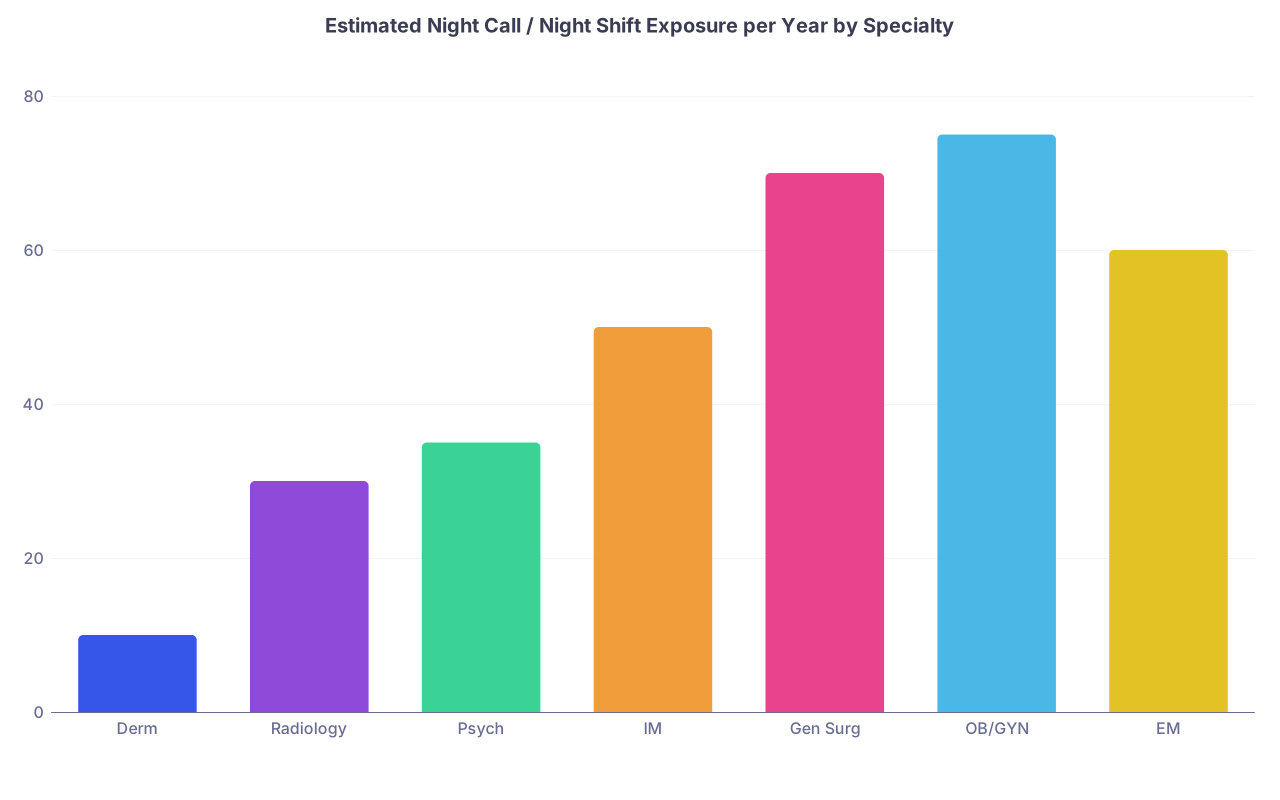
Let us quantify typical annual night exposure by specialty (again: middle years, not internship, and averaged across programs).
| Category | Value |
|---|---|
| Derm | 10 |
| Radiology | 30 |
| Psych | 35 |
| IM | 50 |
| Gen Surg | 70 |
| OB/GYN | 75 |
| EM | 60 |
Rough ranges behind those bars:
- Dermatology: ~5–15 nights / year, mostly home call, often quiet
- Radiology (Diagnostic): ~25–40 nights / year, mostly night float or evening shifts
- Psychiatry: ~30–40 nights / year, combination of call and night float
- Internal Medicine: ~40–60 nights / year
- General Surgery: ~60–80 nights / year
- OB/GYN: ~60–85 nights / year in many programs
- Emergency Medicine: ~50–70 night shifts / year (out of ~180–220 total shifts)
Lifestyle-friendly fields: how “light” are nights really?
Take dermatology. In a typical 3-year Derm residency:
- PGY-2: Some inpatient derm consult call, home call, q4–q7, often low volume
- PGY-3: Less inpatient responsibility, more clinic; call decreases
- PGY-4: Often minimal call; some programs no nights at all
Actual wake-ups after midnight? I have heard dermatology residents report “zero to three” times per month on average, in many programs. Functional sleep loss is more likely from small children than from a pager.
Radiology: Night float is real, but it is finite and clustered.
Common pattern:
- 4–6 weeks per year of night float
- 6–7 nights on, then several days off
- Workload high during shift, but no “post-call” rounds or continuity clinic the same day
So your nights are rough during those weeks, but you are not shot for the rest of the month.
Psychiatry: Frankly, it is softer than its reputation among med students. Outside of a few very busy safety-net hospitals, overnight psych is consult-heavy but not continuous trauma.
Typical psych resident might:
- Do 1–2 weeks of night float a few times a year
- Cover cross-cover for psych units and ED consults
- See spikes during holidays with intox, SI/HI cases, but volume rarely matches IM or OB
Internal Medicine: the “middle of the pack” that feels worse than the numbers
On paper, IM looks moderate: 4–7 nights per month on average across the year. In practice, the clustering on certain rotations makes it feel worse:
- Inpatient wards months: q4, q5, or night float blocks
- ICU months: almost always night float blocks or q3-ish
- Clinic/elective months: essentially no nights
If you stack the ward and ICU months, you can easily have:
- 4–5 months per year with heavy nights
- 6–7 months with light or no call
The variance is the real problem, not just the mean.
Surgery and OB/GYN: where nights pile up aggressively
The data on surgical call are brutally consistent across big programs:
- Many services with q3–q4 in-house call for juniors
- ICU and trauma rotations with night float or q2–q3 call
- Some home call that still keeps you busy (vascular, transplant, etc.)
OB/GYN is similar: labor and delivery never stops, and you are the one catching babies at 03:00. Nights per year commonly sit in the 60–80 range, especially in earlier years.
EM: nights by design, not by “call”
Emergency Medicine has no “call” in the classic sense. You have scheduled shifts. That sounds civilized until you look at the distribution.
Many EM programs land around:
- 16–20 shifts / month
- ~25–35% of those as evenings/nights
- Plenty of weekends and holidays
So a PGY-2 with 18 shifts per month and 30% nights is pulling:
- 5–6 night shifts / month
- 60–70 night shifts / year
Similar quantity of night disruption as OB or Surgery, but organized and predictable.
Weekend Coverage: How Many Saturdays Do You Lose?
A resident’s calendar pain shows up fastest on weekends. You can be “fine” Monday to Friday and still feel wrecked if every weekend is gone.
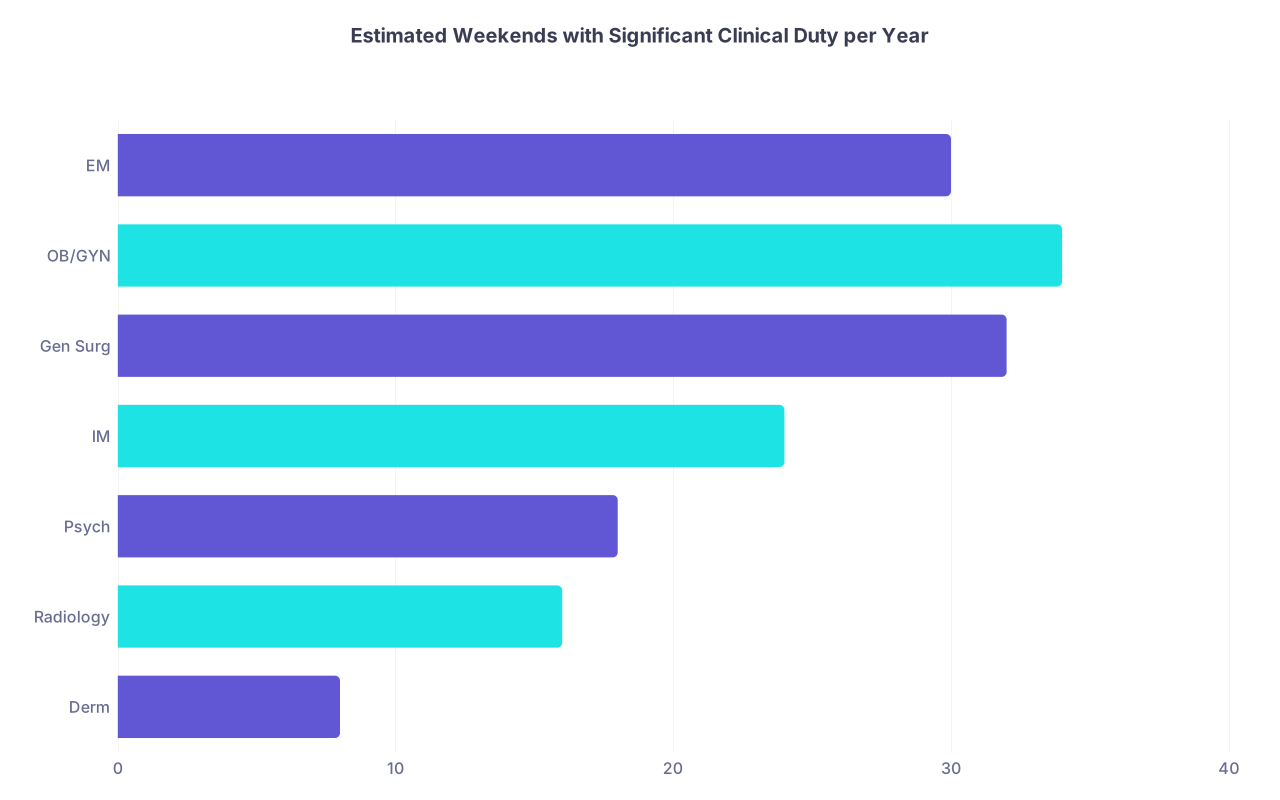
Let us look at approximate weekend exposure:
| Category | Value |
|---|---|
| Derm | 8 |
| Radiology | 16 |
| Psych | 18 |
| IM | 24 |
| Gen Surg | 32 |
| OB/GYN | 34 |
| EM | 30 |
Interpretation by tier:
Low-weekend specialties (roughly 6–12 weekends/year)
Derm, Pathology, many Radiology programs, some Ophtho, PM&R.
Pattern you actually hear:
- “I’m in the hospital 1 weekend a month, sometimes less.”
- Weekend “call” is often consult-only, half-days, or home call.
- Post-residency, weekends drop to nearly zero in many private practice gigs.
Derm example:
- 1 weekend per month PGY-2
- 6–8 weekends total per year PGY-3+
- Some rotations: no weekend coverage at all
You still lose some holidays, but they are spread thin enough that friends in other specialties will be visibly annoyed when you talk about your schedule.
Radiology:
- Call blocks with both nights and weekends clustered
- But many months with zero weekend obligations
- Weekends tend to be busy but staffed properly (one resident plus attending / fellow)
Mid-range: Internal Medicine, Psychiatry, Pediatrics, Neurology, Anesthesia
You are often doing:
- 2 weekends per month during inpatient/ICU months
- 0–1 weekends per month during outpatient and elective blocks
IM resident might end up around 22–26 weekends per year with some duty. But: call structure matters more than the raw count.
Example internal medicine schedule (over a 12-month PGY-2):
- 4 months wards: 2 weekends/month → 8
- 2 months ICU: 2–3 weekends/month → 5
- 1–2 months night float: 2–3 weekends/month → 4
- 4–5 months clinics/electives: 0–1 weekends/month → 3
Total: 20–22 weekends with real call.
Psychiatry or Neurology often run slightly lower, especially in later years.
High-weekend: Surgery and OB/GYN
If there is a field where “every weekend” is not far from the truth during junior years, it is generalized surgical training and busy OB/GYN programs.
Regular patterns:
- 3 weekends / month with at least one day in-house
- Home call on the “off” weekends that still generates pages
- True “two-day weekend with no clinical obligation” can be rare on some services
The yearly math:
- 3 weekends/month × 12 months ≈ 36
- Subtract some vacation and lighter outpatient months → realistic 28–34
Emergency Medicine: somewhere in between. But every weekend presence is usually full shifts, not half-days. That matters if you want predictable off days but also hurts if you care about “normal” weekends.
Holiday Coverage: Who Actually Gets Christmas Off?
Holidays are emotionally overweighted. One terrible Christmas on call can sour your view of a specialty for years.
Residency programs tend to be more “fair” here. Almost everyone works some major holidays, but the frequency varies.
Let us make this concrete. Assume 4 anchor holidays that residents care about:
- Thanksgiving Day
- Christmas Day
- New Year’s Day
- One summer long weekend (July 4 or equivalent)
Here is a realistic distribution of “major holidays worked per year” by specialty tier:
| Tier / Specialty Example | Major Holidays Worked / Year |
|---|---|
| Lifestyle (Derm, Path, Radiology) | 0–1 |
| Moderate (Psych, Neurology, PM&R) | 1–2 |
| Core IM/Peds/Anesthesia | 2–3 |
| Surgery/OB/GYN/EM (shift-heavy) | 2–4 |
You almost never see a resident working all four every year; block scheduling and fairness norms prevent it. But you do see:
- Same person stuck with Christmas two years in a row in small programs
- Certain services (L&D, Trauma, ED) always busy on holidays; IM clinic rotations mostly spared
The key difference: some specialties allow you to “buy” certain holidays off with seniority or negotiation. In others, the service simply cannot function without robust coverage.
Derm and Path: your specialty often does not care if you are off Christmas Day. There is no 20-patient floor of flaking rashes that must be biopsied at 23:00 on December 25. In EM, OB, or Trauma, you are essential every single day of the year.
True “Lifestyle-Friendly” Specialties: Call Profiles in Detail
Let us drill into some of the consistently lifestyle-friendly specialties and map their nights/weekends/holidays more precisely.
| Category | Value |
|---|---|
| Derm | 10 |
| Radiology | 25 |
| Psych | 30 |
| IM | 50 |
| Gen Surg | 75 |
| OB/GYN | 80 |
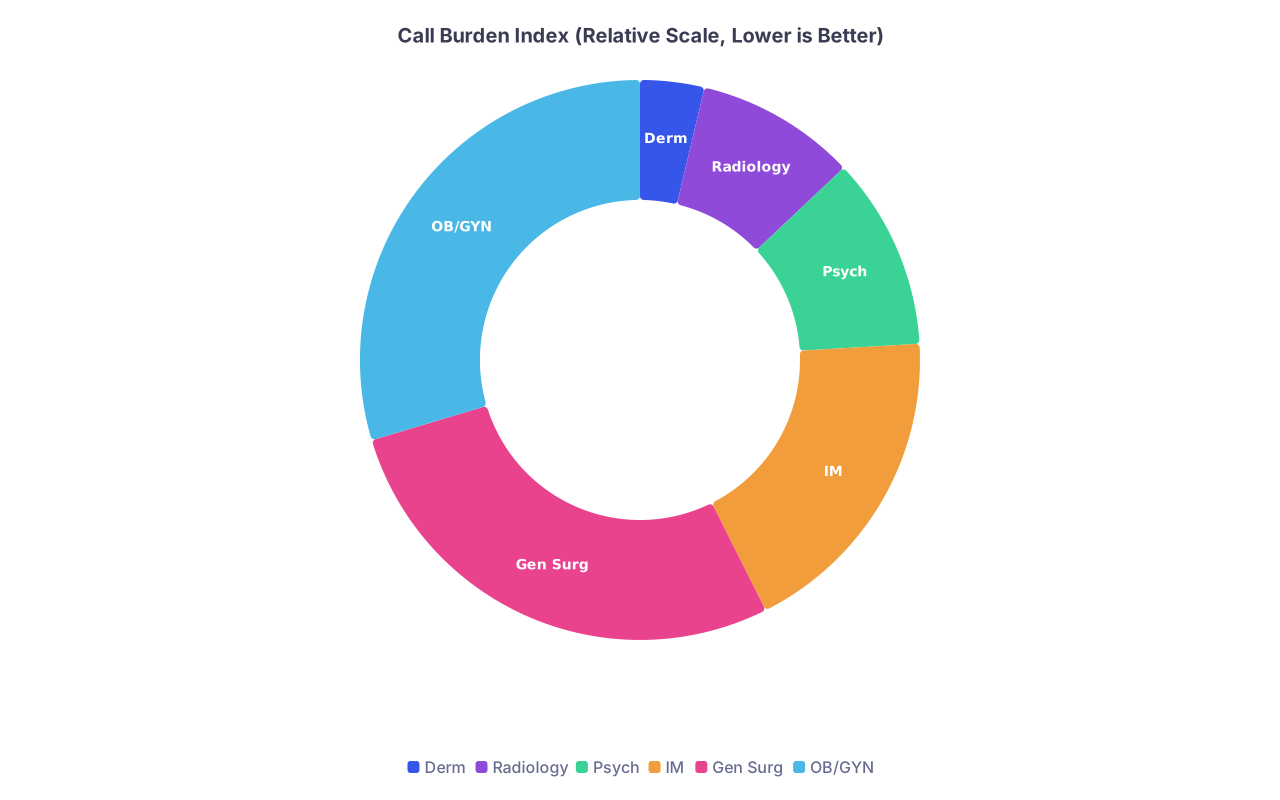
Assume this index is a composite of nights + weekends + holiday burden, scaled roughly 0–100.
Dermatology
I will be blunt: by call frequency, Dermatology is an outlier in your favor.
Resident call profile:
- Nights: Mostly home call for consult service coverage; rare true in-house
- Weekends: 0–1 per month, often lighter duty
- Holidays: Often 0–1 major holidays per year; many groups rotate so each person does one
Post-residency, the situation improves further. Many private practice derm jobs have:
- No nights
- No weekends
- Minimal holiday work (clinic just closes)
From a quantitative lifestyle perspective, few specialties touch it.
Radiology (Diagnostic)
Radiology sits in the “serious but controlled” zone.
Resident pattern:
- Dedicated night float blocks, typically a few weeks per year
- Evening/weekend coverage for ER and inpatient reads
- Schedules often comply very tightly with work-hour rules (because they are easy to audit)
Key points:
- Night intensity can be high (constant imaging from ED/ICU), but you know exactly when it starts and ends.
- Outside of designated call blocks, your weekends are often untouched.
Fellowship and attending life vary. Teleradiology and corporate groups often have structured evening and weekend shifts, while some academic jobs involve light home call only.
Psychiatry
Call in psychiatry is fundamentally about risk management and triaging behavioral crises, not about continuous hands-on procedures.
Resident call exposure:
- Nights: widely program-dependent, but usually 2–4 nights/month in early years, dropping later
- Mix of in-house and home call
- Often protected post-call time
Why it feels livable:
- Admission volumes can spike but are not trauma-night-in-the-ICU level.
- Many psych residents report having time to sleep on a decent proportion of calls at some sites.
- Outpatient-heavy later years reduce call substantially.
Lifestyle-conscious residents who still want patient continuity and talk therapy often end up here for a reason: the data (hours and call) are simply better than IM, OB, or Surgery.
Where “Lifestyle” Gets Misunderstood: EM, Anesthesia, and IM
Medical students frequently mislabel specialties as “lifestyle” based on anecdotes. The numbers often say otherwise.
Emergency Medicine: controlled chaos, but nights are built in
EM does offer:
- Predictable total hours
- Defined number of shifts
- No pager
But the distribution of those hours is brutal:
- Nights, evenings, and weekends are non-negotiable
- Holiday coverage is heavy because the ED is always open
- Circadian rhythm gets hammered for years
Quantitatively, EM may give you 45–50 hours/week on average, but:
- 30%+ of those hours are when your friends and family are off
- Call frequency is “replaced” by constant exposure to off-hours work
From a raw nights/weekends/holidays standpoint, EM is closer to OB than to Derm.
Anesthesia: better than surgery, worse than psych
Anesthesia call is highly program-specific, but broad patterns:
- Overnight call on a q4–q7 basis on some rotations
- OB anesthesia and cardiac call can be intense
- Early morning starts compress recovery time after call
Compared to surgery:
- Fewer truly brutal q2–q3 stretches
- Fewer middle-of-the-night floor calls
- More predictable post-call days
Compared to psychiatry or radiology:
- More early mornings, more nights, more weekends
- OR-heavy services still need 24/7 staff
If you want procedures and the OR but care about nights and weekends, Anesthesia usually sits in a friendlier spot than General Surgery, but it is not in the true “lifestyle” tier.
Internal Medicine: broad but not soft
IM looks versatile and is. But the residency years carry:
- Heavy ward time
- Multiple ICU blocks
- Frequent night float blocks
You can carve out a decent lifestyle later (outpatient cards, endocrinology, allergy, etc.), but during residency you are much closer to the mid-intensity group. Anyone telling you “IM is chill” is either at an outlier cush program or has conveniently forgotten their intern notes at 02:00.
Choosing with Eyes Open: How to Weigh Call vs Everything Else
The data on call frequency do not live in isolation. You still have to integrate:
- What type of work you enjoy
- How much income you want
- How long you can tolerate training intensity
But pretending the call patterns are “all the same everywhere” is intellectually dishonest. They are not.
If your priority is maximal protection of nights, weekends, and holidays during residency and beyond, the data point you toward a consistent set of fields:
- Dermatology
- Pathology
- Ophthalmology
- Diagnostic Radiology
- PM&R (at many programs)
- Psychiatry (at many programs)
If you can accept moderate call but do not want pure punishment:
- Neurology
- Anesthesia
- Internal Medicine (aiming for a lifestyle-friendly subspecialty)
- Pediatrics in some settings
- Some less-trauma-heavy surgical subspecialties after residency
And if you are drawn to the high-acuity, always-on specialties, understand the math you are accepting:
- You will work more nights and weekends than your peers in Derm or Radiology.
- Your holidays will be more likely spent in scrubs than in living rooms.
- You can mitigate some of this later in career choice (e.g., outpatient-only OB, elective-heavy surgery group), but the residency years will still be demanding.
The data are not everything, but they are a clean starting point. You know now which specialties front-load nights, weekends, and holidays and which ones protect them.
With that foundation, your next step is not another vague Reddit thread asking “Is X lifestyle friendly?” It is pulling specific sample schedules from programs you are interested in, lining them up side by side, and comparing actual nights, weekends, and holidays. That is where the decision becomes real. And that analysis is the next dataset you should build.