
The myth that “lifestyle specialties” are all cushy and happy is wrong. The data on burnout and satisfaction tells a more complicated, and frankly more useful, story.
If you are trying to pick a specialty based on work‑life balance, you cannot just rely on hallway gossip about dermatology, radiology, or anesthesia. You need to look at who is actually burning out, who would choose their specialty again, and how that shifts from residency to attending life.
I am going to walk through what the numbers really show and where the usual “lifestyle” suspects actually rank.
The Core Metrics: What We Mean by Burnout and Satisfaction
Before ranking anything, you need to know what is being measured. Otherwise you are optimizing for vibes.
Most of the large‑scale data on physician wellness comes from a few recurring surveys:
- Medscape Physician Burnout & Depression Reports (annual, U.S., thousands of respondents).
- Medscape Physician Lifestyle & Happiness Reports.
- Specialty‑specific surveys (e.g., anesthesiology, EM, IM).
- ACGME resident surveys and smaller peer‑reviewed studies.
Common metrics:
- Burnout prevalence: percentage of doctors in a specialty who report feeling burned out.
- Work hours: typical hours per week.
- “Would choose the same specialty again”: a rough but important satisfaction metric.
- Work–life balance satisfaction: self‑rated, usually on Likert scales.
None of this is perfect. Self‑report bias is real. But patterns across multiple years and sources are very consistent. That consistency is what you should trust.
Big Picture: Burnout by Specialty – Who’s Actually Hurting?
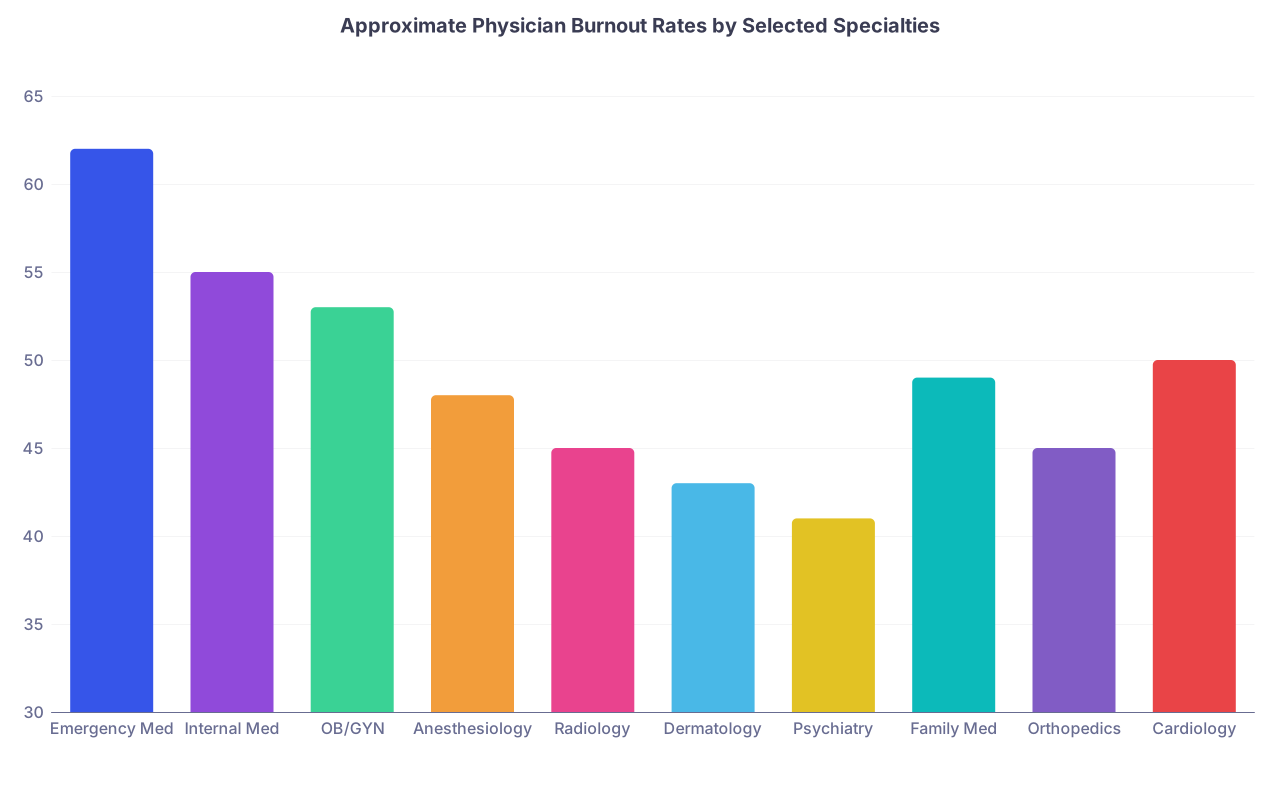
Let us start with a high‑level comparison from recent Medscape physician reports (aggregated and rounded). Think of this as a “risk heatmap” rather than absolute truth.
| Category | Value |
|---|---|
| Emergency Med | 62 |
| Internal Med | 55 |
| OB/GYN | 53 |
| Anesthesiology | 48 |
| Radiology | 45 |
| Dermatology | 43 |
| Psychiatry | 41 |
| Family Med | 49 |
| Orthopedics | 45 |
| Cardiology | 50 |
On average over recent years:
- Highest burnout cluster: Emergency Medicine, Internal Medicine, OB/GYN, Family Medicine, some surgical fields.
- Mid‑range: Cardiology, Orthopedics, Radiology, Anesthesiology.
- Lower cluster: Dermatology, Psychiatry, Pathology (often omitted but consistently low), some hospital‑based subspecialties.
Already you can see the problem with the simplistic “ROAD to happiness” (Radiology, Ophtho, Anesthesia, Derm) mantra. Two of those sit squarely in the middle of the burnout pack in most modern datasets.
Now let’s break it down by the specialties usually labeled “lifestyle friendly.”
Radiology: Better Hours, Moderate Burnout, Good Satisfaction
Radiology is always on the shortlist when students talk lifestyle.
What the data shows:
- Burnout prevalence: roughly mid‑40s% in recent surveys.
- Weekly hours: commonly 45–55 hours; telerad and some outpatient groups can be lower.
- “Would choose again”: frequently >75% would pick radiology again.
Why? A few structural advantages:
- Predictable schedules in many private groups.
- Minimal direct patient pressure (no families yelling in the hallway, no clinic running 90 minutes behind).
- Highly subspecialized paths (MSK, neuro, IR) that allow some tailoring.
The bad news:
- RVU pressure and “just read more” culture are very real. Productivity demands have climbed faster than staffing in many practices.
- Night coverage and 24/7 imaging demand are not trivial. Hospital‑based and telerad roles can involve serious nocturnist grind.
- Isolation and lack of team identity bother some people more than they expect.
Overall: Radiology scores well on lifestyle for many physicians, but the burnout numbers are not “low”; they are just better than the disaster specialties.
If you like pattern recognition, tech, and controlled environments, the data says radiology is a solid lifestyle bet. But do not mistake it for a guaranteed 40‑hour, low‑stress job.
Anesthesiology: Highly Variable Lifestyle, Middle‑of‑the‑Pack Burnout
Anesthesiology often gets group‑ed with radiology as “good lifestyle,” but the stats paint a more nuanced image.
Recent numbers:
- Burnout prevalence: high‑40s% range in many surveys; sometimes a tick below the overall physician average, sometimes about equal. - Weekly hours: wide spread, roughly 45–60 hours common; call and cardiac/trauma tracks spike this.
- Satisfaction: usually respectable; ~70–80% would choose specialty again in many survey cycles.
Key drivers:
- Pros:
- Many cases are scheduled and elective. OR days end when the board is done.
- No longitudinal clinic panel; you are not carrying 2,000 patients in your head.
- High perceived autonomy: you run the room, not the surgeon.
- Cons:
- Early starts. You are there before the first incision.
- Call and overnight emergencies can be brutal in trauma and academic centers.
- Production pressure: “Why is Room 4 not started yet?” culture can grind you down.
What I have seen: anesthesiologists in stable, largely elective private practices can have excellent lifestyles. Those in big academic trauma centers or under‑staffed groups can be wrecked. The mean number hides that bimodality.
For residents, anesthesia can feel intense due to steep responsibility jumps, but post‑training lifestyles are often substantially better than the burnout rate might imply.
Dermatology: The Lifestyle Gold Standard Mostly Lives Up to the Hype
If you want the data‑driven “yes, this really is a lifestyle specialty,” dermatology is the closest thing you will get.
Approximate numbers:
- Burnout prevalence: low‑40s% or below in most modern surveys, often among the 3–5 lowest.
- Weekly hours: 35–45 is common for full‑time; many part‑time options, especially in private practice.
- “Would choose again”: frequently 85–90%+ would pick derm again, among the highest.
Why derm wins:
- Outpatient, clinic‑based, highly controllable schedule.
- Very little overnight or weekend call, and what call exists is often consult‑by‑phone.
- Procedural variety without the physical toll of long OR marathons. - High compensation relative to hours worked, especially with cosmetics.
The trade‑offs the data cannot show but you should factor:
- Clinic volume is high. 30–40+ patients a day is normal and can feel like a conveyor belt.
- Insurance and prior authorization pain are real for biologics and complex derm.
- The path to derm (US MD, high Step scores, research) is competitively stressful.
Bottom line: Of all the “lifestyle” legends, dermatology actually has the strongest evidence base: low burnout, high satisfaction, strong “would choose again” metrics, and favorable hour/compensation ratios.
Psychiatry: Quietly One of the Best Lifestyle Deals
Psychiatry does not always get lumped with classic lifestyle specialties, but the numbers argue it should.
Recent data trends:
- Burnout prevalence: often ~40% or lower, consistently on the lower end of the spectrum.
- Weekly hours: roughly 40–50 for many outpatient psychiatrists; inpatient, academic, and consult roles push higher.
- Satisfaction: high; commonly 80%+ would choose psychiatry again in multiple surveys.
Why psychiatry works for lifestyle:
- Outpatient practice is extraordinarily designable: mix of therapy, med management, telehealth.
- Call can be minimal in many community or outpatient roles.
- Growing demand gives psychiatrists negotiating leverage to shape schedules and workload.
Risks:
- Emotional labor is high. Vicarious trauma, suicidality, and system constraints are draining.
- Documentation and prior auth for certain meds (e.g., LAI antipsychotics) add friction.
- Inpatient state systems and under‑resourced settings can be rough.
But if we anchor on the numbers, psychiatry looks like a top‑tier lifestyle specialty with low to moderate burnout and strong long‑term satisfaction. It does not have the meme status of derm, but the lifestyle data is nearly as good for many practice setups.
Ophthalmology: Strong Lifestyle, Lower Burnout, High Satisfaction
Ophthalmology is often rolled into the “ROAD” set, and in this case, the legend aligns decently with empiric data.
Typical survey findings:
- Burnout prevalence: below average, often low‑40s% or lower.
- Weekly hours: many ophthalmologists cluster around 40–50 hours; clinic plus OR.
- “Would choose again”: high, usually >80%.
Drivers:
- Elective, planned surgical schedule.
- Limited night emergencies relative to other surgical fields.
- High control over clinic days, with predictable flow.
- Strong compensation, especially for cataract‑heavy or refractive practices.
Downsides:
- OR time and clinic throughput demands are real in high‑volume practices.
- Call exists and can be intense in certain retina/trauma‑heavy environments.
- Private equity roll‑up pressure in some markets can worsen autonomy and workload.
From a pure data‑driven lens, ophthalmology sits in the upper tier of lifestyle specialties: lower burnout than most surgical fields, robust satisfaction, and controllable hours in many roles.
Comparing the “Lifestyle Five” with High‑Burnout Fields
Let me line up some high‑level comparative metrics so you can see why perception and reality diverge.
| Specialty | Burnout % | Would Choose Again % | Typical Hours/Week |
|---|---|---|---|
| Dermatology | ~40–43 | ~85–90 | 35–45 |
| Ophthalmology | ~40–45 | ~80–85 | 40–50 |
| Psychiatry | ~38–42 | ~80–85 | 40–50 |
| Radiology | ~45 | ~75–80 | 45–55 |
| Anesthesiology | ~48 | ~70–80 | 45–60 |
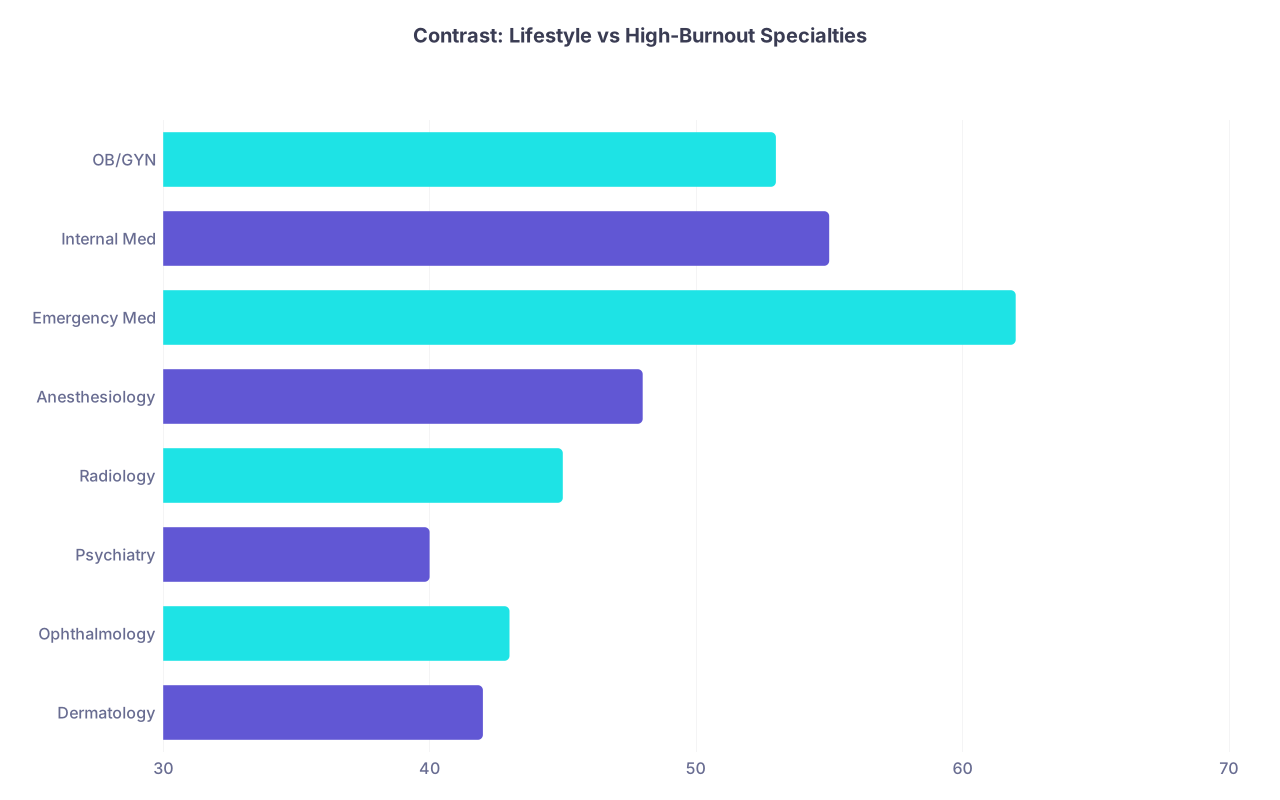
Now contrast that with a few notoriously high‑burnout specialties.
| Category | Value |
|---|---|
| Dermatology | 42 |
| Ophthalmology | 43 |
| Psychiatry | 40 |
| Radiology | 45 |
| Anesthesiology | 48 |
| Emergency Med | 62 |
| Internal Med | 55 |
| OB/GYN | 53 |
Key takeaways:
- Emergency Medicine lives at the top of burnout charts year after year, often 60%+.
- Internal Medicine and OB/GYN consistently hover above 50%.
- The “lifestyle 5” (Derm, Ophtho, Psych, Radiology, Anesthesia) sit below or around the overall physician average, with derm/ophtho/psych distinctly better.
So yes, the “lifestyle” label has some empirical backbone. But the variation within those specialties is wide, and residency is a different story.
Residency vs Attending: The Lifestyle Gap
Here is where many students miscalculate: they look at attending‑level lifestyle data and forget that residency is 3–7 years of very different conditions.
Residents, across the board, report:
- Higher burnout than attendings in the same field.
- Poorer work‑life balance due to duty hours, less control, night float, and weaker autonomy.
A few patterns I see consistently:
- Anesthesia and radiology residency: intense cognitive load early on, call and nights are significant, but generally better than the big three (IM, surgery, OB/GYN) in hour‑to‑hour misery.
- Dermatology residency: comparatively benign schedule and call, but massive academic and performance pressure; everyone is high‑achieving and knows it.
- Psychiatry residency: often less brutal hours, but heavy emotional weight and plenty of call in some programs.
- Ophthalmology residency: a mix; less malignant than general surgery in many places, but still real call, real nights, and real OR stress.
You should treat residency lifestyle and attending lifestyle as two related but distinct distributions. Dermatology is “good‑good”: relatively favorable in both. Psychiatry is usually “good‑good” as well. Radiology and anesthesia are “medium‑good”: residency may not feel like a lifestyle specialty; that payoff is mostly attending‑phase.
The Real Drivers of Lifestyle: It Is Not Just the Specialty Label
If you only remember one section, make it this. Specialty choice sets your baseline risk. But within a specialty, the variance is massive.
The data – and what I have seen first‑hand – says the following variables matter as much as the specialty name on your badge:
- Practice setting:
- Academic vs private vs hybrid.
- Hospital‑employed vs independent vs PE‑backed. - Call structure:
- In‑house vs home call. - Frequency of nights/weekends.
- Actual call volume, not just what is written in the contract.
- Patient volume:
- 25 derm patients a day vs 45 is a different job.
- 6 OR cases vs 12 short cases makes a wildly different anesthesiology day.
- Geography and market saturation:
- Underserved regions often pay more but demand more.
- Oversupplied markets create RVU pressure and shorter visits.
You can see this clearly in survey sub‑analyses: within the same specialty, physicians in outpatient‑only roles and those with minimal call consistently report lower burnout and higher satisfaction.
So if you treat “choose dermatology” as a magic bullet and ignore practice‑type data, you are missing half the equation.
Common Misconceptions About Lifestyle Specialties
Let me be blunt about a few myths that keep showing up in student discussions.
- “Lifestyle specialties are low stress.”
False. They are lower in certain stress dimensions (overnight trauma surgeries, frequent codes), but high in others: RVU quotas, clinic throughput, documentation, diagnostic uncertainty, emotional labor.
- “If I choose X specialty, I will automatically work 40 hours a week.”
Delusional. Most full‑time physicians in any specialty still cluster between 45–60 hours. Lifestyle specialties give you a better chance to pull that toward the lower end, but it is not guaranteed.
- “Burnout is only about hours.”
The data contradicts this. Control over your schedule, alignment with your values, and support at work are massive modifiers. A 50‑hour week in a supportive derm group feels very different from 50 hours in a chaotic, understaffed ED.
How to Use This Data in Your Own Decision
You are not going to get a personalized randomized trial of “your life in each specialty.” But you can use available data intelligently.
Here is a simple decision flow that mirrors what I have watched successful clinicians do:

| Step | Description |
|---|---|
| Step 1 | Start - Self Assessment |
| Step 2 | Consider Derm, Ophtho, Anesthesia |
| Step 3 | Consider Psych, Radiology |
| Step 4 | Anesthesia viable |
| Step 5 | Derm or Ophtho |
| Step 6 | Psych more suitable |
| Step 7 | Radiology more suitable |
| Step 8 | Research burnout & lifestyle data per setting |
| Step 9 | Prioritize programs and jobs with low call, outpatient focus, supportive culture |
| Step 10 | Enjoy procedures? |
| Step 11 | Comfort with acute crises? |
| Step 12 | Enjoy direct patient contact? |
When comparing specialties, use this hierarchy of evidence:
- Multi‑year burnout and satisfaction surveys.
- Average hours and call structure by specialty.
- Real conversations with residents and attendings in different practice models.
- Your own tolerance for certain stressors: nights, OR, clinic volume, emotional content.
If your primary driver is lifestyle, the data supports prioritizing something in the dermatology / psychiatry / ophthalmology cluster, with radiology and anesthesiology as strong contenders if you pick the right practice environment.
But do not sacrifice interest entirely for lifestyle. Burnout rises sharply when people feel bored, misaligned with the work, or trapped – even in “good lifestyle” fields.
Quick Ranking: Where Lifestyle Specialties Really Land
Pulling everything together – burnout prevalence, satisfaction, hours, call – here is a reality‑based tiering among commonly discussed lifestyle specialties:
Top‑tier lifestyle (low burnout, high satisfaction, flexible practice options):
- Dermatology
- Psychiatry
- Ophthalmology
Upper‑middle lifestyle (moderate burnout, high satisfaction, highly practice‑dependent):
- Radiology
- Anesthesiology
Borderline but often marketed as lifestyle (depends heavily on niche/practice):
- Some outpatient subspecialties of IM (allergy, rheum, endo) – not the focus here but numerically competitive with the above.
- Certain non‑interventional radiology and anesthesia niches with controlled hours.
The pattern is clear: the best chances for a long, sustainable career with strong life outside of medicine sit with derm, psych, and ophtho, if you actually like the core work.