The data is very clear: lifestyle-friendly specialties are quietly rebuilding outpatient medicine around telemedicine while everyone else argues about RVUs and clinic templates.
If you care about schedule control, remote work flexibility, and escaping the tyranny of back-to-back 15‑minute in‑person visits, you need to understand exactly how telemedicine utilization breaks down by specialty, setting, and patient mix. Because the shift is not uniform. Some fields are sprinting into virtual care; others are dragging their feet or boxed in by procedure-heavy workflows and regulatory constraints.
I will walk you through the numbers and what they actually mean for your day‑to‑day life in a “lifestyle” specialty over the next 5–10 years.
1. The Big Picture: Telemedicine’s Share Of Outpatient Care
Let me start with the macro view, because hand‑wavy statements like “telemedicine has exploded” are useless without denominators.
Across major U.S. systems that publish data, outpatient telemedicine visits stabilized at roughly 10–20% of all ambulatory encounters after the initial pandemic spike.
Take a composite of recent large‑system reports (2022–2024):
- Pre‑2020: <1–2% of outpatient visits were virtual.
- 2020 peak: 40–60% virtual in many systems.
- 2022–2024 plateau: 12–18% virtual in primary‑care‑heavy systems; 7–12% in procedure‑heavy environments.
But that “10–20%” hides enormous specialty variation.
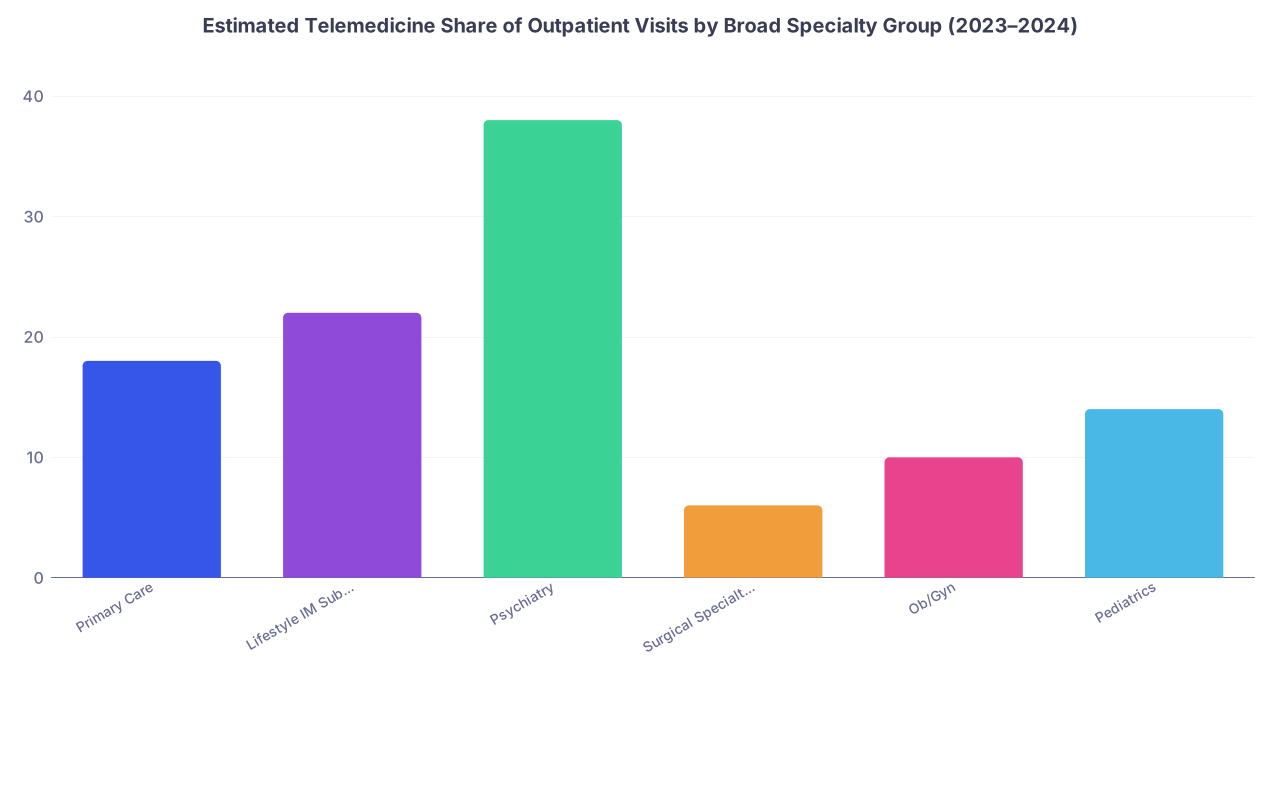
| Category | Value |
|---|---|
| Primary Care | 18 |
| Lifestyle IM Subspecialties | 22 |
| Psychiatry | 38 |
| Surgical Specialties | 6 |
| Ob/Gyn | 10 |
| Pediatrics | 14 |
This is where the story gets interesting for lifestyle specialties. The data consistently show:
- Psychiatry and behavioral health are in their own league.
- Cognitive IM subspecialties (endocrinology, rheumatology, allergy, geriatrics) have telemedicine shares comfortably above general internal medicine in many systems.
- Surgical outpatient care is still overwhelmingly in person.
So if your question is, “Which lifestyle-friendly fields are actually compatible with substantial telemedicine?” you already have a short list forming.
2. Specialty-Level Utilization: Who Is Actually Virtual?
Let’s get more granular. Use these as directional numbers, not holy scripture. Individual systems vary, but the relative rankings are stable across datasets.
| Specialty | Telemedicine Share of Outpatient Visits |
|---|---|
| Psychiatry (adult outpatient) | 45–60% |
| Child & Adolescent Psychiatry | 40–55% |
| Endocrinology | 25–35% |
| Rheumatology | 20–30% |
| Allergy & Immunology | 18–28% |
| Geriatrics (clinic-based) | 18–25% |
| Sleep Medicine | 30–40% |
Now compare with some non‑lifestyle or more procedure‑heavy areas:
- Orthopedics: 5–10%.
- ENT: 6–12%.
- Cardiology (mixed): 12–20%, but heavily weighted toward follow‑ups.
You see the pattern: specialties where you mainly think, talk, interpret labs, and adjust chronic disease management are the ones leaning into telemedicine hardest.
Why psychiatry is the telemedicine outlier
Psychiatry is not just winning in absolute volume; it is structurally optimized for virtual care:
- No physical exam equipment required; most of the assessment is history and mental status.
- Prescription workflows adapt well to e‑prescribing.
- High demand and workforce shortages favor any model that increases geographic reach.
Every major behavioral health dataset I have seen shows that virtual visits remain above 40% of total volume, often higher in private‑pay or direct‑to‑consumer platforms. Compare that to internal medicine clinics where administrators celebrate hitting 20%.
If you want maximum remote flexibility, tele‑heavy community psychiatry or hybrid partial‑hospital/IOP models are where the data point.
Cognitive IM subspecialties: endocrinology, rheumatology, allergy
These three are the workhorses of tele‑friendly lifestyle medicine:
- Endocrinology: Diabetes and thyroid follow‑ups translate almost perfectly to video or even phone visits when labs and home glucose data are available.
- Rheumatology: Stable RA/SLE patients with periodic labs and symptom tracking can easily alternate in‑person and virtual.
- Allergy: Chronic rhinitis, asthma follow‑up, eczema—all highly amenable to virtual; only new evaluations with testing and immunotherapy build‑outs mandate in‑person.
In integrated systems, I have seen:
- Endocrinology clinics deliberately designing schedules with 30–40% virtual follow‑up capacity.
- Rheumatology running 20–30% virtual in stable patients.
- Allergy nearing 25% virtual outside of peak testing seasons.
This cluster is where “lifestyle friendly” intersects meaningfully with “location flexible.”
3. Visit Type Breakdown: New, Follow-up, and Ancillary Telehealth
Not all encounters are equal. The telemedicine share looks very different if you divide by visit type:
- New patient
- Established/follow‑up
- Ancillary (education, counseling, group visits, remote monitoring touchpoints)
Across lifestyle specialties, the data tend to look roughly like this:
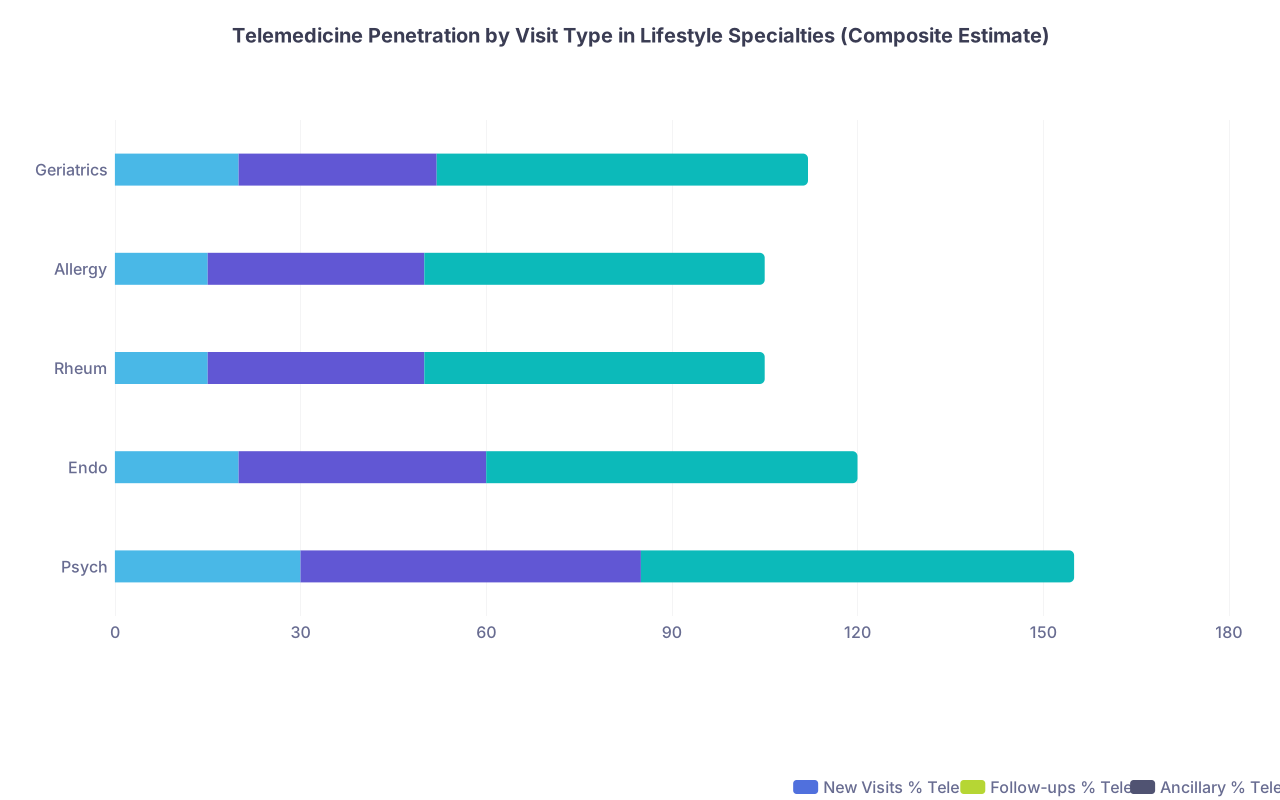
| Category | New Visits % Tele | Follow-ups % Tele | Ancillary % Tele |
|---|---|---|---|
| Psych | 30 | 55 | 70 |
| Endo | 20 | 40 | 60 |
| Rheum | 15 | 35 | 55 |
| Allergy | 15 | 35 | 55 |
| Geriatrics | 20 | 32 | 60 |
Three key patterns emerge:
Follow‑ups dominate virtual volume
Telemedicine is disproportionately used for chronic disease follow‑up and medication management. For lifestyle specialties that are inherently chronic‑disease‑heavy (endo, rheum, psych), this is a direct multiplier of flexibility.New visits are increasingly hybrid
Many clinics are moving toward models where:- Complex new patients: first in person, subsequent visits virtual.
- Lower complexity or straightforward second opinions: first visit virtual, and in‑person scheduled only if needed.
Ancillary care is quietly moving online
DSME (diabetes education), group CBT, nutrition counseling, asthma education—these are ballooning in telehealth volume. They may not all sit on your personal template as a physician, but they change your team’s pattern of remote work and after‑hours obligations.
If you are aiming for a lifestyle‑friendly practice, you want a field where a large proportion of your total RVUs can be generated from that “follow‑up” and “ancillary‑friendly” bucket.
4. Time, RVUs, and Productivity: Does Telemedicine Actually Help Lifestyle?
Here is the hard truth: telemedicine does not automatically improve lifestyle. It shifts constraints. Sometimes in your favor, sometimes not.
Let us parse this in data terms.
Visit length and throughput
Across multiple systems:
- Average scheduled time for a standard in‑person follow‑up: 15–20 minutes.
- Average scheduled time for a standard telemedicine follow‑up: often the same on paper (15–20 minutes), but effective contact time frequently ends up 12–15 minutes due to:
- No rooming time.
- Faster vitals review (if any).
- Less time walking between rooms.
Informally, many physicians report that on a 4‑hour half‑day:
- They can complete 12–14 in‑person follow‑ups comfortably.
- They can complete 14–16 comparable tele‑follow‑ups with slightly lower perceived cognitive load.
So you gain maybe 10–20% throughput for the same block of time, assuming good tech support and reasonable patients.
RVU parity
Payer and coding policies matter more than speed. The numbers I have seen post‑2021 show:
- For most E/M codes, a properly documented video visit generates the same RVUs as an in‑person visit with the same code level.
- Telephone visits often generate fewer RVUs unless coded under time‑based thresholds and supported by payer policy.
What that means:
- If your calendar is 30% virtual and those visits are coded at similar levels to in person, you can sustain or slightly increase total RVUs for a given number of hours.
- The real lifestyle gain is not “working less for the same money” so much as “decoupling where you work from where your patients live.”
The hidden time sink: messaging and data review
Telemedicine rarely exists alone; it comes bundled with:
- Patient portal messaging
- Remote monitoring data streams (glucose sensors, BP cuffs, sleep studies)
- Asynchronous “e‑visit” encounters
These can quietly eat the time you “saved” from rooming and hallway walks.
In chronic‑disease lifestyle fields, a non‑trivial proportion of your work shifts from scheduled, billable blocks to semi‑scheduled or unscheduled micro‑tasks. Physician‑friendly systems are starting to do two smart things:
- Pay RVUs or stipends for certain portal messages and remote monitoring reviews.
- Carve protected time on your schedule to process asynchronous work.
Ask very explicit questions on the interview trail about:
- How telemedicine work is counted for RVUs.
- How portal messages and remote monitoring are compensated.
- What proportion of total patient contacts are unscheduled / non‑visit.
These values decide whether telemedicine is a lifestyle enhancer or a second unpaid job.
5. Outpatient Workflow Changes: What Your Day Actually Looks Like
Forget broad narratives for a moment. Here is the practical reality in tele‑heavy lifestyle specialties.
A typical hybrid half‑day in endocrinology (2024)
I have seen schedules like this in large groups:
- 8:00–9:00 – Two new in‑person patients (complex diabetes, thyroid nodule).
- 9:00–11:30 – Six telemedicine follow‑ups (video) at 20 minutes each:
- Mix of A1c follow‑ups, insulin regimen adjustments, CGM data reviews.
- 11:30–12:00 – Blocked “tele‑admin” time to handle:
- 3–5 patient messages.
- A couple of prescription renewals.
- Quick review of overnight glucose downloads.
Productivity target: similar RVUs to a fully in‑person morning, with the advantage that from 9:00 onward you can technically be at home or in any private space with secure access.
Psychiatry: fully remote days are normal now
In outpatient adult psychiatry, especially in community mental health or large integrated systems, it is common to see:
- 60–100% of outpatient volume delivered via video.
- One in‑person clinic day per week or even per month, sometimes just to maintain certain billing or licensing requirements, or to manage higher‑risk patients needing in‑person assessments.
Lifestyle impact:
- Commute compression: 2–4 days per week with zero commute.
- Greater control over inter‑visit time (no physical patient turnover).
- Potential to work from a different city or state, depending on licensing and organizational rules.
For many residents who choose psychiatry explicitly for lifestyle, this remote‑dominant model is a major attractor.
6. Constraints and Failure Points: Where Telemedicine Does Not Deliver
The hype is strong. The regression to reality is stronger.
Even in lifestyle-friendly specialties, telemedicine hits clear limits.
Physical exam and procedure dependence
Some specialties are “lifestyle” because of hours, not because of virtualizability. Dermatology, for example, is:
- Ambulatory.
- Mostly daytime.
- Relatively low call intensity.
But teledermatology’s share of total dermatology volume is still modest in most systems—often <15%. Why?
- High diagnostic reliance on direct visualization with good lighting and dermoscopy.
- A significant chunk of procedures (biopsies, excisions, cryotherapy) that simply cannot be done virtually.
Telederm’s strength is in triage and asynchronous store‑and‑forward consults, not in replacing the bulk of outpatient clinic time.
Similarly:
- Sports medicine still needs hands‑on exams and procedures.
- GI can do tele‑follow‑ups, but endoscopy anchors you to a physical facility.
So if your vision of “lifestyle” is “I want to see 50–70% of my patients from home,” then some “good lifestyle” fields just will not get you there.
Regulatory and reimbursement friction
You also live or die by policy:
- Cross‑state licensing: Restricts how flexibly you can move around while maintaining a patient panel.
- Audio‑only vs video coverage: Some payers have rolled back payment parity.
- Rural vs urban: Broadband access and patient tech literacy drive adoption.
The consequence is uneven telemedicine penetration even within the same specialty:
- An endocrinologist in a tech‑savvy urban system might run 35% telemedicine.
- A peer in a rural, older population might struggle to hit 15%, even if the practice wants more.
7. Career Strategy: Matching Telemedicine Data To “Lifestyle” Goals
You are not choosing a specialty; you are choosing a future daily schedule pattern. The telemedicine utilization numbers give you a probabilistic view of what that schedule can look like.
Based on current data trends:
If you want maximum remote flexibility + strong lifestyle:
Psychiatry (especially outpatient) and sleep medicine are clear front‑runners.If you want a mix of in‑person and stable telemedicine volume, anchored in chronic disease:
Endocrinology, rheumatology, allergy/immunology, geriatrics are your best bets.If you want procedural work but still some telemedicine flexibility:
Consider cardiology with a strong outpatient focus, or pain medicine with heavy longitudinal follow‑up.
Here is a simple numeric framing I use with residents:
| Specialty | Telemedicine % (Weight 0.5) | Remote‑Friendly Task Mix (0.3) | Scheduling Flexibility (0.2) | TLI (0–10, Approx) |
|---|---|---|---|---|
| Psychiatry | High | Very High | High | 8.5–9.5 |
| Endocrinology | Moderate‑High | High | Moderate‑High | 7.5–8.5 |
| Rheumatology | Moderate | High | Moderate | 7.0–8.0 |
| Allergy/Immunology | Moderate | Moderate‑High | Moderate | 7.0–8.0 |
| Geriatrics | Moderate | Moderate | Moderate | 6.5–7.5 |
| Dermatology | Low‑Moderate | Low‑Moderate | Moderate | 6.0–7.0 |
| Orthopedics (outpt) | Low | Low | Low‑Moderate | 4.0–5.0 |
The exact numbers are less important than the ordering. The “lifestyle” conversation needs to include this telemedicine lens, not just call schedules and vacation days.
8. Training and Residency: What You Should Look For Now
You are in the “specialty‑specific residency insights” phase. Translation: you still have leverage. Use it.
Here is what I would explicitly ask programs, with a telemedicine data mindset:
What percentage of your faculty’s outpatient visits are telemedicine, by clinic?
If they cannot answer, they probably are not managing this thoughtfully.Do residents and fellows participate in telemedicine visits?
Programs that exclude you from telehealth clinics are training you for 2015, not 2030.Is there structured teaching on virtual exam techniques, documentation, and billing?
Telemedicine‑competent graduates will have better negotiating power later.How is telemedicine scheduled—dedicated blocks vs mixed in‑person/virtual sessions?
Dedicated blocks are usually more efficient and less chaotic for clinicians.How are portal messages and remote monitoring work handled and compensated in this system?
You want to know whether the culture treats them as invisible labor.
Look for concrete percentages, not hand‑waving. “We’re expanding telemedicine” is meaningless unless the data show it.
9. Telemedicine Trends: The Next 5–10 Years For Lifestyle Specialties
The trajectory is not linear, but the direction is stable. The next decade will likely see:
- Modest but steady increases in telemedicine share for lifestyle specialties:
- Psychiatry settling in the 50–70% virtual range for outpatient in many markets.
- Endo/rheum/allergy inching upward by 5–10 percentage points as workflows mature.
- Growth of hybrid care models:
- “Every third visit virtual” protocols for stable chronic disease.
- Dedicated virtual clinics (e.g., “Diabetes Teleclinic Tuesday”).
- Expansion of asynchronous care:
- Remote patient monitoring with billable review events.
- Structured e‑visit questionnaires for low‑acuity issues.
So the strategic question shifts from “Will telemedicine last?” to “In my chosen specialty, how can I structure my practice so that the 20–50% virtual component actually enhances my lifestyle instead of eroding it?”
You answer that with three levers:
- Specialty choice (psych vs endo vs derm, etc.).
- Practice setting (integrated system vs private group vs telehealth‑first company).
- Explicit contracting around telehealth workload and compensation.
If you get those right, telemedicine is not just a gimmick; it becomes a structural advantage in your career.
With these data‑driven guardrails, you are in a much better position to choose a specialty and practice model that aligns with the way outpatient care is actually shifting. The next step is to drill down into individual program cultures and contracts—how they schedule, pay, and protect your time in this hybrid world. That is where lifestyle is either preserved or quietly destroyed. But that is a deeper negotiation story for another day.