
The myth that all doctors work 80 hours every week is statistically wrong—and dangerously out of date.
If you look at the data instead of the folklore, you see enormous differences in average weekly work hours between specialties. Some “lifestyle” fields consistently run 45–50 hours per week. Others live near the 60–70 range even after training. The variance is not subtle. It is the difference between seeing your kids on weeknights and not seeing them at all.
Let me walk through what the numbers actually show, not what older attendings like to pontificate about based on their residency in 1993.
1. The Data Reality: Hour Ranges, Not Fairy Tales
You are not choosing between “medicine = no life” and “quit medicine.” You are choosing between distributions of time. Work-hour distributions, specifically.
Across studies from Medscape, AAMC, AMA, and specialty workforce reports (2018–2024), the average full-time practicing physician tends to land in the 50–55 hours/week range. But that “average” hides a 15–20 hour spread by specialty.
On the lifestyle-friendly side, you consistently see:
- Dermatology
- Ophthalmology
- Physical Medicine & Rehabilitation (PM&R)
- Psychiatry
- Allergy & Immunology
- Radiology (diagnostic)
- Some outpatient-focused subspecialties (rheumatology, endocrinology, etc.)
On the punishing side, you see surgery, OB/GYN, and hospital-based acute care (EM, though better controlled than surgery, still lives with nights and weekends).
Let us quantify rather than vibe-check this.
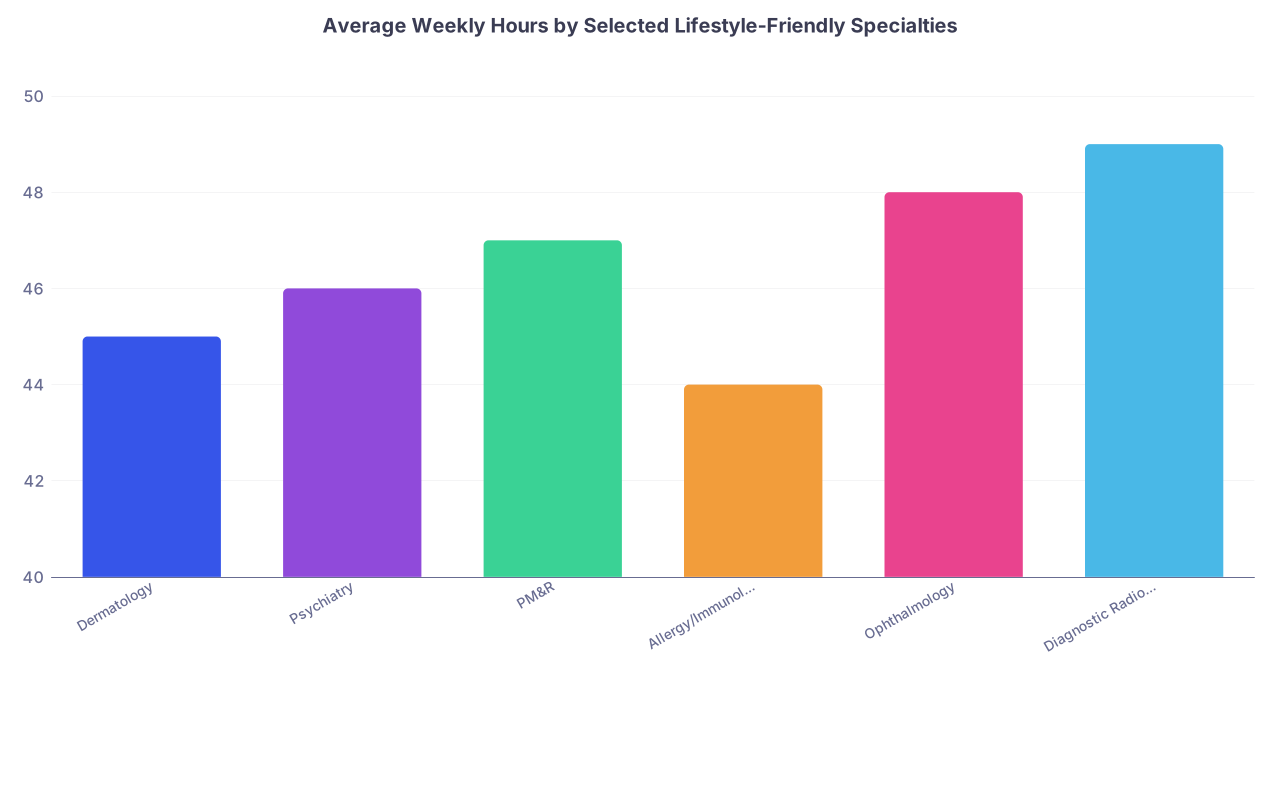
| Category | Value |
|---|---|
| Dermatology | 45 |
| Psychiatry | 46 |
| PM&R | 47 |
| Allergy/Immunology | 44 |
| Ophthalmology | 48 |
| Diagnostic Radiology | 49 |
You will find minor differences across data sources, but the pattern is stable: lifestyle-friendly specialties cluster in the mid‑40s to high‑40s for practicing attendings. Not 35. Not 60. Mid‑40s to high‑40s.
Residency is a different beast (ACGME 80-hour cap across the board), but post-training life diverges dramatically.
2. Big-Picture Benchmarks: How Specialties Stack Up
Let me put these lifestyle specialties next to some less friendly ones so you can see the contrast.
| Specialty Group | Avg Weekly Hours |
|---|---|
| Lifestyle-friendly outpatient core | 45–49 |
| General Internal Medicine (outpatient) | 50–55 |
| Hospitalist Medicine | 50–60 (7-on/7-off) |
| Emergency Medicine | 45–50 (but shifts, nights) |
| OB/GYN (general) | 55–65 |
| General Surgery | 60–70 |
There are two key takeaways:
- “Lifestyle-friendly” does not mean “40-hour office job.” Think 45–50 hours, not 9–5.
- Some non-lifestyle specialties have similar raw hours (e.g., EM ≈ derm) but much worse scheduling patterns (nights, weekends, circadian chaos).
So if you only ask, “How many hours per week?” you are missing half the story. You must combine hours with when those hours are worked.
3. Specialty Deep Dive: Numbers, Not Nostalgia
Now let’s break down the core lifestyle-friendly specialties, with realistic hour ranges during residency vs attending practice, and the tradeoffs the data suggests.
Dermatology: The Gold Standard for Predictable Days
Dermatology is always in the top 3 when med students rank “best lifestyle.” The data backs that up.
Attending-level benchmarks (full-time):
- Clinic days: typically 4–4.5 days/week
- Daily schedule: roughly 8:00–5:00 (with some variation)
- Average weekly hours: ~45 hours, many reports at 40–48
- Nights/weekends: rare and usually negligible call burden
Residency is still residency:
- PGY‑2 to PGY‑4 derm residents: commonly report 50–60 hours/week
- Most programs well below the 80-hour cap except at transitional/preliminary intern year
- Home call in many places, minimal in-house overnight
The tradeoff? Hyper-competitive entry. The time you “save” later is front-loaded as extra time, stress, and research effort in medical school. Statistically, this is where you pay: Step scores, research output, AOA, away rotations.
Psychiatry: Lifestyle with Cognitive Workload
Psychiatry plays a different game. The emotional load is high; the physical and hour load is moderate.
Attending-level benchmarks:
- Outpatient psychiatrists: 40–48 hours/week
- Inpatient psychiatrists: ~45–50 hours/week
- Call: varies, but often lighter than hospitalist or surgery; nights common in some inpatient roles but usually better compensated and less intense
- Many psychiatrists intentionally cap at 4 days/week of direct patient care and use the 5th day for admin or not at all
Residency:
- PGY‑1: closer to 55–65 hours/week (with medicine/neurology rotations)
- PGY‑2–4: often 50–60, with stretches of easier outpatient blocks
- Overnight call still exists, but intensity ≠ surgery call
If you look purely at hours, psychiatry is consistently on the lower half of the spectrum. Where it is not “easy” is emotional fatigue, chronic patient complexity, and documentation. But the time data is favorable.
Physical Medicine & Rehabilitation (PM&R): Under-the-Radar Lifestyle
PM&R flies below many students’ radar. The work-hour data suggests that is a mistake if you care about lifestyle.
Attending-level benchmarks:
- Outpatient-heavy PM&R: ~45–50 hours/week
- Inpatient rehab hospital roles: ~48–52 hours/week
- Call: generally low acuity; rehab units are not ICUs
Residents I have spoken with often phrase it like, “Busy days but you go home on time.” That is what the data suggests, too.
Residency:
- Commonly 55–60 hours/week
- Early years heavier due to medicine, ICU, and trauma rotations
- Senior PM&R years often move toward clinic-heavy days and less brutal call
If you want procedural work without a surgical schedule, PM&R is one of the better hour/interest tradeoffs available.
Allergy & Immunology: Short Weeks, Long Waitlists
Allergy/Immunology is small, subspecialized, and quietly one of the best lifestyle deals.
Attending-level:
- Many full-time allergists report 40–45 hours/week
- Clinic-based, scheduled patients, minimal inpatient or overnight work
- Call: often trivial; sometimes shared and mostly phone-based
You do not see many allergy attendings sitting in hospitals at 2 a.m. running codes. The work just does not tend to generate that kind of pattern.
Training path is longer (IM or peds plus fellowship), and the field is small (fewer positions). But in terms of weekly time commitment, the numbers are consistently favorable.
Ophthalmology: High Skill, Controlled Schedule
Ophthalmology workloads are a split: clinic and OR. Yet the week is still relatively controlled compared with general surgery.
Attending-level:
- Clinic + OR: commonly 45–50 hours/week
- OR days start early but usually do not extend to midnight marathons
- Call: depends heavily on practice and region; trauma centers more demanding, community practices more relaxed
If you break it down, an ophthalmologist might work 4 clinic days (8–5) and 1 OR day, totaling roughly mid‑40s, plus some call. Not derm-level peaceful, but far from gen surg.
Residency is tougher:
- Near or at 60–70 hours/week in some programs, especially early years
- Call with true emergencies (retinal detachments, open globe injuries)
- The distribution improves considerably after training
Diagnostic Radiology: Hours vs Perception
Radiology and lifestyle get mentioned together a lot. The truth is more nuanced.
Attending-level:
- Traditional daytime radiologist: ~45–50 hours/week
- Teleradiology: variable, often 7-on/7-off or other compressed models, but total hours hover around similar ranges
- Nights: dedicated night float roles may work fewer actual weekly hours but work exclusively nights
The raw hours often look similar to derm or ophtho. What changes is the cognitive load (constant high-stakes decisions, RVU pressure) and the sometimes rigid expectation to read a huge volume each hour.
Residents:
- Historically worked very hard, though ACGME has standardized caps
- Common real-world ranges: 55–65 hours/week, plus independent study
If you like controlled environments and do not mind sitting in front of multiple monitors, the hour data is actually on your side.
4. Residency vs Attending: Do Not Confuse the Two
A common mistake: hearing a resident in a “lifestyle” specialty complain of 70-hour weeks and deciding the field is not lifestyle-friendly. That is an illusion created by the residency phase.
Look at the two phases separately.
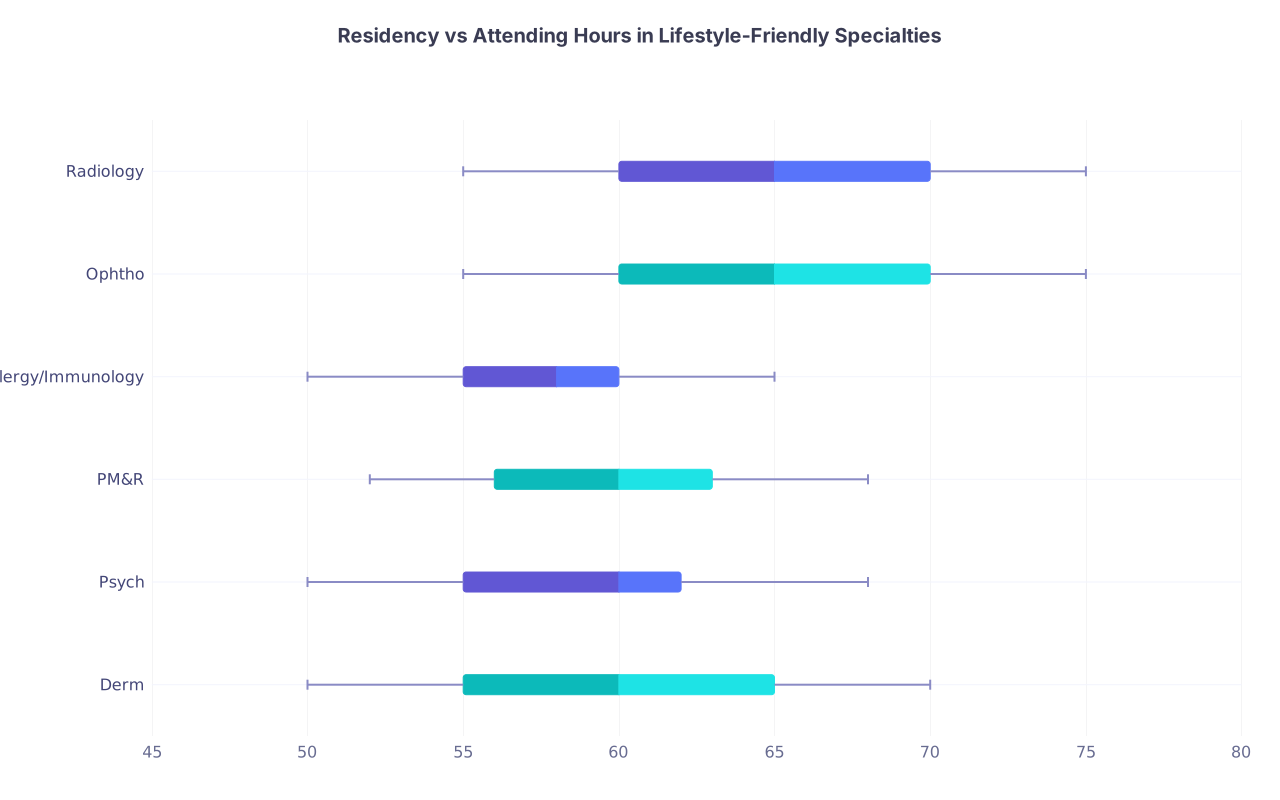
| Category | Min | Q1 | Median | Q3 | Max |
|---|---|---|---|---|---|
| Derm | 50 | 55 | 60 | 65 | 70 |
| Psych | 50 | 55 | 60 | 62 | 68 |
| PM&R | 52 | 56 | 60 | 63 | 68 |
| Allergy/Immunology | 50 | 55 | 58 | 60 | 65 |
| Ophtho | 55 | 60 | 65 | 70 | 75 |
| Radiology | 55 | 60 | 65 | 70 | 75 |
Interpretation:
- Residency medians: cluster around 60–65 hours/week across almost all these specialties
- Attending medians: drop steeply into the 45–50 range
The residency period is a fixed cost. The specialty you choose mostly dictates what happens after that fixed period. The data says that if you want a 45–50 hour/week life, derm/psych/PM&R/allergy/ophtho/rads get you there. General surgery simply does not, on average.
5. Schedules, Not Just Totals: When Those Hours Happen
Two specialties can both average 46 hours/week and feel nothing alike.
Emergency Medicine vs Dermatology is the classic example:
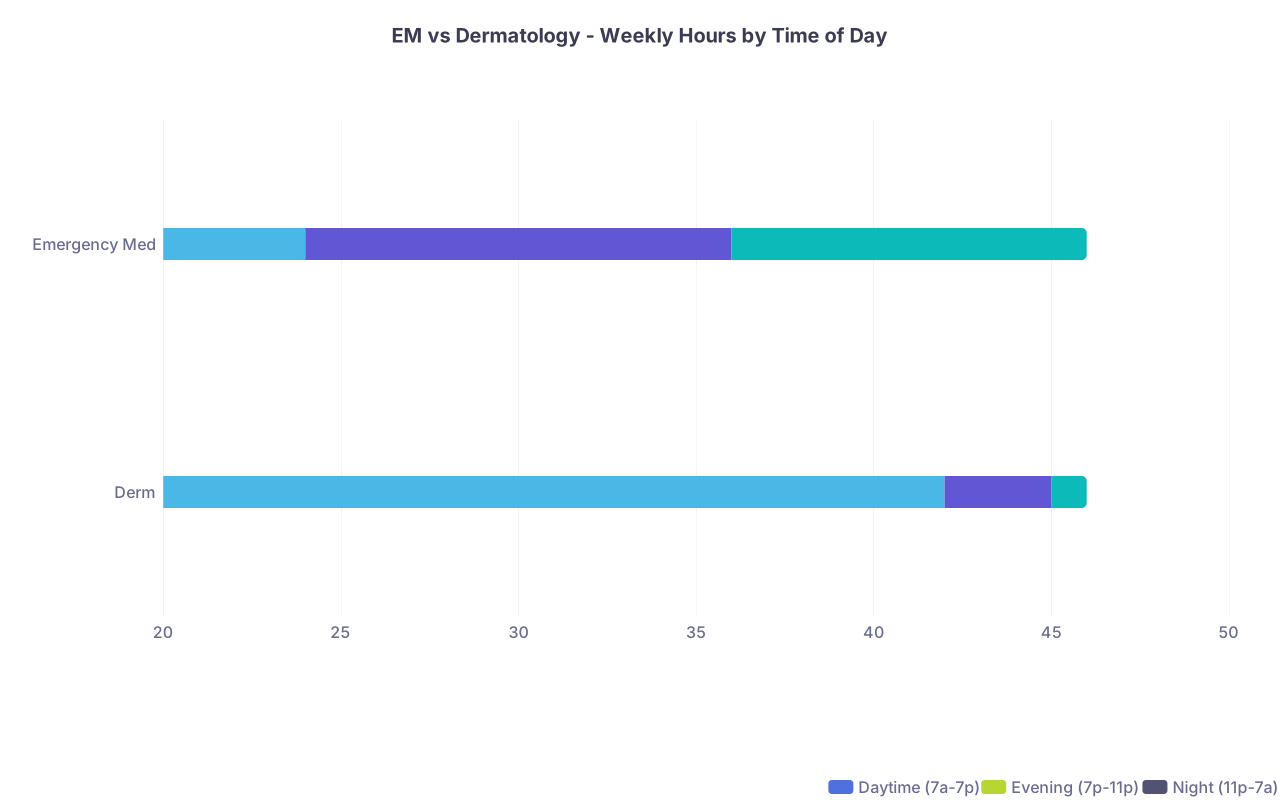
| Category | Daytime (7a-7p) | Evening (7p-11p) | Night (11p-7a) |
|---|---|---|---|
| Derm | 42 | 3 | 1 |
| Emergency Med | 24 | 12 | 10 |
Same rough total hours. Very different circadian reality.
Lifestyle-friendly specialties tend to share three scheduling traits:
- Daytime-centric work. 80–95% of hours between 7 a.m. and 6 p.m.
- Predictable weeks. You usually know your schedule months in advance.
- Limited weekend and holiday commitment. Often rota-based, infrequent, or largely phone call.
Surgery and OB/GYN routinely fail all three. EM hits the hours but fails the first one hard. That is why you hear older EM docs talk about “burning out at 50” even though their timesheets do not look outrageous.
6. Productivity, Pay, and Hours: The RVU Equation
Some fields look more lifestyle-friendly than they actually feel, because of how productivity targets are structured.
Two radiologists both working 48 hours/week can have very different stress levels if one is under constant RVU pressure reading 120 studies/day while the other reads 70.
There is a rough, data-driven pattern:
Dermatology, Allergy, Psych (outpatient)
Often high income/hour worked, with reasonable RVU or visit-volume expectations. You can scale down to 0.7–0.8 FTE and still earn a solid income.Hospital-based (Radiology, Anesthesia, EM)
Income/hour can be high, but variability is greater. Group culture, RVU demands, and call burden matter a lot.Internal Medicine outpatient
Often ends up around 50–55 hours/week if you count inbox work at home. EMR bloat crushes a lot of the theoretical “40-hour clinic job” image.
Hours alone do not capture burnout risk. But specialties with lower hours plus less night/weekend work tend to have lower burnout and higher career satisfaction on large surveys. Psych, derm, and allergy consistently score well there.
7. Common Myths the Data Kills
Let me be blunt about a few myths that do not survive contact with numbers.
“All specialties are brutal; you just pick what you love.”
False. Hours differ by 15–20 per week on average, and scheduling patterns differ even more. Choosing a 60–70 hour, heavy-call field vs a 45–50 hour, clinic-based field is not a rounding error. Over a 30-year career that is thousands of hours of difference.
“Lifestyle-friendly means you are not a ‘real doctor.’”
Nonsense. Ophthalmologists doing complex eye surgery, psychiatrists managing life-threatening conditions, and PM&R physicians leading rehab for spinal cord injuries are hardly “not real doctors.”
This is usually just insecurity projected from specialties that normalize martyrdom.
“You cannot really work under 50 hours as a physician.”
Plenty of attendings in derm, psych, allergy, and outpatient subspecialties work 0.6–0.8 FTE. When they do, hours fall into the 30–40 range. They trade income for time. The full-time benchmarks are around 45–50. The physics works.
8. Matching Your Tolerance to the Data
The right question is not “What is the easiest specialty?” The right question is “What work-hour distribution am I willing to live with for 20–30 years?”
Here is a rough distribution snapshot that most closely aligns with practicing physician surveys:
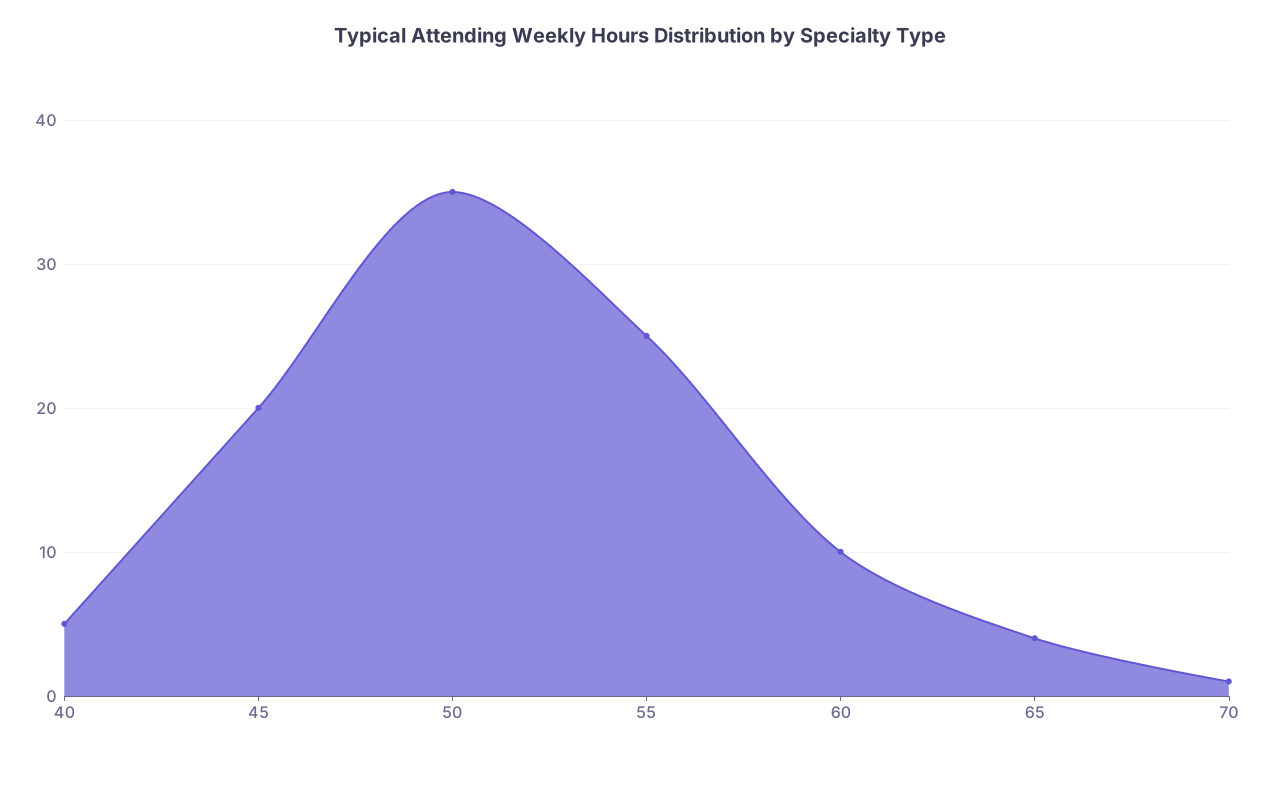
| Category | Value |
|---|---|
| 40 | 5 |
| 45 | 20 |
| 50 | 35 |
| 55 | 25 |
| 60 | 10 |
| 65 | 4 |
| 70 | 1 |
Read it as: most physicians cluster around 45–55 hours/week. If you want to be near the left tail (40–45), you skew toward derm, psych, allergy, outpatient-only roles, and part-time setups. If you choose general surgery, neurosurgery, or OB, you are intentionally moving toward the 60+ tail.
One more structured comparison helps summarize the lifestyle group:
| Specialty | Residency Hours (typical) | Attending Hours (typical) | Nights/Weekends Pattern |
|---|---|---|---|
| Dermatology | 50–60 | 40–48 | Minimal, mostly phone |
| Psychiatry | 50–60 | 40–50 | Light to moderate, site-dependent |
| PM&R | 55–60 | 45–50 | Low acuity, shared |
| Allergy/Immunology | 50–55 (fellowship) | 40–45 | Very limited |
| Ophthalmology | 60–70 | 45–50 | Variable, heavier in trauma hubs |
| Diagnostic Radiology | 55–65 | 45–50 | Structured shifts, some nights |
9. Realistic Planning: What This Means for You
You do not control everything—location, group culture, and staffing shortages can blow up any schedule—but you are not powerless either.
If you choose:
- Dermatology, psych, allergy, PM&R, or a lifestyle subspecialty, the data says your baseline full-time life will likely settle around 45–50 hours/week with predominantly daytime work.
- Ophthalmology or diagnostic radiology, you are still in that 45–50 band as an attending but with more variation based on practice setting.
- Surgery or OB, you are deliberately signing up for 55–70 as a normal week, often with nights and weekends.
You can then layer on personal choices: 0.8 FTE, academic vs private, urban trauma center vs community clinic. Those move you up or down within your specialty’s typical band. But the band itself is heavily specialty-dependent.
10. Bottom Line
Three points, no fluff:
- Lifestyle-friendly specialties reliably cluster around 45–50 hours/week for full-time attendings, with substantially less night and weekend work than surgery, OB, or ICU-heavy fields.
- Residency hours are similar across specialties (usually 55–70/week), so judge lifestyle based on attending data, not PGY‑2 complaints.
- If you want a realistic shot at long-term work-life balance, the data repeatedly points to dermatology, psychiatry, PM&R, allergy/immunology, ophthalmology, and diagnostic radiology as the most favorable starting points—assuming you are willing to pay the upfront cost to match into them.