
The myth that “lifestyle specialties” always mean lower earnings or slow paths to partnership is wrong. The data show a far more nuanced—and frankly, more profitable—picture for physicians who pick their practice setting strategically.
Below I am talking specifically about lifestyle-oriented private practices in historically more lifestyle-friendly specialties, not hospital employment and not academic tracks. The dynamics are completely different once you step into a lean, outpatient-heavy, productivity-driven group.
We will focus on:
- Time to partnership
- When income tends to peak
- How lifestyle really looks once you are an owner
All with numbers, not vibes.
1. Defining “Lifestyle-Oriented” Private Practices
Before talking timelines and earnings curves, you need a clear operational definition. I use three criteria:
- Procedural or outpatient-heavy (low inpatient / call burden).
- Controllable hours (predictable clinic, limited nights/weekends).
- Private practice structure with a transparent buy-in or equity pathway.
Using those filters, the most common lifestyle-friendly specialties where private practice is still robust and partnership matters are:
- Dermatology
- Ophthalmology
- Allergy & Immunology
- Radiology (especially outpatient imaging groups)
- Anesthesiology (large private groups with defined equity tracks)
- Physical Medicine & Rehabilitation (PM&R, especially pain and MSK practices)
- Gastroenterology (borderline “lifestyle” but very procedure-efficient)
Emergency medicine used to sit here, but corporate consolidation and contract volatility have damaged its lifestyle and partnership economics in many markets. I will reference it, but it is no longer the prototypical “lifestyle private practice” story.
2. Time to Partnership by Specialty: What the Numbers Show
Forget the brochure language (“3–5 years”); look at actual data from offers, MGMA benchmarks, contract review patterns, and what partners in these groups will quietly tell you at 10 p.m. over conference drinks.
Across lifestyle-oriented specialties, time to full partnership clusters tightly around 2–5 years post-hire, with meaningful variation by specialty and market competitiveness.
| Specialty | Common Range (Years) | Modal Value | Notes |
|---|---|---|---|
| Dermatology | 1.5–3.5 | 2–3 | Fast track in high-volume PP |
| Ophthalmology | 2–4 | 3 | Often tied to buy-in timing |
| Allergy/Immunol. | 2–3 | 2–3 | Small groups, simple tiers |
| Radiology | 3–5 | 4–5 | Often large groups |
| Anesthesiology | 2–4 | 3 | Depends on group stability |
| PM&R (Pain/MSK) | 2–4 | 3 | Heavily productivity-based |
| Gastroenterology | 2–5 | 3–4 | Procedure volume is key |
The outliers:
- Dermatology and allergy routinely offer 2–3-year partnership tracks, occasionally shorter. Why? Low overhead per incremental visit and very clear RVU economics make it easy to see if a new associate is profitable.
- Radiology and some anesthesia groups stretch to 4–5 years because these are often large groups with shared hospital contracts and complex equity pools. They also use longer tracks as retention filters.
If a “lifestyle” group is offering >5 years to partnership, with vague language and no defined buy-in formula, the data from actual practice outcomes say this: the probability that you will ever see true partner-level economics drops sharply.
3. Compensation Curve: Associate vs Partner, and Earning Peaks
You are not just asking “how long till partnership?” You are asking “what does the earning trajectory actually look like over a 10–15-year horizon?”
Let’s quantify.
A common structure in lifestyle-oriented private practices:
- Years 0–2 (Associate)
Guaranteed base + productivity bonus, total comp maybe 55–70% of a mature partner’s income. - Years 3–5 (New Partner)
Buy-in (spread over several years) + share of profits. Net comp moves to 80–100% of a mature partner, temporarily dragged by buy-in payments. - Years 6–12 (Mature Partner)
Peak production years. Owner share of profits + productivity. This is where most physicians see their lifetime income peak. - Years 13+ (Late Career Partner)
Production plateaus or declines a bit. Some groups shift to senior tracks, reduced call, or partial retirement.
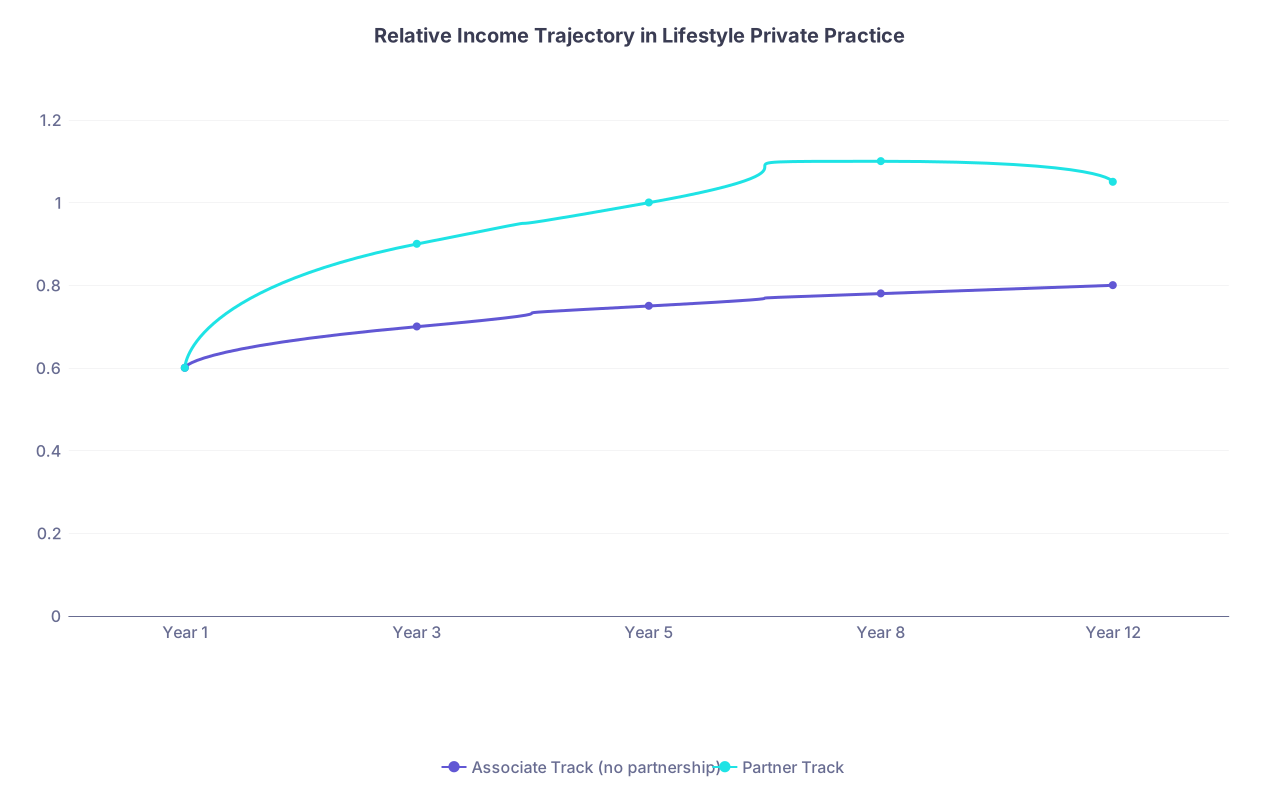
To visualize the relationship between years from residency completion and relative income (associate vs partner), a generic pattern looks like this:
| Category | Associate Track (no partnership) | Partner Track |
|---|---|---|
| Year 1 | 0.6 | 0.6 |
| Year 3 | 0.7 | 0.9 |
| Year 5 | 0.75 | 1 |
| Year 8 | 0.78 | 1.1 |
| Year 12 | 0.8 | 1.05 |
Interpretation:
- A career associate in a lifestyle practice tends to hover around 70–80% of partner income. Looks “fine” early, but the comp gap compounds massively across decades.
- A partner-track physician typically overtakes associate-level income around years 3–5, then pulls ahead meaningfully from years 6–12.
In numbers:
- If a dermatology partner in a busy private group averages $700k,
an associate at 65–75% is at $455k–$525k. - Ten years of that gap is $1.75–$2.45 million in cumulative lost income.
That swamps a $300–$800k buy-in.
The data are brutal: In lifestyle-friendly specialties where private practice margins are strong, not becoming a partner is usually the most expensive “lifestyle” choice you can make.
4. Specialty-by-Specialty: Time to Partnership and Earning Peaks
Now let’s go specialty by specialty and tie time to partnership with where earnings typically peak.
Dermatology
This is the flagship lifestyle specialty in private practice economics.
- Time to partnership: Commonly 2–3 years, occasionally as short as 18–24 months in growth practices.
- Associate comp: Often $350k–$450k base with bonuses, total $400k–$550k.
- Partner comp: Mature partners in high-volume groups: $600k–$1M+, with many clustered around $700k–850k depending on cosmetics vs medical mix.
Earnings typically peak around 7–12 years out of residency, when:
- Patient panels are full.
- Procedures and cosmetics are optimized.
- Overhead per RVU is minimized.
Lifestyle-wise, you often see 4-day clinic weeks, little to no inpatient work, and minimal call. The “crunch” years are actually early, when you are ramping volume.
Ophthalmology
Still lifestyle-friendly if you are not doing retina call every other night.
- Time to partnership: 3 years is common; 2–4 years typical.
- Associate comp: $275k–$375k early, trending to $350k–$450k with bonuses.
- Partner comp: Cataract-heavy comprehensive partners: $500k–$800k, higher with premium IOLs and refractive work.
The critical piece in ophtho is surgical volume. Your earnings peak when you are:
- Booking full OR blocks.
- Optimizing premium lens and refractive upsell.
- Minimizing non-clinical time.
Income often peaks around 8–15 years out of residency, aligning with maximum surgical efficiency. That is where work hours do not necessarily go up, but revenue per hour spikes.
Allergy & Immunology
Quietly one of the more rational lifestyle private practice niches.
- Time to partnership: Often 2–3 years. Small groups; simple economics.
- Associate comp: $230k–$320k.
- Partner comp: $350k–550k, depending on ancillary revenue (allergy shots, biologics, testing).
Peak earnings usually fall in the 7–12-year window, once you:
- Build a loyal chronic patient base.
- Optimize shot clinic revenue.
- Negotiate payer contracts more aggressively as a group.
Hours are predictable. Minimal nights, minimal procedures, lots of repeat visits. For physicians very focused on weekday, daylight medicine, this is a strong data-backed option.
Radiology (Outpatient and Private Groups)
Radiology straddles lifestyle/performance. Hospital-based call can hurt lifestyle, but large private groups with teleradiology and shift flexibility are still more lifestyle-friendly than most surgical disciplines.
- Time to partnership: 4–5 years is common in large groups; 3–4 in smaller ones.
- Associate comp: $350k–$450k initially, sometimes more with nights/weekends.
- Partner comp: $550k–800k+, highly region-dependent and heavily tied to hospital contracts.
Earnings peak often 5–10 years into partnership, once you have:
- Senior scheduling preferences.
- High RVU throughput.
- Stable hospital contracts.
Radiology groups frequently have longer partnership tracks but also large equity pools, so the eventual jump is significant. Lifestyle is heavily schedule-driven: you “buy” lifestyle with reduced shifts and accept some income compression.
Anesthesiology
Anesthesia is extremely group- and market-dependent. In healthy private groups:
- Time to partnership: 2–4 years typical.
- Associate comp: $300k–400k+ (often paid hourly/day-rate equivalents).
- Partner comp: $450k–700k+, again very group-specific.
Peak earning years cluster around 5–12 years post-residency, when:
- You are taking high-value OR assignments.
- You get a full share of stipends and call distributions.
- You have some control over shift selection.
The lifestyle “win” is usually predictable daily schedules, optional extra shifts for income, and the ability to trade call for cash. But corporate consolidation has eroded classic partnership pathways in some markets; the data are highly bifurcated between true private groups and quasi-employed models.
PM&R (Especially Pain and MSK Practices)
PM&R is very wide, but the private practice lifestyle story is primarily outpatient MSK and interventional pain.
- Time to partnership: 2–4 years in most pain/MSK groups.
- Associate comp: $250k–350k for general MSK; $300k–450k+ for pain.
- Partner comp: Busy interventional pain partners: $500k–900k+, heavily dependent on procedure volume and ownership of ancillaries (ASC, imaging, PT).
Income peaks in the 5–10-year range post-residency for interventional pain, once:
- Procedure days are consistently full.
- Your proportion of high-RVU interventions is maximized.
- You own part of the ASC or related ancillaries.
Lifestyle can be decent—clinic days plus procedure days, little inpatient work—but high-earning pain partners often trade some lifestyle for throughput.
Gastroenterology
GI is not “easy,” but it is procedure-dense with controllable outpatient-heavy schedules in private practice.
- Time to partnership: 3–4 years is typical, 2–5 overall range.
- Associate comp: $350k–450k.
- Partner comp: $600k–1M+, especially where partners own endoscopy centers.
Peak earnings usually occur 6–12 years into practice, when:
- Endoscopy slots are maximally used.
- You have equity in the ASC.
- You have stable referral streams.
Lifestyle is mixed; call and hospital work are real. But per-hour earnings in well-run GI groups are among the highest in all of medicine.
5. Lifestyle Reality: Hours, Call, and Control
“Lifestyle-friendly” does not mean 30-hour weeks and early retirement. It usually means a high revenue per hour and predictable schedules.
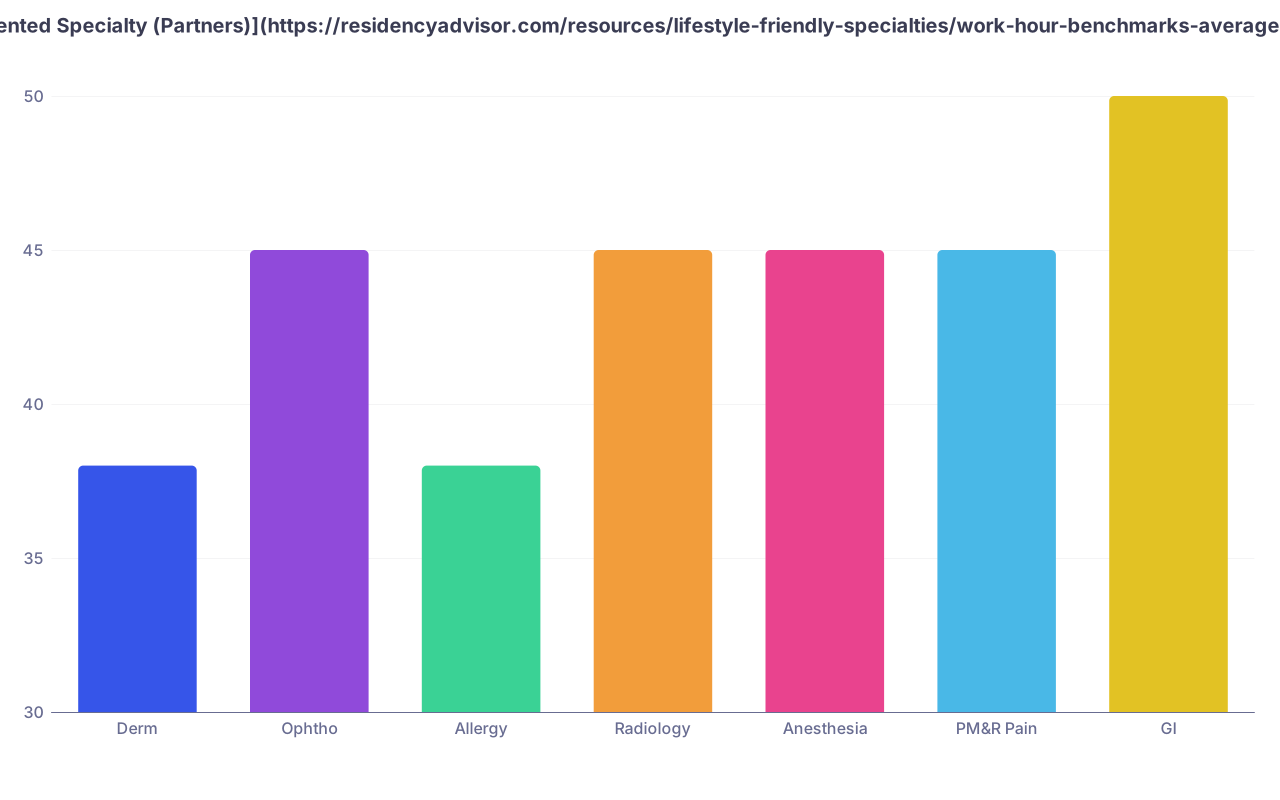
A realistic hours snapshot for a partner in these specialties (clinic + admin, average over a year):
| Category | Value |
|---|---|
| Derm | 38 |
| Ophtho | 45 |
| Allergy | 38 |
| Radiology | 45 |
| Anesthesia | 45 |
| PM&R Pain | 45 |
| GI | 50 |
Rough pattern:
- Dermatology / Allergy: ~35–40 hrs/week, extremely predictable, rare nights/weekends.
- Ophthalmology / PM&R / Anesthesia / Radiology: ~40–50 hrs/week, sometimes shift-based or OR-day heavy, but still structured.
- GI: ~45–55 hrs/week, more call and hospital time, but procedure-heavy days.
The real lifestyle advantage is not that you work dramatically fewer hours than other physicians. The edge is:
- You can compress income into predictable daytime hours.
- You have more control over reducing hours later in your career without destroying your income.
A mature dermatology or GI partner can cut to 3–4 days a week and still out-earn many full-time hospital-employed internists. That is lifestyle leverage.
6. Contract Red Flags That Delay or Destroy Partnership
From reviewing a lot of contracts and watching actual outcomes, there are patterns. Certain clauses reliably correlate with delayed partnership and flattened earnings.
Big red flags:
Undefined partnership criteria.
If the contract does not specify:- Target year (e.g., “eligible after 3rd full year”), and
- Objective metrics (RVUs, collections, quality benchmarks, citizenship factors),
then the group keeps all the optionality and you take all the risk.
“Partnership subject to unanimous approval” with no criteria.
In practice, this often means: “We will never make you a full partner if the current partners like the current economics.”No disclosed buy-in formula.
If you do not know:- How practice value is calculated (EBITDA? Book value? Arbitrary number?), and
- Over what period the buy-in is paid,
you cannot model your actual return.
RVU / collections discrepancies between associates and partners.
When associates work under:- Higher RVU thresholds, and
- Lower conversion factors,
it often means you are subsidizing partner income without a clear path to join them.
If the contract structure is vague, the data from these groups show a consistent outcome: time to partnership drifts longer, and some associates never reach parity.
7. Strategic Takeaways: Where Lifestyle and Earnings Actually Align
Putting the numbers together, three specialties stand out where time to partnership is short, earning peaks are high, and lifestyle is genuinely controllable:
| Specialty | Partnership Speed | Earning Peak Level | Lifestyle Control |
|---|---|---|---|
| Dermatology | Fast (2–3 yrs) | Very High | Excellent |
| Ophthalmology | Moderate (3 yrs) | High | Very Good |
| Allergy | Fast (2–3 yrs) | Moderate-High | Excellent |
PM&R (pain/MSK), radiology, anesthesia, and GI can absolutely deliver strong lifestyle and earnings, but:
- They are more group-dependent.
- Call and coverage can erode the lifestyle edge if not structured well.
- Time to partnership can be longer or more political.
If your core priority is lifestyle with strong earnings in a private practice model, the data strongly favor:
- Dermatology
- Ophthalmology
- Allergy & Immunology
With PM&R and radiology as conditional contenders when group structure is right.
FAQ (Exactly 4 Questions)
1. At what career stage do most physicians in lifestyle-friendly private practices hit their maximum income?
Most hit peak earnings around 7–12 years after residency. That aligns with several years of full partnership, maximal patient or procedure volume, and often full buy-in completion. The early years (0–3) are associate years with lower effective percentages; years 3–6 are usually transitional with buy-in drag; the true peak often appears once both panel and equity are mature.
2. Is a long partnership track (5+ years) ever a good sign?
Occasionally. In very large radiology or anesthesia groups with deep hospital contracts and large equity pools, a 4–5 year track can reflect complex integration rather than exploitation. But for smaller outpatient lifestyle practices (derm, allergy, ophtho, PM&R), a >5-year track with vague criteria is almost always a bad economic signal. Historically, the probability of reaching full partner-level economics under those terms is low.
3. How big is a typical buy-in, and does it actually pay off?
Buy-ins in lifestyle-oriented private practices commonly range from $200k to $800k, either as a lump sum, multi-year payroll deduction, or “sweat equity” via reduced compensation. Given that partner income can be $150k–$400k higher per year than associate income, the payback period is often 1–3 years. Over a decade, cumulative gains almost always dwarf the initial buy-in cost, assuming the group is stable.
4. From a lifestyle standpoint, is hospital employment safer than pursuing partnership?
Safer for short-term predictability, yes. But the data show that hospital-employed physicians in these specialties typically plateau lower and often have less schedule control than owner-partners once you reach mid-career. You trade partnership risk for capped earnings and administrative control. For physicians with a long time horizon and willingness to read contracts carefully, well-structured private practice partnership almost always outperforms hospital employment on both income and long-term lifestyle flexibility.
Two key points to keep anchored:
- In lifestyle-oriented specialties, time to partnership is the single biggest driver of lifetime earnings variance.
- The true lifestyle advantage is not “fewer hours,” but higher revenue per predictable hour once you are an owner, usually peaking 7–12 years out.