
Most residents are choosing specialties with the wrong metric: they chase prestige or passion and ignore the math on debt and lifestyle. The data shows that some “boring” fields quietly crush both.
If you are carrying $250,000–$400,000 in student debt and want a life that does not revolve around call schedules and pager anxiety, you cannot afford to “go with your gut” alone. You need a spreadsheet mindset.
I am going to treat this like what it is: a constrained optimization problem. Two objective functions:
- How fast can you realistically pay down educational debt?
- How much control do you have over your time, location, and workload?
Some specialties spike on one axis and crater on the other. A few sit in that sweet upper-right quadrant: strong income, strong schedule control, reasonable training length, and flexible practice models.
Let’s quantify that.
1. The Debt–Lifestyle Equation: What Actually Matters
Strip away the fluff and there are five variables that determine how a specialty balances loan repayment and lifestyle:
- Training length (years until you earn an attending salary)
- Median attending income (3–10 years out, not just fresh grads)
- Typical hours/week and call burden
- Flexibility of practice models (part-time, outpatient only, telehealth, locums)
- Geographic leverage (how much pay jumps in underserved or non-coastal markets)
You are not trying to “maximize income” alone. You are trying to maximize:
After-tax, after-loan dollars per hour of controllable work.
Not raw salary. Not peak earning potential at age 58. The question is: In your 30s and 40s, how much are you earning for each hour you choose to work, after the government and your loans take their piece, while still having control over nights, weekends, and vacation?
Let’s take a simplified view of after-loan hourly economics. Assume:
- Tax + payroll hit ≈ 35% effective on attending income levels
- Aggressive loan payoff: 10-year horizon on $300,000 at ~6–7% (annual payment ≈ $40,000–$45,000)
- Hours are real weekly averages, not brochure numbers
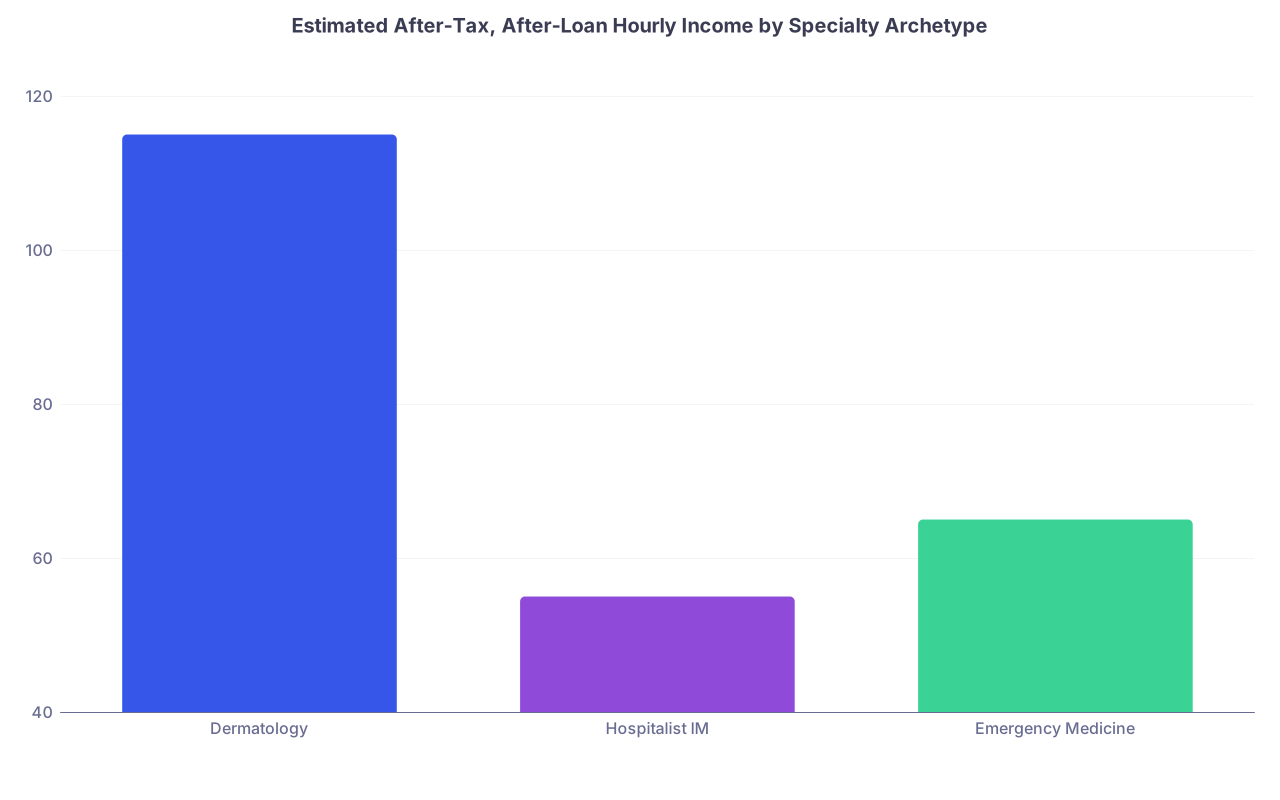
To make this less abstract, compare three archetypes:
| Category | Value |
|---|---|
| Dermatology | 115 |
| Hospitalist IM | 55 |
| Emergency Medicine | 65 |
These are ballpark figures (USD per hour) using typical incomes, hours, and loan payments. Here is the point: a 2x difference in effective hourly rate radically changes your ability to pay loans and still live like a human.
Now, which real specialties sit in that high-hourly, controllable-lifestyle band?
2. Benchmarking Lifestyle-Friendly Specialties
Before ranking, I want a shared baseline. Consider this mini-dashboard:
| Specialty | Training (yrs total) | Typical Hours/Week | Median Income ($k) | Call Intensity | Part-time Friendly |
|---|---|---|---|---|---|
| Dermatology | 4 med + 4 res = 8 | 35–45 | 450–600 | Very low | Excellent |
| Outpatient Psychiatry | 4 + 4 = 8 | 40–50 | 280–350 | Low | Excellent |
| Emergency Medicine | 4 + 3 = 7 | 32–40 (shifts) | 350–450 | Moderate | Good |
| Anesthesiology | 4 + 4 = 8 | 45–55 | 420–550 | Moderate | Good |
| Outpatient Neurology | 4 + 4 = 8 | 45–55 | 280–350 | Low–moderate | Good |
Numbers are rounded from a mix of MGMA, Doximity, Medscape, and compensation reports over the last few years. Things move slightly year to year, but the order of magnitude is stable.
Already, you can see the pattern: certain cognitive, procedure-light specialties win on schedule control, but a subset also delivers solid income. That overlap is what you should chase.
3. Top Tier: Fields That Genuinely Balance Debt and Flexibility
These are the specialties that, based on raw numbers, give you both a clear path to crushing six-figure loans and a life you actually control most weeks.
Dermatology: The Unfairly Good Option
Derm is the poster child for “this is why the match is so competitive.”
- Training: 4-year residency (often 1 transitional + 3 derm)
- Median income: $450,000–$600,000+ depending on cosmetics/procedures and region
- Hours: 35–45/week, usually office hours, limited call, very few emergencies
Financially, a typical early-career dermatologist might see:
- Gross: $475,000
- After 35% tax: ≈ $309,000
- Loan payment (10-year on $300k): ≈ $45,000/year
- Net after-loan: ≈ $264,000
At 40 hours/week, 48 weeks/year, that is about $137 per effective hour. And that is with an aggressive payoff schedule.
The lifestyle side is equally weighted:
- Scheduled clinic. Very little night/weekend work.
- Procedures that can be batched; no 3 a.m. trauma pages.
- High part-time potential (3–4 day weeks) while still out-earning many full-time colleagues in other specialties.
For pure “debt-to-lifestyle” efficiency, dermatology is a top-3 specialty in the entire field of medicine. The trade-off is obvious: the path in is brutal (high Step scores, research, AOA, strong letters). But mathematically, the payoff is enormous.
Outpatient Psychiatry: The Underrated Work–Life Arbitrage
Psychiatry used to be underpaid. Those days are mostly gone, especially for outpatient and telehealth-heavy practices.
- Training: 4 years
- Median income: $280,000–$350,000 outpatient, often more in high-demand markets or with productivity models
- Hours: 40–50/week; call is often optional or light, and you can structurally avoid inpatient if you want
A very realistic model:
- Gross: $320,000
- After tax (35%): ≈ $208,000
- Loan payment (same 10-year, $300k): ≈ $45,000
- Net after-loan: ≈ $163,000
At 45 hours/week, 48 weeks/year, that is about $75 per effective hour.
The psych advantage is not just the raw numbers. It is the flexibility:
- Telepsychiatry is established and reimbursed.
- You can dial up or down panel size and hours with relatively linear changes in income.
- High geographic arbitrage: rural or under-served metro areas pay heavy premiums.
You can go 0.7 FTE, live in a low-cost area, and still obliterate your loans on a 10–15 year horizon without feeling like you are sprinting.
Emergency Medicine: Lifestyle by Design, Not by Default
Emergency medicine has become more volatile (corporate groups, saturated markets in some regions), but the structure of shift work still creates a level of schedule control other fields envy.
- Training: 3–4 years
- Median income: $350,000–$450,000 (wide spread; rural groups often higher)
- Hours: Commonly 12–14 shifts/month of 8–12 hours. Call technically does not exist, but nights/weekends/holidays are embedded.
A standard model: 13 10-hour shifts/month = 130 hours.
Annual:
- Gross: $375,000
- After tax: ≈ $244,000
- Loan payment: ≈ $45,000
- Net after-loan: ≈ $199,000
Total hours: 130 × 12 = 1,560. Effective hourly net after loan: ≈ $127/hour.
That is top-tier efficiency, even after you factor in the emotional and cognitive load of ED work.
The catch is not in the math; it is in sustainability:
- Nights and circadian disruption accumulate.
- Burnout is a real and rising signal in the data.
- Market pressure exists in saturated urban areas, though rural demand remains strong.
If you can stomach, literally and figuratively, shift work and acute chaos, EM gives you one of the sharpest tools for fast loan payoff and high lifestyle control. You are not tethered to the hospital off-shift. Your time is truly off when you leave.
Anesthesiology: High Income, Negotiable Lifestyle
Anesthesia sits in a sweet middle. Plenty of procedures and OR time for those who like intensity, with decent leverage to shape schedules and avoid brutal call as you move into private practice or outpatient centers.
- Training: 4-year residency, optional 1-year fellowship
- Median income: $420,000–$550,000 (cardiac/pain often higher)
- Hours: 45–55/week, with call or early start times typical, but wide variation.
Let us run a conservative community hospital attending:
- Gross: $450,000
- After tax: ≈ $292,000
- Loan payment: ≈ $45,000
- Net after-loan: ≈ $247,000
Hours: 50/week × 48 weeks = 2,400 hours
Effective hourly net after-loan: ≈ $103/hour.
Lifestyle is not derm-level, but you have options:
- Outpatient surgery centers with minimal call.
- Pain practices with clinic-heavy schedules (some trade OR time for clinic).
- Group models where you can buy down your call or FTE.
Anesthesia is also portable. You can move to higher-paying regions or do locums to spike your income for a few years while hammering loans.
4. Solid Middle: Strong Lifestyle, Moderate but Adequate Debt Velocity
Not everyone wants to gun for peak earnings. Some people are fine with “enough” as long as nights and weekends are predictable and you are not drowning in pager alerts. These fields often hit that balance.
Outpatient Internal Medicine / Hospitalist: The Workhorse
Internal medicine is everywhere. The lifestyle depends almost entirely on how you practice.
Hospitalist:
- 7-on/7-off is the classic, with 12-hour shifts
- Income: $280,000–$350,000 is common
Sample numbers:
- Gross: $300,000
- After tax: ≈ $195,000
- Loan payment: ≈ $45,000
- Net after-loan: ≈ $150,000
Hours: 84 hours/week (7 days) × 26 weeks ≈ 2,184 hours
Effective hourly net after-loan: ≈ $69/hour.
Outpatient IM:
- 40–50 hours/week, almost no nights, home-call for minor issues
- Income: $240,000–$280,000
Say:
- Gross: $260,000 → after tax ≈ $169,000
- Loan: $45,000
- Net: $124,000
Hours: 45 × 48 = 2,160 → ≈ $57/hour effective net.
The lifestyle here is stable and predictable, especially outpatient. You get holidays, most weekends, and an actual routine. The trade-off is that loan repayment will be slower unless you live cheaply or stretch payoff to 15–20 years or use forgiveness strategies.
Outpatient Neurology: A Quiet Sleeper
Neurology does not usually show up on “lifestyle” lists, but outpatient-heavy neuro can be very lifestyle friendly.
- Training: 4 years
- Income: $280,000–$350,000 outpatient, more with sub-specialization (e.g., EMG, sleep)
- Hours: 45–55/week, infrequent emergencies if you structure your practice away from stroke call
Assume:
- Gross: $300,000 → after tax ≈ $195,000
- Loan: $45,000 → net ≈ $150,000
At ~50 hours/week, effective ≈ $62/hour.
Flexibility is decent:
- You can focus on clinic and procedures (EMGs, Botox, etc.).
- Locums and tele-neurology exist.
- In some markets, demand is high enough to negotiate call or schedule.
Not top-tier for debt burn, but comfortably adequate with good lifestyle.
5. Where the Math Betrays the Lifestyle Narrative
Some fields are sold as “great lifestyle” but systematically weak on the debt axis unless you are unusually entrepreneurial or accept significant trade-offs.
Pediatrics: Lifestyle Yes, Loan Velocity No
Residents constantly say, “Peds has great hours, I love kids.” Fine. But the income data is blunt.
- Training: 3 years
- General outpatient peds income: ~$180,000–$230,000
- Hours: 45–55/week is common
Run a mid-range example:
- Gross: $210,000
- After tax: ≈ $137,000
- Loan (same $45,000/year): net ≈ $92,000
Hours: 50/week × 48 weeks = 2,400 → ≈ $38/hour effective.
This is not catastrophic. You can live, support a family, exist. But if you have $300,000–$400,000 in loans and you want a 10–15 year payoff while also buying a house and not living like a resident until 45, the math is tight.
Lifestyle can be good, but nights/weekends and call are not rare. You end up paying for the “softer” nature of the work with financial rigidity.
Family Medicine: Flexibility High, Compensation Drag
Family medicine is extremely flexible geographically and in practice style. That is its strength. Its weakness is average pay.
- Training: 3 years
- Income: $220,000–$260,000 (more with OB, rural work, or urgent care shifts)
- Hours: 45–55/week, a lot of admin and inbox work
Take:
- Gross: $240,000
- After tax: ≈ $156,000
- Loan: $45,000 → net ≈ $111,000
At 50 hours/week, ≈ $46/hour effective.
Where FP wins is flexibility:
- You can move to low-cost rural areas, score signing bonuses and loan repayment assistance.
- Urgent care or direct primary care models can change the economics.
- Government programs (NHSC, state loan forgiveness) often target FM heavily.
If you aggressively combine rural stipends + PSLF or state-level forgiveness, FP can still work. But pure-market, fee-for-service FP (especially in high-cost coastal cities) is one of the weakest debt-to-lifestyle plays.
6. Forgiveness, PSLF, and How They Change the Rankings
If you are chasing PSLF (Public Service Loan Forgiveness) or working in safety-net systems with strong loan repayment programs, the equation shifts.
Under PSLF:
- You pay income-driven payments (often lower early on).
- After 10 years of qualifying payments, the remaining balance is forgiven tax-free.
This compresses the difference between low-paying and high-paying specialties on the debt side, because:
- A pediatrician at $200k and a dermatologist at $500k both hit 10 years.
- The derm paid more each year, but both might have remaining balance forgiven.
- The higher-income doc could have simply paid the loans off in <10 years and exited the system.
Forgiveness effectively subsidizes lower-paying specialties. When PSLF is part of the plan, the “debt” variable matters less and lifestyle/fit matters more. Outpatient psych, peds, FM, and IM all look materially better in that frame.
But two caveats:
- PSLF requires you to commit to qualifying employment (usually 501(c)(3), academic, or government) for a decade.
- Policy risk exists. Changing rules, paperwork errors, and bureaucratic headaches have burned people.
From a pure numbers standpoint, PSLF makes sense for lower-income, longer-training specialties. For derm, ortho, anesthesia, EM, or other high earners, straight payoff often wins.
7. Ranking Fields by Debt–Lifestyle Efficiency
If I aggregate everything—income, hours, call, flexibility, geographic leverage—the specialties that consistently rise to the top of the “loan repayment vs lifestyle” balance are:
- Dermatology – Maximal hourly efficiency, minimal call, highly controllable schedule. Brutally competitive, but the numbers are ridiculous.
- Emergency Medicine – High hourly pay, pure shift work, off means off. Lifestyle trade-offs are circadian and burnout, not call.
- Anesthesiology – Strong income, decent flexibility, OR-based lifestyle that can be tuned via practice choice.
- Outpatient Psychiatry – Moderate income, exceptional flexibility (telehealth, part time, private practice), very good match with PSLF.
- Outpatient neurology / outpatient IM – Solid middle ground; loans get paid, lifestyle can be stable if you resist excessive RVU pressure.
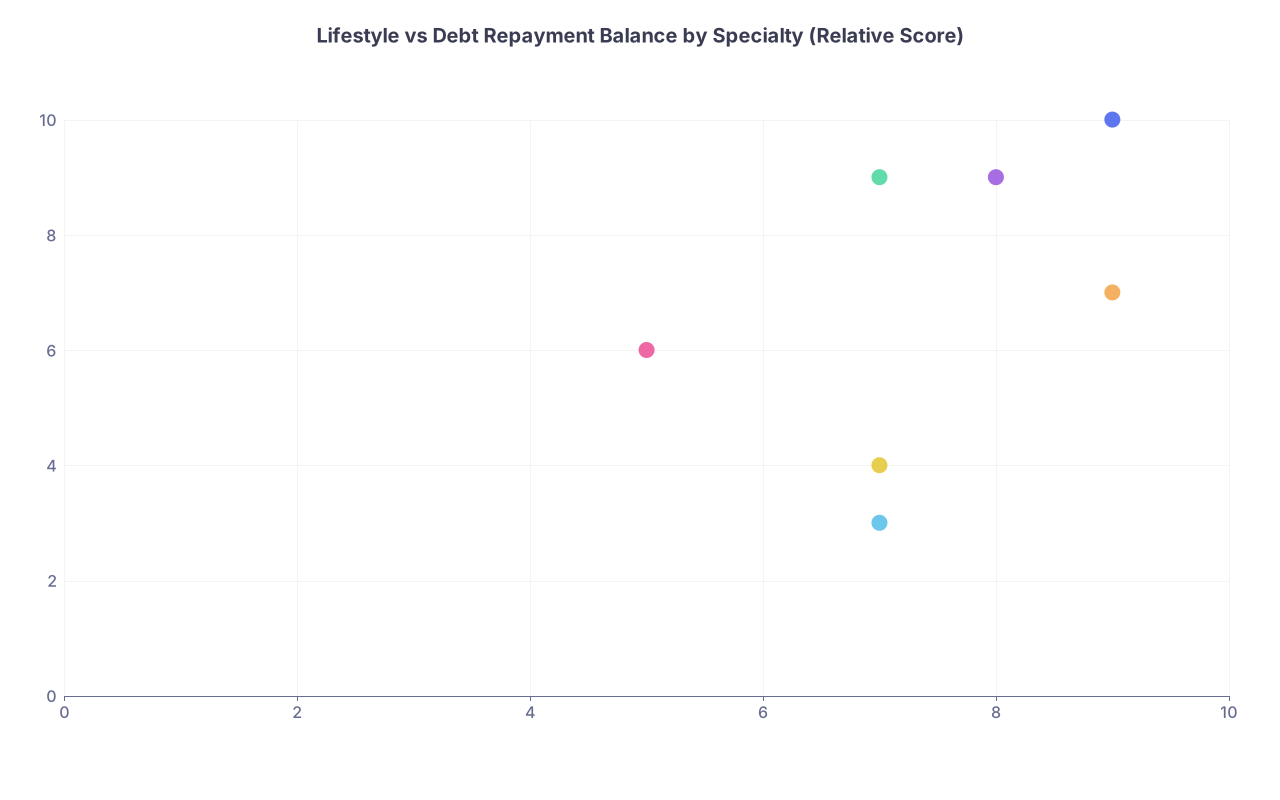
To visualize the trade-offs more cleanly:
| Category | Value |
|---|---|
| Dermatology | 9,10 |
| Emergency Med | 8,9 |
| Anesthesiology | 7,9 |
| Outpt Psych | 9,7 |
| Hospitalist IM | 5,6 |
| Pediatrics | 7,3 |
| Family Med | 7,4 |
Here the x-axis (first number) is lifestyle flexibility (1–10) and the y-axis (second number) is debt repayment power (1–10), normalized from the income, hours, and call data we walked through.
Derm, EM, anesthesia, and psych cluster in the upper-right. Peds and FP drift down on the debt axis, even though lifestyle can be quite good subjectively.
8. A Realistic Residency-to-Attending Trajectory
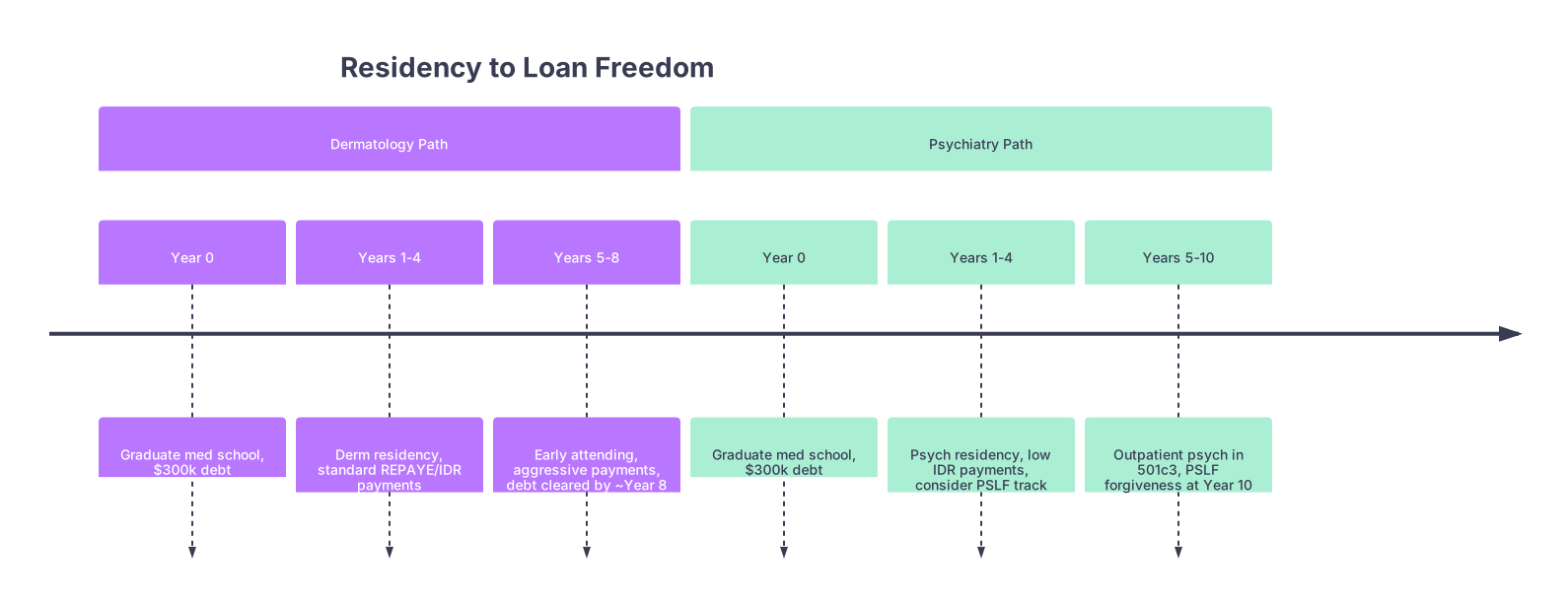
Debt and lifestyle do not start the day you become attending. They build from MS4 on. Let me map a simple career arc for a psych resident vs a derm resident to show the cumulative effect.
| Period | Event |
|---|---|
| Dermatology Path - Year 0 | Graduate med school, $300k debt |
| Dermatology Path - Years 1-4 | Derm residency, standard REPAYE/IDR payments |
| Dermatology Path - Years 5-8 | Early attending, aggressive payments, debt cleared by ~Year 8 |
| Psychiatry Path - Year 0 | Graduate med school, $300k debt |
| Psychiatry Path - Years 1-4 | Psych residency, low IDR payments, consider PSLF track |
| Psychiatry Path - Years 5-10 | Outpatient psych in 501c3, PSLF forgiveness at Year 10 |
Two different strategies, both viable:
- Derm: Use high income to crush loans in ~4 attending years.
- Psych: Use PSLF alignment and moderate income to reach forgiveness at 10 total years.
Either way, you escape debt before your mid-40s with room for a sane lifestyle.
9. How to Use This Data Before You Lock in a Path
Here is the honest hierarchy for decision making if you care about both money and your life outside the hospital:
Start with your tolerance for call and nights.
If you hate nights and weekends, you need fields where those are structurally limited: derm, outpatient psych, outpatient IM/neuro, some anesthesia settings.Overlay the income and hours.
Use realistic MGMA/Doximity ranges, not cherry-picked anecdotes. Ask attendings what they actually make and how much they actually work.Model your loans explicitly.
Take your projected balance, plug it into a loan calculator at 6–7%, and see:- What does a 10-year standard payoff cost annually?
- How does that compare in EM vs psych vs derm vs peds?
Decide early if PSLF is your route.
If yes, peds/FM/IM/psych look far better. If no, high-earning, lifestyle-friendly specialties become disproportionately attractive.Remember: FTE is a dial, not a switch.
In high hourly-value fields (derm, EM, anesthesia, psych), going from 1.0 FTE to 0.8 FTE may still leave you with more net income than a full-time lower-paying field, with more free time. That is the ultimate hack.
Key Takeaways
The specialties that most effectively balance loan repayment and lifestyle—based on hours, income, and flexibility—are dermatology, emergency medicine, anesthesiology, and outpatient psychiatry, with outpatient neurology/IM as solid middle options.
Fields like pediatrics and family medicine can offer good subjective lifestyle but are objectively weak for rapid debt payoff unless you stack forgiveness programs, rural stipends, or PSLF.
Your best move is to treat specialty choice like a quantified decision: model your debt, plug in realistic hours and income for each field, and choose the path that puts you in the high hourly, high-control quadrant rather than just chasing prestige or vague notions of “work–life balance.”