
You’re 6 months out of residency. Your first attending job is… fine. The schedule is heavier than promised, the RVU pressure is real, vacation approvals are slow, and you’ve already seen one partner burn out. You keep hearing about colleagues doing locums full‑time—working a few intense weeks, then disappearing to hike, travel, or just sleep.
You’re wondering: is locum tenens actually a viable long‑term career path for a specialist, or is it just a stopgap between “real jobs”?
Here’s the answer you’re looking for: yes, locums can be a sustainable long‑term career for specialists—but only if you’re honest about your priorities, intentional about your setup, and realistic about the trade‑offs.
Let’s break it down like an adult career decision, not a glossy recruiter pitch.
The Core Question: Can You Build a Whole Career on Locums?
Yes. I’ve seen cardiologists, anesthesiologists, hospitalists, EM docs, intensivists, radiologists, and even subspecialists like GI and interventional cardiology live on locums for 5–15+ years.
But they fall into a few clear patterns:
| Profile Type | Typical Priority |
|---|---|
| High-income maximizer | Max cash, accept travel |
| Lifestyle optimizer | Time off, flexibility |
| Geographic sampler | Try many locations |
| Burnout recovery | Step away from politics |
| Bridge-to-something-else | Income while building next step |
Notice what’s missing: “wants stable, predictable, permanent team and leadership role.” If that’s you, full-time locums will frustrate you.
So the first filter: if you need long-term stability, deep roots in one system, and a defined promotion path, make locums a side tool, not the main engine.
If you care more about money, time, and autonomy than titles and office politics, locums can absolutely be your main career vehicle.
The Money Question: Will You Come Out Ahead?
Short version: as a specialist, most of the time, yes—you’ll earn more with locums, especially if you’re willing to be mobile and take less cushy assignments.
Typical patterns I see:
EM / Hospitalist / Anesthesia / Intensivist
- W‑2 employed: solid but capped salary, RVUs, bonus games.
- Locums: higher hourly/day rates, premium for nights, weekends, rural, critical need.
- Downside: unpaid downtime, variable volumes, less control over long‑term schedule.
Procedural subspecialists (GI, Cards, Ortho, IR)
- Employed groups can be extremely lucrative once partnership hits—but the first years can be rough and political.
- Locums: high daily rates, less upside than a killer partnership, but more immediate cash, less buy‑in drama.
Non-procedural subs (Endo, Rheum, ID, Heme/Onc)
- Demand is climbing fast; locums rates are improving.
- Long-term, you may end up blending locums + telemedicine + part-time employed for optimal income.
The piece people ignore: the “dead space” between jobs. With locums, if one assignment drifts down in volume or politics get weird, you can cut your losses and pick up another. That flexibility is financial leverage.
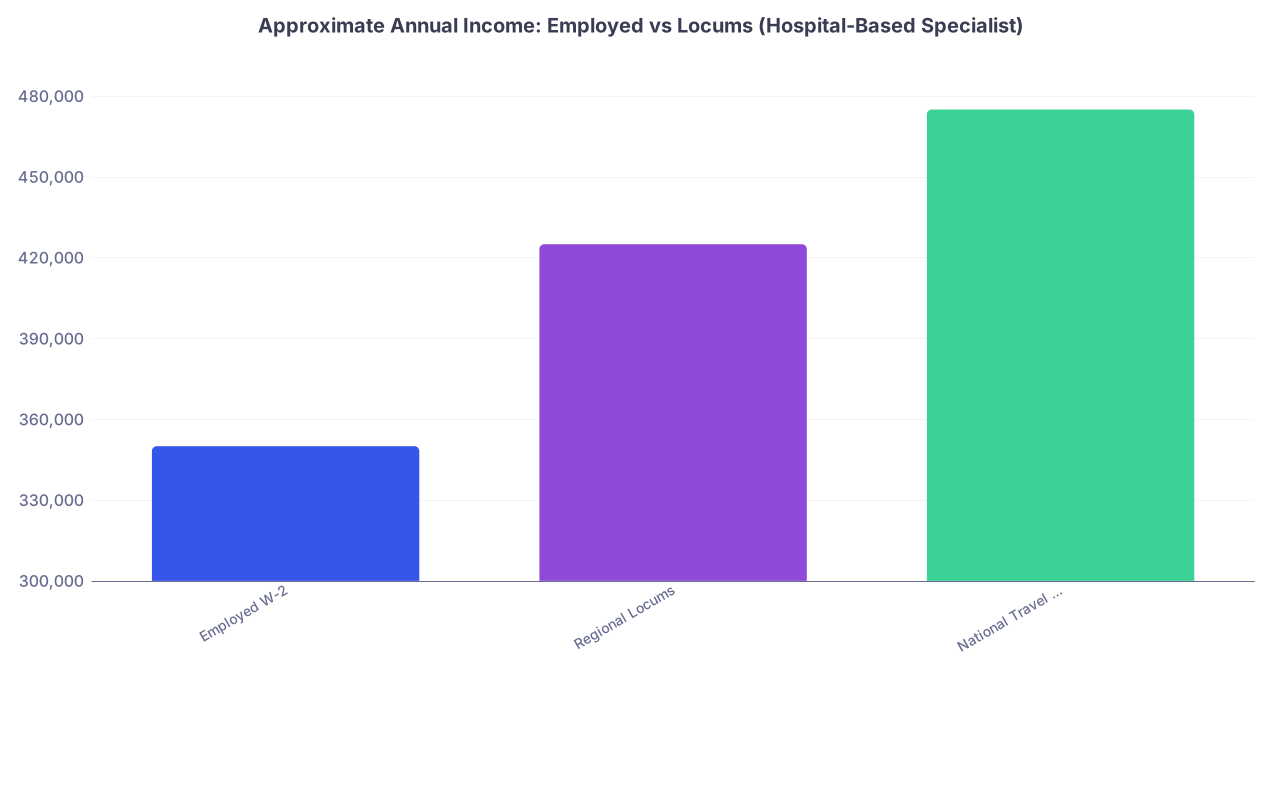
Here’s a rough comparison for a hospital-based specialist who is willing to travel:
| Category | Value |
|---|---|
| Employed W-2 | 350000 |
| Regional Locums | 425000 |
| National Travel Locums | 475000 |
These are ballpark numbers, not guarantees. But if your priority is total pre-tax income and you’re not tied to one city, locums usually wins.
Caveats:
- No built-in retirement match—you must DIY 401(k)/solo 401(k)/SEP.
- No automatic disability insurance—you must buy and maintain it yourself.
- You have to budget for the down weeks. No work = no pay.
If you’re financially sloppy, full-time locums can magnify your problems. If you’re disciplined, it can accelerate financial independence.
The Stability Trade: How Risky Is a Full-Time Locums Career?
You’re not crazy to worry about this. Long-term locums has real risks, and you should be clear-eyed about them.
Contract and volume risk
Hospitals change leadership. Groups lose contracts. Census drops. You can get a “we’re cutting back your shifts” email with two weeks’ notice.
That’s why mature locums docs almost always:
- Maintain relationships with 2–3 agencies (not just one).
- Keep a small portfolio of sites they can rotate through.
- Stay on top of credentialing at a couple of backup hospitals.
If you rely on a single site for 80–90% of your income, you’re basically in an at‑will job without the benefits. That’s dumb. Spread the risk.
Credentialing and licensing burden
As a specialist, especially in higher-risk fields, credentialing can be a slog:
- 60–120 days is common.
- Multiple state licenses if you want regional/national options.
- Endless references, procedure logs, CME tracking, etc.
Does it kill locums as a career? No. It just means you need to think 3–6 months ahead, not 3–6 weeks.
Malpractice and legal risk
Most locums agencies cover malpractice, usually claims‑made. A few key points:
- Check tail coverage if you stop using a given agency.
- Understand limits (e.g., $1M/$3M vs $2M/$4M).
- For high‑risk specialties (OB, neurosurg, IR), be extra picky about policy details.
If you bounce between agencies for years, you’ll have a patchwork of coverage histories. Keep all your policy info organized. Future lawyers will not care that you “think the agency handled it.”
Lifestyle Reality: Does It Actually Feel Better Than a Permanent Job?
Often, yes. But not automatically.
Let’s be blunt about what actually improves:
Control over your time.
You can stack 10–14 shifts in a row, then disappear for 2–3 weeks. Try asking a traditional group for that.Freedom from meetings and politics.
You are not going to the 7 am “strategic update” about some new EHR widget. You show up, do the work, sign the charts, and leave.Location flexibility.
You can winter in Arizona, summer in the Pacific Northwest, and avoid crime-ridden or understaffed places if you choose. Or you can do the opposite if the money is right.
But some things absolutely get harder:
Personal relationships and family life.
If you have a spouse locked into a job, kids in school, aging parents nearby—jumping state to state for months at a time will strain everyone. Some people manage it with regional assignments and commuter setups, but you have to plan intentionally.Professional community.
You won’t have one “home crew” unless you cultivate it. Many permanent staff see locums rotate through as background. If connection and mentorship matter, you’ll have to work to build it.Day-to-day friction.
You’re constantly learning new EHRs, phone trees, and unwritten rules. In Epic at site A, “stat” CT means 30 minutes. At site B, it means 3 hours unless you physically call radiology. You adapt, or you get burned.
If you’re early in your career and still ramping up your skill set, that last piece matters. Some specialties lend themselves better to long-term locums because the workflows are more standardized.
Specialty-Specific Reality Check
Not all specialties are equally suited to a 100% locums career. Here’s the honest view.
| Specialty Type | Long-Term Locums Fit |
|---|---|
| EM / Hospitalist / CCM | Excellent |
| Anesthesia | Excellent |
| Radiology / Telerads | Very Good |
| General Surgery | Good |
| GI / Cards / Ortho / IR | Mixed (site-dependent) |
| Outpatient subs (Endo, Rheum, Neuro) | Variable |
A few nuances:
Emergency Medicine & Hospitalist
Locums is practically built for you. Shift-based, 24/7 coverage, constant demand. Long-term locums careers are very common here.Anesthesia & Critical Care
Great fit. High rates, flexible schedules. Just watch call requirements and case mixes—some places will dump every train wreck on “the locums.”Radiology
Teleradiology has blown this wide open. Many rads are basically doing locums full-time from home, across multiple states. Licensing and credentialing are the bottlenecks, not demand.Surgical & procedural subspecialties
Long-term locums is possible, but you’ll often be:- Covering call gaps
- Filling in for FMLA/retirement transitions
- Handling community hospitals that can’t recruit a permanent doc
These can be lucrative but chaotic. Routine elective practice with your own long-term patient panel—much harder to achieve as a pure locums surgeon.
Clinic-heavy specialties (Endo, Rheum, Neuro, Allergy)
Locums can cover gaps, but building a stable, long-term locums career is trickier. Continuity matters more, and clinics may prefer a permanent solution. You may end up blending locums with telemed or part-time employment.
The Business Side: Can You Build Real Security on Locums?
You’re basically running a small professional services business. If you treat it like “just picking up shifts,” your long-term position will be weak.
Here’s what the long-term locums specialists who are actually secure do:
Set up the right structure.
Often an S‑corp or LLC taxed as S‑corp (talk to an actual accountant, not a recruiter). It lets you:- Optimize taxes (salary vs distributions)
- Deduct travel, CME, licensing, home office (within reason)
- Keep clean books for future options (buying a home, starting a practice, etc.)
Build real reserves.
They keep:- 3–6 months of living expenses in cash or very liquid assets
- An additional buffer for malpractice tail or surprise tax bills Locums income can be lumpy. If your checking account is always on fumes, you will feel very unsafe.
Create a benefits package for themselves.
- Solo 401(k) or SEP for retirement.
- Individual disability and life insurance.
- Healthcare via ACA marketplace, spouse’s plan, or a small-group policy if running a true business.
Keep optionality alive.
They maintain:- A clean CV without insane gaps or constant 1-month stints.
- Contact with a few academic or large system colleagues.
- Procedure logs, CME, ABMS certification, all up to date.
Why? So if they want to pivot back to a permanent role at 45 or 50, doors are still open.
When Long-Term Locums Is a Bad Idea
Let me be blunt where people get hurt:
Long-term full-time locums is usually a bad fit if:
- You’re extremely risk-averse and have high anxiety about uncertain schedules.
- You want to be medical director, section chief, or climb an institutional ladder.
- Your spouse and kids are deeply tied to one location and expect you home daily.
- You’re already drowning in disorganization—late on charts, taxes, CME, bills.
- You crave one close, stable group of colleagues more than anything else.
In those cases, locums is better as a supplement or a bridge, not the main path.
How to Test This Without Blowing Up Your Life
You don’t need to commit for 20 years on day one. You test it in controlled ways.

| Step | Description |
|---|---|
| Step 1 | Start Employed |
| Step 2 | Pick Up PRN Locums Shifts |
| Step 3 | Keep Locums as Side Income |
| Step 4 | Increase Locums, Reduce FTE |
| Step 5 | Save 6-12 Months Expenses |
| Step 6 | Try 6-12 Months Full Time Locums |
| Step 7 | Return to Hybrid or Employed |
| Step 8 | Commit to Long Term Locums Strategy |
| Step 9 | Like the Work and Lifestyle |
| Step 10 | Meets Income and Lifestyle Goals |
Smart way to do it:
- Start with a few locums weekends or a week of vacation at your primary job.
- See if you can handle the travel + new system + different team dynamic.
- Track your actual after-tax income versus your usual work.
- Pay attention to how your family reacts to your being away more.
If, after 6–12 months of part-time locums, you’re happier, richer, and less burned out, then consider ramping up. If not, you just learned something valuable for a small cost.
Key Takeaways
Locum tenens can absolutely be a viable long-term career path for many specialists—but it’s a better fit for those who value autonomy, income, and flexibility over stability, titles, and deep institutional roots.
The doctors who succeed long-term in locums treat it like a business: diversified sites, strong financial planning, proper legal/insurance setup, and a clear backup plan.
You do not have to decide forever right now. Start with controlled experiments—part-time locums, hybrid arrangements—and let real data from your own life tell you if long-term locums is your lane.