Most physicians doing locums are flying blind. They chase random contracts, bounce between states, and then wonder why their schedule, income, and sanity never stabilize. That is backward.
You are not “picking up shifts.” You are building a rotation circuit. A predictable, multi-state loop of hospitals and dates that works for you, not against you.
Here is how to engineer that on purpose.
Step 1: Decide What Your Circuit Actually Needs To Do
Before you touch recruiters, licenses, or contracts, you need a concrete target. Otherwise, agencies will happily design your life for you. You will not like the result.
Answer these non-negotiables first:
Income floor
- How much pre-tax per month must you clear?
- Example: “I need a minimum of $28k/month gross to cover taxes, loans, and savings.”
Work intensity
- How many clinical days per month can you tolerate long term (not just for 3 “hero” months)?
- Example: “14–16 shifts/month max; no more than 7 in a row.”
Lifestyle boundaries
- Where you absolutely will not work (region, climate, call burden).
- What is off-limits: 24-hour in-house call? Solo night coverage? Critical access with no backup?
Practice style
- ED vs inpatient vs outpatient vs hospitalist/nocturnist vs OR-heavy vs clinic.
- Academic vs pure community.
- Level I trauma center vs rural ED with you and one nurse.
Travel preferences
- Fly vs drive.
- Maximum travel time door-to-door.
- Will you keep a car stashed near a hub airport?
Put this into a one-page “locum spec.” This is what you test every opportunity against.
Example spec for a hospitalist:
- Income: ≥ $300k/year equivalent (about $25k/month gross).
- Shifts: 14–16 12-hour shifts/month; prefer 7-on/7-off blocks.
- Scope: No ICU procedures; open ICU with intensivist coverage only.
- Geography: West + Midwest only; avoid Northeast winters.
- Travel: Direct flight from DEN or SLC; max 1 connection.
- Lifestyle: No more than 3 different facilities in the circuit at any time.
That page becomes your filter. Anything that does not fit is a no, no matter how breathless the recruiter sounds.
Step 2: Choose 2–3 Anchor States (Not 8 Random Ones)
The biggest mistake I see: new locum physicians apply to 6–10 state licenses “to keep options open,” spend thousands, then discover that only 2 of them actually have work that fits their life.
You want anchor states, not a license zoo.
Use these criteria to pick 2–3 anchor states:
Volume of locum work in your specialty
- Talk to multiple agencies, not just one. Ask bluntly:
- “Which three states are you consistently filling hospitalist shifts in right now?”
- “Where did you place the last three EM physicians like me?”
- Compare answers. Patterns will jump out—TX, CA, AZ, WA, etc.
- Talk to multiple agencies, not just one. Ask bluntly:
Licensing practicality
- Is the state in the Interstate Medical Licensure Compact (IMLC)?
- Typical licensing times: 4–6 weeks through compact vs 3–9 months standalone.
- Fees: Some states are comically expensive and slow. Skip them initially unless the job is exceptional.
Travel routing
- Choose states you can reliably reach via:
- One major hub airport you like (DEN, ATL, DFW, PHX, SEA, etc.).
- Easy connections, not three-hop itineraries through nowhere.
- Think like a pilot. You want routes that are robust in bad weather.
- Choose states you can reliably reach via:
Tax and cost-of-living considerations
- High state income tax + mediocre rates? Hard pass unless the volume and schedule are perfect.
- No-income-tax states (TX, FL, NV, WA, TN, WY, SD, AK, NH on interest/dividends) are often more attractive, if the work quality is decent.
Clinical fit
- Are the types of hospitals in that state aligned with your skill set?
- Example: A fresh grad without significant ICU experience should not build an anchor in a state where half the gigs are solo intensivist-lite hospitalist roles.
| State | Locums Volume (Hosp/EM) | IMLC Member | Tax Climate | Typical License Time |
|---|---|---|---|---|
| Texas | High | No | No income tax | 3–5 months |
| Arizona | High | Yes | Moderate | 4–6 weeks (IMLC) |
| Washington | Moderate-High | Yes | High tax | 4–8 weeks (IMLC) |
| Florida | High | Yes | No income tax | 4–8 weeks (IMLC) |
| California | Very High | No | High tax | 4–9+ months |
Pick 2 states to start, maybe a third in month 6–12 after your circuit stabilizes.
Step 3: Get Licensing and Credentials on an Assembly Line
Licensing and credentialing are where physicians lose months to chaos. You are going to systematize it.
3.1 Build your “credentialing packet” once
Create a folder (local + cloud backup) with:
- Current CV (month/year format, no gaps).
- Medical school diploma + residency certificate.
- Board certification proof.
- DEA + state controlled substance registrations.
- Driver’s license, passport, and a professional headshot.
- Malpractice claims history (5–10 years).
- Procedure logs if relevant to your field.
- Immunization records (Hep B, MMR, Varicella, TB tests, COVID).
- BLS/ACLS/ATLS/PALS cards as appropriate.
- Three reference letters / contact list (people who actually answer their phone).
You want to be able to reply to a credentialing request with: “Attaching full packet; let me know if anything is missing.”

3.2 Use the IMLC if you qualify
If your primary license state is IMLC-eligible, stop overthinking and use it.
- Apply for compact eligibility first.
- Then add member states as needed (AZ, WA, FL, etc.).
- The time saved is often the difference between getting into a circuit this year vs next.
3.3 Stagger your applications
Do not shotgun all states at once. Use a sequence:
- Month 0:
- Apply for anchor State 1 license (and IMLC if eligible).
- Month 1:
- As State 1 progresses and jobs solidify, add State 2.
- Month 3–6:
- Only add State 3 if:
- You actually have a contract offer, and
- Your current circuit cannot provide enough work.
- Only add State 3 if:
This prevents the “$5,000 in unused licenses” problem I see every year.
Step 4: Secure 2–3 “Core” Facilities Before You Overextend
Your circuit is not “nationwide availability.” It is a small, repeatable loop of facilities that know you.
Target: 2–3 core sites across 2–3 states where you are on the schedule every 1–3 months.
How to pick good core sites
Look for facilities that:
- Offer recurring blocks, not just one-off emergency coverage.
- Have reasonable onboarding (EPIC/Cerner training once, not 5 days unpaid nonsense).
- Treat locums as partners, not warm bodies.
- Staff predictably: they know their schedules 2–4 months out.
Red flags:
- “We post the schedule 2 weeks in advance.”
- Constant frantic texts: “Can you cover tomorrow?”
- Chronic under-staffing with unsafe ratios.
- Multiple canceled contracts for other physicians in the past year.
What to say to recruiters and medical directors
You are not passive here. You are designing a circuit. So speak like it.
- “I am looking to build a long-term rotation circuit. I prefer to return to the same facility monthly or every other month.”
- “I can commit to 7–10 shifts/month if we can pre-book 3 months at a time.”
- “If the first 2–3 weeks go well, I would like to be on your recurring schedule. Can we discuss a pattern?”
You are signaling: “I am not a one-and-done traveler. I am reliable capacity.”
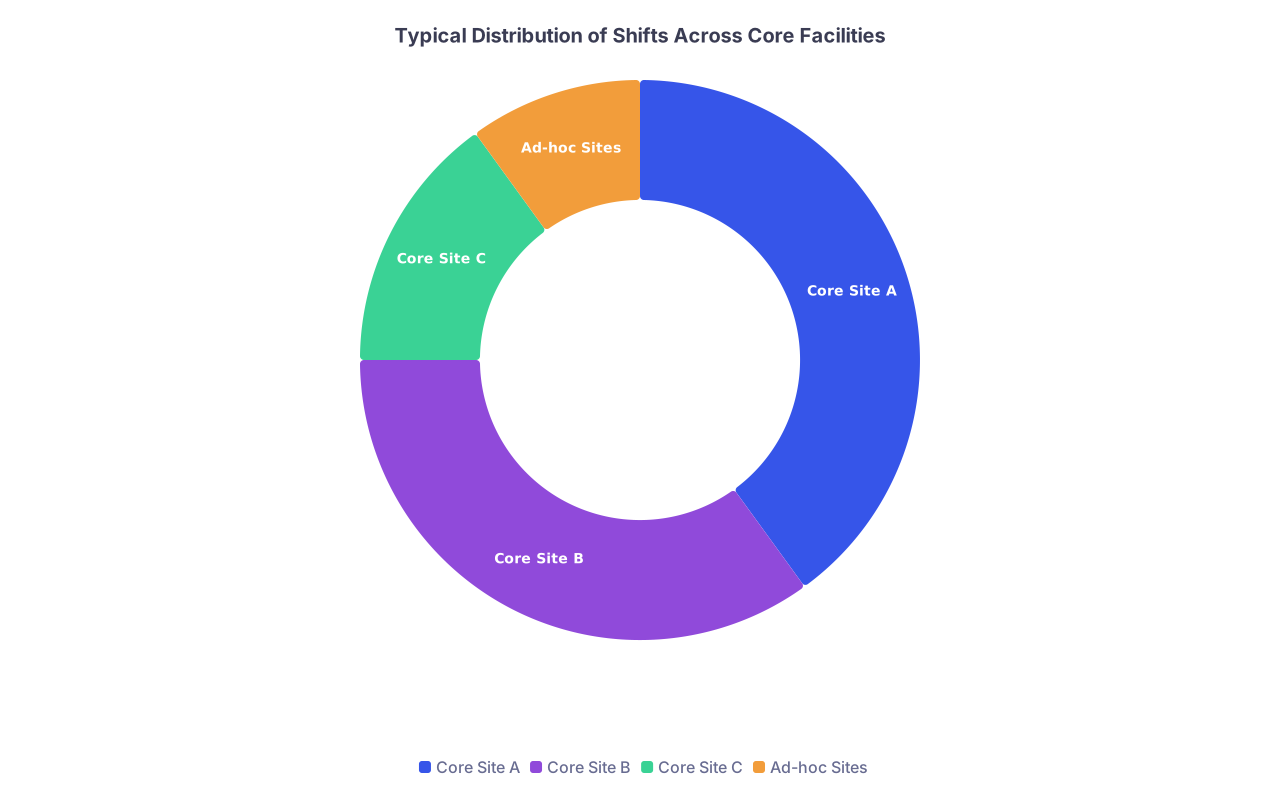
| Category | Value |
|---|---|
| Core Site A | 40 |
| Core Site B | 35 |
| Core Site C | 15 |
| Ad-hoc Sites | 10 |
A very workable model:
- Core Site A (State 1): 7 shifts/month
- Core Site B (State 2): 5–7 shifts/month
- Occasional Site C (backup): 2–4 shifts/month
That is a circuit. Not glamorous, but stable and bankable.
Step 5: Design a Rotating Calendar That Actually Works
You are trying to avoid the “ping-pong chaos” pattern: CA one week, NY the next, TX the week after, all red-eyes and no sleep.
You want geographic and temporal clustering.
Use a simple monthly frame
Example for a hospitalist who likes 7-on/7-off:
- Week 1: Core Site A (AZ)
- Week 2: Off / Admin / Family
- Week 3: Core Site B (WA)
- Week 4: Off / Optional extra shifts (float)
Or an EM circuit:
- Days 1–10: Core Site A (TX) – mix of days/nights.
- Days 11–17: Home + recovery.
- Days 18–25: Core Site B (CO).
- Days 26–30: Available for a short 3–4 shift block at either site if they need.
Use one master calendar and stick to it. If a new offer conflicts, your default answer is no.

| Step | Description |
|---|---|
| Step 1 | Week 1 - Site A State 1 |
| Step 2 | Week 2 - Off |
| Step 3 | Week 3 - Site B State 2 |
| Step 4 | Week 4 - Off or Float |
Cluster travel by region and season
- Winter:
- Favor states with less brutal winter travel (AZ, NV, FL, TX vs ND, ME).
- Summer:
- Fine to add upper Midwest or Northwest assignments if they are attractive.
If you drive between sites (common in the Midwest/West):
- Build loops: e.g., Denver → rural Wyoming → Utah → back to Denver.
- Leave a basic “travel box” in your car: scrubs, stethoscope, spare shoes, toiletries, spare white coat, chargers.
Step 6: Set Non-Negotiable Guardrails With Agencies and Facilities
You will quickly drown in “amazing opportunities” if you do not set clear rules.
Here are guardrails that protect your circuit:
Minimum block length
- “I do not travel for less than 4 consecutive shifts unless it is a driving distance assignment.”
Lead time
- “I confirm out-of-state assignments at least 30 days in advance.”
- Last-minute heroics should be the exception and very well paid.
Cancellation terms
- Push for:
- Cancellation penalty if they drop you within 30 days.
- Guaranteed minimum hours per shift (especially in EM and urgent care).
- If a facility cancels on you twice last minute with no penalty, they are off your circuit. Period.
- Push for:
Shift timing and pattern
- Night shifts? You either:
- Embrace them and build your circuit around them, or
- Set a strict limit (e.g., “No more than 4 consecutive nights” or “No nights at all”).
- Night shifts? You either:
Scope creep
- If a “no procedures” role starts turning into lines, intubations, cross-coverage on 40 extra patients, call it out early.
- “This is drifting beyond what I agreed to. If the role has permanently changed, we should reset the rate or reconsider the fit.”
You teach people how to treat you. That includes hospitals.
Step 7: Diversify Agencies Without Letting Them Run You
I rarely recommend working with only one agency. That hands them all the leverage. But juggling ten is also asking for chaos.
The sweet spot: 2–3 agencies, plus direct-hire at one or two facilities if you can manage it.
How to structure this:
- Agency A:
- Primary pipeline for State 1 and Core Site A.
- Agency B:
- Primary pipeline for State 2 and Core Site B.
- Agency C:
- Only for specific regions, or for backup if A/B cannot fill a month.
You tell them that. Directly.
- “I am already working with Agency X for State 1. I am happy to work with you for State 2 and 3, and for anything else that fits my circuit and schedule.”
This avoids contract conflicts and double-submission problems.
Step 8: Control Your Money Like a Business, Not Like a Tired Employee
A multi-state rotation circuit is a small business. If you treat it like gig work, taxes will teach you that lesson the hard way.
Build a clear financial model
Know your minimum accepted rate by adding:
- Your target annual gross (e.g., $350k).
- Estimated tax load (often 30–40% all-in as 1099).
- Travel time cost (unpaid hours).
- Licensing and credentialing friction.
Then turn it into a floor:
- “I do not accept less than $X/hour for EM shifts.”
- “My day rate floor for inpatient work is $Y.”
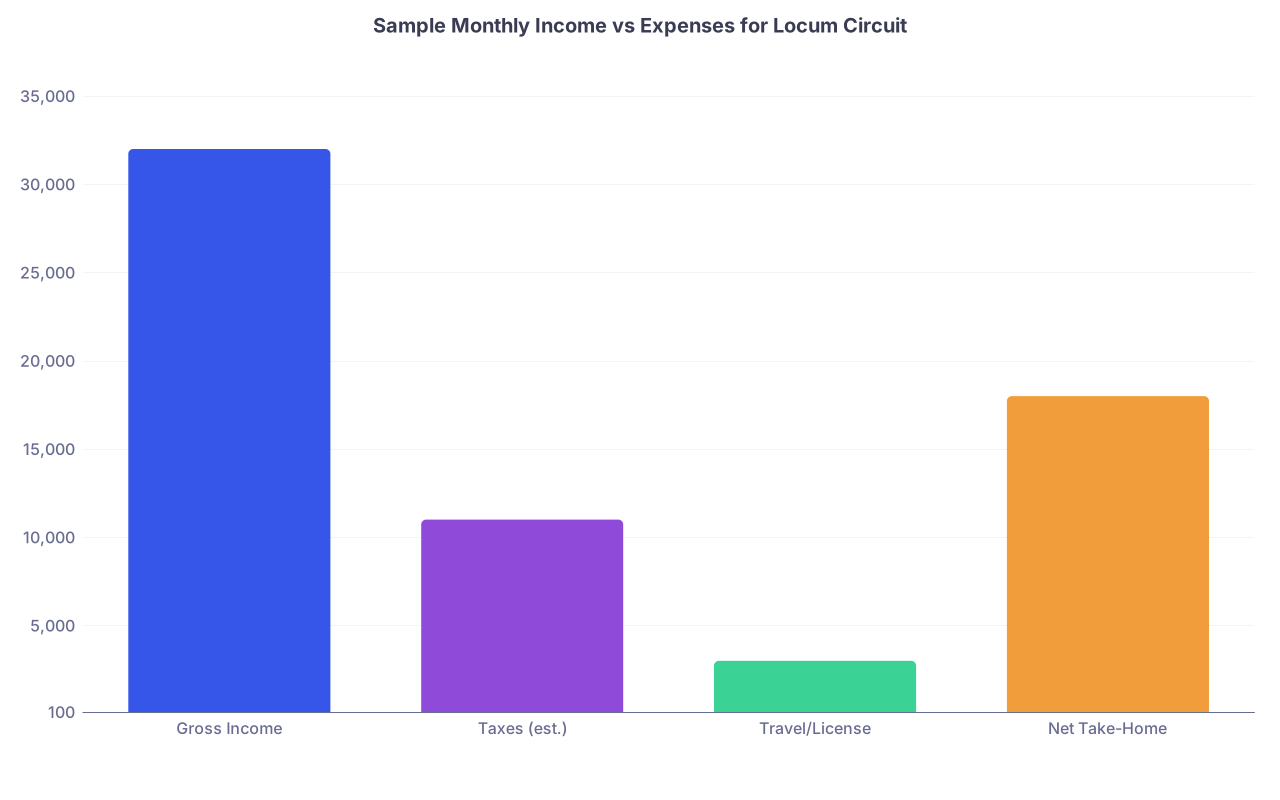
| Category | Value |
|---|---|
| Gross Income | 32000 |
| Taxes (est.) | 11000 |
| Travel/License | 3000 |
| Net Take-Home | 18000 |
Separate your finances
- Open:
- A dedicated business checking account.
- A tax savings account.
- Every payment:
- Automatically move 25–35% to the tax account.
- Track:
- Mileage, flights, hotels, meals while traveling, licensing fees, CME.
You want to be able to look at each site and ask: “What is my net hourly rate after real-world costs?” If a site looks good on paper but wrecks you with travel and unpaid time, drop it.
Step 9: Make Yourself “Frictionless” To Rebook
Hospitals build their own informal list of “go-to locums.” You want to be at the top.
How to do that without selling your soul:
Be predictable
- Show up early. Do your notes. Respond to admin emails within 24 hours.
- Never be the locum who refuses basic teamwork.
Communicate your returning availability early
- On week 2 of a rotation that you like:
- “I am opening my schedule for March and April. I can offer 7–10 days each month. Do you want first pick before I give dates to other sites?”
- On week 2 of a rotation that you like:
Reduce onboarding friction
- Keep a running notebook of:
- Order sets.
- Local workflows.
- Key phone numbers (ICU, pharmacy, consultant lines).
- When you return, you are already up-to-speed. That is gold to them.
- Keep a running notebook of:
Be honest about problems, early
- If a nurse manager or consultant is making your work impossible, document specific incidents and talk to the medical director like a peer, not a complainer. You are trying to fix the system so your next trip is better.
That is how you get: “We want you back every month. Name your dates.”
Step 10: Add, Drop, and Upgrade Sites Methodically
Your circuit is not static. The trick is to change it deliberately, not reactively.
When to add a new state or site
- Your current 2–3 sites:
- Cannot consistently give you your target # of shifts, or
- Are clearly trending worse (pay cuts, staffing mess, chronic cancellations).
- You have:
- A concrete offer that is better (pay/conditions), and
- A long enough contract window (3–6 months recurring).
Then:
- Test the new site for 1–2 blocks.
- If it passes your filter (pay, workload, culture), promote it to “core.”
- Demote or drop the weakest existing core site.
When to fire a site from your circuit
You do not need drama. Just be factual with yourself:
- Unsafe staffing you cannot fix.
- Repeated late schedule posting that ruins your planning.
- Chronic last-minute cancellations without compensation.
- Administrative hostility to locums.
Quietly finish your commitments. Decline future dates. Move on.

Step 11: Protect Your Health and Sanity Across States
Multi-state locum work looks glamorous on Instagram. In reality, it can grind you down fast if you do not build recovery into the system.
A few non-negotiables:
Guaranteed off days at home
- Do not sell them all for one more shift. Your future self will not thank you.
Sleep discipline
- Night shifts:
- Use blackout curtains, eye mask, and a consistent pre-sleep routine.
- Travel days:
- Never plan to land at midnight and start a 7 a.m. shift. You are not a machine.
- Night shifts:
Standardized kits
- One travel kit that always stays packed:
- Noise-canceling headphones.
- Cheap but decent stethoscope back-up.
- Chargers, dongles, backup scrubs, minimal workout gear.
- Reduces “I forgot X” stress.
- One travel kit that always stays packed:
Boundaries with agencies and schedulers
- You do not need to answer recruiter texts at 10 p.m.
- Set a window: “I respond to scheduling messages between 9 a.m. and 5 p.m. local time on weekdays.”
Step 12: Turn the Circuit Into Optionality (Not a Trap)
A well-built multi-state locum rotation circuit should give you options, not just more work.
You are buying:
- Freedom to say no to toxic full-time jobs.
- Income power to pay off loans faster.
- A broad view of how different systems run (or fail).
Over time, you may:
- Convert one of your core sites to a perm or part-time staff job if it is truly excellent.
- Pivot your circuit to more niche, high-paying work (rural critical access, high-acuity ED, etc.).
- Scale back as your financial goals are met.

Key Takeaways
Treat your locum work as a designed circuit, not random gigs. Choose 2–3 anchor states and 2–3 core facilities, then build a predictable rotation around them.
Systematize licenses, credentialing, and scheduling. Create one master credentialing packet, stagger state licenses, and insist on recurring blocks booked months in advance.
Protect your time, money, and health with hard boundaries. Set rate floors, block lengths, cancellation terms, and off-days—then enforce them. That is how you make locum tenens sustainable instead of chaotic.