
The biggest reason locum assignments fall apart is not pay, not schedule, not even the hospital. It’s licensure and credentialing you assumed were “handled.”
Let me be blunt: if you treat licensure and credentialing as background noise while you finish residency or your staff job, you’re setting yourself up to miss start dates, lose income, and get quietly blacklisted from some agencies and facilities. I’ve watched it happen more times than I care to count.
You’re post‑residency, entering the job market, maybe eyeing locums for flexibility or as a bridge gig. Good choice. But you can absolutely wreck that plan with a few very avoidable mistakes.
This is the landmine map. Read it before you step.
1. Believing “Licensure Will Be Quick” Because Someone Told You That
You will hear this line a lot: “This is a fast state. We can get you licensed in 6–8 weeks.”
Do not build your life around that promise.
State medical boards do not care about your travel plans or your contract. They care about:
- Primary source verification of your education and training
- Any gaps in training or employment
- Any disciplinary or malpractice history
- Whether your paperwork was 100% correct the first time
If any of that is slow, vague, or sloppy, that “fast” state becomes a 4–6 month saga.
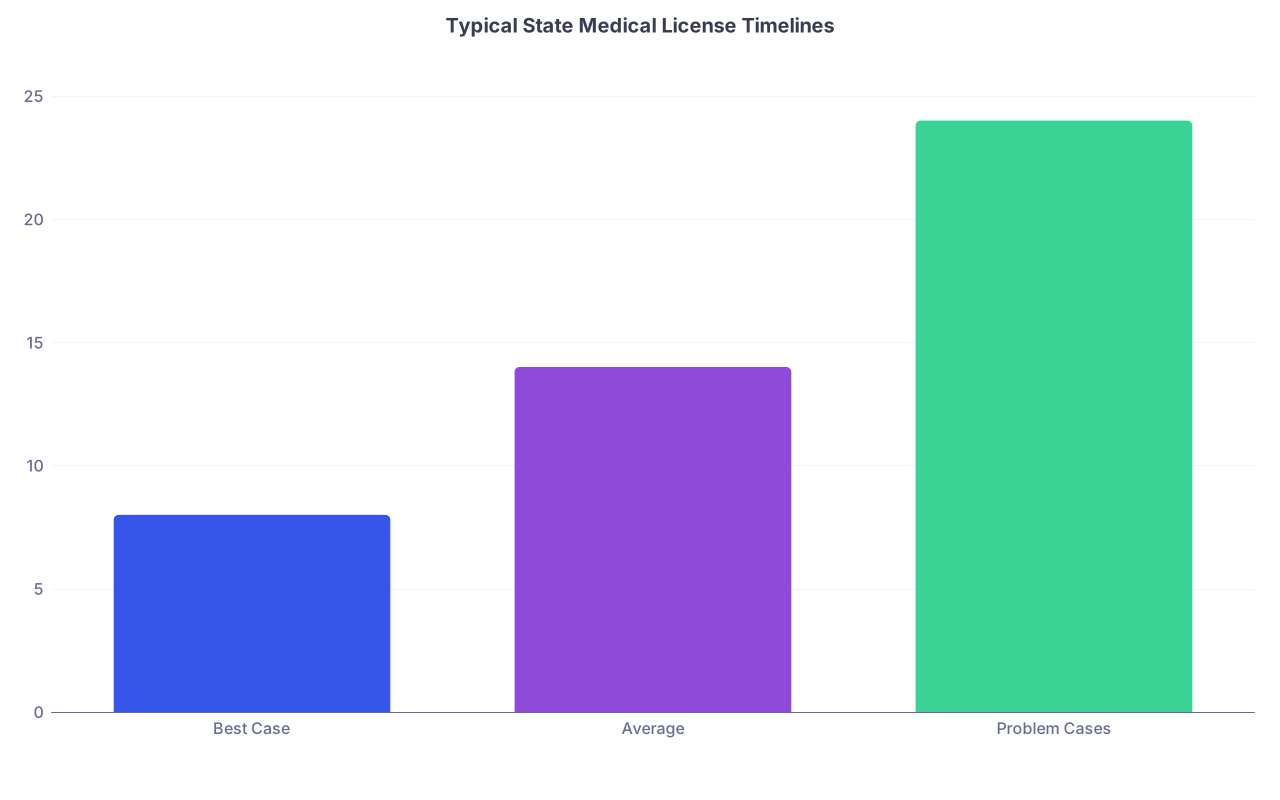
| Category | Value |
|---|---|
| Best Case | 8 |
| Average | 14 |
| Problem Cases | 24 |
(Values in weeks. Yes, 6 months happens. Frequently.)
The mistake
You sign a locums contract with a start date 8–10 weeks out based on the recruiter’s optimism. You give notice to your staff job. You line up travel. You maybe move.
Then:
- Board needs “clarification” from your program director
- Your med school is slow sending transcripts
- Your background check pings an address you forgot to list
- There’s one “yes” to a regulatory question (“ever been investigated?”) that triggers manual review
Suddenly the board meeting you needed to make is missed. Your start date moves. Then moves again. The site gets annoyed. They fill the slot with someone already licensed. You’re sitting at home without income.
How to avoid it
- Assume 12–16 weeks minimum for any new state license, even if the recruiter says “fast.”
- Do not tie your only income source to a start date contingent on new licensure unless you have serious savings.
- Push for assignments in states where you’re already licensed for your first locum gigs.
- If you’re using IMLC (Interstate Medical Licensure Compact), understand: it’s faster, not magical. Board backlogs still exist.
The adult thing: overestimate the time. If you’re pleasantly surprised, great. If not, you’re not panicking.
2. Treating Credentialing Paperwork Like an Afterthought
Licensure is one gate. Credentialing is another, and it can kill your start date all by itself.
Hospitals, health systems, and corporate groups credential at their own glacial pace. Many require:
- Detailed employment history (month‑accurate, no gaps)
- Explanations for any gap longer than 30–60 days
- Verifications from every employer, training site, and reference
- Copies of every license, DEA, board cert, ACLS/BLS, immunization records
- NPDB query, background check, drug screen
The mistake is assuming, “They have my CV, they’ll handle the rest.”
They will not. They’ll email you for missing pieces. If you ignore that email for a week because you’re on nights or on vacation, your file stops cold.
I’ve watched a perfectly good locums start date burn because a physician didn’t answer a simple “please explain this 4‑month gap” email for 10 days. That’s all it took.
Red flags that delay credentialing
- CV gaps with no explanation (even studying for boards needs to be stated)
- Inconsistent dates across CV, application, and references
- Unanswered “yes” responses on application questions (board action, malpractice, leave of absence)
- Missing immunization records (especially Hep B and TB)
- Slow references—attendings or chiefs who sit on forms for weeks
What you should do differently
- Block 1–2 uninterrupted days to complete the full hospital application, not 30 minutes between cases.
- Keep a master document with: exact employment dates, addresses, contact names, license numbers, NPI, DEA, board cert dates, and all your immunizations. Copy‑paste, do not re‑invent each time.
- Respond to every email from medical staff offices and credentialing departments within 24 hours—even if it’s just “Received, I’ll get you this by [date].”
Slow response from you = your file goes to the bottom of the pile. And they have a big pile.
3. Underestimating Payer Enrollment: The Silent Start‑Date Killer
Here’s a wonderful surprise locums doctors run into: the facility credentialing is done, you’re technically cleared to work, but you’re not enrolled with payers yet. That means:
- You can’t bill under Medicare/Medicaid yet
- Commercial plans won’t recognize you
- The site may not be able to use you for insured patients
Some hospitals will start you anyway and “billing will catch up.” Many will not. They’ll delay your start until enrollment is done. That can add weeks.

| Step | Description |
|---|---|
| Step 1 | Signed Locums Contract |
| Step 2 | State License In Process |
| Step 3 | Hospital Credentialing |
| Step 4 | Payer Enrollment |
| Step 5 | Final Start Date Confirmed |
| Step 6 | Start Date Pushed |
Common mistakes
- Assuming “credentialed” = “ready to bill”
- Not asking your agency who handles payer enrollment and average timelines
- Accepting a start date that doesn’t factor in payer timelines
Locums companies vary. Some handle enrollment proactively. Some leave it to the facility. Some… just hope it works out.
How to protect yourself
Ask, out loud, and in writing:
- “Who is responsible for payer enrollment—your agency or the facility?”
- “What payers do I need to be enrolled with for this assignment?”
- “What’s the realistic timeframe from complete application to active enrollment?”
- “Has this facility onboarded a new locums physician in the last 6 months? How long did it take?”
If they dodge those questions or say, “It’s usually fine,” assume it’s not fine. Adjust your timeline or pick another assignment.
4. Ignoring “Small” Application Questions That Aren’t Small
Every licensure and credentialing packet has those dreaded regulatory questions:
- Ever been investigated?
- Ever had privileges limited, suspended, or revoked?
- Ever had a malpractice claim, even if dropped?
- Ever had issues with substance use?
- Ever taken a leave of absence from training?
Your temptation: minimize, downplay, or “forget” something that feels minor or embarrassing.
Do not do this.
Two problems:
- Boards and hospitals cross‑check your answers with NPDB, previous applications, and sometimes references.
- Inconsistency is often worse than the underlying issue.
I’ve seen an assignment blow up because a physician checked “No” on “ever had malpractice claims” when NPDB clearly showed a settled case. Board flagged it. Hospital paused credentialing. Everyone froze. Start date gone.
Not because of the malpractice itself. Because of the discrepancy.
How to handle this like a grown‑up
- Answer every question honestly and consistently with prior applications.
- If you’re not sure whether something “counts,” assume it does and ask the credentialing specialist how to disclose it properly.
- Add a brief, factual explanation when needed: dates, circumstances, your role, and outcome. No drama, no excuses.
You’re not being graded on perfection; you’re being graded on trustworthiness and clarity.
Lying or omitting? That’s an automatic fail.
5. Letting Your Own Documents Expire While You’re “Too Busy”
Missing start dates isn’t always some big systemic failure. Sometimes it’s you forgetting that your DEA expires in two weeks.
Common culprits:
- DEA registration
- State controlled substance registration (in states that require separate one)
- ACLS/BLS/PALS
- Board certification / MOC requirements
- State medical license renewal
- Hospital‑specific required modules or trainings
Here’s what happens. Your license is fine, credentialing is almost done, and then someone notices your ACLS will expire 3 days before your start date. Many hospitals won’t clear you to start with an impending expiration like that. They’ll wait for updated proof, which triggers re‑verification. Now you’ve pushed your start by 2–4 weeks over a 4‑hour course.
| Document/Item | Dangerous Window Before Start |
|---|---|
| DEA Registration | 90 days |
| State License Renewal | 120 days |
| ACLS/BLS/PALS | 60 days |
| Board Certification Cycle End | 6 months |
| TB Test / Immunization Proof | 30–60 days |
What to do instead
- Build a simple spreadsheet or reminder system with all expiration dates and set alerts 6 months, 3 months, and 1 month before.
- Before you sign a locums contract, cross‑check your expiring items against the planned start and end dates.
- If something expires near the start date, renew it before you start paperwork, so you’re not injecting chaos mid‑process.
You cannot outsource this. Agencies try to remind you, but if their reminder hits your spam folder, you’re still the one not working.
6. Failing to Control Your CV, References, and Story
Credentialing and licensure aren’t just about checkboxes. They’re about whether your story makes sense.
Two common self‑sabotages:
- Sloppy CV – wrong dates, overlapping jobs you never actually worked simultaneously, missing gaps, outdated addresses.
- Unprepared references – people listed as references who are surprised to be contacted or who respond with vague or negative feedback.
Boards and medical staff offices are allergic to inconsistency. If your CV says you finished residency in 06/2025, your application says 07/2025, and your reference writes 05/2025, what does that trigger?
More questions. More verifications. More delay.
How to bulletproof this
- Update your CV with exact month/year for every position and training. No “2019–2022” nonsense.
- Account for every month after medical school. Studying, parental leave, health leave, research, unemployment—label it.
- Use the same CV for all applications in a given cycle. Don’t have five versions floating around.
- Call or email your references before listing them. Confirm they’re willing, available, and know your timeline.
If your PD, APD, or recent department chief hates paperwork and sits on forms, that’s not a great primary reference for rapid locums onboarding. Pick people who like you and answer email.
7. Thinking “My Agency Will Handle It” Means You Don’t Have To
Locum agencies promise white‑glove service. “We’ll take care of licensure and credentialing for you.”
Translation: they’ll send forms, track some pieces, and pester offices. They cannot:
- Make your med school send transcripts faster
- Make your PD answer verification emails
- Fix inconsistencies in your history without your input
- Decide how to answer regulatory questions for you
The dangerous mindset is passive: “They’ve got it.” So you:
- Don’t check your email regularly
- Don’t respond quickly to document requests
- Don’t chase down missing verifications
- Don’t ask where things really stand
Then three weeks before your start, you get the email: “We’re still waiting on X and Y. The hospital might need to push the start date.”
Now you’re furious at the agency. But you also haven’t logged into your portal or answered two credentialing emails in 10 days.
How to be the physician agencies prioritize
- Ask for a realistic timeline at the start: license, credentialing, payer enrollment. Not the “marketing” version.
- Request a weekly status update in writing listing exactly what’s outstanding and who owns it (you, the agency, the hospital, the board).
- Treat document/clarification requests as STAT orders. Same‑day or next‑day response.
- Keep your own folder (digital or physical) with every document you send. Don’t make them chase you for the same thing twice.
Agencies love physicians who make their job easier. Those physicians get more opportunities, faster starts, and more flexibility when things go sideways.
8. Overcommitting and Double‑Booking Based on Optimistic Timelines
One more landmine I see a lot: the aggressive hustler mindset.
You sign:
- A locums contract in State A (needs new license) starting August 1
- Another in State B (also new license) starting September 1
- You tell your current employer you’re done July 15
You’re trying to “stack” income. Reasonable goal. But you’ve built your entire life on two unissued licenses and two medical staffs you’ve never worked with.
If either state board or hospital slows down, the dominoes fall:
- Assignment A start moves to September
- Assignment B now conflicts or also moves
- You have no active work in August
- The agencies start to see you as “unreliable” even though much of this wasn’t your fault
Locums is supposed to buy you freedom, not force you into calendar gymnastics.
Smarter approach
- Anchor your initial locums work in states where you’re already licensed, even if pay is slightly lower.
- Stagger assignments so each new‑license assignment is backed up by work that doesn’t depend on new credentials.
- Never fully rely on an unissued license for your only source of income in the immediate next 60 days.
Risk spreads. Or it collapses all at once. Be on the right side of that equation.
9. Assuming Post‑Residency = Automatic Smooth Sailing
Post‑residency physicians have specific pitfalls that attending‑convert‑to‑locums folks don’t.
Watch for these:
- Training verifications: Your residency office may be swamped in June–August. That’s exactly when you need them fastest. Plan for the lag.
- IMMIGRATION/visa issues: If you’re on a J‑1 or H‑1B, locums can be complicated or impossible in certain settings. Don’t sign anything until you’ve talked to an immigration attorney who knows physician work.
- Gaps after residency: “Study time” or “travel” may look like red flags if you don’t label it clearly and consistently in your paperwork.
- Board exam timing: If you’re sitting for boards, some hospitals get nervous about credentialing someone whose board status is “pending.” Not all, but enough that you need to ask.
You’re not a fully anonymous, long‑standing attending yet. Systems scrutinize new grads more. Act accordingly.
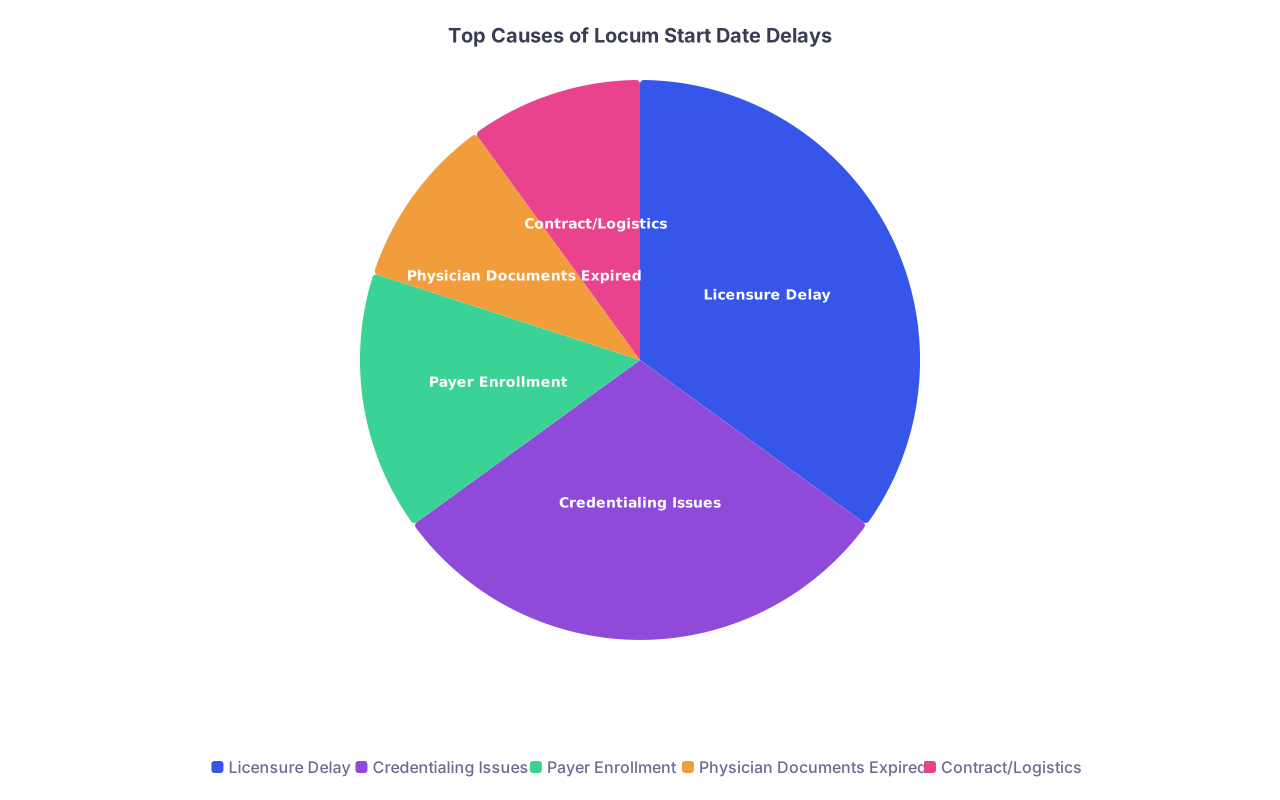
| Category | Value |
|---|---|
| Licensure Delay | 35 |
| Credentialing Issues | 30 |
| Payer Enrollment | 15 |
| Physician Documents Expired | 10 |
| Contract/Logistics | 10 |
FAQs
1. How early should I start licensure and credentialing work before a planned locum start date?
Six months out is safe; four months is the absolute minimum I’d gamble on for a new state license plus hospital credentialing. If you’re a new grad and need training verifications, start earlier. Do not wait until you’ve signed a contract to begin gathering documents—build your master file during your final months of residency or while still in your staff job.
2. Is the Interstate Medical Licensure Compact (IMLC) a guarantee of fast locums starts?
No. It’s an accelerator, not a guarantee. It can shorten state licensure time, but it does nothing for hospital credentialing, payer enrollment, or slow references. I’ve seen IMLC licenses issue in weeks and I’ve seen them stall for months due to missing verifications or background check questions. Use it, but don’t treat it as magic.
3. What single action would prevent the most missed locum start dates?
Own the timeline. Create a simple tracker with: each state license, each facility, what step they’re on, what’s pending, who is responsible, and realistic due dates. Then respond to every licensure/credentialing email within 24 hours. That alone—active, organized oversight by you—prevents more derailments than any fancy agency support ever will.
Key takeaways: Don’t trust optimistic timelines; build in brutal buffers for licensure, credentialing, and payer enrollment. Don’t go passive; you must drive your own paperwork, references, and documents like they’re critical clinical tasks—because they are. And do not stack your entire financial life on unissued licenses and uncompleted credentialing. Protect your start dates, and your locums career will actually work the way it’s supposed to.