
The politics of being the temp doc are brutal—and no one tells you the rules.
Locum tenens recruiters will sell you “flexibility,” “freedom,” and “great pay.” The permanent docs will smile and say, “We’re so glad you’re here.” Administration will call you “a valued partner.”
Behind closed doors? That’s not what gets said.
I’ve sat in those meetings. I’ve heard the program director mutter, “Just have the locum cover it.” I’ve watched permanent groups blame every systemic problem on “the temps.” And I’ve seen locums accidentally burn bridges they didn’t even know existed—simply because they didn’t understand the unwritten politics of being the outsider on a permanent team.
Let me walk you through what actually happens, and how to survive it with your reputation—and sanity—intact.
What You Really Are to Them (And Why That Matters)
Here’s the part nobody wants to say out loud: on most permanent teams, you are not a colleague first. You are a pressure valve.
You’re brought in because:
- Someone quit
- Someone went on leave
- Volumes spiked
- Admin delayed hiring
- Or the place is such a revolving door they live on locums
Officially: you’re “here to help the team.”
Unofficially: you’re there so the permanent docs can avoid drowning—and avoid making unpopular schedule changes.
The hierarchy in most places looks more like this:
| Priority Rank | Who Actually Comes First |
|---|---|
| 1 | Hospital administration |
| 2 | Permanent physician group |
| 3 | Nursing leadership |
| 4 | Advanced practice staff |
| 5 | Locums / temp physicians |
No one will say this explicitly, but you’ll feel it. Quickly.
You’re “out-group” from day one. That affects:
- How much support you get
- How your mistakes are interpreted
- How your suggestions are received
- Whether they ever invite you back
The biggest error new locums make? Acting like a permanent doc without the power or political capital of one.
The Quiet Resentment You Walk Into
There’s almost always pre-existing resentment around your arrival. You just do not hear it on day one.
Here’s the backstory I’ve heard in real conversations:
- The group doesn’t want to admit to admin they’re understaffed or mismanaged, so they frame your presence as “temporary support,” not structural failure.
- Some permanent docs fought against hiring locums at all, worried it would delay recruitment for a full FTE.
- Others resent that you’re getting paid more per shift than they are—while they’re stuck with the committees, inboxes, and chronic patients.
So when you show up, smiling, ready to help, there’s a running internal monologue on some of the permanent side that sounds like:
- “Must be nice to just fly in, work, and leave.”
- “Of course admin found money for locums but not for us.”
- “I hope they don’t expect us to fix whatever this person screws up.”
That’s the baseline you’re walking into. Understanding that changes how you move.
The ‘Temp Doc’ Stereotypes You’re Fighting
Before you even pick up a stethoscope, there’s a mental template you’re being matched against. It’s not flattering.
In leadership meetings, I’ve heard phrases like:
- “Locums dump.”
- “They admit everyone and turf the fallout to us.”
- “They don’t know our system.”
- “Quality dips when we bring in temps.”
Is that always true? No.
Is that believed? A lot more than you think.
So your real job the first few weeks isn’t just patient care. It’s disproving three specific stereotypes:
- The “lazy spoiler” – avoids procedures, avoids tough families, soft-admits, pads the census.
- The “chart disaster” – terrible documentation, no understanding of billing, leaves time bombs in the chart.
- The “vanishing ghost” – impossible to reach, doesn’t answer pages, disappears before sign-out.
You’re judged as a group, not as an individual. One bad locum five months ago will shape how they see you tomorrow.
You counter this not by big speeches but by consistent, boring reliability:
- You answer pages
- You close charts
- Your notes are clean
- Your handoffs are tight
Insider truth: a local nurse’s quiet, “This locum is actually really solid,” carries more weight than any recruiter’s promise or your CV.
How Power Actually Flows: It’s Not Through Your Contract
You think your contract defines your role. It doesn’t. Power in a permanent team flows through three channels:
- The core physician group
- Nursing leadership and charge nurses
- The hospitalist/ED/ICU “fixer” doc everyone trusts
If you don’t know who those people are by the end of day two, you’re already behind.
And here’s the part locums underestimate: nursing leadership can make or break you faster than any attending. I’ve watched this happen:
- Locum shows up, acts impatient at sign-outs, corrects a nurse abruptly in front of others.
- Charge nurse quietly tells the nurse manager, “This doc is unsafe and rude.”
- Within 48 hours: “We’ve decided not to extend your assignment.”
The official explanation? “We’re going in a different direction.”
The real one? The nurses voted no.
You need to identify the actual power structure:
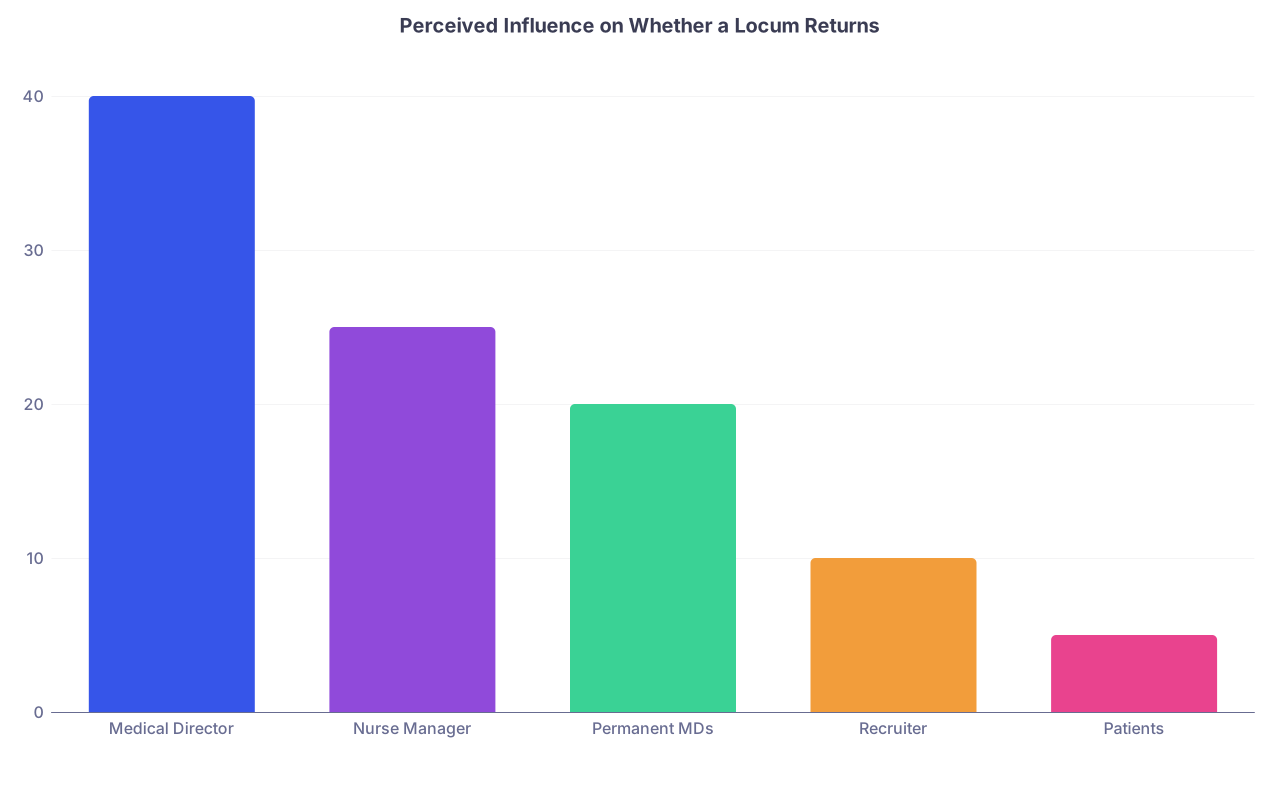
| Category | Value |
|---|---|
| Medical Director | 40 |
| Nurse Manager | 25 |
| Permanent MDs | 20 |
| Recruiter | 10 |
| Patients | 5 |
Those numbers are not from a formal study. They’re from sitting in debrief meetings.
Admin will listen to the medical director. The director will quietly ask the nurse manager and one or two senior docs, “Should we bring this person back?” That’s the real vote.
Day One: What You Do In The First 4 Hours Sets Your Label
Your first half-shift writes your label in people’s heads. They may never update it.
Here’s what savvy locums do the second they walk in:
They go straight to the charge nurse and say something like:
“I’m Dr. X, I’ll be with you for the next few weeks. I know I don’t know your system yet, so if I’m about to do something that doesn’t fit your usual flow, stop me. I’m here to make your day easier, not harder.”
And then they mean it.
They don’t brag about how many places they’ve worked. They don’t talk about how “broken” this or that EHR is compared to somewhere else. They don’t try to “fix” the hospital on day one.
They ask:
- “Who usually handles tough discharges here?”
- “How does your consult culture work—do you like early consults or only after we’ve tried X?”
- “Any unwritten rules about admissions between services?”

| Step | Description |
|---|---|
| Step 1 | Arrive |
| Step 2 | Find charge nurse |
| Step 3 | Ask about workflows |
| Step 4 | Meet unit clerk/secretary |
| Step 5 | Clarify sign out expectations |
| Step 6 | Start patient care |
Notice what’s missing? Marching straight to the physician lounge to complain about travel, pay, or prior jobs.
The permanent docs are watching how you treat their people. That’s what they care about.
The Schedule Games You’re Not Seeing
One ugly truth: you will sometimes be used as currency in internal politics.
I’ve literally heard a medical director say:
“Give the locum the weekend. I’m not pissing off our senior guy again this quarter.”
You will be:
- Given the worst stretches of nights
- Loaded with higher census “because you’re here to help”
- Used to cover unpopular sites, clinics, or units
If you push back clumsily, you get labeled “difficult” and you’re gone. If you never push back, you get exploited.
The sweet spot is controlled flexibility. You signal:
- “I’ll take my share of ugly shifts; I’m not here to cherry-pick.”
- “But I don’t do abusive nonsense, and I know my safety limits.”

| Category | Prime Day Shifts | Nights/Weekends | Holiday Coverage |
|---|---|---|---|
| Locum | 20 | 60 | 20 |
| Permanent | 40 | 40 | 20 |
The smart play: take some crap upfront, then renegotiate once you’ve proven your value.
By week two or three, after you’ve shown you’re reliable, you can say to the scheduler or director:
“I’m happy to keep pitching in on nights and weekends, but this current balance isn’t sustainable long term. Can we level it out a bit if I extend?”
You need leverage to make that ask. Leverage comes from: the nurses liking you, your notes being clean, and the permanent docs not dreading sign-out from you.
Blame, Complications, and Who Gets Thrown Under the Bus
Here’s a nasty little pattern nobody admits in public: when there’s a bad outcome or a patient complaint, the “temp doc” is the easiest scapegoat.
I’ve been in QA meetings that went like this:
- Case is reviewed.
- System failures identified.
- Documentation gaps from multiple people.
- But the note from the locum becomes the focal point.
Why? Because the permanent team has to work together long-term. You? You’re disposable. Politically low-risk to blame.
You protect yourself by:
- Rock-solid documentation.
Not wordy. Not obsessive. Clear thinking, clear plan, conscious decision-making. - Explicit handoffs.
“Discussed with Dr. X on night shift, plan agreed upon…”—you name names and times. - Owning your decisions in real time.
If you’re not sure, you call the ICU, the ED, the specialist. Quietly. Document it.
If something does blow up, don’t be naive. Ask directly:
“Will this be reviewed formally? I want to make sure my chart reflects what actually happened.”
That’s not defensive. That’s you understanding the game.
Culture Clashes: “How We Do It Here”
Permanent teams have rituals and norms that are invisible until you violate them.
Examples:
- One hospitalist group I know expects zero social admits. If you admit for placement, you’d better have bleeding on the floor.
- Another place likes early palliative care involvement. If you never involve them, you’re seen as “overly aggressive” and out of step.
- Some teams want every borderline patient admitted to medicine; others expect more aggressive ED discharge.
You figure this out by watching and asking:
- “How would you normally handle this borderline CHF patient—admit or obs?”
- “Do you guys run codes a particular way? Who usually takes the lead?”
- “Are there services that get irritated if we consult too early or too late?”

Permanent staff are hypersensitive to, “That’s not how we do it here.”
You saying that to them? Suicide.
Them saying that about you? Common.
Your line is: “Walk me through how you usually handle this here; I want to align with your standard.”
You’re not there to fix them in two weeks. Not unless you’re being explicitly paid as a consultant. You’re there to keep the machine running without jamming the gears.
Being Evaluated for a Permanent Job (Without Anyone Saying It)
Sometimes the “locum” role is secretly a prolonged job interview. Other times, it isn’t—but it turns into one anyway.
Here’s the trick: the criteria they use to judge locums as potential hires are different from what they claim publicly.
They do not care primarily about:
- Your publications
- Your exact training pedigree
- Your ability to quote guidelines from memory
They care about:
- Do nurses roll their eyes or light up when your name is on the assignment?
- Do you call for help appropriately or either never ask or constantly panic?
- Are your discharges clean or do they create outpatient chaos?
- Are your notes billable without causing compliance nightmares?
Over a couple months, this becomes obvious in the hallways.

| Category | Value |
|---|---|
| Team fit | 35 |
| Reliability | 25 |
| Clinical skill | 20 |
| Cost | 10 |
| Academic CV | 10 |
If you might want to stay somewhere, act like that from week one. Do not treat it like a throwaway gig and then suddenly pivot to “ideal colleague” when a permanent spot opens. The staff remember those first weeks.
On the flip side, if you know you would never work there long-term but they’re trying to court you, you need to be polite but clear early. Otherwise resentment builds when you inevitably say no.
Protecting Your Reputation Across Assignments
Programs talk. Recruiters gossip. Nursing managers move hospitals and take their opinions with them.
“The good locum” and “the disaster locum” become folk legends.
I’ve heard conversations like:
“Do you remember that locum who wouldn’t help with admissions after 4 p.m.?”
“Oh God, yes. Never again. If they’re using that agency, I’d avoid them; they send people like that.”
You want to be the name that, when it comes up, people say things like:
- “They worked hard.”
- “Didn’t complain.”
- “Did not dump on us.”
- “Took feedback well.”

One underused move: at the end of a longer assignment, ask the medical director or lead:
“I’ve been here a couple months now. Anything you’d suggest I do differently on my next assignment? I’m trying to get better at this role.”
You’ll get rawer feedback than most residents ever hear. And—equally important—that director now mentally categorizes you as a professional, not a mercenary.
Knowing When to Walk Away
Not every political game is worth playing.
There are hospitals where:
- Locums are set up to fail with impossible workloads
- Permanent docs offload all their worst patients and never reciprocate
- Admin cuts corners on safety because “we can always get another locum”
- The culture is: “Blame the temp” whenever anything goes wrong
You are not obligated to fix a toxic system on a two-month contract. You are obligated to:
- Practice safely
- Not lie
- Not trash the place publicly in ways that violate contracts or patient privacy
But you are absolutely allowed to decide, “This gig isn’t worth my license or mental health,” finish your agreed block, and decline extension.
And you say that calmly, not dramatically. To your recruiter, you say:
“Clinically I could function there, but the culture and support structure weren’t safe or sustainable. I won’t be returning.”
You don’t need to set yourself on fire trying to impress a group that’s already decided temp docs are disposable.
The Quiet Advantage You Actually Have
For all the politics, there’s a card you hold that permanent people don’t: you can leave.
That sounds simplistic, but it gives you a kind of psychological insulation they don’t have. Permanent docs get stuck in years-long feuds with admin, trapped by mortgages, kids’ schools, or narrow job markets.
You can rotate out of dysfunction. You can choose where to invest your reputation long-term.

So use your locum years strategically:
- Identify systems that run well and steal their habits.
- Learn to read team dynamics quickly.
- Build a personal brand as “the locum who makes our lives easier, not harder.”
Because down the line—when you’re applying for a permanent job, or trying to negotiate a better contract—those stories about how you handled being the temp doc on a permanent team matter more than another line on your CV.
You’re not just “covering shifts.” You’re training in high-level medical politics, on someone else’s dime.
Handled well, being the temp doc can become the best leadership residency you ever did. Mishandled, it can quietly poison your reputation across an entire region.
You get to choose which one it becomes.
You’ve now seen the real playbook. The next step is obvious: decide which gigs you’ll tolerate, which you’ll leverage, and which you’ll walk away from. And when you’re ready to turn one of those assignments into a permanent home—well, that’s when the politics truly change. But that’s a story for another day.