
The fastest way to hate locums is to say “yes” to every shift they offer you.
If you treat locum tenens like an all‑you‑can‑eat buffet, you will be exhausted, resentful, and looking for a permanent job within six months. I have watched it happen, repeatedly: smart new attendings, fresh out of residency, overbook themselves into the ground.
You can avoid that. But only if you design your schedule on purpose, not shift by shift.
This is a step‑by‑step system for building a locum schedule that pays well, protects your brain, and is still sustainable a year from now.
1. Decide What “Sustainable” Actually Means for You
You cannot design a good schedule until you define your limits. Most physicians skip this part and then claim they are “burned out by locums” when what they really did was run a 6‑month sprint at a 3‑year job.
Start here.
A. Hard limits: hours, nights, weekends, call
Write these down. Literally. On paper or in a notes app. Until they are explicit, you will violate them.
Decide, for the next 6–12 months:
- Maximum clinical hours per week
- Maximum number of consecutive workdays
- Maximum number of nights per month
- Maximum number of 24‑hour (or in-house) calls per month
- Minimum days fully off between assignments
- Maximum travel days per month
For example, a realistic “sustainable” set for a new attending might look like:
- 40–50 clinical hours/week on average
- No more than 7 consecutive workdays
- 4–6 nights/month
- 2–3 in‑house calls/month (if they are brutal, fewer)
- At least 5 consecutive days off after every 14 days worked
- Maximum 6–8 travel days/month
If your residency trained you to work 80 hours/week with 1 day off in 7, that was survival training, not a template for the rest of your career.
B. Financial floor: the minimum you must earn
Sustainable also means “pays your bills without panic.”
Calculate three monthly numbers:
Bare‑bones expenses
- Rent/mortgage
- Minimum loan payments
- Insurance, utilities, food, car, basic phone/internet
This is survival.
Comfortable expenses
- Bare‑bones + normal discretionary spending + reasonable savings
This is what “life is okay” looks like.
- Bare‑bones + normal discretionary spending + reasonable savings
Aggressive goal (if you are in a hurry)
- Comfortable + extra loan payoff or savings
This is fine for a season. Not forever.
- Comfortable + extra loan payoff or savings
Then, translate that into required monthly clinical hours based on typical locum pay in your specialty.
Example – Hospitalist:
- Average locum rate: $180/hour
- Target monthly post‑tax income: $16,000
- Assume 30% total tax/benefits load → you need about $23,000 gross
- $23,000 ÷ $180 ≈ 128 clinical hours/month
128 clinical hours is roughly:
- 12–13 12‑hour shifts, or
- 16 8‑hour shifts plus a few extras
Now you have a range:
- Absolute minimum number of shifts/month
- Maximum number of shifts/month you are willing to do before self‑destructing
That range is your design space.
2. Pick a Schedule Pattern Before You Pick Assignments
Random shifts produce random burnout.
You need a pattern. A template you try to maintain, even as locations change.
Two main patterns actually work long term:
- Block model – Common for hospitalist, EM, anesthesia, some IM subspecialties
- Clinic model – Common for primary care, psych, outpatient subspecialties
A. Block model patterns
You are combining 3 elements: work block, recovery, and travel.
Common sustainable patterns I have seen people keep for 1–2 years:
- 7 on / 7 off (classic)
- 5–7 on / 7–10 off (great if you want travel or side projects)
- 10–14 on / 10–14 off (only if you are very strict about recovery)
The details matter. For example:
- If you work 7 consecutive 12‑hour shifts in a busy community ED, your first 2 days off are not “days off.” They are recovery days. You will barely do laundry and stare at a wall.
- If you combine a 10‑day stretch of days and nights with travel packed on both ends, you are effectively working 14–15 days.
So you plan by the month, not by the assignment.
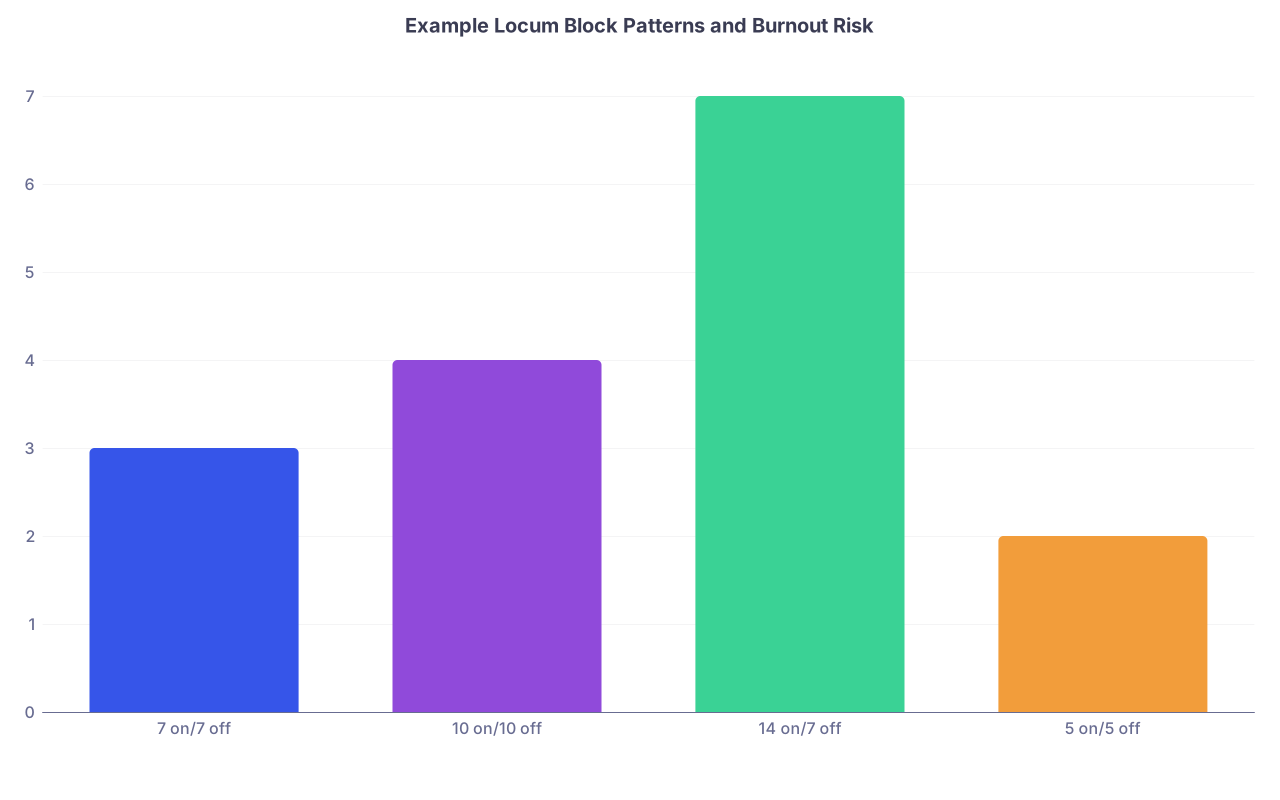
| Category | Value |
|---|---|
| 7 on/7 off | 3 |
| 10 on/10 off | 4 |
| 14 on/7 off | 7 |
| 5 on/5 off | 2 |
(Scale 1–10: higher = more burnout risk if repeated for 6+ months, assuming high‑intensity inpatient work.)
A rule that saves careers:
The longer the block, the longer the guaranteed recovery period must be, written into your own rules.
For new attendings in their first locum year, I usually recommend:
- Start with 7 on / 7–10 off or 5–7 on / 7 off
- Do not book more than 2 blocks/month for the first 3 months
- Reassess after actually living it
B. Clinic model patterns
For outpatient locums (FM, IM clinic, psych, some derm, etc.), you have a different problem: hours look “lighter,” but the emotional load is often heavier and more constant.
Sustainable templates:
- 3–4 clinic days/week, stable site, ongoing
- 2 weeks on / 2 weeks off at a travel site
- 4–6 weeks of full‑time locums, then 2 weeks off
Key variables:
- Patients/day
- New vs. follow‑up balance
- Support staff quality
- Charting time (in‑clinic vs. after hours)
A “40‑hour week” with 24 patients/day, poor MAs, and bad EMR will wreck you faster than 50 hours in a well‑run clinic.
3. Build a 6‑Month Framework Before Saying Yes to Anything
Now you create a skeleton.
Not a perfect plan. A framework to protect your time and energy.
Step 1: Draw a 6‑month calendar
On paper or in a digital calendar, block out:
- Non‑negotiable commitments (weddings, family events, exams, board review courses)
- Desired vacation or “no work” weeks (at least one full week every 8–10 weeks)
- Travel buffer days (1 day before and 1 day after each planned locum block or clinic stretch)
Step 2: Choose your core pattern
Example:
- You decide on a 7 on / 7 off inpatient block model.
- You want to work 2 blocks/month.
On the calendar, mark:
- The maximum number of workdays each month
- Tentative “work blocks” (e.g., first and third weeks of each month)
Your calendar might look like:
- Month 1: 2 work blocks (14 days)
- Month 2: 2 work blocks (14 days)
- Month 3: 1–2 work blocks (10–14 days, one lighter month)
- Month 4–6: repeat but with 1 fewer block over the whole period to avoid back‑to‑back heavy months
Step 3: Lock your personal red lines into the calendar
Examples of red lines I advise:
- No more than 10 consecutive clinical days, ever
- At least 2 fully off days at home between assignments, with no clinical work and no travel
- At least one 4–7 day unbooked period every 8 weeks, preferably at home
Now, when recruiters call, you are not starting from zero.
You are simply asking, “Does this assignment fit into my pre‑built skeleton without violating my rules?”

| Step | Description |
|---|---|
| Step 1 | Define Limits |
| Step 2 | Choose Pattern |
| Step 3 | Build 6 Month Calendar |
| Step 4 | Mark Red Lines |
| Step 5 | Evaluate Assignments |
| Step 6 | Accept |
| Step 7 | Decline or Modify |
4. Negotiate the Schedule, Not Just the Rate
Most physicians obsess over the hourly rate and barely touch the schedule details. That is how you end up with a $260/hour contract and a nervous system that is fried by month three.
You fix that by negotiating with your non‑negotiables in hand.
A. What you must clarify before signing
Ask, in writing:
- Exact shift times and durations
- Are 12‑hour shifts really 12, or does sign‑out routinely add 1–2 hours?
- Expected census/volume
- Patient cap for hospitalist
- Expected patients/day in clinic
- Expected cases/room in OR, etc.
- Nights and weekends by number
- “One weekend/month” often means 4 shifts in EM or 2–3 calls in IM
- Call expectations
- In‑house vs. home
- Average pages/night
- Admit load, cross‑cover volume
- Charting expectations
- Any expectation of off‑the‑clock charting?
- Any unpaid admin time (meetings, inbox, refill work)?
B. Schedule protections to ask for
You do not need to be a diva. You do need to be specific.
Things you can and should request:
- Maximum number of consecutive shifts
- “I can commit to no more than 7 consecutive 12‑hour shifts.”
- Guaranteed recovery days after night blocks
- “After a stretch of 3 or more nights, I need 2 days off before day shifts.”
- Equitable distribution of weekends and holidays
- “Happy to share weekends fairly, but not every weekend.”
- “Soft” requirements made explicit
- If they say, “Our docs usually pick up an extra shift or two,” state clearly whether you will or will not.
If the site refuses basic protections and expects you to plug endless gaps, that is not a sustainable locum site. That is a desperation site. Your burnout risk there is extreme.
| Red Flag | What It Really Means |
|---|---|
| “Unlimited shifts available” | Chronic understaffing |
| “We really need someone flexible” | Expect schedule changes and add-ons |
| No clear night/weekend expectations | You will likely carry more than you want |
| “Docs usually stay a bit late” | Underestimated workload, unpaid hours |
| “You can always pick up extra call” | They will pressure you to overwork |
5. Use “Work Blocks” and “Recovery Blocks” Like a Training Plan
You are not scheduling hours. You are managing physiologic load. Like training for a marathon. Except the injury is mental and emotional, not just physical.
Think in two‑week units:
- Work block: 5–10 days of concentrated clinical time
- Recovery block: 4–9 days of decompression, admin, and life
A. Design your work blocks intentionally
During work blocks:
- Accept you will have limited social life.
- Reduce nonessential obligations.
- Protect sleep like you are on ICU nights again.
Concrete strategies:
- No early flights after night shift unless you absolutely must.
- Arrange housing close to the site to cut commute time.
- Pre‑set simple routines: same breakfast, same pre‑shift checklist, same wind‑down routine.
This is not the period to start a new side business or train for an Ironman.
B. Design recovery blocks so they actually recover you
Common mistake: jamming recovery weeks with travel, admin tasks, and social events until they are more draining than working.
In each recovery block, structure your time:
Days 1–2: Decompression
- Sleep without an alarm.
- Minimal planning.
- No big decisions.
Days 3–5: Life and admin
- Bills, CME, licensing, credentialing, emails, trip planning.
- Light exercise, reconnect with family/friends.
Days 6–7: Intentional rest or focused project
- Short trip, hobby, reading, or deep work on one non‑clinical project.
- Not 57 errands and 3 flights.
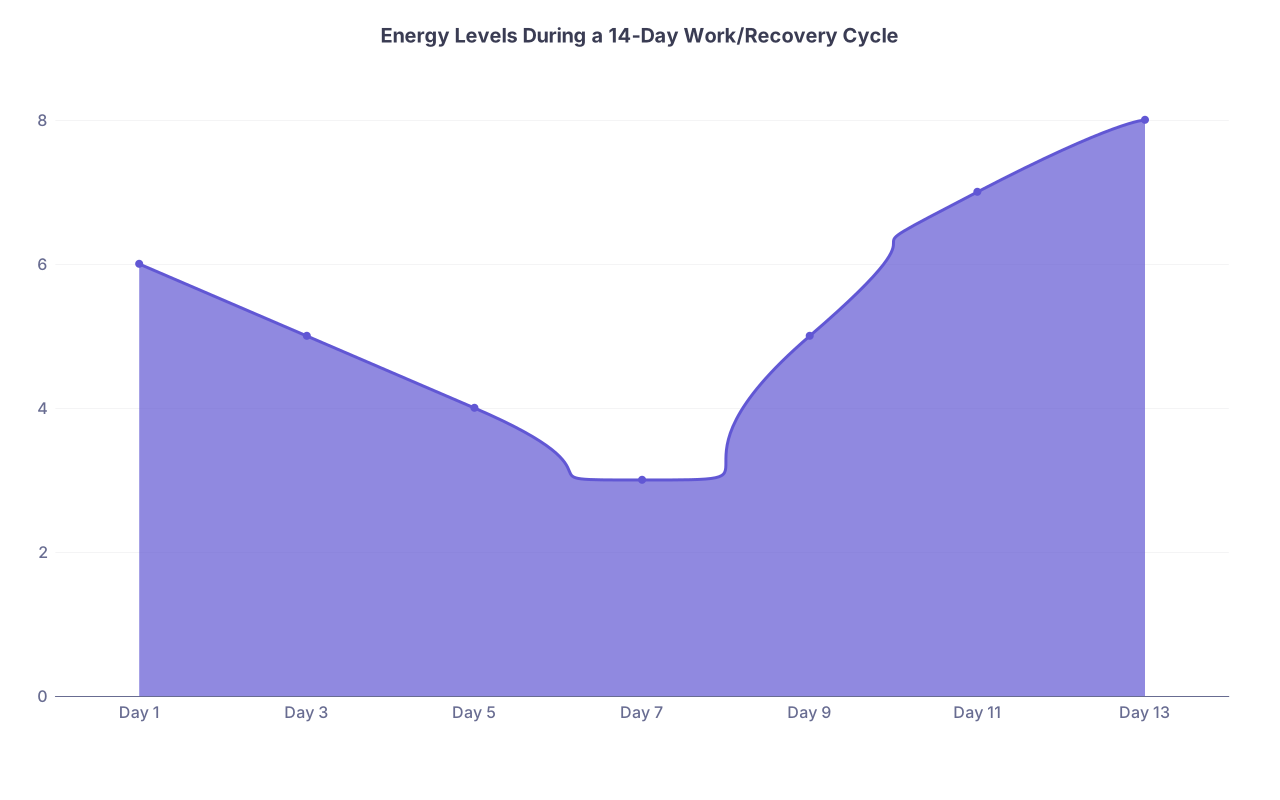
| Category | Value |
|---|---|
| Day 1 | 6 |
| Day 3 | 5 |
| Day 5 | 4 |
| Day 7 | 3 |
| Day 9 | 5 |
| Day 11 | 7 |
| Day 13 | 8 |
(Subjective energy 1–10: dips at end of work block, then rises again through recovery.)
If you continuously use your “off” weeks for heavy travel, conferences, and family obligations without slack, your net recovery is zero. That is burnout with airline miles.
6. Protect Sleep, Transitions, and Travel Like Your License Depends On It
Because it does.
Most bad decisions, near‑misses, and “I can’t do this anymore” moments I have seen in locums trace back to two things:
- Chronic sleep debt
- Stacked, poorly planned transitions
A. Non‑negotiable sleep rules
Set explicit rules for yourself:
- Minimum 7 hours in bed before every clinical day.
- No red‑eye flights followed by clinic or rounding the same day.
- After final night shift:
- Either sleep 3–4 hours then go to bed at normal time that night, or
- Sleep full day and accept that the following day is not productive.
If an assignment’s travel options force you into chronically unsafe sleep, you pass. No rate justifies a wrecked nervous system and risky practice.
B. Travel day rules that actually work
You are not a tourist. You are a clinician with time‑limited cognitive bandwidth.
Smart rules:
- Travel the day before the first shift, ideally arriving by mid‑afternoon.
- Never end a block with a night shift followed by early morning flight, then expect to drive a long distance at the destination.
- If there is significant time zone change (2–3+ hours):
- Arrive 1–2 days before your first shift the first time you go.
- Once you know your own reaction, you can adjust.

You will occasionally break these rules for a specific, high‑value reason. But if you break them habitually, you are designing burnout.
7. Build a Simple Tracking System and Actually Use It
If you do not track your load, your memory will lie to you. You will underestimate how much you are working and overestimate how much you are resting.
You need a one‑page dashboard for your locum life.
A. What to track
Use a spreadsheet, Notion, Airtable, or even just a Google Doc table. Track:
- Dates of each workday
- Site and shift type (day, night, call, clinic)
- Hours worked
- Travel days
- Subjective fatigue / mood rating (1–10)
- Net pay per block
Every 4–6 weeks, review:
- Average clinical hours/week
- Number of nights/month
- Number of travel days/month
- Average fatigue rating at the end of each block
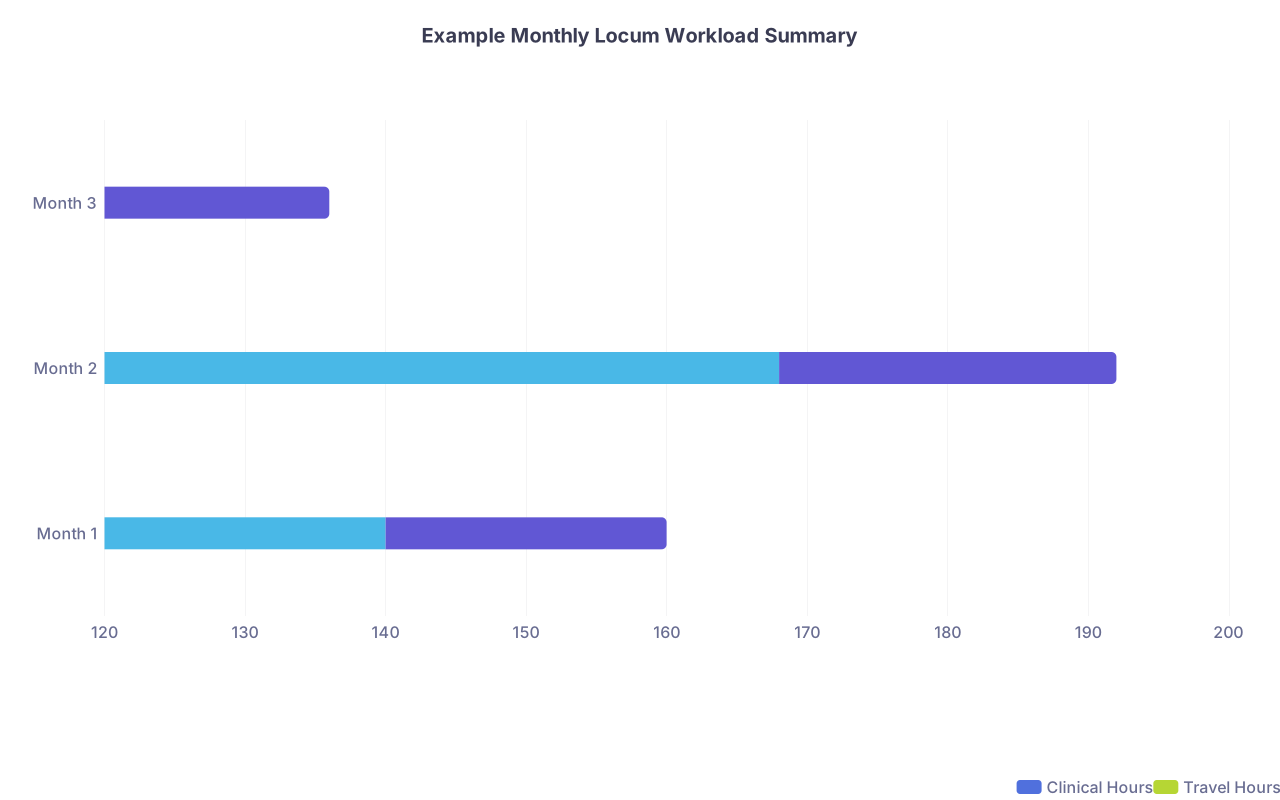
| Category | Clinical Hours | Travel Hours |
|---|---|---|
| Month 1 | 140 | 20 |
| Month 2 | 168 | 24 |
| Month 3 | 120 | 16 |
If you see:
- Fatigue scores creeping up
- More nights or travel days than you expected
- Income higher than needed but energy dropping
Then you adjust before you hit the wall.
B. Use the data to reset your limits
Every 3 months, look at your numbers and answer:
- Did I cross my “maximum” hours or nights more than once?
- Was I functioning well at the end of each block?
- How many true days off did I have (no travel, no charts, no admin)?
If you felt like garbage despite “normal” numbers, your limits are lower than you thought. Reset them.
This is not weakness. This is calibration.
8. Pre‑Commit to Saying “No” Under Specific Conditions
Locums culture quietly glorifies hustle. “I did 24 shifts this month.” “I covered 3 hospitals and 2 states.” That mindset will chew you up.
You will not maintain healthy boundaries based on vibes. You need pre‑written rules for when you decline work.
Examples of personal “no” rules:
- If I have already committed to 14+ clinical days in a month, I decline additional shifts unless another block cancels.
- I do not add extra nights to a block that already contains 3+ nights.
- I do not extend an assignment without at least 3 days at home in between.
- I do not agree to any shift that requires me to work within 24 hours of landing from an overseas flight.
- I do not book two high‑intensity assignments back‑to‑back (e.g., EM trauma center → ICU locums) without 7 days off.
Have these in writing. When a recruiter calls, you do not think from scratch. You simply check against your rules.

If an opportunity is amazing but conflicts with your rules, adjust something else consciously rather than just piling on top.
9. Design the Non-Clinical Parts of Your Life Around Your Schedule
Locums creates dead space: long airport waits, quiet evenings in contract housing, empty daytime periods after night shifts. You can either let that time decay or you can integrate it into a balanced life.
To stay sane long term, give structure to three areas:
A. Relationships
High‑frequency travel stresses relationships. Waiting until “things calm down” is a fantasy.
So you:
- Schedule recurring calls or video chats with partner/family/friends during work blocks.
- Use some off days at home instead of always traveling elsewhere.
- If you have a partner, involve them in the 6‑month planning so they are not just reacting to your shifts.
B. Professional growth
Locums can easily become “same shift, different hospital” with zero growth. That stagnation feels like burnout.
During recovery weeks:
- Dedicate 2–4 hours to CME, reading, or skill development.
- Pick 1–2 medium‑term projects (e.g., board certification, QI consulting, teaching, side business) and move them in small, consistent chunks.
C. Health and sanity habits
No, you will not maintain a perfect gym schedule on nights. But you can design “minimum viable habits”:
- 10–20 minutes of movement on every workday. Walks, stairs, basic bodyweight.
- One “anchor meal” that is healthy and repeated (e.g., your standard breakfast).
- A 5–10 minute wind‑down routine before bed: no screens, simple breathing or journaling.
Your schedule is not just shifts and flights. It is the scaffolding around your whole life.

10. Know the Early Warning Signs You Need an Immediate Schedule Reset
Most people do not crash suddenly. They erode.
If any of these show up for more than 2–3 weeks, your schedule is no longer sustainable:
- You start dreading shifts at a site you initially liked.
- Minor annoyances trigger disproportionate anger or cynicism.
- You are making more small errors or near‑misses than usual.
- You constantly think “I just need to get through the next month” and have been saying that for 3 months.
- Recovery weeks no longer restore you; you start them already exhausted.
When you see this, do not “push through.” That is residency thinking. Now you:
- Cancel optional future blocks if your contract allows.
- Reduce nights and high‑acuity shifts for the next 1–2 months.
- Add more home‑based recovery time.
- Reassess whether specific sites are toxic and should be dropped entirely.
Burnout is much harder to reverse than to prevent. Catch the slide early.
11. Put It All Together: A Sample Sustainable 6-Month Locum Plan
To make this concrete, here is a composite example for a new hospitalist graduate:
Inputs:
- Needs $18k/month post‑tax to cover loans and living expenses
- Average rate: $190/hour
- Targets ~130 hours/month
- Prefers 7 on / 7 off
- Wants 1 full vacation week every 3 months
Framework:
- 2 blocks of 7 12‑hour shifts each month (14 shifts = 168 hours)
- This is more than the minimum, but builds a savings buffer.
- One lighter month every 3 months:
- Only 1 block (7 shifts = 84 hours)
6‑Month sketch:
- Month 1: 2 blocks (14 days) at Site A
- Month 2: 2 blocks (14 days) at Site A
- Month 3: 1 block (7 days) at Site B, 1 week vacation, then rest at home
- Month 4: 2 blocks (14 days) back at Site A
- Month 5: 2 blocks (14 days) at Site B
- Month 6: 1 block (7 days) at Site A, rest of month off for boards + personal
Built‑in protections:
- No more than 7 consecutive days
- Travel days before and after each block
- At least one full week completely off in Months 3 and 6
- Data tracking each month to tweak nights vs. days and spread across sites
Could this be tweaked? Of course. But this is the difference between “accumulated shifts” and an intentional, sustainable plan.
Designing a locum schedule that will not burn you out is not a mystery. It is a discipline:
- Define your limits and financial needs.
- Choose a working pattern that respects both.
- Build a multi‑month skeleton before you accept a single shift.
- Negotiate schedule protections as hard as you negotiate rate.
- Treat recovery as a non‑negotiable part of your job, not a luxury.
You want a concrete next step?
Open a 6‑month calendar right now and block out: your non‑negotiable personal events, at least two full “no work” weeks, and your maximum number of clinical days per month. Until that skeleton exists, every “great locum opportunity” is just another chance to accidentally burn yourself out.