
The way people talk about locums, you’d think it’s a cheat code for medicine.
“$300 an hour.”
“Fly in, fly out, no politics.”
“Just bank cash and leave.”
That story is incomplete bordering on dishonest. The headline hourly rate is the least reliable metric for judging locum tenens work.
If you’re post‑residency and looking at the job market, you need to hear this now: the “easy money” locum myth is how people get trapped in mediocre assignments, stalled careers, and very ordinary income dressed up as something special.
Let’s dissect what those big hourly numbers do not tell you.
The Locum Hourly Rate Is Not Your Real Pay
The locum brochure says $260–$350/hr and your brain does the math:
“$300/hr × 40 hours × 48 weeks = $576,000.”
You’re already mentally paying off loans and leasing a Tesla.
Here’s the first myth to kill: that “hourly rate” is your income. It’s not even close.
You have to convert rate into effective compensation. That means:
- Time you’re paid vs time you’re responsible
- Taxes and benefits you’re giving up
- Unpaid downtime between gigs
- Call, nights, weekends
- Travel friction and burnout
Most physicians I’ve seen chase the rate and ignore the denominator: everything that eats away at that headline number.
Paid hours vs responsibility hours
Let me be blunt: many locum contracts are structured to make the hourly number look sexy on paper while pushing a ton of unpaid or underpaid time onto you.
Common tricks:
- “8-hour shift” that’s actually:
- 30+ minutes pre‑shift for sign‑in, EMR log‑in, messages
- 30–60 minutes post‑shift finishing notes and calls
- “Home call” that destroys your night but pays pennies compared to what it does to you functionally
- Being “on” for clinical questions as the only doc, even when you’re technically off the clock
You should be calculating an all‑in effective hourly rate:
Effective hourly = (Total pay for assignment) ÷ (All hours you were either working, on call, or required to be on site)
When people actually run that calculation, the $300/hr fantasy often becomes a $150–$200/hr reality. Which is… just decent W‑2 money, minus benefits and stability.
Gross vs Net: The Independent Contractor Tax Trap
Most locum docs are 1099 independent contractors. Recruiters pitch this like a perk: “You can write everything off. Huge tax advantages.”
Some of that is true. But the myth is that 1099 automatically means “more money.” Often, it means “more risk, more complexity, and not nearly as much extra as you think.”
Let’s quantify.
Say you get:
- $300/hr
- 12‑hour shifts
- 10 shifts/month
Gross: $300 × 12 × 10 = $36,000/month or $432,000/year.
Looks luxurious. But now account for:
- Full self‑employment tax (both sides of Social Security & Medicare on a big chunk of income)
- Health insurance (no group plan, worse rates, higher deductibles)
- No employer match for retirement
- No paid vacation, CME, holidays, sick days
- Malpractice sometimes not covered (or covered in the most bare‑bones way)
Now compare to a fairly standard employed job:
| Item | Locum 1099 | Employed W-2 |
|---|---|---|
| Gross pay | $432k | $340k salary |
| Retirement match | $0 | ~$17k (5% on 340k) |
| Health insurance subsidy | $0 | ~$10k–$15k |
| Paid vacation (4 weeks) | $0 | ~$26k value |
| Employer payroll tax | You pay full | Employer pays half |
You might still come out ahead as a locum. But not by as much as that hourly rate suggests. And that ignores dead time between contracts, travel days at $0/day, and unbillable onboarding.
If you are not aggressively:
- Using an accountant who understands physician 1099 income
- Maxing retirement options (solo 401(k), backdoor Roth, HSA, etc.)
- Tracking business expenses correctly
…then the tax “advantages” will not magically appear. You’ll just pay high taxes on irregular income and wonder why the math isn’t working.
The Illusion of Freedom: Your Time Isn’t Really Your Own
People like to say, “Locums gives you freedom.” Sometimes it does. Often it just swaps one set of constraints for another.
Here’s the freedom pitch:
- Pick your schedule
- Work when you want
- Take months off
Now the reality layer:
- To maintain high annual income, you actually need to book consistently; “gaps” in your schedule are unpaid and often longer than planned
- Many “flexible” assignments become sticky because once you’re credentialed somewhere, it’s easier to keep going back than to start over somewhere else
- If you want to stack shifts and “crush it for 6 months then chill,” you’re competing with 100 other docs who told the recruiter the same thing
I’ve watched this play out repeatedly: a new grad starts locums with a “work hard then disappear” plan. Twelve months later they’ve worked 10 of those months because:
- Assignments ended later than expected
- Credentialing at the next site took longer than promised
- The recruiter conveniently always has “just one more month they really need you for”
You’re not free if your income crashes whenever you take a real break. You’re just self‑employed and tired.
What “High Rate” Jobs Often Hide
Let’s talk about why some locum jobs pay $350/hr and others pay $200/hr for similar specialties and regions.
They are not paying you for your time. They are paying you for:
- Risk
- Dysfunction
- Undersupply
- Desperation
And those don’t show up on the rate sheet.
Patterns I’ve seen over and over:
Clinical risk mismatch
- Tiny hospital, single‑coverage ED, no in‑house surgery or ICU, but they still expect you to manage train‑wrecks until a transfer happens (if it happens).
- Hospitalist role with no ICU support but 18‑20 patients and frequent decompensations.
Operational dysfunction
- No night coverage from consultants. You’re begging for callbacks for hours.
- EMR that triples your charting time.
- Chronic understaffing of nurses, RT, lab, radiology.
Community or location penalties
- Remote, socially isolated, poor schools, limited flights.
- Seasonal spikes (tourist towns, ski areas, oil boom regions) that crush volume for months.
The hourly number is hazard pay. For actual hazards: clinical, logistical, legal, and psychological. That doesn’t mean you shouldn’t do it. It just means you need to stop pretending it’s “easy money” and call it what it is: compensated risk and inconvenience.
Travel and Downtime: The Silent Income Killers
Here’s another major distortion: nobody counts the travel and onboarding time when they brag about their hourly pay.
Let’s sketch a very normal month for a “high earning” locum:
- 10 shifts at 12 hours each = 120 clinical hours
- 2 full travel days (out and back) = 16–24 hours of lost time
- 1 day wasted on hospital onboarding, repeated EMR training, mandatory modules
- Several evenings doing admin: scheduling calls, recruiter calls, credentialing paperwork
Your original calculation:
“$300 × 120 = $36,000 → $300/hr.”
Your real calculation:
Let’s say 120 clinical + 24 travel + 8 admin/onboarding = 152 hours.
$36,000 ÷ 152 = $237/hr.
Now layer in unpaid gaps between assignments. If you average 10 working months a year instead of 12 (very common with locums), your annualized effective hourly rate drops again.
This is why I push people to look at annual net income divided by total professional hours and days away from home. Not whatever number the recruiter highlighted in bold in the email.
Skill Decay, Credentialing Chaos, and Career Narrative
Locums can be great for certain goals: sampling regions, trying practice settings, negotiating leverage. But if you’re not careful, it also quietly erodes things you need long term: continuity experience, leadership roles, and a coherent CV story.
Clinical muscle and complexity
Some locum gigs are pure “warm body” slots:
- Minimal continuity
- No follow‑up
- Bread‑and‑butter cases only
If you stack too many low‑acuity, low‑responsibility roles, you stop stretching your clinical skills. Sounds dramatic? Watch what happens to procedural volume when a hospitalist does nothing but low‑acuity swing‑shift locums for three years.
Hiring committees do notice when your experience looks like a string of month‑long gaps and “PRN coverage” roles with little progression in responsibility.
Credentialing purgatory
Every new site means:
- Primary source verification of med school, residency, prior hospitals
- Malpractice history, NPDB queries
- State license hassles in some cases
- Repeating the same OSHA/HIPAA/EMR modules you could do in your sleep
This is unpaid, cognitively draining work. And it stretches timelines. A job that “starts in June” turns into “actually your credentialing just cleared, can you start in August?”
If you do locums deliberately—targeted systems, longer blocks, licenses in strategic states—the hassle is manageable. If you bounce around reactively chasing $20/hr differences, the friction burns you out.
The Psychology: Why the Myth Persists
So why does the “easy money” locum myth survive despite all this?
Because:
- Recruiters sell dreams, not spreadsheets
- Doctors anchored in low residency pay are dazzled by any big number
- Social media flex culture: people post their gross checks, not their net or their 3‑am transferral nightmares
- Early attending fear: people want a pressure‑release valve from hospital politics, so the story “just do locums and be free” spreads fast
I’ve overheard this exact line at least a dozen times in resident lounges:
“If attending life sucks, I’ll just do locums at $300 an hour and peace out.”
That’s not a plan. That’s a meme.
You need something better: a clear picture of what you want your work and life to look like over 3–5 years, and how locums either fits that or doesn’t.
When Locums Actually Is a Power Move
Let me be clear: I’m not anti‑locums. I’m anti‑naïve locums.
Locums is powerful when you use it like a scalpel, not a default setting.
Smart uses I’ve seen:
- Bridge year after residency: Pay down high‑interest debt while you sample regions and systems, with a defined end date and specific financial targets.
- Negotiation leverage: Demonstrate you can earn $X as a locum, then use that data to push back on lowball employed offers.
- Lifestyle arbitrage: High‑rate weeks stacked a few times a year to buy meaningful chunks of true time off, while your baseline is a sane employed role.
- Geographic exploration: Intentionally try 2–3 hospitals in different states before locking into a long‑term position.
Notice what all of those have in common: intentionality, time bounds, and actual math behind the decision. Not just “the hourly rate is huge.”
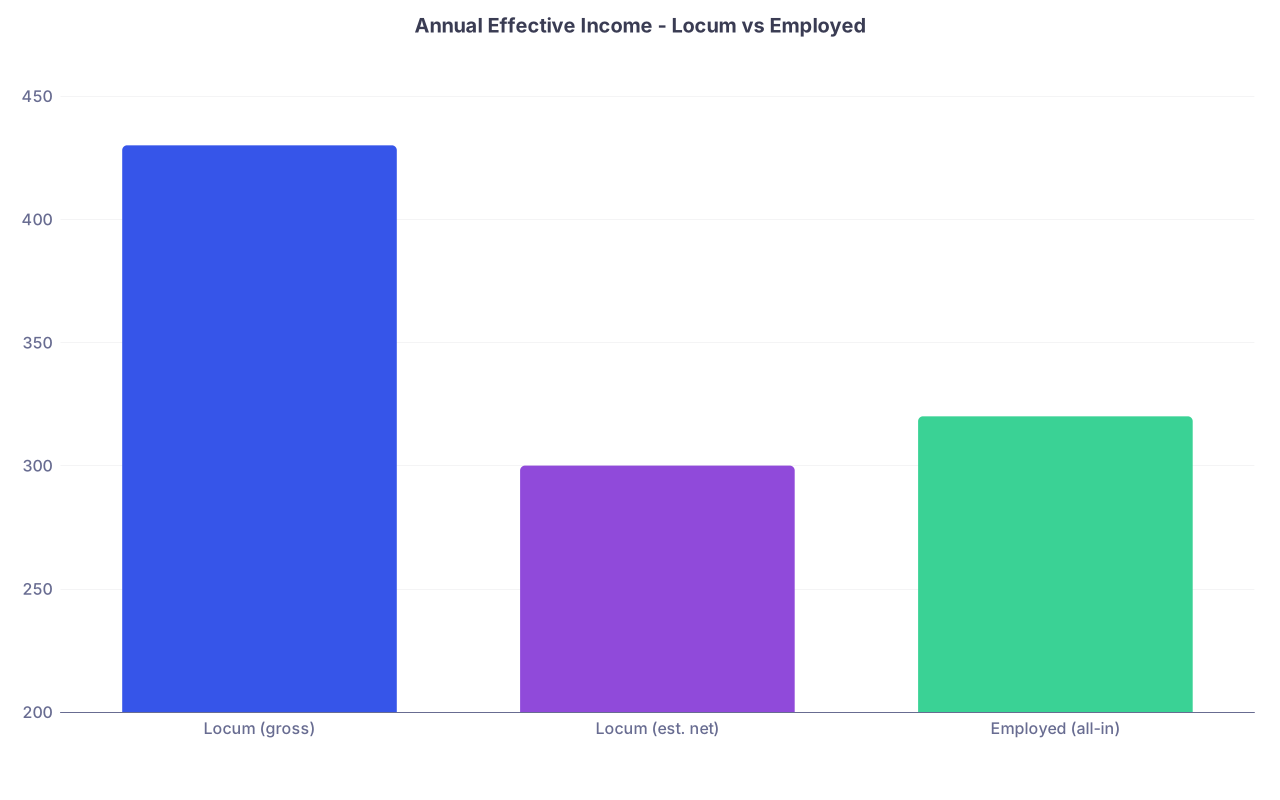
Here’s how the earnings compare when you zoom out to the year instead of the shift:
| Category | Value |
|---|---|
| Locum (gross) | 430 |
| Locum (est. net) | 300 |
| Employed (all-in) | 320 |
Rough, but realistic for a lot of hospital-based specialties: the “$430k” locum gig might feel big, but after taxes, no benefits, and gaps, it behaves much closer to a mid‑300s employed job. The difference is not life‑changing; the volatility and hassle can be.
How to De‑Mythify Any Locum Offer in 10 Minutes
You want one practical thing? Do this for every offer:
- List all compensated work
- Scheduled clinical hours
- Expected call
- Average overrun on shifts
- List all uncompensated but required work
- Travel days
- Onboarding, EMR training
- Credentialing bursts, mandatory meetings
- Estimate your true annual pattern
- Realistically, how many full months will you work per year?
- How often do contracts slip or cancel?
Then compute:
- Total annual gross pay (using realistic number of shifts worked, not fantasy maximum)
- Total professional hours (clinical + call + travel + admin)
- Effective hourly rate = gross ÷ hours
- Compare that to an employed, all‑in package (salary + match + insurance + PTO value ÷ real hours)
A quick visual of what actually drives your locum income:

| Category | Value |
|---|---|
| Headline hourly rate | 25 |
| Total hours incl. travel/call | 30 |
| Weeks actually worked | 20 |
| Tax/benefit structure | 25 |
The rate is only about a quarter of the story.
If you want to visualize the path from “shiny offer” to “real life,” this is how it actually flows:

| Step | Description |
|---|---|
| Step 1 | See high hourly rate |
| Step 2 | Estimate shifts and months |
| Step 3 | Add travel and admin time |
| Step 4 | Calculate total hours and gross pay |
| Step 5 | Subtract taxes and lost benefits |
| Step 6 | Compare to employed offer |
| Step 7 | Take targeted locum gig |
| Step 8 | Negotiate or decline |
| Step 9 | Still better for your goals |
Run this once or twice and the magic disappears. Which is good. You’re making decisions with clear eyes instead of vibes.
A Quick Reality Snapshot by Assignment Type
One last lens: not all locum setups are equal. Here’s how different patterns tend to shake out financially and lifestyle‑wise:
| Pattern | Looks Like | Often Really Is |
|---|---|---|
| 7-on/7-off hospitalist | “Half-time year” | 60–70 hr weeks + recovery weeks |
| Weekend-only ED coverage | “Extra money on side” | Burnout accelerator |
| Short 2–4 week stints | “Ultimate flexibility” | Credentialing churn, unstable |
| Long 6–12 month contract | “Too close to employed” | Often best pay:stress ratio |
The long, boring, stable locum gigs are usually where the real money and sanity live. The flashy high‑rate, short‑term, high‑acuity jobs are where your effective rate quietly collapses under the weight of chaos.
The Bottom Line
Strip away the marketing and the “$300/hr” screenshots and you’re left with this:
- The locum hourly rate is a distraction. Your real income is determined by total workload, weeks actually worked, taxes, and lost benefits.
- High rates usually signal hidden costs. Risk, dysfunction, remoteness, and burnout don’t show up in the contract header, but they’re what you’re being paid for.
- Locums is a sharp tool, not a lifestyle default. Used deliberately—with math, clear goals, and exit criteria—it can be powerful. Used casually, it’s just another way to work a lot for less than you thought.