
Most physicians leave thousands of dollars on the table in locum contracts because they have no script and no plan.
You do not fix that with “confidence” or “knowing your worth.” You fix it with structure, numbers, and rehearsed lines you can actually say out loud without sounding awkward.
This is the playbook.
1. Ground Rules: How Locum Negotiations Really Work
Before scripts, you need to understand the game you are walking into. Otherwise you’ll read numbers off a blog and still get steamrolled.
The power dynamics (that nobody explains clearly)
Here is what is actually happening in most locum deals:
- The hospital (or group) has a fixed bill rate they pay the agency
- The agency takes a cut and offers you a lower hourly
- Everyone tries very hard to make sure you never know the bill rate
I have heard recruiters say things like:
- “This is the max the client will pay.”
- “All our doctors make this rate at this site.”
- “If I ask for more, they might move on to another candidate.”
Sometimes that is true. Often it is lazy or strategic.
Your job is not to argue their story. Your job is to test it.
What actually is negotiable?
At a typical locums assignment, you can usually push on:
- Hourly rate (or daily rate for 24-hour shifts)
- Call differentials (call pay vs in-house rate)
- OT rate (after 8/10/12 hours; or after certain weekly hours)
- Travel (flights, rental car vs mileage, rideshare)
- Housing (hotel vs extended stay vs stipend vs Airbnb)
- Meal allowance (per diem, hospital meal vouchers)
- Guaranteed hours (minimums per day or per assignment)
- Cancellation terms (how much notice, what they must pay you)
- Licensing and credentialing costs (paid, and ideally up front)
- Bonuses (sign-on, completion bonus, extension bonus)
- Schedule pattern (block scheduling, weekends, number of shifts)
If someone tells you “nothing is negotiable,” that is usually code for “I do not want to do extra work” or “you have no leverage on this particular job.”
You test that with calm, repeatable scripts.
2. Your Baseline: Know Your Numbers Before You Talk
If you get on the phone with a recruiter with no prep, you have already lost 30–40% of your leverage.
Step 1: Build your personal rate floor
You need a minimum rate you will not go below. Not emotional. Math-based.
Find typical ranges for:
- Your specialty
- Your region (or region you are open to)
- Your setting (ED vs clinic vs inpatient vs OB call)
Decide your floors:
- Absolute floor: “I will not leave my house for less than X.”
- Preferred target: “I will open at Y so we land near Z.”
Example for an EM physician:
- Market range: $220–$325/hr
- Absolute floor: $260/hr
- Preferred target: $290/hr (so landing at $275–$280/hr is acceptable)
Write those down. In front of you. During every call.
Step 2: Decide what matters more than raw rate
Sometimes a slightly lower rate with strong perks is actually much better.
| Offer | Hourly Rate | Housing | Travel | Guaranteed Hours | Realistic Weekly Take-home* |
|---|---|---|---|---|---|
| A | $260 | Basic hotel | Economy airfare | 8 hr/day | ~$8,300 |
| B | $240 | Furnished apartment | Rental car + gas | 10 hr/day | ~$9,000 |
| C | $280 | Stipend only | No car, reimburse mileage | 8 hr/day | ~$8,600 |
*Rough numbers assuming 5 days, no OT, pre-tax, and basic estimates of perk values.
You need a simple rule in your head:
- “I will accept slightly lower rate if:
- They guarantee __ hours per shift/week
- They provide __ type of housing
- They cover travel __ way”
Write this too. Because when you are tired and the recruiter sounds friendly, you will forget your own standards.
3. Core Scripts: From First Contact to Final Number
This is the part you wanted: exact words.
You will not use them verbatim every time. You will adapt them to your style. But you need a skeleton.
A. First call with recruiter: You are gathering intel, not negotiating
Your first job is to collect data, not blurt your rate.
Goal: Get as many concrete details as possible and avoid committing to a number first.
Script: Opening positioning
“Thanks for reaching out. I am definitely open to the right locums fit. Before we talk rates, I want to understand the scope of work. Can you walk me through the schedule, volumes, and expectations at this site?”
Then ask, specifically:
- “What are the typical daily hours actually worked?”
- “What patient volume per day per physician?”
- “Is there midlevel support? How many?”
- “Any procedures or responsibilities outside the usual scope?”
- “What is the call burden and how is call compensated?”
Then immediately go into logistics and perks:
“How are housing and travel arranged for this site?”
“Is there a guaranteed minimum of hours per day or per week?”
“What is your policy on cancellations by the facility?”
Now—when they try to push you to name a rate first:
They say: “What rate are you looking for?”
You say (Script 1: Deflect & Flip):
“I work with a range depending on location and workload. For this specific site, what is the rate range you have approved from the client?”
If they still push:
“I understand you need to know I am in the right range. I have a reasonable market-based floor, but I want to make sure we are not anchoring too low. Why do you not share the current range other physicians are at for this site, and we will see if we are in the same ballpark?”
You do this calmly. No irritation. Just firm.
If they absolutely refuse, you have two choices:
- Walk away (if this sounds like a rigid lowball firm)
- Or give them your high anchor, not your floor
Script 2: High Anchor
“For a site with this volume and call setup, I typically look for something in the $X–$Y per hour range, assuming standard housing and travel are covered.”
Your X should be above your actual target. For example:
- Target: $270/hr
- Say: “$285–$305/hr”
Let them pull you down, not up.
4. Advanced Rate Negotiation: How to Push Without Burning Bridges
Once you have the initial offer, the real game begins.
B. Responding to the first offer: You never accept it immediately
Example: Recruiter emails:
“Client is offering $220/hr with hotel and rental car, 8-hr guaranteed days.”
Your internal reaction: “Too low.”
Your external response must be measured and numeric.
Script 3: Counter with reason
“Thanks for sending the details. Given the census you described and the call burden, $220/hr is below what I have seen for similar roles.
For a schedule like this, I am comfortable at $260/hr with the current housing and travel setup, or $250/hr if we can guarantee 10 hours per day. Can you check with the client if that is workable?”
3 parts here:
- Acknowledge
- State why it is low (relative to market, workload)
- Give two clear options they can take back
Recruiters like options. It lets them “negotiate” for you.
C. Using workload and schedule as leverage
If they say the rate is “fixed,” you pivot.
Script 4: If they claim rate is fixed
“If the rate is truly fixed at $220/hr, then to make this workable I would need stronger guarantees on my side.
Specifically, I would need:
• A guarantee of at least 10 paid hours per day,
• Confirmation of no last-minute cancellations without full pay, and
• Either upgraded housing (extended stay/furnished apartment) or a housing stipend at $X per month.If we can make those adjustments, I can consider the $220/hr.”
Now they have a choice:
- Protect the rate, sweeten the perks
- Or increase the rate to avoid messing with logistics
Either path is more money to you (in cash or value).
5. Perks and Protections: Scripts for Everything Beyond Rate
You will make or lose a surprising amount of value on the “small” stuff.
Housing: where most physicians quietly suffer
Common scenario: agency auto-books you into a cheap, noisy hotel 25 minutes from the hospital. They brag about “free breakfast.” You hate your life for three months.
Do not let that happen.
Script 5: Housing standards before they book
“For housing, I function best with a quiet space and a kitchen, since I am on longer stretches.
My preference is a furnished apartment or extended-stay style hotel close to the hospital. Is your housing budget flexible enough to support that? If not, can we convert to a stipend of $X per month and I will arrange my own place?”
If they say “we always use hotel X”:
“I understand that is your default. I have had poor sleep and safety issues with standard hotels in the past, so I am not able to accept long-term stays in that setup.
I can move forward if we either:
• Use an extended-stay format, or
• Provide a housing stipend of at least $X so I can secure appropriate housing.”
You must say “I am not able to accept” instead of “I do not like.” One is preference. The other is a boundary.
Travel: flights, cars, and the nickel-and-dime games
Standard patterns:
- “We only reimburse lowest economy.”
- “No rental car; we do mileage only.”
- “We do not pay for baggage.”
Sometimes fine. Sometimes a waste of your time.
Script 6: Travel upgrade ask
“For travel, I need this to be sustainable for recurring assignments.
• I will need a rental car on site, not just mileage, given call coverage and errands.
• I also prefer refundable or at least changeable flight fares given how often hospitals shift schedules last-minute.Is that something you can support routinely, or would that require client approval?”
If they say “no rental, mileage only” and you really want the job:
“If we are limiting to mileage, then I would need to see that reflected in the hourly rate. What is the highest hourly you can do if I handle my own car and just submit mileage?”
Trade one perk for higher rate whenever possible.
6. Critical Contract Clauses: What to Negotiate in Writing
Phone scripts are useless if the contract undercuts everything you just won verbally.
You need to scan for a few landmines and fix them.
A. Guaranteed hours
Look for this in the contract:
- “Physician will be paid for actual hours worked.”
- Or vague language with no minimums.
That means you can be scheduled 8 hours, sent home after 3, and only get 3 hours of pay. No.
Script 7: Email to adjust guaranteed hours
“I see that the current draft does not specify any guaranteed minimum hours.
For me to proceed, I need the contract to reflect a guarantee of at least 8 billable hours per scheduled day, regardless of low census or early release by the facility.
Please add language confirming a minimum of 8 hours of pay per scheduled day.”
If you already negotiated 10 hours:
“...a minimum of 10 hours of pay per scheduled day.”
Tie it to “scheduled day,” not “worked day.”
B. Cancellation terms
Typical bad clause:
“Client may cancel shifts at any time without penalty.”
Your response: absolutely not.
Script 8: Pushback on cancellation
“The current cancellation language allows the client to cancel shifts without any compensation. That level of risk is not workable given that I am traveling and reserving those dates.
I need the agreement to specify that:
• Shifts cancelled less than 30 days in advance are paid at 100% of the guaranteed hours, and
• Shifts cancelled 30–60 days in advance are paid at 50%.I am open to slightly different percentages, but I do require meaningful cancellation compensation.”
You might not get everything. But they will move off “zero.”
7. Role-Play: A Full Negotiation from Start to Finish
Let me stitch this together so you can see how it flows in real time.
Scenario
- You are a hospitalist, 1 year post-residency
- Location: midwestern community hospital
- Schedule: 7-on/7-off, 12-hr shifts, 16–18 patients per day
- Recruiter’s first offer: $165/hr, hotel, flight, no car, “occasional” nights
You want:
- $190–$200/hr
- Clear night differential or protected day assignment
- Extended-stay style housing or stipend
- Rental car
Step 1: First call
You gather all the job details first. Then they ask, “What rate are you looking for?”
You:
“For hospitalist work at this volume, I typically look for something in the $195–$210/hr range with standard housing and travel covered. Where is this particular site sitting right now for other physicians?”
Recruiter: “We are at $165/hr. That is what everyone there is getting.”
Step 2: Initial counter
You:
“$165/hr is significantly below what I have seen even for lower-volume sites. Given 12-hour shifts and up to 18 patients, I would need to see $195/hr to make this viable at that census.
If the rate is truly capped, we can explore adjusting other levers, but at $165/hr as-is, I would have to pass.”
You are calmly telling them you will walk.
Recruiter: “I can ask the client, but I do not think they will go that high.”
You:
“I understand. Please check with them. If they cannot move the rate, then we can look at strengthening guaranteed hours, nights compensation, and housing to see if that closes the gap.”
Step 3: Recruiter comes back
They email:
“Client approved $180/hr, hotel, flight, no rental car, schedule mix of days/nights.”
You respond by email (keeps a paper trail):
“Thank you for checking with the client. $180/hr is closer to my range.
To move forward, I would need to clarify a few items:
• Guaranteed hours: I need a clear guarantee of 12 hours of pay for each scheduled day.
• Nights: If nights are included, I typically see either a higher rate for nights (for example $195/hr) or a fixed night shift differential. How does this site usually handle that?
• Housing: For 7-on stretches, I function best in an extended-stay–style setup with a kitchen, or a housing stipend so I can arrange a furnished apartment. Is that possible for this site?
• Transportation: I will need a rental car while on assignment; can you confirm that can be included?”
You have now opened four additional negotiation lanes.
Step 4: Finalizing
Recruiter comes back:
- $180/hr for days, $190/hr for nights
- 12-hr guaranteed
- Extended-stay hotel with kitchenette
- Rental car included
You compare this to your baseline. This meets your minimums and gives you night premium and solid perks. Reasonable to accept.
8. Quick Visual: What To Negotiate, In What Order

| Step | Description |
|---|---|
| Step 1 | New Locum Opportunity |
| Step 2 | Gather Job Details |
| Step 3 | Ask Their Rate Range |
| Step 4 | Counter With Higher Rate |
| Step 5 | Negotiate Perks |
| Step 6 | Walk Away |
| Step 7 | Guarantee Hours and Cancellation Terms |
| Step 8 | Review Contract Wording |
| Step 9 | Request Revisions |
| Step 10 | Sign and Confirm Schedule |
| Step 11 | Rate Acceptable? |
| Step 12 | They Move? |
| Step 13 | Matches Verbal Deal? |
Keep that order in your head. Rate → perks → protections → contract language.
9. Tracking and Improving: Your Locum Negotiation Dashboard
You should not be re-learning this on every assignment. Track it.
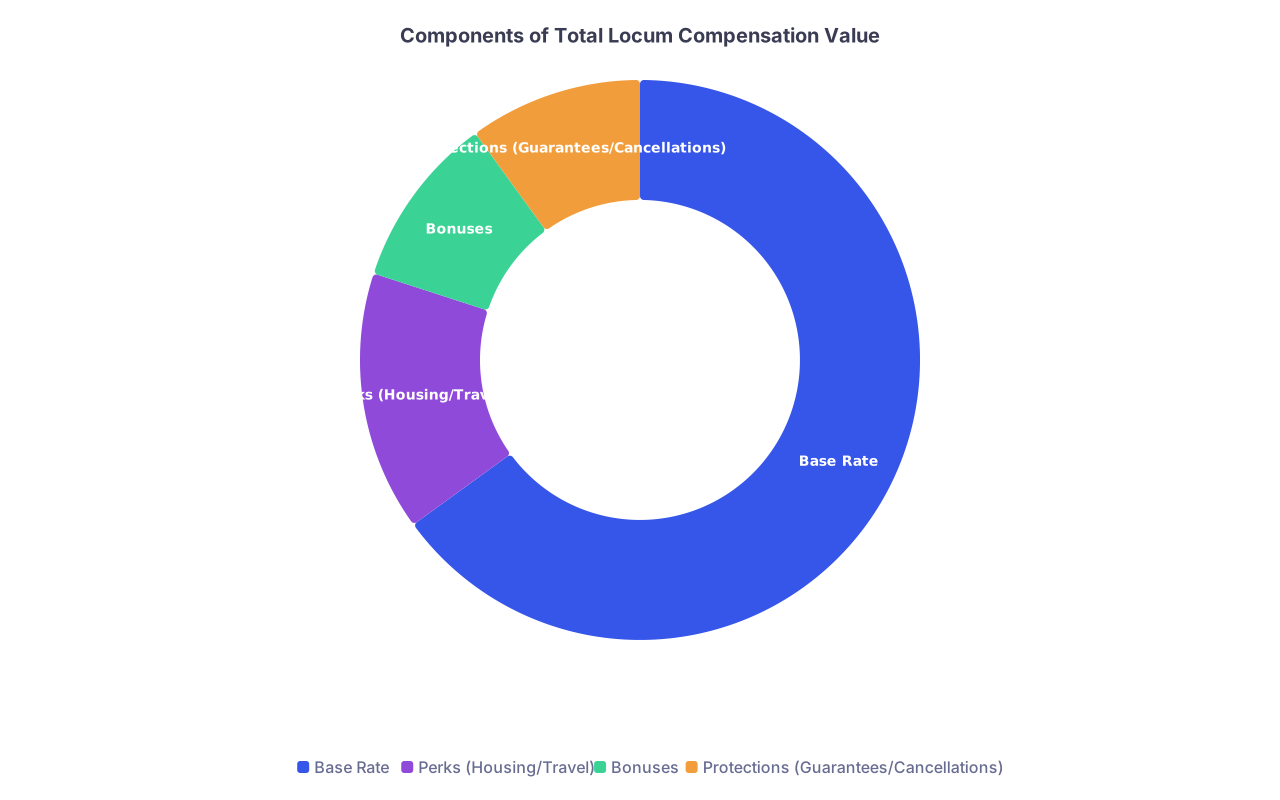
| Category | Value |
|---|---|
| Base Rate | 65 |
| Perks (Housing/Travel) | 15 |
| Bonuses | 10 |
| Protections (Guarantees/Cancellations) | 10 |
Create a simple spreadsheet with columns like:
- Agency
- Site name / location
- Specialty
- Base rate (day / night / call)
- OT rate and trigger
- Housing type / value
- Travel details
- Guaranteed hours
- Cancellation terms
- Your initial ask
- Their first offer
- Final deal
Over time you will see patterns:
- Which agencies under-offer initially
- Which regions are much more flexible
- How far you can reasonably push at your current experience level
That becomes your real-time market reference, not some random number you saw in a forum three years ago.
10. Common Mistakes That Kill Your Leverage
You probably recognize at least one of these from colleagues:
Answering “What is your rate?” with a single fixed number
- Always answer with a range or deflect back to their range.
Talking too much
- State what you want. Then shut up. Silence makes the other side work.
Sounding apologetic
- “Sorry, I was hoping for more…” → weak.
- Use: “At that rate, I would have to pass” or “To make this workable, I would need…”
Failing to walk away
- If you never walk away from a bad deal, agencies learn they can always lowball you.
Accepting verbal promises that never make it into the contract
- If it is not in writing, it does not exist. Full stop.
11. Concrete Next Steps: What To Do Today
Do not wait for the next recruiter call to improvise.
Today, do this:
Write down:
- Your absolute minimum hourly for:
- Local work
- Travel assignments
- Your preferred target range
- Your absolute minimum hourly for:
Draft 3 scripts on a notepad or in your phone:
- Script for deflecting “What is your rate?”
- Script for countering a low offer
- Script for asking for housing/travel upgrades
Choose one friend or colleague who does locums and:
- Ask them their usual rate and perks
- Ask what they wish they had negotiated at their first job
Open your latest or upcoming locum contract and highlight:
- Guaranteed hours clause
- Cancellation terms
- Housing and travel descriptions
If you cannot find them, or they are vague, email the agency today and ask them to clarify—in writing.
FAQ
1. Should I ever tell a recruiter my true minimum rate?
No. You should tell them a working range that is above your minimum, not your rock-bottom floor. Your minimum is for you. If they know your real floor, every conversation will start there. Use your minimum to decide when to walk away, not as a number you broadcast.
2. Is it worth paying a lawyer to review a locum contract?
For your very first few contracts or any long-term / high-dollar assignment, yes, it is a smart investment. You do not need a 10-page memo, but a focused review to flag non-compete clauses, malpractice tail coverage, cancellation terms, and liability issues can save you from one very expensive mistake. Once you have seen a few, you will recognize patterns and can reserve legal review for unusual or restrictive agreements.
Open your last recruiter email right now, scroll to the rate and perks section, and rewrite your reply using one script from this article—before you hit send.