You’ve just finished residency. Your first attending job offer feels underwhelming, so you do what everyone in the Facebook groups says is “the move”: locums.
The recruiter tells you, “$220 an hour, all travel covered, easy schedule, this doc before you cleared 500K last year.”
Fast forward three months.
You’re in a mid-range hotel off a highway, eating DoorDash again, scrolling your bank app.
The deposits look… underwhelming.
Your credit card balance is higher.
You’re exhausted. And now you’re wondering:
“How am I working this much and not making the money I thought?”
You’re not crazy. A lot of smart physicians lose money—or at least lose ground—doing locums because they forget or underestimate hidden costs. Let’s walk through the traps so you don’t join them.
1. Misleading Headline Rate: The “$250/hr” Lie
Everyone focuses on the rate. Recruiters lead with it. Colleagues brag about it.
But most people compare it to a W‑2 employed salary completely wrong.
Here’s the mistake:
You compare “$250/hr locums” to “$120/hour equivalent” from a W‑2 job and assume you’re “doubling your income.”
You’re not.
You’re forgetting:
- Taxes (self-employment hit)
- Unpaid time (travel days, gaps between contracts)
- Benefits (retirement match, health insurance, CME, disability)
- Hidden overhead (credentialing time, license fees, etc.)
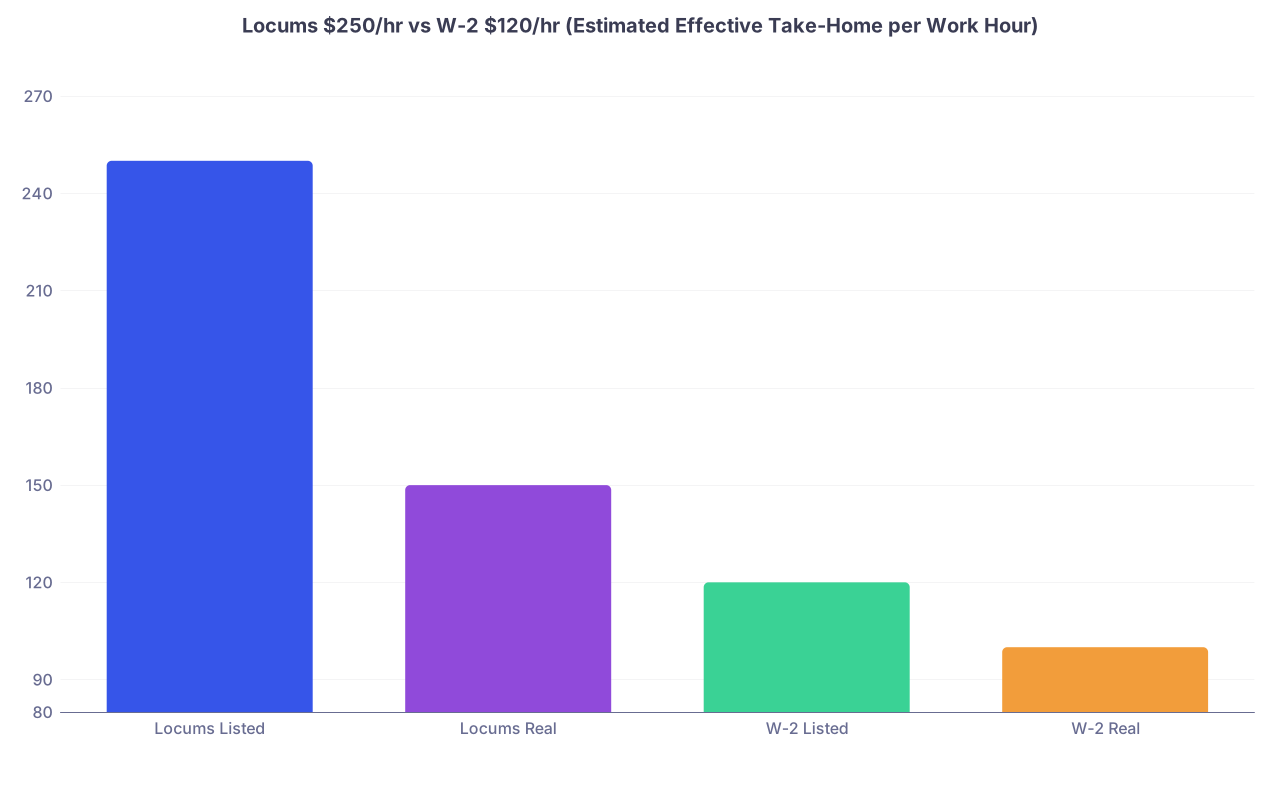
| Category | Value |
|---|---|
| Locums Listed | 250 |
| Locums Real | 150 |
| W-2 Listed | 120 |
| W-2 Real | 100 |
Rough reality for many early attendings:
- Locums “$250/hr” might feel like:
- ~$150–170/hr after:
- Self-employment taxes
- Unpaid travel days
- Uncompensated call hassles
- ~$150–170/hr after:
- W‑2 “$120/hr” might feel like:
- ~$100/hr after tax
- But with:
- Paid vacation
- CME money
- Retirement match
- Employer-paid malpractice tail
Do not make the mistake of comparing gross locums rate to gross W‑2 rate.
Compare effective after‑tax income per total time committed, including:
- Travel days
- Orientation days
- Credentialing waiting periods
- Gaps between contracts
If you’re not doing that math, you’re going in blind.
2. Travel Days and Dead Time: The Hours You Don’t Count
The boldest lie in locums budgeting is pretending only clinical hours matter.
You will lose money if you:
- Treat travel days as “off days” instead of unpaid work
- Ignore dead time between contracts
- Underestimate how often flights, weather, or hospital chaos eat your schedule
Reality check:
- 7-on/7-off contract that requires:
- Fly in the night before = 1 extra unpaid day
- Fly out the morning after = ½ to 1 extra unpaid day
- Your “7 days of work” has now cost you 9 days of life and location commitment.
So your “$250/hr x 12 hours x 7 days” isn’t the full story. You gave them 9 days of your calendar for 7 days of pay.
Then add gaps:
- Credentialing delays of 6–12 weeks
- A site that suddenly cancels or “postpones” your start date
- A slow month with no good contracts because you were too geographically picky
Locums revenue is lumpy.
If you don’t:
- Keep a realistic annual projection (not just “if I work 20 shifts a month…”)
- Plan for dry spells
- Budget assuming 2–3 slow months a year
…you’ll think you’re making bank, then realize in December that your “annualized income” is much lower than you told yourself in July.
3. Housing and Food: Death by 1,000 Small Charges
The number of physicians who underestimate housing costs is staggering. I’ve seen people literally wipe out their “rate premium” with sloppy housing choices.
Typical mistakes:
- Picking “convenient” but overpriced extended-stay hotels
- Ignoring taxes and fees on short-term rentals
- Not negotiating long-term rates
- Double housing (locums housing + home rent/mortgage sitting unused)

The big hidden killers
Short-term housing taxes and fees
- Weekly hotel stays with added occupancy taxes
- Airbnb/VRBO cleaning + service fees that add $300–600/month easily
Food inflation from being on the road
- Restaurant or DoorDash for 2–3 meals/day
- No time or space to batch-cook
- “I’ll just grab something” = $30+ per day, minimum; many people hit $50–70
Paying for housing in two places
- Your main home: rent/mortgage + utilities
- Locums site: hotel/apartment + taxes + parking
- If you’re not using your primary housing at all, you’re subsidizing your own locums lifestyle for no reason
This is where many docs secretly lose $1,000–$3,000/month without really feeling it, because it’s split across:
- $18 breakfast here
- $32 dinner there
- $7 airport coffee
- $12 Uber because you “don’t have groceries yet”
You want to avoid the slow bleed?
- Commit: Cheap, predictable housing — preferably with:
- Kitchenette or full kitchen
- Fridge big enough to store groceries
- Decide upfront:
- Am I keeping my primary home?
- If yes, am I willing to accept effectively lower income to pay for double housing?
- If no, can I emotionally and logistically handle being more nomadic for 1–2 years?
4. Taxes and Entity Setup: Overconfidence That Costs You
Locums = 1099 = you are a business, whether you like it or not.
Too many new attendings:
- Say “I’ll figure it out later”
- Use a random online LLC service
- Have no clue about quarterly payments
- Don’t track expenses properly
Then April hits and they owe $40k+ they didn’t plan for.
Mistake pattern I see constantly
Year 1:
- You start locums in July
- No quarterly estimates
- You spend freely because your checking account looks huge
- April: giant tax bill, penalties, panic
Year 2:
- You now owe for last year’s underpayment
- Plus this year’s quarterly estimates
- Cash flow feels tight
- You start thinking “locums doesn’t pay as well as I thought”
What you’re forgetting to factor in:
- Extra 7.65% “employer” side of FICA on much of your income
- State taxes where you work (not just where you live, in some cases)
- Loss of pre-tax benefits you’d get as an employee
- Cost of:
- Accountant familiar with physicians and multi-state issues
- Bookkeeping software or service
If you’re not:
- Making quarterly estimated tax payments
- Tracking deductible expenses (licenses, CME, part of phone, some travel, etc.)
- Getting specific guidance on entity structure (LLC/PLLC taxed as S‑corp or not)
…you’re probably overpaying and under‑planning. Both cost you real dollars.
5. Malpractice, Tail, and Insurance Gaps You Didn’t Price In
You’d be surprised how many doctors never ask the right malpractice questions before signing a locums contract.
Common blind spots:
- Assuming tail coverage is handled when it’s not
- Not checking retroactive dates if switching agencies
- Not clarifying what happens if you’re named in a lawsuit after you leave
Then there’s the other insurance:
- Health insurance (especially painful if your spouse/partner doesn’t carry it)
- Disability
- Life insurance
- Professional liability beyond malpractice (in some situations)
These are expenses your W‑2 job probably covered partly or fully. As a 1099, they’re yours.
| Insurance Type | Typical Annual Range (USD) |
|---|---|
| Individual Health | 8,000–20,000+ |
| Own-Occ Disability | 2,000–6,000 |
| Term Life (30s-40s) | 300–1,200 |
| Umbrella Liability | 200–600 |
If you don’t build these into your mental hourly rate, you’re lying to yourself about what you really earn.
6. Licensing, Credentialing, and “Admin Time” That No One Pays For
Locums has an entire hidden workload that no W‑2 job ever exposed you to.
You’re going to spend dozens of hours on:
- State medical licenses
- DEA registrations (sometimes multiple states)
- Hospital credentialing
- Privileging packages
- Annual re-credentialing
- Modules (you know, those 3-hour “safety” trainings that are half outdated PowerPoint)
None of that is paid. But it’s time. Your time.

| Step | Description |
|---|---|
| Step 1 | Sign Locums Contract |
| Step 2 | Send CV and References |
| Step 3 | State License Application |
| Step 4 | Hospital Credentialing Forms |
| Step 5 | Online Modules and Training |
| Step 6 | Travel Booked |
| Step 7 | First Day On Site |
Now multiply that by:
- 3–5 different hospitals in one year
- 2–4 states if you’re not careful
I’ve seen physicians easily spend 80–100 unpaid hours in a year just on this nonsense.
At your “real” hourly rate, that’s like handing back $15k–25k of value. You don’t see it in a bank account, but you feel it in your exhaustion.
If you want to avoid that:
- Limit the number of agencies and hospitals you work with
- Stick to regions where you already hold licenses or can get compact licenses (if applicable)
- Be realistic: admin time is part of the job; build it into your income expectations
7. Lifestyle Wear and Tear: Burnout Has a Price Tag
This one’s squishy, but it’s real. I’ve watched it eat people alive financially.
Locums sounds “flexible.” But a lot of people run it like a grind:
- Constant red-eyes or long drives
- Living out of suitcases
- Never fully integrated into a team
- Lonely off-days in random small towns

So what happens?
- You spend more on:
- Food
- Alcohol
- “Treat yourself” purchases
- Last-minute flights home
- You burn out faster and:
- Take unpaid breaks
- Cancel contracts (burning bridges)
- Accept worse‑paying but easier gigs out of fatigue
All of that has a financial impact.
You cannot run at “max shifts, max travel, max grind” indefinitely. If you build your financial plans around superhuman output, you will fail. And then you’ll blame locums, when the real mistake was your expectation.
Plan like this:
- Pick a sustainable maximum number of shifts/month
- Build margin into your schedule for:
- Actual rest
- Time at home
- Relationships that actually support you (not just social media venting)
Otherwise, your “locums years” will cost you emotionally and financially.
8. Comparing Locums to Fantasy W‑2 Jobs Instead of Real Ones
Another subtle but expensive mistake: comparing locums income to an imaginary attending job, not the one you could actually get.
Example:
- You’re in EM, just out of residency
- You imagine:
- Perfect group
- Great schedule
- $250/hr
- Partnership track
- Reality job offers:
- $200/hr
- Heavy nights
- Questionable leadership
- No real say in operations
You bail on all W‑2 offers, pick locums at $260/hr, and tell yourself you’re “way ahead.”
But then you forget:
- W‑2 benefits:
- 3–5 weeks PTO
- Health insurance contributions
- Retirement match (e.g., 3–5% of salary)
- Paid CME
- Malpractice tail covered
- Stability:
- No gaps between shifts
- You can buy a house more easily
- Easier to set up consistent childcare, spouse job, etc.
If you do the math honestly, especially over 3–5 years, that “not-good-enough” W‑2 might leave you ahead of locums—especially if you’re sloppy with locums expenses.
Locums makes the most financial sense when:
- You are very intentional about:
- Scheduling
- Housing
- Taxes
- Long-term plan
- You’re using it as:
- A bridge to geo-move
- A way to pay off debt aggressively
- A strategic lifestyle choice, not a default
If you’re just drifting? You’ll leak money.
9. Bad Negotiation and Saying Yes Too Fast
Locums agencies are not your friends. They’re vendors. They get paid when you work.
New attendings often:
- Take the first rate they’re offered
- Don’t ask what the hospital is paying the agency
- Never push back on:
- Call burden
- Extra duties
- “Oh by the way we also need you to cover clinic some days…”

| Category | Value |
|---|---|
| Hourly Rate | 80 |
| Call Pay | 60 |
| Travel Stipend | 50 |
| Housing Quality | 40 |
| Schedule Flexibility | 35 |
Every time you:
- Don’t question the call structure
- Accept “it averages 14–16 patients a day” without asking for actual numbers
- Agree to “occasional nights” that magically become half your schedule
…you’re gambling with your time and your sanity.
Minimum protections you should negotiate or clarify:
- Exact call expectations:
- In-house vs beeper
- Average pages/calls per night
- True patient volume:
- Pull actual RVUs or counts from prior quarters if they’ll share
- Travel details:
- Who books?
- Max number of layovers?
- What happens when flights are canceled?
If you’re not pushing on those details, you’re probably working for less than your real value.
10. No Exit Plan: Staying in Locums Too Long by Default
Locums can be a powerful tool. It’s not automatically a long-term strategy for everyone.
Big mistake:
You go into locums as a “temporary” plan… with no actual decision point.
So you drift:
- Year 1: “I’m just figuring out what I like.”
- Year 2: “Market’s weird, I’ll keep doing this.”
- Year 3: “Now I’m priced out of buying in my ideal city and my CV looks scattered.”
You lose:
- Time building seniority in a stable group
- Partnership or profit-sharing options
- Roots in a community (which support long-term mental health)
- Negotiation power that comes with being indispensable somewhere
Locums works best when you can answer:
- How long am I willing to do this at high intensity? (e.g., 1–3 years)
- What financial goals must I hit to call this “successful”? (e.g., $200k loans gone)
- What decision checkpoints will I have? (e.g., every 6–12 months, seriously reevaluate)
Without that, you just float. Floating is expensive.
FAQs (5 Questions)
1. How do I know if a locums rate is actually “good” after hidden costs?
Reverse-engineer it. Start with the hourly rate, then subtract:
- ~10–12% for extra self-employment payroll taxes (rough approximation)
- Your estimated monthly:
- Health insurance
- Disability and life if you’re paying them
- Average out-of-pocket housing premium vs what a W‑2 job in your home city would cost
- Add up unpaid travel and admin time and convert it into “shadow work hours”
Then compute: total net income / total hours (clinical + travel + admin) over a year. If that number isn’t clearly beating your best realistic W‑2 options, the rate isn’t actually “good.”
2. Is it ever smart to do locums right out of residency?
Yes, but only if you treat it like a business decision, not a rebellion against employment. It can be smart if:
- You have a clear financial goal (e.g., eliminate high-interest debt in 2 years)
- You’re willing to live modestly and aggressively bank the difference
- You have or will quickly get a good accountant
- You’re disciplined about tracking hours, expenses, and actual net worth growth
Jumping straight into locums with no plan, just because you “hate hospital politics,” is how people burn out and wonder where the money went.
3. What’s the biggest hidden cost most physicians truly underestimate?
Housing and food, easily. Not just the raw amount, but the friction—being tired, always in transit, and defaulting to expensive options. Second biggest is unpaid time (travel, credentialing, admin) that never shows up in your locums invoice but absolutely drains your calendar.
4. Can I fix these mistakes if I’m already mid‑locums and feel like I’m losing money?
Yes. You don’t have to start over, you just have to stop the leaks. Practical fixes:
- Renegotiate or switch to cheaper, more stable housing with a kitchen
- Work with your accountant to:
- Set up proper estimated taxes
- Clean up your deductions
- Trim the number of hospitals and states you cover to reduce admin overhead
- Set a hard maximum on travel days/month and focus on longer blocks at fewer sites
Most locums disasters are fixable in 3–6 months if you get ruthless and honest about what’s not working.
5. How do I avoid getting seduced by recruiter promises that don’t pan out?
Treat recruiters like sales reps—because that’s what they are. To protect yourself:
- Ask for hard numbers: average census, RVUs, call volumes, turnover
- Request to speak with another physician currently on the contract (and actually ask them pointed questions)
- Get every important term in writing: rate, call structure, overtime, cancellation policies
- Start with a trial block (1–2 weeks) before committing long-term if possible
If a recruiter gets vague, dodges your questions, or pressures you to decide “today,” assume the site is riskier than they’re admitting.
Key Takeaways
- Don’t compare headline locums rates to fantasy W‑2 numbers. Compare real after‑tax dollars per total hour of your life committed.
- The money you “lose” isn’t usually in the rate. It’s in housing, food, taxes, insurance, unpaid admin time, and lifestyle choices you forgot to price in.
- Locums can absolutely be lucrative—if you treat it like a business, negotiate hard, and set a clear time‑bound plan instead of drifting from one “great” contract to the next.