
Malpractice insurers are not afraid of “locums.” They’re afraid of uncontrolled variables walking into an already risky system with someone else’s name on the building.
Let me translate that into plain English: they worry that you, as a locum, will show up in a strange hospital, take care of high‑risk patients with half the information you need, under unclear supervision, and then disappear before the lawsuit hits. That’s the fear.
You’ll never hear that on a recruiter call. But it’s what’s said in risk management meetings, carrier underwriting calls, and hospital credentialing committees. I’ve sat in those rooms. I’ve heard the exact phrases:
- “Who actually knew this physician?”
- “Why was he credentialed for that procedure?”
- “Who’s responsible once the contract ends?”
Let me walk you through what malpractice carriers and hospital risk teams actually worry about with locum tenens physicians, and how you can position yourself as “low risk” instead of “walking liability.”
1. The Core Anxiety: “We Don’t Really Know This Doctor”
Here’s the unspoken baseline: insurers trust stability and predictability. Locums, by definition, are neither.
In every underwriting discussion about covering locums, the same subtext shows up: “We do not really know who this person is beyond a stack of paperwork.”
What that means behind closed doors:
- They know your CV is polished by you (or an agency).
- They know references often come from people who like you, not from the person who thinks you’re reckless.
- They know hospitals sometimes rush locum privileges because they’re desperate for coverage.
The insurer’s nightmare scenario looks like this:
A hospital in a rural area is drowning in volume. They bring you in to cover nights in the ICU or ED. You’re new. No one really orients you. Your first shift: understaffed, unfamiliar EHR, maybe one other physician who’s also new. A critical, borderline case comes in at 2 a.m. Documentation is thin, cross-cover is chaotic, and three months after you leave, the family hires an attorney.
The insurer gets the claim file and reads: “Physician: Locum tenens, here for 6 weeks, no longer available at this facility.”
That’s the first big fear: transient, poorly known providers taking on high‑acuity care with limited oversight.
So every other worry flows from that: how predictable are you, how safe are you under stress, and how easy is it to defend your care when the chart is all they have left.
2. The Real Red Flag: Scope Creep in Unfamiliar Systems
If I had to pick the number one thing malpractice carriers obsess over with locums, it’s this: people doing too much, too fast, in environments they do not fully understand.
Carriers and hospital risk teams have seen this pattern over and over:
- A locum with outpatient comfort gets slotted into inpatient/hospitalist work.
- An anesthesiologist comfortable with ASA 1–2 in community settings thrown into a place that quietly takes higher‑risk cases.
- A general surgeon used to co-surgeons and plenty of resources ends up solo with limited backup.
Or the worst one: “But they were credentialed for that.”
I’ve sat in cases where the defense attorney flips through the privileges page and says, “They let you do this here?” Because once you’re privileged for something, the legal assumption is: you were competent to do it.
Insurers worry a lot about scope creep disguised as “privileges”:
- Credentialing teams sometimes rubber‑stamp broad privilege sets because “we need coverage.”
- Locums sometimes sign privilege forms without really reading them, because compensation depends on “being flexible.”
- The combination is toxic when something goes wrong.
From the insurer’s perspective, locums are higher risk if:
- You cross specialties or higher‑risk areas that are not in your core comfort zone.
- You accept broad privileges in a high‑acuity setting without a documented track record there.
- You’re the “yes” person for every shift, every role, every patient type.
What they love, even if they won’t say it: the locum who clearly defines their lane and stays in it ruthlessly.
If you ever want to see a risk manager visibly relax, say this during onboarding:
“I want to be very explicit about what I do not want to be privileged for or assigned to. Here’s my comfort zone.”
That gets documented. That matters when cases come up. And yes—people in the back office notice.
3. The Orientation Problem: “No One Showed Me How This Works”
Now we get to the dirty secret everyone knows but pretends not to: most locums get terrible orientation. Sometimes none.
From an insurer’s view, this is gasoline on the fire. You’re in a new:
- EHR
- Call system
- Medication formulary
- Policy environment
- Culture
And yet, you’re expected to function at full speed on day one. You already know this. What you may not realize is how predictably this shows up in lawsuits.
In claim reviews, this line appears constantly:
- “I did not know that was the system here.”
- “No one told me that consults had to go through X.”
- “I thought the lab auto‑notified us of critical values.”
- “I didn’t know there was a sepsis protocol button.”
- “In my usual hospital, the nurse handles that paging process.”
Carriers see a pattern: locums are blamed for system failures they never had a chance to learn.
But here’s the key ugly truth: juries don’t care how bad your orientation was. They assume you’re a professional and should have asked more questions.
So insurers worry that locums:
- Do not aggressively clarify workflows at the start.
- Assume “this hospital is probably similar to my last one.”
- Are reluctant to appear “high‑maintenance” by asking for details.
If you want to lower your profile as “risky locum”:
- On day one, over-document your questions.
“Can you show me the critical value alert system?”
“How do I get emergent imaging at night?”
“Who’s the backup attending if I need help?” - Keep a personal “hospital quick sheet” in your pocket or phone. Where to find order sets, on‑call lists, emergency codes, who to call for stroke, sepsis, OB emergency, etc.
Risk managers love physicians who behave as if orientation is their responsibility, not an afterthought. Because they know the hospital will always under-deliver.
4. Night Shifts, High Acuity, and “Ghost Supervision”
Malpractice risk is not evenly distributed. Insurers know exactly where the danger spikes: nights, weekends, understaffed settings, and vague supervision chains.
Locums are disproportionately used in those spots.
You think of it as “flexibility.” They think of it as “intensified risk in already stressed environments.”
Common insurer worries:
- The locum in the ED at 2 a.m. with no in‑house consultant and useless phone backup.
- The hospitalist covering 80–100 patients overnight, including fresh post‑ops, without clear escalation pathways.
- The anesthesiologist in a rural OR where the only backup is “available by phone,” who lives 40 minutes away.
Even worse: when supervision relationships are paper‑only. On paper, there’s a “supervising physician” or “medical director.” In reality, they’re barely engaged.
Insurers worry that:
- Locums don’t know who truly has their back.
- Local staff assume “the locum should handle it” and fail to escalate.
- No one documents when backup was unavailable, unreachable, or declined to come in.
If you want to sound disturbingly sophisticated in a new facility (and drop your perceived risk profile):
Ask these exact questions to the medical director or chief on day one, and repeat in an email:
- “When I have a borderline case at 2 a.m., who do you expect me to call first?”
- “What kind of situation would you expect me to activate a rapid response or call the ICU attending directly?”
- “Is there any situation where you’d want to be notified even if I think I can handle it?”
Then you document their answers. In an email:
“Per our discussion today, my understanding is: For unstable patients in X situation, I will call Y; for Z types of cases, I should involve ICU early, etc.”
Malpractice carriers love this kind of record if something goes bad. It shows you tried to align with local standards and expectations, not freelance your own.
5. Documentation: The Only Thing Left When You’re Gone
Insurers are brutally realistic about one fact: by the time a malpractice claim is filed, most locums are long gone.
You won’t be there to explain yourself to the risk manager, or walk the defense attorney through your thought process. All they have is:
- Your chart
- A few emails
- Maybe some nurse notes
So they worry that locums:
- Chart minimally, assuming “it’s the same standard as back home.”
- Under-document reasoning (“watchful waiting” without writing the rationale).
- Fail to clearly state limitations (“unable to reach consultant,” “no ICU beds available,” etc.)
Here’s something no one tells you: in closed‑door file reviews, insurers sometimes literally say, “This is a defensible decision with indefensible documentation.”
When they say that about a locum, they’re thinking: “We will pay more on this claim than we should, because we cannot explain what this doctor was thinking.”
If you want to look like a dream locum on paper:
- Document your thinking, not just your actions.
- When you are operating under limitation (no consultant, no CT at night, patient refusing transfer), write it clearly.
- Use very clear time stamps for escalation:
“00:30 – paged neurosurgery. No response by 00:50. Called transfer center; no tertiary beds available. Discussed risk with family; they elected to stay here with close monitoring.”
Locums who write like this are much easier to defend. Insurers absolutely notice.
6. Claims History: Patterns That Make Insurers Nervous
Here’s another uncomfortable point: your claims history as a locum is viewed differently than a traditional staff doc.
A single small claim over a ten‑year stable career at one institution? Most underwriters shrug.
Multiple incidents over a few years at multiple facilities as a locum? That looks very different. It suggests a pattern that follows you, not the system.
Insurers and hospital credentialing teams look for:
- Clusters of complaints at multiple sites.
- Patterns in allegations: poor communication, missed follow‑up, “rude” or “dismissive” behavior cited over and over.
- Repeated peer review flags or “not invited back” stories that don’t match your polished narrative.
The ugly version: some locums end up on an unofficial “do not touch” list at the carrier level. They’re technically insurable, but everyone knows, “If this name pops up again, expect trouble.”
To avoid even drifting toward that category:
- Take patient complaints and staff feedback seriously, especially in locums work. Those comments follow you more than you realize.
- If you leave a facility after friction, own your version in writing with your agency or group so there’s a contemporaneous record, not just the hospital’s side.
- Clean up your interpersonal footprint. Carriers worry much more about doctors who generate hostility and documentation wars than the ones who quietly ask for help.
A surprising amount of malpractice risk is human conflict masquerading as “clinical error.”
7. Why Certain Specialties and Settings Make Them Sweat
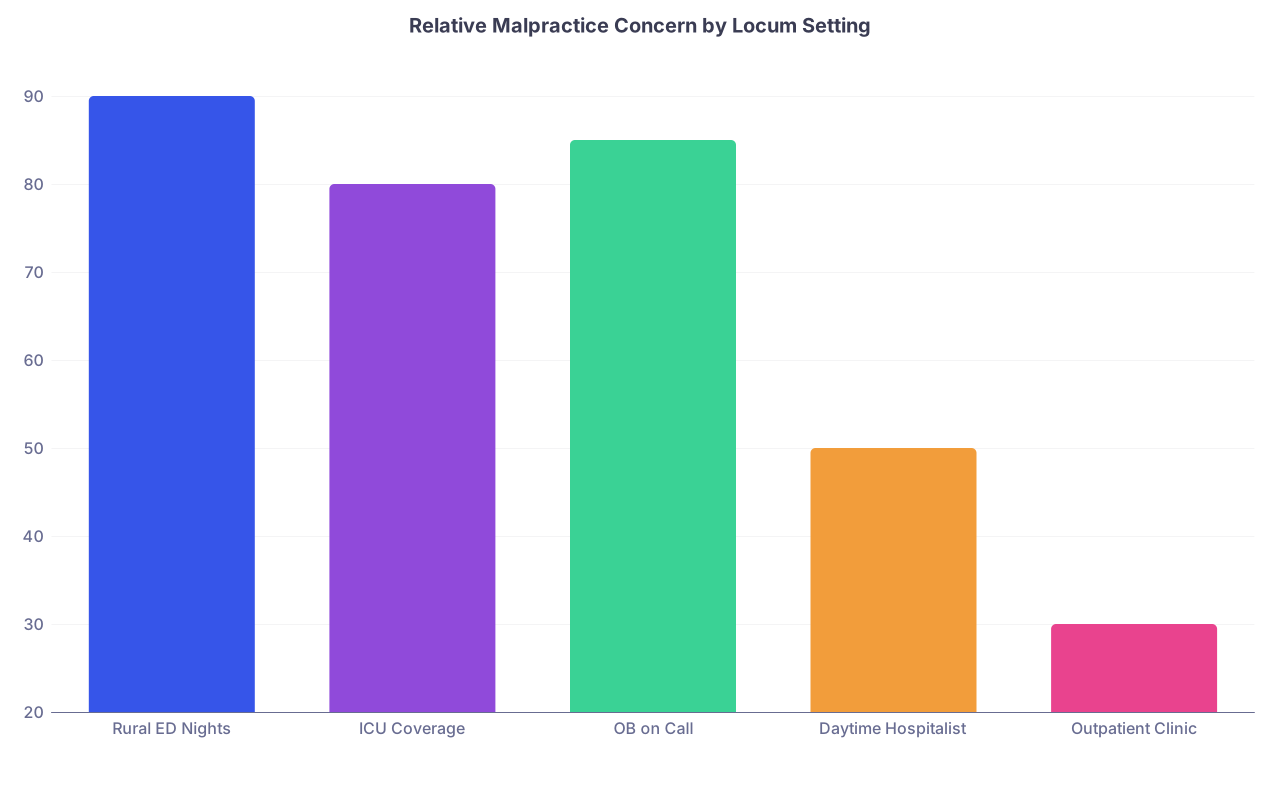
Not all locums slots are equal in insurer land. Some combinations are particularly unnerving:
High‑acuity + poor support + locum = red alert.
| Category | Value |
|---|---|
| Rural ED Nights | 90 |
| ICU Coverage | 80 |
| OB on Call | 85 |
| Daytime Hospitalist | 50 |
| Outpatient Clinic | 30 |
Behind closed doors, I’ve heard variations of:
- “Locum OB at a low‑volume hospital with no in‑house anesthesia is a nightmare.”
- “Solo ED coverage with a locum in a place that still uses paper charts? That’s a claim waiting to happen.”
- “ICU locums where the ‘team’ is mostly nocturnists and travel nurses who just met.”
They’re especially wary when:
- The hospital itself has a history of frequent claims.
- There’s no robust peer review or QA process that includes locums.
- There’s chaos in leadership: rotating chiefs, temporary medical directors, etc.
As a physician, you should be reading the same signals. If the environment feels unsafe to you, trust me, it’s already lit up mentally at the carrier’s office.
8. How You Can Present as “Low-Risk, High-Value” to Insurers and Hospitals
Let me flip this around. There is a profile of locum that malpractice carriers quietly like. They see them as stabilizers, not amplifiers, of risk.
These are the physicians who:
- Stick to a defined clinical lane and say no to scope creep.
- Aggressively clarify orientation gaps and escalate early.
- Document clearly, especially when systems fail around them.
- Have a track record of clean peer reviews across varied sites.
- Treat nursing staff and local teams as allies, not adversaries.
You do not need to say, “I’m trying to be low risk from a malpractice perspective.” That sounds absurd. But you can act in ways that communicate it implicitly.
Some concrete moves:
Before accepting an assignment, ask the recruiter very direct questions:
“What’s the acuity?”
“How many patients per shift?”
“Who else is on at night?”
“Any recent malpractice or risk issues that I should know about?”
You won’t get full truth, but you’ll smoke out the most dangerous situations.During credentialing, proactively limit your privileges to what you truly do well. Write:
“I am not requesting privileges for X, Y, Z. I do not intend to cover those services.”At the site, introduce yourself to the nurse manager, charge nurses, and main consultants and say something like:
“If you ever feel uncomfortable with a plan, I want you to speak up early. I’d rather be annoyed for five seconds than wrong for the rest of my life.”
That line spreads. And the people who might otherwise quietly resent “the locum” start defending you instead of criticizing you in the chart.
And yes, insurers see that in the record when things blow up.

| Step | Description |
|---|---|
| Step 1 | New Locum Assignment |
| Step 2 | Defined Privileges |
| Step 3 | Scope Creep Risk |
| Step 4 | Lower System Risk |
| Step 5 | High System Risk |
| Step 6 | Good Documentation |
| Step 7 | No Issue |
| Step 8 | Defensible or Not |
| Step 9 | Clear Scope? |
| Step 10 | Adequate Orientation? |
| Step 11 | Claim Filed? |
This is how risk managers mentally map you, even if they never put it on paper.
9. The Locum’s Leverage: You Can Walk Away
Here’s something hospitals and insurers hate to admit: you, as a locum, actually have more safety leverage than many employed physicians.
Why? Because you’re not locked into a long‑term contract, politics, or a single salary stream. You can say no.
The smartest locums I’ve seen do three things ruthlessly:
- They walk away from unsafe environments, even if it costs them a short‑term check.
- They insist on reasonable orientation, support, and staffing before agreeing to extend a contract.
- They make their comfort zone non‑negotiable.
The worst malpractice stories I’ve seen with locums start with:
“I knew it felt unsafe, but I didn’t want to lose the income / upset the recruiter / look weak.”
Let me be blunt: malpractice insurers are far more worried about the locum who tolerates chaos than the one who raises safety concerns and, if ignored, bails.
When you push back on unsafe setups, you’re not being “difficult.” You’re functioning like unpaid risk management. The smart hospitals know this.

10. What Malpractice Insurers Would Tell You If They Could Be Honest
If you cornered a seasoned malpractice underwriter at a conference reception and got a drink into them, here’s roughly what they’d say about locums:
- “You are not inherently higher risk. The situations you’re placed into are.”
- “We get nervous when you pretend you’re fine in environments that would rattle anyone.”
- “We’re much more comfortable defending you when you documented that the system failed around you and you still tried to do the right thing.”
- “We take note of locums who ask the right questions up front. It shows judgment. Good judgment is the best malpractice protection you have.”
And maybe the most important point:
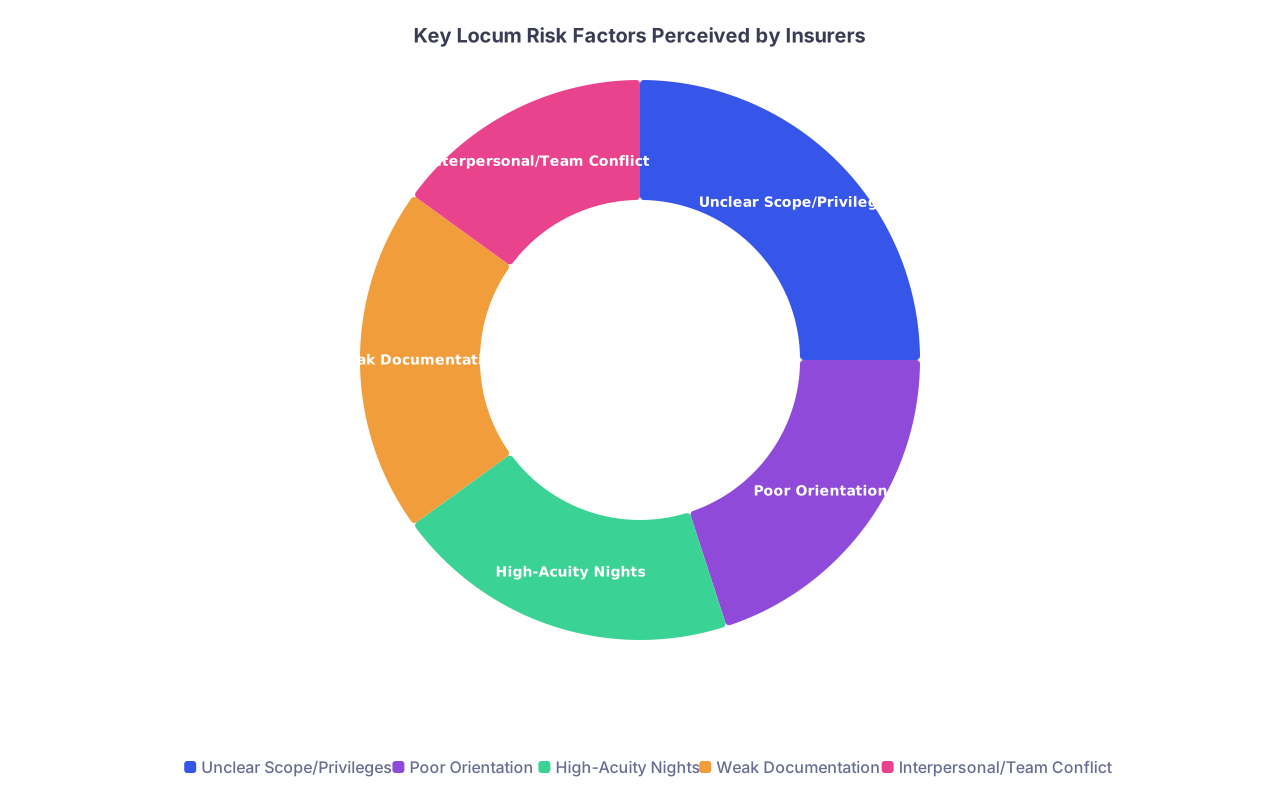
They don’t need you to be perfect. They need you to be predictable, honest about your limits, and transparent in your chart. If you can do that consistently, you stop looking like a liability and start looking like a stabilizing force.
And there’s always demand for that.
| Category | Value |
|---|---|
| Unclear Scope/Privileges | 25 |
| Poor Orientation | 20 |
| High-Acuity Nights | 20 |
| Weak Documentation | 20 |
| Interpersonal/Team Conflict | 15 |
FAQ: Locum Malpractice Questions You’re Probably Thinking About
1. Are locum physicians actually sued more often than permanent physicians?
Not automatically. The raw numbers are messy because locums cluster in higher‑risk settings: rural EDs, understaffed hospitals, high‑acuity services. When you adjust for that, the issue isn’t “locum vs employed,” it’s environment and support. Insurers worry less about your label and more about where and how you’re practicing.
2. Does working lots of short locum assignments hurt me with malpractice carriers later?
It can, if the pattern comes with complaints, peer review issues, or any claims. A varied locum history with clean records and good references is fine. A string of three‑ to six‑month gigs where you’re “not invited back” or there are repeated behavioral issues sets off alarms. Stability isn’t mandatory, but a pattern of friction is a big problem.
3. Who usually covers malpractice for locums—the agency, the hospital, or me?
Depends on the arrangement. Many locum agencies provide claims‑made coverage while you’re on assignment, sometimes with tail. Some hospitals require you to have your own policy or tail. You should always know: who is the named insured, what the limits are, and who pays for the tail. Do not assume “the agency handles it” without seeing the actual policy terms.
4. What specific behaviors make a locum look “safe” to malpractice insurers and hospital risk teams?
Consistent, clear documentation. Early escalation for borderline cases. Respectful, collaborative behavior with nursing and staff. Saying no to unsafe scope or assignments. Asking orientation questions that show you’re trying to align with local standards. When chart reviews show that pattern, insurers breathe easier.
5. If a malpractice case happens years after an assignment, how involved will I need to be as a locum?
Potentially very involved. You can be deposed, required to give testimony, and pulled back into a case tied to an assignment from years ago, even in another state. Your best protection is the chart you left behind and any contemporaneous documentation (emails, notes) that show your reasoning and system constraints. You might physically be gone, but your signature and your decisions are absolutely still in the room.
Key takeaways:
Locums themselves are not what malpractice insurers fear. They fear poorly oriented, over‑extended physicians in unsafe systems who pretend everything is fine. If you define your scope, demand clarity and support, and document your thinking and limitations, you stop being a wild card and become exactly what everyone actually wants: a reliable, low‑drama physician who can drop into chaos and not make it worse.