
The public story is that locum tenens is a meritocracy. The private reality is that recruiters use a quiet, ruthless ranking system on every physician they talk to—and most locums doctors never figure out why they’re not getting the best assignments.
Let me walk you through how you’re actually being scored behind the scenes.
What Recruiters Really Optimize For (It’s Not Just “Good Doctor”)
Every agency and in‑house recruiter will tell you they’re looking for “the best fit” and “strong clinicians.” That’s the surface layer. Underneath, they’re ranking you on one brutal axis:
Risk vs. Reliability.
You’re not just a CV. You’re a probability. A probability that:
- you’ll show up on time
- you won’t blow up the schedule
- you won’t generate complaints
- you won’t walk off assignment
- you won’t cause a credentialing disaster
Clinically excellent but operationally chaotic? You get quietly deprioritized.
To a recruiter, the “perfect” locum physician is:
- clinically safe and average-to-good
- low drama, low maintenance
- predictable and responsive
- administratively competent
Notice I didn’t say “brilliant” or “elite.” Those words almost never come up on internal calls. They say “solid,” “easy to work with,” “no nonsense,” “shows up.”
If you want the best locum gigs—clean schedules, higher rates, repeat sites—you have to understand how they score you on that reliability axis, often within the first week of contact.
The Hidden Scorecard Recruiters Use On You
No one will ever show you this, but there’s a mental (and often literal) scorecard in play. I’ve heard versions of it on internal calls at multiple agencies. They’re not identical, but the buckets are the same.
1. Response Time: The Fastest Get First Dibs
Here’s the uncomfortable truth: most top-paying, low‑drama assignments never hit the mass email blast. They get filled in hours, sometimes minutes, by the “A‑list” physicians who reply fast and say yes cleanly.
Recruiters track—and remember—your speed.
- You reply to texts/emails within 1–2 hours during business hours: you’re “responsive”
- You take 24–48 hours to answer basic questions: you’re “slow”
- You disappear mid-thread: you’re “unreliable”
On internal calls you’ll hear:
- “Don’t send that job to him, he takes days to answer.”
- “Text Dr. ___, she gets back to me in five minutes—start with her.”
They will not say this to your face. They just stop sending you the good stuff first.
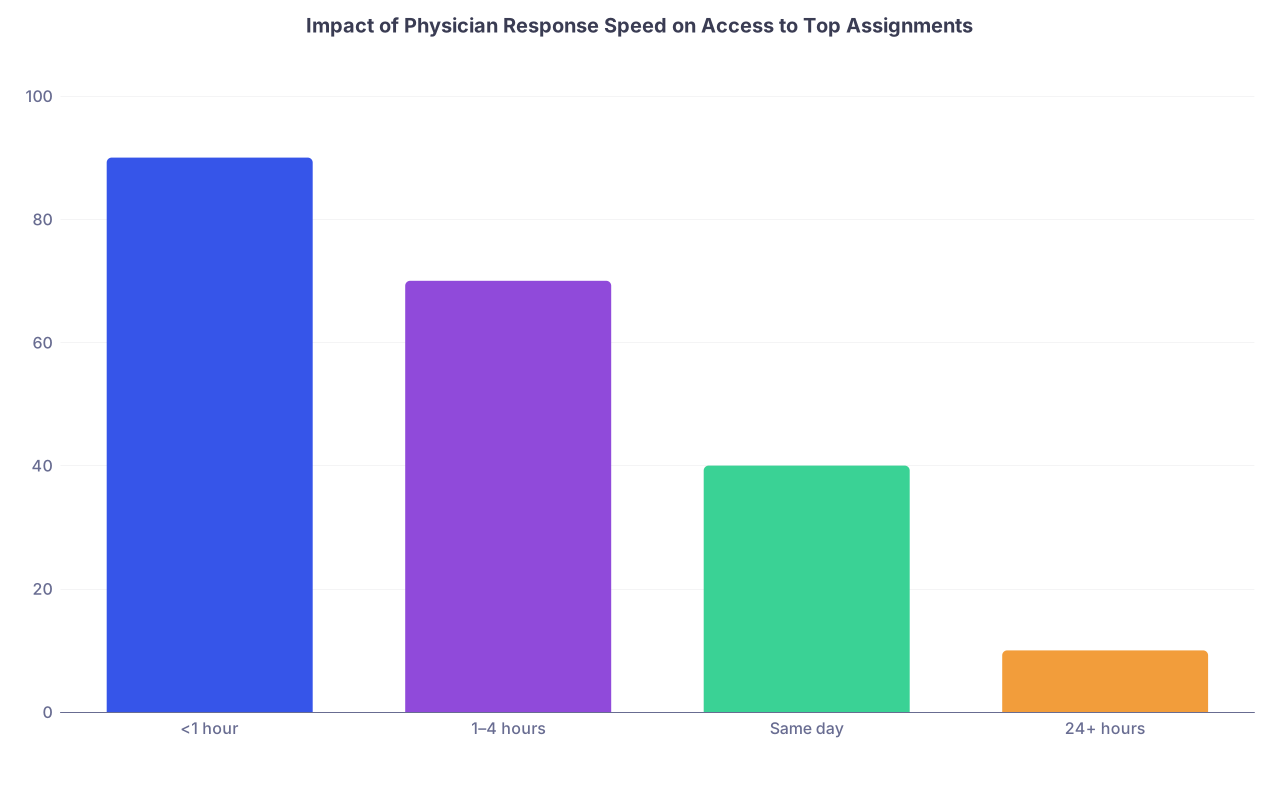
| Category | Value |
|---|---|
| <1 hour | 90 |
| 1–4 hours | 70 |
| Same day | 40 |
| 24+ hours | 10 |
(Those percentages reflect how often, roughly, I’ve seen physicians in each bucket get offered premium assignments before a job goes public.)
If you want to be ranked high: when a recruiter you trust messages you about a real job, answer the same day—even if it’s just “Got it, I’ll confirm tonight.”
2. Availability Pattern: Your Calendar Is a Signal
Recruiters are not just looking at how much you can work. They’re reading your availability pattern like a personality test.
- You give them clear blocks months in advance: you’re “plan-able”
- You give them “maybe this weekend” or “depends on my mood”: you’re “time waster”
- You constantly change what you previously promised: you’re “never again”
Here’s the ranking they almost never admit to:
| Availability Pattern | How Recruiters Label You |
|---|---|
| 5–7 consecutive days, repeated blocks | High value, easy to place |
| 3–4 day blocks, predictable | Solid, dependable |
| Single random days, short notice | Filler, last-resort option |
| Constantly changing or vague dates | High risk, avoid if possible |
On pipeline calls, they ask: “Who do we have that can give us weeks at a time?” Those people get put at the top of the list. If you’re always offering scattered one‑off days, expect last-minute, messy coverage work.
3. Credentialing & Paperwork Behavior
This one separates professionals from headaches fast.
Every recruiter has a mental list of doctors who:
- send complete credentialing packets, correctly filled, within 48–72 hours
- answer follow‑ups without drama
- do their onboarding modules without being nagged
And then the others, who:
- need five reminders for every document
- fight every form, every vaccine, every policy
- ghost halfway through credentialing
Here’s the part you won’t hear publicly: if you burn a recruiter’s time on credentialing once, you get downgraded for months. I’ve literally heard:
“I’m not running him through another hospital. Last time we chased him for three weeks and he bailed.”
You become too expensive from a staff-time standpoint. So even if your CV is stellar, they’ll offer the plum assignment to the person who behaves like an adult with paperwork.
4. Clinical Reputation vs. Complaint Risk
Hospitals and groups call recruiters back. And they are brutally honest when they do.
The feedback isn’t a 10‑page report. It’s usually one line, and that one line determines your future opportunities in that system and often at that agency.
Typical recruiter notes after a call with a site:
- “Good doc, would take back.” → gold stamp
- “Clinically fine but staff didn’t like him.” → borderline
- “Won’t have her back.” → effectively blacklisted from that client
- “Charting incomplete, late notes, QA issues.” → red flag
They care a lot less about whether you’re “the best clinician we’ve ever seen” and a lot more about whether you caused problems.
What really hurts your ranking:
- nursing or staff complaints about attitude
- repeated late arrivals or no‑shows
- poor documentation that triggers hospital QA
- refusing standard policies in an entitled way
You don’t hear those conversations. You just notice job offers slowing down, or that you’re only getting places nobody wants.
5. Rate Behavior: Are You Reasonable or a Headache?
Let’s be blunt. Agencies care about margins. Hospitals care about budgets. Everyone cares about predictability.
You are ranked on money in three ways:
- Do you know your market value, or are you wildly unrealistic?
- Do you negotiate once and then stick to it, or do you keep moving the goalposts?
- Do you pull last-minute rate hikes or threats?
A physician who says, “For Hospital X, with that volume and call burden, I’d need roughly $Y. If you can’t get there, that’s fine, but that’s my floor,” and then holds that line? That person gets respect.
The one who:
- agrees verbally to $220/hr
- then demands $260 when the paperwork arrives
- then pushes for $280 a week before start
…might get the first payday, but the recruiter will quietly flag them as a short‑term profit, long‑term problem. They will not send that doctor into their most important client accounts.
6. Professionalism Signals You Don’t Realize They’re Watching
Most physicians underestimate how much is inferred from small behaviors in early interactions.
They notice:
- how you talk to the scheduler vs the “actual” recruiter
- whether you return calls when you say you will
- how you react when something goes wrong (credentialing delay, travel mix‑up, schedule shift)
- how you speak about previous sites and staff
Every time you explode over a flight change or a missed email, you’re telling them what you’ll be like when something bigger breaks at the hospital. And things always break at the hospital.
The physicians who rise on the internal ranking list usually sound like this on calls:
“That’s annoying, but ok, what’s Plan B?”
“Got it, not ideal, but I can flex this time.”
“I’m not happy with that, but I committed, so I’ll follow through. Next time we’ll do it differently.”
They’re not doormats. They hold boundaries. They just aren’t volatile.
The Tiers You Never See: How Recruiters Actually Classify Locums
Internally, agencies absolutely stratify physicians. They don’t always use these exact labels, but the logic is the same.
| Tier | Description | Typical Opportunities You See |
|---|---|---|
| A-List | High reliability, low drama | First look at best-paying, clean sites |
| B-List | Solid but not priority | Standard mixed-bag assignments |
| C-List | Known issues, slow, or unpredictable | Last-minute, undesirable coverage |
| DNR / Do Not Use | Burned bridges, high risk | Rarely or never presented |
The unspoken rules:
- A‑list gets first call / first text on new premium jobs
- B‑list gets the leftovers that still need decent coverage
- C‑list gets the “we’re desperate, it’s a mess, but here’s a job”
- DNR doesn’t even hear about openings unless someone is panicking
If you’ve ever wondered why a colleague is somehow always at better hospitals, shorter calls, higher rates—this is why. They’re sitting on the A‑list with that recruiter or agency.
And yes, this varies by agency. You can be B‑list in one shop and A‑list in another. Which is exactly why burning time and trust is so dangerous—you don’t see which list you just slipped down to.
How Locum Physicians Quietly Get Downgraded
Here are the “career limiting moves” I’ve actually seen push good doctors down, sometimes permanently.
The Ghosting Problem
You’d think physicians wouldn’t do this. They do. Constantly.
Sign a letter of intent, then vanish before credentialing.
Confirm dates verbally, then take a permanent job and never tell the recruiter.
Negotiate hard for a slot, then no‑show the start date.
Recruiters remember every single one of these. Their client remembers as well. You just tagged yourself as high-risk.
One recruiter phrase I’ve heard too many times:
“He burned me once. I’m not putting him in front of [Big Health System] again.”
Burning Bridges With Hospitals
Walking off an assignment mid‑contract, unless the site is truly dangerous or deceptive, is a reputation grenade. It may be justified from your perspective. But the story the hospital tells the agency is rarely generous.
Try this instead: finish the block you’re in, document everything you’re unhappy with, and tell the recruiter calmly you will not be renewing. Word gets around about the difference.
Toxic Travel Behavior
You’d be amazed how often I’ve seen things like:
- screaming at a travel coordinator
- refusing economy flights, demanding business class for a 2‑hour hop
- insisting on luxury hotels well beyond policy
That puts a giant asterisk next to your name. If you’re consistently “high maintenance,” recruiters will hesitate to put you in front of conservative or sensitive hospital clients.
How To Deliberately Move Yourself Up the Ranking
You can absolutely game this system—ethically—once you know what’s being scored.
1. Decide Which Recruiters You Actually Want to Impress
Not all agencies are equal. Not all recruiters are competent.
Work with a few, not ten. Two or three serious relationships are better than spraying your CV across the entire industry. Tell them clearly:
“These are the types of sites and schedules I’ll prioritize. If you bring me those, I’ll respond quickly and follow through.”
Then actually do it.
2. Clean Up Your Communication Habits
This is low‑hanging fruit and makes a massive difference.
- Respond to relevant texts/emails the same business day
- Use short, clear answers instead of vague hedging
- If you’re not interested, say “No, thanks” quickly instead of ghosting
- If your situation changes, update them before they chase you
You want the recruiter thinking: “When I text Dr. X, I know I’ll get a straight answer.”
3. Be Ruthless About Your Own Reliability
If you say you’re available, you’re available. If you commit, you show up, even if the job turns out less glamorous than advertised.
The secret here: recruiters notice doctors who take a mediocre assignment early in the relationship and handle it like a pro. Those physicians get “upgraded” for the better stuff later.
4. Treat Paperwork Like Part of the Job, Not an Annoyance
You don’t have to enjoy it. But you do have to not be a nightmare.
Practical approach:
- Set aside a 2–3 hour block to do all onboarding and credentialing for a new site in one shot
- Ask the credentialer, “What are the most common issues that delay this?” and avoid them
- Return incomplete items within 24–48 hours
That alone will bump you a tier with most agencies. You become “easy to credential,” which is recruiter catnip.
5. Negotiate Sharply But Once
The physicians recruiters respect the most are often the hardest to lowball—but the easiest to implement once terms are set.
Do your homework on fair market rate for your specialty, region, and call burden. Set your floor. Then say something like:
“For that workload and location, my minimum is $X/hr plus call at $Y. If the client can do that, I’m all in. If not, I’ll pass this one, but keep me in mind for others.”
Then don’t keep re‑opening the topic. You’ll be labeled “clear and professional,” not “greedy and slippery.”
6. Be Consciously Low Drama, Especially Early
You’re being evaluated more intensely on the first one or two assignments. Everyone is deciding if you’re safe to send to their best accounts.
So:
Swallow a few small annoyances. Operate like a grownup. When you do have to push back (and sometimes you should), keep it measured:
“I can work with this for this contract, but I wouldn’t return under these call conditions.”
“This schedule doesn’t match what we agreed to. I’ll honor these dates, but let’s fix this before any extensions.”
You’re demonstrating spine without volatility. That’s a rare combination. Recruiters fight to keep physicians like that.

| Step | Description |
|---|---|
| Step 1 | Initial Contact |
| Step 2 | Response Speed |
| Step 3 | Credentialing Behavior |
| Step 4 | First Assignment |
| Step 5 | Recruiter A-List |
| Step 6 | Recruiter B-List |
| Step 7 | Recruiter C-List or DNR |
| Step 8 | First Dibs on Premium Jobs |
| Step 9 | Standard or Late Offers |
| Step 10 | Few or No Offers |
| Step 11 | Site Feedback |
The Long Game: Why This Matters Years After Residency
Most physicians do not think long‑term about their locum reputation. They think transactionally: “This job, this month, this rate.”
Recruiters and health systems think in years.
- the ortho surgeon who’s always available for two-week blocks every winter
- the EM doc who can stabilize any small rural ED without drama
- the anesthesiologist who floats between systems and everyone says “please send them back”
Those people end up with:
- higher base rates without begging for every extra dollar
- first pick of holiday schedules (if they want the pay)
- flexibility to say no and still be offered more work later
You do not need to be the most brilliant clinician in your specialty to be that person. You need to understand the unspoken rules of how you’re ranked—and play to them deliberately.
Because years from now, you won’t remember the specific recruiter emails that annoyed you, or the single shift where travel got botched. You’ll remember whether you turned locum work into leverage, freedom, and options—or into a string of chaotic, underpaid gigs.
And that difference usually comes down to one thing: did you behave like a high‑reliability professional in a world that quietly rewards exactly that?