
The fastest way to ruin a medical career is to damage your reputation in your first few locum contracts.
Not clinical skill. Not board scores. Your reputation.
As a new locum, you are walking into tight-knit ecosystems where everyone talks: credentialing, nursing, other docs, recruiters, and administrators. If you repeat the common mistakes I see young physicians make, your name will quietly move to the “do not bring back” list. And you will rarely be told why.
Let me walk you through the landmines. So you do not step on them.
1. Treating Locums Like a Temporary, “Doesn’t Count” Job
This is the foundational mistake. Everything else flows from it.
Too many new attendings think:
- “It’s just locums, not my real job.”
- “I’ll behave better once I’m in a permanent position.”
- “This is just a paycheck while I figure out my life.”
Everyone around you can smell that attitude. And they will document it with a smile.
How this destroys your reputation:
You underestimate how tightly people in a region talk.
- That CMO who watched you stroll in late to sign-out? He used to work at the hospital 30 miles away—the one you are about to apply to.
- That nurse manager you annoyed? She knows every other nurse manager in the system.
Your file with the locums agency gets coded in subtle ways:
- “Good clinically, some professionalism concerns.”
- “Not a great fit for high-acuity / independent sites.”
- “Boundary issues; would not place at flagship clients.”
You will never see that language. But it will quietly limit where you get sent.
Behaviors that scream “temporary, I don’t care”:
- Chronically showing up right at shift start, never early.
- Turning down basic committee or process tasks with “I’m just locums.”
- Ignoring local documentation expectations because “my last place didn’t care.”
- Refusing to learn the EMR shortcuts or order sets because “I’m only here a few weeks.”
How to avoid this:
- Decide up front: every site you work is part of your permanent professional record.
- Ask at orientation, “What does an excellent locum look like here?” Then actually meet that bar.
- Treat every contract as though you could end up applying for a permanent job there or in that system.
The physicians who get invited back (and get offered full-time roles on favorable terms) are the ones who never act like the work “doesn’t count.”
2. Being Unreliable With Schedule, Arrival, and Coverage
You can survive an average bedside manner. You will not survive being unreliable.
I have seen recruits blacklisted across multiple agencies for a single pattern: not showing up when promised.
High-risk behaviors:
- Agreeing to shifts you are not sure you can cover “and figuring it out later.”
- Showing up late more than once—especially on your first days.
- Leaving sign-out early or handing off in a sloppy, rushed way.
- Refusing appropriate add-ons near shift end without discussion.
Here is what actually happens behind the scenes:
| Event | How It Gets Labeled Internally |
|---|---|
| Repeated late arrivals | "Chronic tardiness" |
| Last-minute shift cancellations | "Unreliable for critical coverage" |
| Poor communication about swaps | "Difficult to schedule / coordinate" |
| Walking out at shift end abruptly | "Unsafe handoff behavior" |
You may think:
- “It was just 10 minutes.”
- “They found someone else to cover.”
- “It was only one shift I cancelled.”
What gets written:
- “Pattern of being late”
- “Unreliable with commitments”
- “Would not rebook for critical coverage needs”
How to avoid this:
- For your first contract at a site, treat the schedule as non-movable. No swaps, no last-minute changes, unless it is a genuine emergency.
- Arrive 15–20 minutes early, especially at new sites. Every time.
- If you must cancel, do it as far in advance as humanly possible, with clear written documentation of the reason, and propose specific alternative dates.
- Never disappear at the end of a shift. Confirm with the incoming doc: “Anything else you need from me before I head out?”
You can debate clinical judgment. You cannot debate whether someone showed up.
3. Ignoring Local Culture and Chain of Command
Locums who crash and burn usually make the same arrogant mistake: assuming clinical competence is enough to override local culture.
It is not.
You can be a brilliant intensivist and still be labeled “toxic” if you ignore how the place actually runs.
Common culture violations:
- Bypassing the charge nurse and directly criticizing staff to administration.
- Ordering tests or consults in ways that blatantly conflict with local protocols.
- Talking down to APPs or IM residents because “that’s not how we did it at my residency.”
- Going around the local medical director to complain directly to the CMO or CEO.
Here is the quiet calculation admin makes: “Is this person worth the trouble?”
If the answer becomes no, your contract magically is “no longer needed” after this block.
What to do instead:
- Within your first 1–2 shifts, identify:
- Who is the true clinical leader (not just by title)?
- Who is the person nurses go to when something is wrong?
- Who actually controls the schedule?
- When you see a problematic pattern (unsafe staffing, weird policies), bring it first to:
- The local medical director, or
- The lead physician on service. And phrase it as: “Can you help me understand how this usually works here?”
- Never blast the system in front of staff: “This place is a mess,” “Who wrote these ridiculous protocols?” You may think you are venting. They hear: “I look down on all of you.”
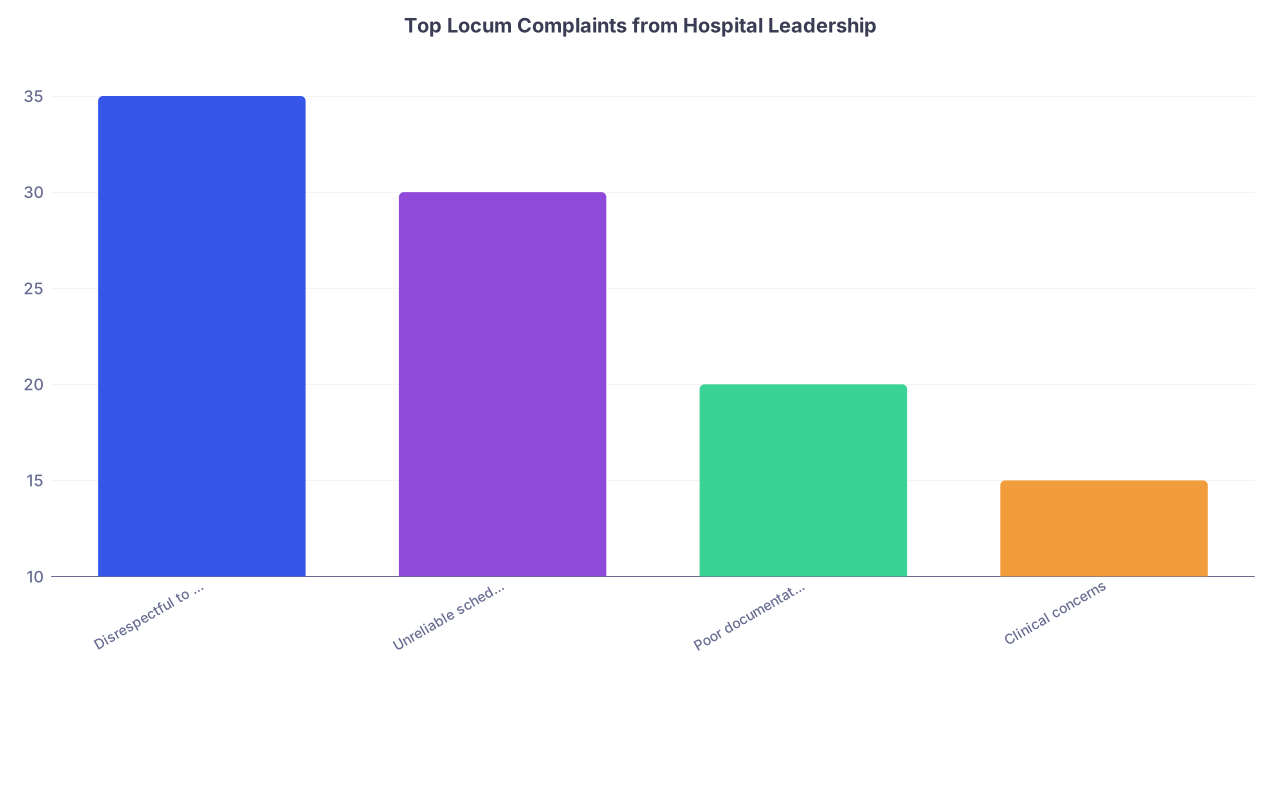
| Category | Value |
|---|---|
| Disrespectful to staff | 35 |
| Unreliable schedule | 30 |
| Poor documentation | 20 |
| Clinical concerns | 15 |
Notice what is at the bottom: true clinical competence issues. Most damage comes from behavior and culture friction, not medicine.
4. Sloppy Documentation and Coding Habits
You will not get called into the CEO’s office for being less charming. You will get there if your notes put the hospital at financial or legal risk.
New locums often underestimate how visible their documentation is:
- Coders review it.
- Quality teams review it.
- Malpractice risk officers review it.
- Sometimes, the CMO personally reads your charts after a complaint.
Documentation mistakes that get you flagged:
- Cut-and-paste disasters (wrong gender, wrong side, wrong problem list).
- Missing critical decision-making elements:
- No discussion of alternatives.
- No documentation of shared decision making.
- No explanation for admitting or sending home borderline cases.
- Chronically incomplete notes leading to downcoding or denials.
- Wild variability in coding level—with no supporting documentation.
A silent but deadly risk:
If your charts consistently lead to downcoding or payer denials, revenue cycles notice. Fast. The phrase “This locum costs us money” spreads quickly.
How to avoid this:
- First week at any site, ask:
- “Do you have any documentation or coding cheatsheets for common visits?”
- “What has gotten other locum providers in trouble with billing here?”
- Have a basic, repeatable template for:
- H&P
- Consult note
- ED encounter
- Discharge summary
- For borderline decisions (send home vs admit, treat vs not treat), over-document your reasoning once you are in a new system.
- Avoid lazy copy-forward. If you must use it, do a fast but real edit: problem list, exam, plan, all updated.
Strong documentation is boring. It also quietly makes you the locum they feel safer keeping.
5. Playing Games With Recruiters and Agencies
You can have legitimate complaints about locum agencies. Many do play hardball with rates, travel, and contract details.
But do not make the equally stupid mistake of thinking you can manipulate recruiters without consequences.
Here is what gets you labeled as “high-risk” on the agency side:
- Shopping offers and using fake competing rates as leverage.
- Quietly accepting interviews at multiple sites through different agencies for the same region/date.
- Backing out after signing a confirmation because “I got something better.”
- Hiding schedule restrictions or planned vacations to get a contract, then “remembering” them later.
Agencies talk. Recruiters move between companies. And big systems use multiple agencies and share feedback.

Consequences you will not see directly:
- “Do not present this candidate to flagship clients.”
- “Okay for low-priority sites only.”
- “Short contract lengths only; monitor reliability before extending.”
- “High maintenance. Protect margins accordingly.”
In plain language: you will get sent to worse sites, with worse pay, on worse terms.
How to avoid this:
- Be brutally honest about:
- Your availability.
- Your competing opportunities.
- Your dealbreakers (location, shifts, census, procedures).
- If you must turn down a contract late in the process:
- Do it by phone plus email.
- Own your part: “I overcommitted. I should have been clearer.”
- Do not suddenly invent a vague “family emergency.”
- Work with fewer agencies and build actual relationships with 1–2 recruiters who understand your preferences and can trust your word.
You do not need to be naïve. You do need to be predictable and truthful. That is how you become someone they fight to place, not quietly sideline.
6. Boundary Problems: Staff, Social Media, and Gossip
This is where young locums torch careers in record time.
You are new. You are away from home. You are surrounded by other professionals. The lines blur fast.
Red flag behaviors that get you reported or informally blacklisted:
- Flirting aggressively with nurses, APPs, or techs. Especially on night shifts.
- Drinking with staff after work and oversharing about:
- Previous employers.
- Other doctors.
- Your personal life in graphic detail.
- Posting anything on social media that could:
- Identify the hospital.
- Reference cases from your shift (even “de-identified”).
- Mock the community, staff, or leadership.
Nobody will tell you to your face, “We think you are a liability.” They will just not renew you.
Boundaries that protect you:
- Do not hook up with staff. Do not “see how it goes.” Just do not. Power dynamics plus gossip in small towns is a disaster combo.
- If you attend social events with staff, limit alcohol and avoid becoming the entertainment.
- Assume every staff member is connected to leadership through two degrees at most.
- On social media:
- No workplace rants.
- No “crazy case” stories.
- No selfies in identifiable clinical areas, even if you think it looks harmless.
Boundary violations will follow you harder than a missed diagnosis that was defensible.
7. Taking on More Than You Can Safely Handle (and Hiding Struggles)
New attendings—especially fresh out of residency—hate looking weak. Locums can amplify that.
You walk in thinking, “I must prove I can handle anything.” That mindset is exactly how you end up on risk management’s radar.
Dangerous patterns:
- Agreeing to solo coverage (e.g., single hospitalist or ED doc) in a system you barely know.
- Pretending you are comfortable with procedures you last did as an intern and have not touched since.
- Staying silent about unsafe volumes, unknown workflows, or lack of backup.
- Crumbling under pressure, then snapping at staff or making panicked, erratic decisions.
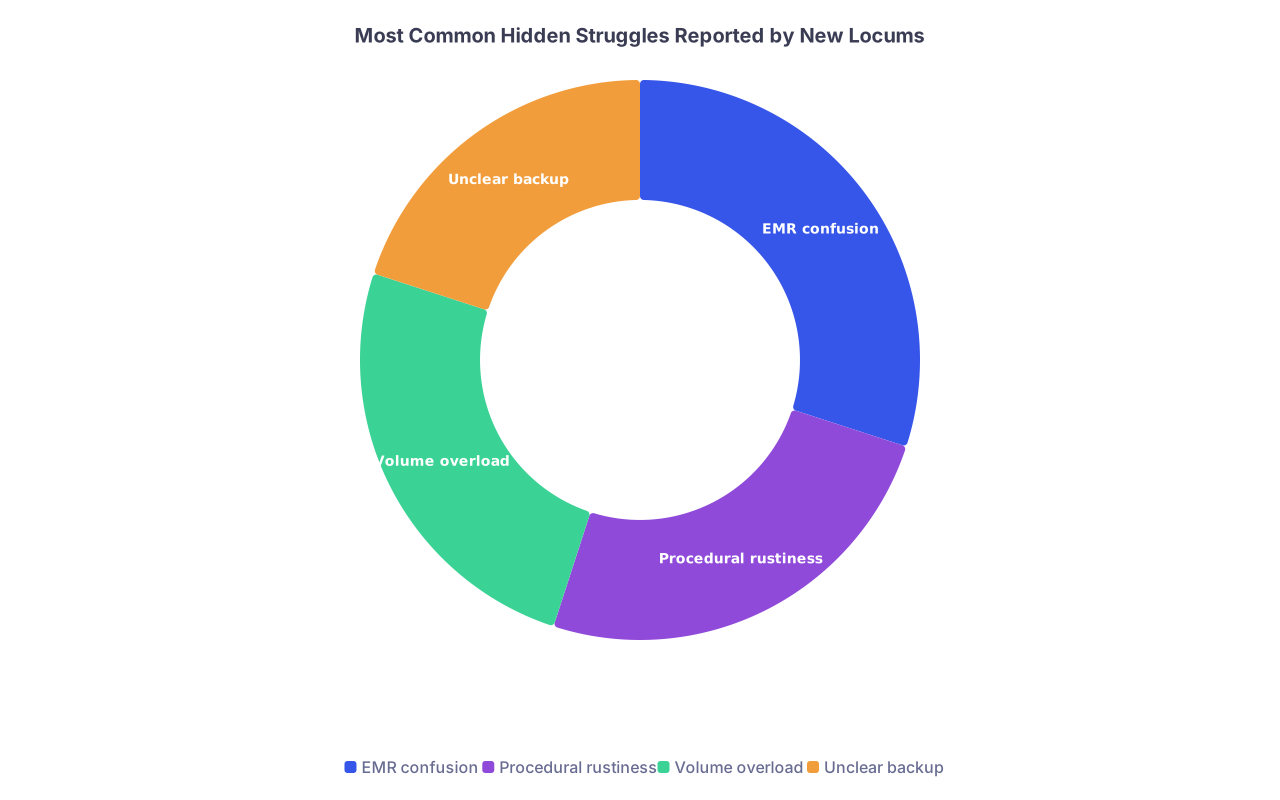
| Category | Value |
|---|---|
| EMR confusion | 30 |
| Procedural rustiness | 25 |
| Volume overload | 25 |
| Unclear backup | 20 |
Almost none of these issues are fatal if you raise them early. They become fatal when you hide them until something bad happens.
How to avoid this trap:
- During contract negotiation:
- Ask specific volume and acuity questions. Get actual numbers, not “average is fine.”
- Clarify backup: “Who is physically in-house? Who is available by phone? How fast can they get here?”
- During your first shifts:
- Say out loud, “I am new to your system. I will probably be slower. Please flag if you see me missing any local steps.”
- With procedures:
- If you have not done it independently and recently, do not pretend you are fully competent.
- Phrase it like: “I am comfortable assisting or doing this with backup present, but I have not done it solo in X years. What is your usual process?”
- If the situation is genuinely unsafe, document your concerns to the right person (e.g., medical director) and your agency. Calmly, factually, not as a rant.
Being honest about limits early looks professional and safe. Melting down mid-crisis looks incompetent and dangerous.
8. Leaving Without Closure—or Burning the Bridge on the Way Out
Your final impression at a site often matters more than your first.
I have seen physicians do well for months, then blow the whole relationship with how they exit.
Exit mistakes that haunt you:
- Ghosting your recruiter or the site when you decide not to extend.
- Announcing to staff, “This place is a disaster; I am never coming back,” during your last shift.
- Leaving critical follow-up tasks incomplete:
- Results reviews.
- Follow-up appointments.
- Pending notes.
- Failing to return badges, pagers, or hospital property.
Here is what gets written:
- “Unprofessional behavior at departure.”
- “Left charts incomplete.”
- “Not welcome for future assignments.”
Your name becomes a quiet cautionary tale when their next locum asks about “what happened to that last doctor.”
A clean exit looks like this:
- You give your recruiter and site adequate notice you are not renewing (ideally 30–60 days, or whatever your contract states).
- You ask, “Is there anything you need from me before I finish my last block? Any specific handoffs, outstanding issues, or feedback?”
- You leave your charts closed, your inbox cleared, and follow-ups clearly documented.
- You send one short, professional thank-you email to the medical director or key contact:
- Appreciating the opportunity.
- Leaving the door open for future work.
You are not trying to win a popularity contest. You are building a record: “This is a reliable professional we can safely bring back.”
FAQ: Avoiding Reputation Damage as a New Locum
1. How many “bad” contracts does it take to hurt my locum career?
Usually one pattern, not one contract. A single site with minor friction is survivable if:
- You are transparent with your agency.
- There are no major professionalism or safety concerns. Repeated similar complaints—late arrivals, attitude issues, documentation problems—across two or more sites is when your name starts triggering concern.
2. Will hospitals and agencies really share information about me?
Yes. Not always formally, but:
- Recruiters move between agencies and take their opinions of candidates with them.
- Hospital systems using multiple locum vendors talk about which physicians they want back—or never again.
- Medical directors informally warn colleagues at neighboring facilities.
Assume anything serious that happens will travel.
3. What should I do if I already made a mistake that might have hurt my reputation?
Do not double down or disappear. Instead:
- Own the behavior with your recruiter and, when appropriate, the site leadership.
- Ask directly, “Is there anything I can do to repair this?”
Then change the pattern. A single error followed by obvious improvement is often forgivable. Unexplained repetition is not.
4. How can I tell if a site is labeling me as a problem without telling me?
Warning signs:
- Sudden reduction in requested shifts or blocks with vague explanations.
- No interest in extending despite staffing needs.
- Your recruiter starts pushing you toward different clients instead of that system.
If you sense this, ask your recruiter privately: “Can you get me honest feedback from the site so I can improve?” Then listen without arguing.
5. Is it safer to avoid locums entirely right after residency?
No. Locums can be an excellent bridge post-residency. The risk is not the locums model; it is treating locums like a throwaway job. If you:
- Show up reliably,
- Respect local culture,
- Document carefully,
- Keep clean boundaries,
you will build a reputation that actually strengthens your career options.
Remember:
- Locums work is permanent in one way: the reputation you create follows you.
- Reliability, respect for local culture, and clean documentation protect you more than any single clinical skill.
- Most damage comes from avoidable behavior, not from honest clinical uncertainty. Guard your reputation like it is your most valuable credential—because it is.