
The most expensive mistakes new attendings make with locum tenens contracts are the ones they never see coming.
You’re not going to blow up your career because you forgot a comma. You’re going to blow it up because you trusted a “standard contract,” skimmed the ugly parts, and signed anyway.
Locums can be fantastic—freedom, money, flexibility. But the contract is a landmine field, especially for fresh attendings just out of training who don't yet have their radar tuned for what’s predatory, what’s merely annoying, and what’s a flat-out dealbreaker.
Let’s walk through the 7 clauses young attendings most often regret ignoring—and how to avoid getting trapped by them.
1. Non-Compete and Restrictive Covenants: The “I Didn’t Think It Applied to Me” Trap
This is the clause that quietly handcuffs your future.
You’re excited. It’s a locums assignment in a city you like. You tell yourself, “It’s just temporary. I’ll figure out my long-term plan later.” Then the recruiter sends the contract with a cheery, “It’s just our standard non-compete; everybody signs it.”
You sign.
Twelve months later you want to stay local—maybe even take a permanent offer at the very hospital you’ve been saving for the last year. Suddenly legal tells you: “Your locums agreement prohibits you from working within 25 miles of here for two years unless the agency releases you.”
That’s when people panic.
Common non-compete mistakes:
Not reading the actual language.
People read the summary the recruiter says out loud: “It just says you can’t work directly for this client right away.” The written clause usually says more. A lot more.Ignoring the radius and duration.
20–50 miles and 1–2 years is typical. In a dense metro area, that might mean half the city. In a rural area, that might be the only hospital in reach of your family.Missing the “any facility we introduce you to” language.
This is sneaky. It can apply not just to the current hospital, but any facility the agency emails you about—even if you never worked there.Confusing non-compete vs. non-solicit.
Non-solicitation (not poaching staff or asking the hospital to bypass the agency) can be reasonable. Non-compete (you can’t work anywhere within a radius) is where careers get boxed in.
What to do instead:
- Read it like a lawyer with trust issues. Location, scope (which facilities), radius (miles), and duration (months/years). All of it.
- Push back.
Ask for:- Restriction limited to that specific facility only
- Short duration (6–12 months, not 2–3 years)
- Narrow radius (5–10 miles in urban; or “only this campus”)
- Insist on a clear buyout or release pathway.
If you want to convert to permanent, what’s the fee? Who pays—hospital or you? Get numbers, not “to be determined.”
And do not swallow the “We can’t change it; it’s standard” line without testing it. Agencies change these clauses every day for physicians who actually push.
2. Cancellation and Termination Terms: The “We Thought You Knew” Clause
Nothing wrecks your finances faster than counting on a three-month contract that evaporates after three weeks.
I’ve seen it play out like this:
A new attending signs a 12-week assignment, declines another offer, arranges childcare, and maybe even gives up an apartment. Then census drops. The hospital calls the agency. The agency calls you: “They’re cutting back. Sorry. It’s in the contract.”
And they’re right. It is.
Most young attendings don’t realize there are two cancellation sides:
- How easily you can cancel
- How easily they (hospital/agency) can cancel
You’ll regret ignoring:
“Termination without cause” language
This usually lets either party terminate for any reason with X days notice. I’ve seen 90 days, 30 days, and disturbingly, 7 days.Minimum guaranteed shifts vs. “anticipated” schedule
“The physician is anticipated to work 15 shifts per month” is worthless without a guarantee. Anticipated just means “maybe.”Penalties for you canceling, but none for them
One contract billed the doctor for locums coverage to replace them if they left early, but allowed the hospital to cancel with 14 days’ notice and zero financial penalty.
How to protect yourself:
Demand symmetry.
If they can cancel with 30 days, you should be able to cancel with 30 days. If they insist on harsher penalties for you, that’s a red flag.Get something guaranteed in writing.
Guaranteed:- Minimum shifts per week/month, or
- Minimum hours per week
Or a cancellation fee payable to you if they cut the contract short.
Clarify travel/lodging fallout.
If they cancel, who eats:- Non-refundable airfare?
- Airbnb / hotel deposits?
- Rental car?
That should all be addressed, not left to “we’ll figure it out.”
If the contract lets the facility walk away at will while holding you to a stricter standard, understand this clearly: you are disposable in their eyes.
3. Schedule, Call, and “Other Duties as Assigned”: The Silent Overtime Sinkhole
The quickest way for a locums job to become a burnout machine is vague schedule language.
This is where young attendings get blindsided. You’re told: “12-hour shifts, 14 per month, light call.” The contract says: “Provider agrees to work schedules as set forth by the Facility, including days, nights, weekends, and call, as needed.”
“As needed” is a trap door.
Red flags:
No maximum hours per day or week
Without caps, it’s entirely possible to be scheduled for 7 x 12-hour shifts in a row with nightly call “just this month.”Unclear call expectations
Phrases like “shared call responsibilities” with no numbers are meaningless. Are you Q3? Backup? In-house? Phone-only? How often are you really being called in?“Other duties as assigned” with no limits
That cute phrase can turn into committee meetings, mandatory staff education, or covering another unit that was never discussed.
Protect yourself on paper:
Spell it out. In the contract, not just over the phone.
Shifts:
- Type (day/evening/night)
- Length (8, 10, 12, 24 hours)
- Expected pattern (e.g., “no more than 5 consecutive shifts”)
Hours:
- Maximum scheduled hours per week/month
- Whether staying late is compensated or “part of the job”
Call:
- Frequency (e.g., Q4 nights, 1 weekend per month)
- In-house vs. home call
- Guaranteed call stipend vs. per-call compensation
- Call-back pay details (from what minute, at what rate)
Write it like you’re preventing future gaslighting. Because you are.
4. Compensation Structure and Hidden Deductions: The “But I Thought It Was $X/Hour” Illusion
The advertised rate is rarely the actual rate you’ll feel in your bank account.
A young hospitalist I knew saw an email: “$225/hour, no call, travel and lodging included.” Sounded great. After their first month they realized:
- They weren’t being paid for charting done after shift end.
- A “holiday coverage differential” they expected… didn’t exist.
- Travel costs were paid only after submission and approval, not upfront.
- Malpractice tail would be their problem if they didn’t stay a full year.
The “$225/hour” collapsed into something much uglier when the dust settled.
Here’s where people get burned:
Not understanding what hours are billable
If your shift ends at 7 pm and you’re charting until 8 pm every single time—does that extra hour get paid? Or is it silently expected?Per diem vs. hourly vs. per shift
“$2,700 per 12-hour shift” is not the same as “$225/hour” if they decide the shift is “11.25 clinical hours plus 45 minutes of unpaid admin.”Overtime and extra shifts
Is there a higher rate after a certain number of hours? Or is the “premium” only in the recruiter’s sales pitch?Deductions and fees
Watch for:- Credentialing fees pulled from your checks
- Travel “caps” that you exceed without realizing it
- Housing provided but taxed as income in a way you weren’t expecting
Get clarity in black and white:
- Exact hourly or per-shift rate, and what counts as work hours.
- How after-hours charting and call-backs are compensated.
- Whether holiday/weekend pay differs—and if not, don’t assume it does.
- What’s covered vs. reimbursed vs. your responsibility (with dollar caps).
If the numbers in the email don’t match the precision in the contract, assume the contract is the truth and the email was the marketing.
5. Malpractice Coverage and Tail: The “I Didn’t Realize I Was Uninsured” Time Bomb
This one doesn’t hurt immediately. It hurts years later, when a letter shows up about a patient you barely remember.
Common lazy assumption: “The locums company covers malpractice, so I’m good.”
Sometimes yes. Sometimes half-yes. Sometimes absolutely not.
Here’s how young attendings get burned:
Occurrence vs. claims-made confusion
Occurrence policy: You’re covered for incidents that happen while you were there, even if the claim appears years later.
Claims-made policy: You’re covered only if the claim is made while the policy is active. Once you leave and the policy stops? That coverage evaporates unless you have tail.No one mentions tail until it’s too late
Some locums outfits proudly say “We provide coverage!” but it’s claims-made and they don’t provide tail when you leave. Tail can cost tens of thousands. For a short locums stint, that math gets ugly fast.Gaps between assignments
If you hop between agencies and hospitals, you can end up with weird exposure gaps if you don’t understand who is actually covering what, and when.
Non-negotiables you should insist on:
Written confirmation of:
- Policy type (occurrence vs. claims-made)
- Carrier and limits (e.g., $1M/$3M)
- Retroactive dates if claims-made
Tail coverage in writing
If it’s claims-made, you want it clearly stated:
“Agency will provide tail coverage at no cost to physician for all services provided under this agreement.”
If they refuse to provide tail, you need to calculate the real risk and cost, not just shrug. Especially if you’re in a high-risk specialty (OB, EM, surgery, anesthesia, etc.).
And do not rely on a recruiter’s verbal “Of course you’re covered!” That phrase has gotten a lot of people in serious trouble.
6. Travel, Housing, and “You Can Submit Receipts Later”: The Out-of-Pocket Drain
Travel and housing clauses are where a “high-paying” locums gig quietly turns into a break-even hassle.
The pattern is predictable:
You’re told:
- “We cover travel, housing, and a rental car.” You imagine:
- Airline tickets booked for you, decent lodging, simple reimbursement.
What you find:
- They have max caps buried in a policy document you never saw.
- They expect you to pay everything up front and wait 30–60 days.
- “Housing included” means a noisy extended-stay 40 minutes away.
The mistakes:
Not asking whether they book vs. reimburse
Huge difference. If you’re flying cross-country and staying for months, floating thousands on your credit card may matter.Ignoring caps and rules
You see “travel reimbursed,” but the internal policy is:- Max $400 round-trip flight
- Max $100/night hotel
- No reimbursement for Uber, tolls, luggage fees
Not clarifying what “housing provided” means
Is it:- Dedicated apartment?
- Hotel?
- Shared unit with another locums doc?
- Clean? Safe? Within 10 minutes of the hospital or 45?
No plan for cancellation impact
If the hospital cancels early, who pays the unused Airbnb fees? You don’t want that surprise.
What to insist on:
Concrete terms:
- Who books flights, lodging, and car
- Whether there are dollar caps (with amounts)
- What’s included (parking, baggage, mileage reimbursement, etc.)
Minimum housing standards:
- Private space, separate from other staff
- Reasonable distance from the facility
- Safe area (yes, this matters, and yes, some places cut corners)
If they’re vague about logistics, expect headaches. If they’re precise and experienced, you can relax more. Contracts should reflect that difference.
7. Indemnification, Liability, and “Hold Harmless” Clauses: The Silent Legal Trap
This is the clause almost nobody reads carefully—and it’s the one that can hang you out to dry if anything really goes wrong.
Buried near the end of many locums contracts is language that looks like this:
“Physician agrees to indemnify, defend, and hold harmless the Company and its clients from any and all claims, losses, damages, or expenses arising out of Physician’s services…”
Read that again.
They’re trying to make you financially responsible for protecting the agency and hospital from legal fallout tied to your work. That’s an insane amount of risk for an individual doctor.
Common landmines:
Broad indemnification in favor of the agency/hospital
If written badly, you could be on the hook for legal fees, settlements, and more—even when there were system failures outside your control.One-way clauses
You indemnify them. They do not indemnify you. Totally unbalanced.No carve-outs for negligence by others
If the hospital screws up staffing, systems, or documentation, but the claim has your name anywhere near it, you might get dragged into indemnifying them.
What sane looks like:
Mutual indemnification
Each party is responsible for its own negligence or misconduct, not everybody else’s.Narrow scope
Your indemnity should be:- Limited to your own acts or omissions
- Excluding situations where the hospital or agency is partly or mostly at fault
Malpractice policy as the main risk vehicle
You should not be personally backstopping corporate entities with your future earnings.
This is one of the clauses where having an attorney review your contract is absolutely worth the money. A single indemnification disaster can wipe out years of income.
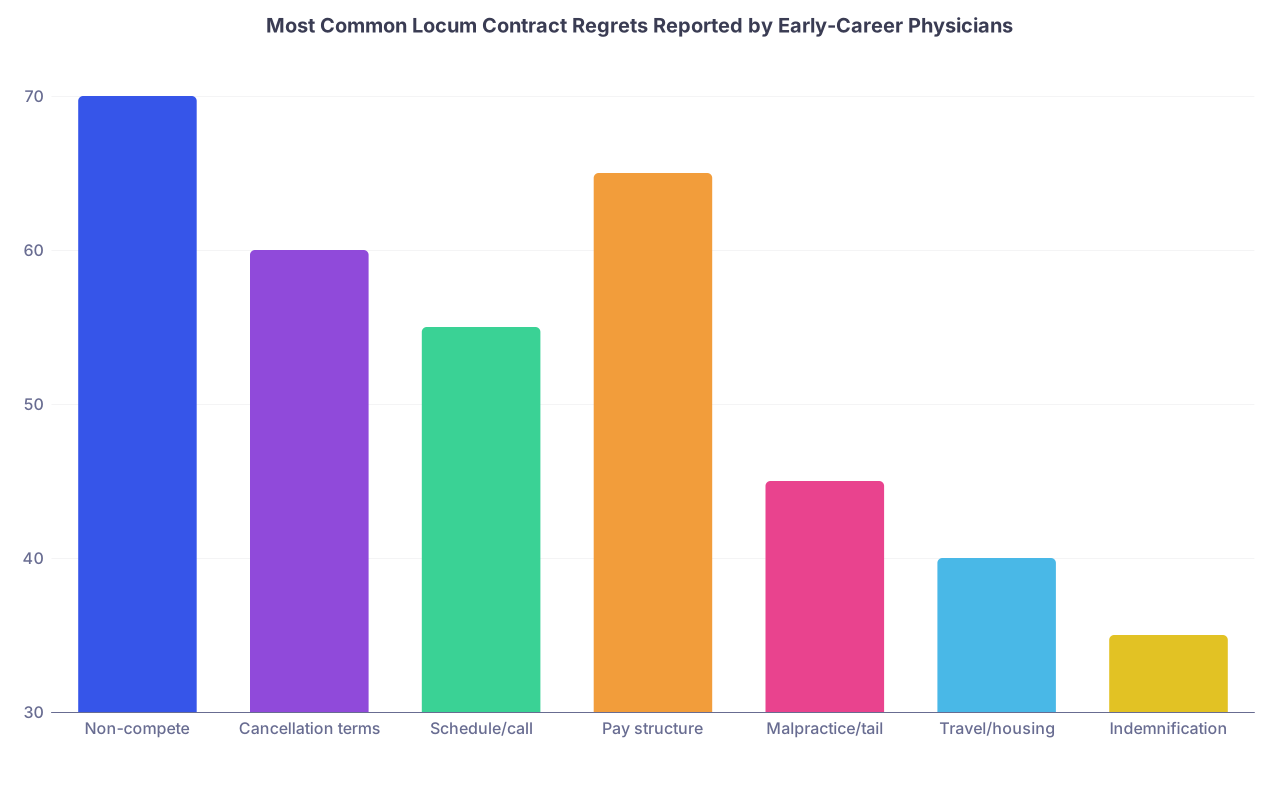
| Category | Value |
|---|---|
| Non-compete | 70 |
| Cancellation terms | 60 |
| Schedule/call | 55 |
| Pay structure | 65 |
| Malpractice/tail | 45 |
| Travel/housing | 40 |
| Indemnification | 35 |
The Bigger Pattern: Why Young Attendings Get Burned
It’s not because you’re stupid. It’s because the system is set up in a way that rewards you for saying “yes” quickly and punishes you (socially, not legally) for slowing things down.
There’s a predictable pattern:
- You’re tired and financially behind after residency/fellowship.
- Recruiter shows up offering fast money and flexibility.
- They emphasize: “We need to finalize this quickly so we can credential you.”
- You feel like pushing back on contract terms might “lose the opportunity.”
- You sign. You regret it later.
The people on the other side do this every single day. You don’t. That asymmetry is exactly why you have to slow down and treat the contract as a negotiable document, not gospel.

| Step | Description |
|---|---|
| Step 1 | Receive Locum Offer |
| Step 2 | Sign Quickly |
| Step 3 | Hidden Clauses Discovered Later |
| Step 4 | Limited Options and Regret |
| Step 5 | Identify Red Flags |
| Step 6 | Walk Away |
| Step 7 | Revised Contract |
| Step 8 | Sign With Protection |
| Step 9 | Review Contract Thoroughly |
| Step 10 | Negotiate Changes |
| Clause Type | Reasonable Example | Risky Example |
|---|---|---|
| Non-compete | 6–12 months, single facility only | 2 years, 25–50 miles, all client facilities |
| Cancellation | 30 days, symmetric both ways | Client 7 days, you 60–90 days or big penalty |
| Schedule/Call | Max 60 hrs/week, defined call frequency | “As needed” with no max or specifics |
| Compensation | Clear hourly, OT, call, holiday in writing | Vague “competitive pay,” no OT or call detail |
| Malpractice/Tail | Occurrence or claims-made with tail paid | Claims-made, no tail, vague carrier info |
How to Stop Being Easy to Exploit
Here’s the simple, unsexy truth: the single best protection is being willing to walk away.
If you treat every locums offer as “my only chance,” you’ll sign whatever is put in front of you. If you treat it as one of many options in a long career, your bargaining position sharpens immediately.
Concrete moves to avoid becoming a regret story:
Always sleep on the first draft.
Don’t sign same-day. Ever. “Urgency” is a tactic.Have a standard checklist.
Non-compete, cancellation, schedule/call, compensation details, malpractice/tail, travel/housing, indemnification. You read all of those every time.Pay an attorney once.
Get a healthcare or employment attorney to review your first 1–2 locum contracts in full. Have them mark what’s normal, what’s bad, and what’s insane. Use that as your internal baseline going forward.Force email summaries.
When something is explained to you verbally (“Don’t worry, we’ll never do that”), reply:
“Please confirm in writing that [specific promise].”
If they won’t write it, that’s your answer.
And remember: a contract that looks “fine” when everything goes well needs to also protect you when everything does not go well. Because eventually, something won’t.
FAQ (Exactly 3 Questions)
1. Is it normal for locum tenens contracts to have non-compete clauses?
Yes, it’s common—but the scope varies wildly. A narrow non-compete limited to the specific facility for 6–12 months is annoying but survivable. A broad one covering an entire health system or region for 2–3 years is overreaching and can trap you geographically. You should always try to narrow it: limit it to the exact facility, shorten the time frame, and clarify that you can still work elsewhere in the area. If they refuse any change, that tells you a lot about how they see you—as a commodity, not a partner.
2. Do I really need a lawyer to review a locums contract?
Need? No. But skipping legal review on your first major contract is how people end up paying five figures for tail coverage or getting blocked from jobs they want. Think in terms of downside: an attorney review might cost a few hundred dollars. A bad indemnity or non-compete clause can cost you tens of thousands in lost income or legal exposure. At least for your first contract—or any unusually long or restrictive one—having a lawyer who understands physician contracts look it over is money well spent.
3. How much can I realistically negotiate as a brand-new attending?
More than recruiters will tell you, less than your ego might want. You probably won’t double your hourly rate, but you can often tweak non-compete radius or duration, clarify and cap call, get better cancellation terms, and tighten malpractice/tail language. The key is picking your battles: focus on the clauses that can really hurt you (non-compete, cancellation, malpractice/tail, indemnification), not cosmetic stuff. The biggest shift is psychological—once you’re truly willing to walk away, you stop accepting “this is just how we do it” as the final answer.
Open your most recent or pending locum contract today and do one thing: go straight to the non-compete, cancellation, malpractice, and indemnification sections and highlight every sentence you don’t fully understand. If you can’t explain each line in plain language, don’t sign it.