
It’s July 1st. Your fellowship just ended, the institutional badge is turned in, and your first full-time locums contract kicks off this month. You’ve got income coming in, but you also know this: locums can either be a bridge to burnout or a career that actually gives you your life back.
The difference is in your first four quarters.
You are not “just picking up shifts.” You’re building a business. A portable, contract-based clinical career. If you treat this year like residency-with-airports, you’ll regret it. If you treat it like a deliberate transition year, you’ll have leverage, options, and actual control by this time next year.
Let’s walk quarter by quarter, then zoom into months and specific to‑dos.
Big-Picture Timeline: Your First Year as Full-Time Locums
Here’s the arc:
- Q1 (Months 0–3): Stabilize income and logistics, learn the locums game
- Q2 (Months 4–6): Optimize schedule, pay, and taxes; start building your “brand”
- Q3 (Months 7–9): Consolidate good sites, cut bad ones, negotiate like a grown-up
- Q4 (Months 10–12): Decide: commit to long-term locums model, hybrid, or permanent
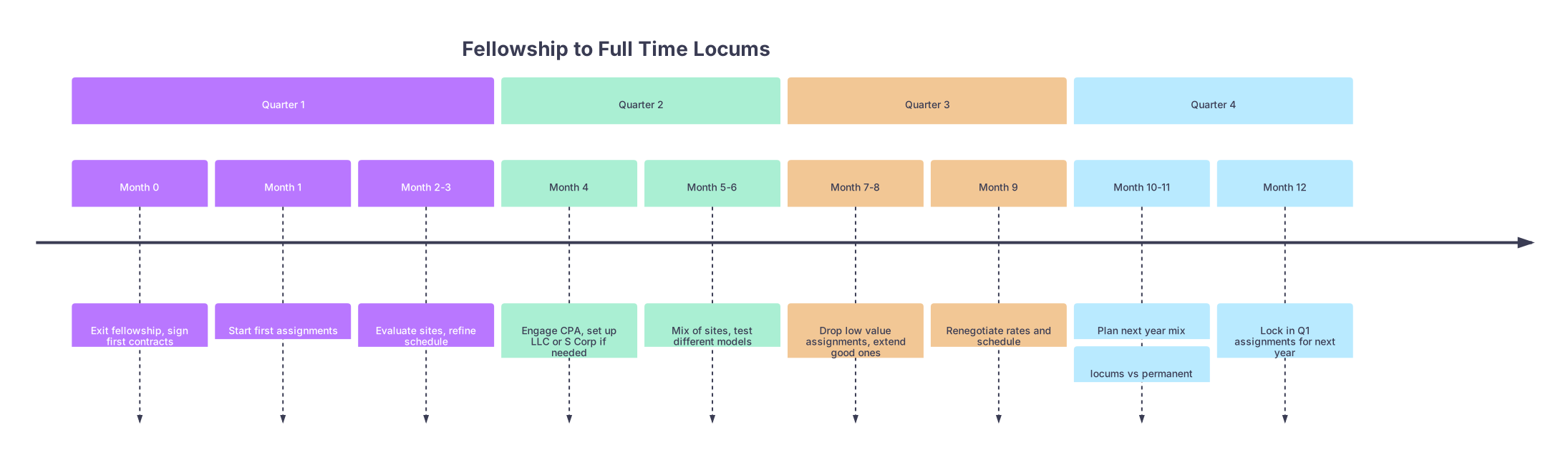
| Period | Event |
|---|---|
| Quarter 1 - Month 0 | Exit fellowship, sign first contracts |
| Quarter 1 - Month 1 | Start first assignments |
| Quarter 1 - Month 2-3 | Evaluate sites, refine schedule |
| Quarter 2 - Month 4 | Engage CPA, set up LLC or S Corp if needed |
| Quarter 2 - Month 5-6 | Mix of sites, test different models |
| Quarter 3 - Month 7-8 | Drop low value assignments, extend good ones |
| Quarter 3 - Month 9 | Renegotiate rates and schedule |
| Quarter 4 - Month 10-11 | Plan next year mix |
| Quarter 4 - Month 12 | Lock in Q1 assignments for next year |
Quarter 1 (Months 0–3): Stabilize and Learn the Game
At this point you should be laser-focused on three things: income stability, basic systems, and avoiding dumb mistakes that follow you for years (bad contracts, poor documentation, tax chaos).
Month 0: Final Months of Fellowship / “Pre-Launch”
You’re still in training or just finishing. Use this time ruthlessly.
At this point you should:
Decide your first 6–9 months strategy
- One primary site with heavy weeks?
- Or 2–3 sites rotating monthly?
- My advice: for your first quarter, stick to 1–2 sites tops. You need repetition more than variety right now.
Register with 2–3 locums agencies (not 10)
Look for:- Strong in your specialty (e.g., CompHealth for hospitalist, Weatherby, Jackson & Coker, etc.)
- Transparent pay discussions upfront
- Dedicated recruiter who actually returns calls
Lock down credentialing pipeline
- Apply for at least 1 extra state license besides your current one.
- Get your paperwork “kit” ready:
- Updated CV in Word format
- Board cert proof
- Procedure logs
- Immunization records
- 3–5 references who actually answer emails
- Create a “Locums Docs” folder with PDFs of everything. You’ll be asked for the same document 40 times.
Start a basic financial + legal skeleton
- Open:
- A separate checking account for locums income
- A separate savings account for taxes
- Meet with a CPA who understands physician 1099 income.
- Decide if you’re starting as:
- Sole proprietor (fine for first 3–6 months)
- Or LLC taxed as S-corp (worth it once income is consistently high)
- Open:
| Item | Simple Start (Month 0–3) | Upgrade Later (Month 4–12) |
|---|---|---|
| Business form | Sole proprietor | LLC / S-Corp |
| Banking | 1 business checking | Checking + high-yield save |
| Tax help | Annual tax prep only | Quarterly planning + prep |
| Bookkeeping | Spreadsheet | Software + bookkeeper |
Month 1: First Assignment(s) Begin
You’re on the ground now. New EMR, new nurses, new call system.
At this point you should:
-
- Hours worked, shifts by site, travel time
- Pay rates, bonuses, overtime policies
- Annoying-but-critical details: call structure, support staff, consultant responsiveness
Build a “first 5 shifts” checklist for each new site
- EMR smart phrases / macros
- Where to find:
- Protocols (sepsis, stroke, etc.)
- On-call lists
- Transfer procedures
- Who to call when:
- You can’t get a CT at 3 am
- You need admin backup for a difficult family/patient
Start a simple income and expense log
- Revenue by site
- Travel reimbursements vs out-of-pocket
- Meals, mileage, licensing fees, CME
This is boring. Do it anyway. You’re building leverage data.
Month 2–3: Evaluate and Adjust
By now you’ve seen the best and worst of at least one site.
At this point you should:
Score each site ruthlessly Use a 1–5 rating on:
- Pay per actual hour worked (not just “rate per shift”)
- Staff and consultant support
- Workload and acuity
- Safety and medico-legal risk
- Commute / travel burden
Decide which sites are “extension candidates”
- Good sites: request extensions before the agency brings it up. You want timeline control.
- Mediocre but tolerable: negotiate better pay or better schedule before extending.
- Dangerous or miserable: set an exit date and stick to it.
Clean up your admin life
- Are you saving every contract and addendum?
- Do you have your malpractice certificates per site?
- Did you set up:
- Password manager (you will have 10+ EMR logins)
- Cloud backup for your important documents

| Category | Value |
|---|---|
| Site A | 4.5 |
| Site B | 3.2 |
| Site C | 2.1 |
Quarter 2 (Months 4–6): Optimize Schedule, Pay, and Taxes
You’ve proven you can survive. Now we stop acting like a temp worker and start acting like a consultant.
Month 4: Lock in a Baseline Schedule
At this point you should stop “saying yes to everything” and start designing your calendar.
At this point you should:
Define your monthly targets
- Desired net take-home per month
- Maximum number of clinical days you’re willing to work
- Days blocked for:
- Travel home
- Family/relationships
- CME or board prep (if relevant)
Structure your Q2–Q3 backbone
- Aim for:
- 1 “anchor” site providing ~60–70% of shifts
- Optionally 1 backup site for flexibility and leverage
- Don’t juggle 4–5 hospitals yet. You’ll bleed energy in transitions.
- Aim for:
Start saying “no”
- To:
- Random last-minute shifts that destroy your rest days
- Long stretches (>10–12 days) without a break unless the pay is absurd
- To:
Month 5: Get Serious About Taxes and Business Structure
This is where a lot of locums docs get burned. First year feels great. Then the tax bill hits.
At this point you should:
Hire a CPA or tax firm that sees 1099 physicians all the time
- Ask directly:
- How many independent contractor physicians do you handle?
- How do you structure reasonable S-corp salaries?
- How do you handle multi-state income?
- Ask directly:
Decide on entity structure
- If annualized income is heading north of ~$250k–300k:
- Strongly consider an LLC taxed as S-corp.
- If you’re unsure or income is variable:
- Start as sole prop but set quarterly tax estimates now.
- If annualized income is heading north of ~$250k–300k:
Set up quarterly tax payments
- Open a separate high-yield savings just for tax money.
- Auto-transfer 25–35% of each paycheck into it.
- Pay your first or second estimated payment this quarter.
Month 6: Refine Your Niche and “Brand”
Not in the social media sense. In the “what kind of locums doc are you” sense.
At this point you should:
Clarify your clinical positioning
- Hospitalist who likes open ICU?
- Outpatient IM who can handle high-volume walk-ins?
- Anesthesiologist okay with solo rooms but not hearts?
- Be explicit. Communicate that to recruiters. It reduces bad-fit offers.
Develop a one-page “Locums CV / profile”
- Bullet points:
- Procedures you actually do independently
- Environments you’re comfortable in (rural critical access, tertiary center, etc.)
- Ideal schedule patterns (7-on/7-off, blocks of 5, strictly days/no nights, etc.)
- Bullet points:
Begin tracking your effective hourly rate by site
- Take:
- Total pay for that assignment
- Divide by total hours on site (including call, notes finished after shift)
- Drop or renegotiate anything with low effective hourly rate unless there’s a very good reason (location, family proximity, etc.).
- Take:
Quarter 3 (Months 7–9): Consolidate, Negotiate, and Protect Yourself
This is the quarter where a lot of people either level up or stall out.
Month 7: Cut the Dead Weight
You know which sites are a problem. Stop pretending you don’t.
At this point you should:
Formally exit bad assignments
- Give clear, professional notice.
- No drama, no bridge burning, but also no guilt.
- “Due to scheduling changes, I’ll be unable to extend beyond [date]. I’ve appreciated working with the team.”
Prioritize repeat assignments at your best sites
- Continuity matters:
- Staff knows you.
- You move faster in their EMR.
- You reduce risk because you actually understand their system.
- Continuity matters:
Start watching for “perm pressure”
- Some sites will start nudging you:
- “Have you thought about joining us full-time?”
- Decide ahead of time:
- Are you open to this within the next year?
- Or are you firmly locums-only for now?
- Some sites will start nudging you:
Month 8: Renegotiate Rates and Terms
You’re no longer a brand-new fellow. You’ve got a track record.
At this point you should:
Review all current and upcoming contracts
- Look for:
- Outdated rates compared to newer offers
- Unpaid call
- Cancellation terms that favor the hospital only
- Look for:
Go back to your agent (or hospital directly) with concrete asks Examples:
- “I’ve done 60 shifts here in the last 6 months. For extensions, I’d like to move from $180/hour to $200/hour given the volume and night coverage.”
- “Current call structure doesn’t reflect the actual burden. I’d like a call stipend of $X per night, or a minimum hour guarantee.”
Use your data
- Show:
- Shifts completed
- Quality feedback (if you’ve gotten emails/thanks from leadership, keep them)
- Consistency and willingness to cover tough blocks
- Show:
Month 9: Risk Management Checkpoint
You’re exposed in ways W-2 docs are not. Handle that.
At this point you should:
Confirm malpractice details site by site
- Occurrence vs claims-made
- Tail coverage: who’s paying, and do you have proof?
- Get your own file with:
- Policy numbers
- Coverage periods
- Confirmation of tail (email or certificate)
Review your disability and life insurance
- You’re 1099. No employer safety net.
- Make sure:
- Disability policy is in force and adequate
- Beneficiaries are updated
- You’re not relying on old “residency” group policies that ended
Begin building a small emergency fund
- Goal: 3 months of average living expenses in cash.
- Locums schedules can evaporate with one admin change.
Quarter 4 (Months 10–12): Decide Your Long-Term Model and Lock in Next Year
Now you’ve seen enough to make real decisions. It’s not theoretical anymore.
Month 10: Strategic Planning Month
You’re no longer “new.” Time to act like someone running a practice—because you are.
At this point you should:
Review your entire year’s data
- Income by site
- Effective hourly rate by site
- Time away from home vs at home
- Which months felt overloaded vs underbooked
Decide your next-year model Options:
- Full-time locums as a long-term career
- Double down on 2–3 anchor sites
- Maybe add a high-paying “project” every few months
- Hybrid locums + part-time employed
- E.g., 0.5 FTE at a group + 6–8 locums shifts/month
- Use locums as a bridge to a carefully chosen permanent job
- Target 1–2 systems where you’ve done locums and liked the culture
- Negotiate perm with actual insider knowledge of workload
- Full-time locums as a long-term career
Month 11: Lock in Q1 (and Ideally Q2) of Next Year
The worst locums feeling: it’s December 20th and you have nothing scheduled for January.
At this point you should:
Have at least the next 3 months of work booked
- Aim for:
- 70–80% of desired shifts already contracted
- Room for 20–30% flexibility or high-paying last-minute stuff
- Aim for:
Renegotiate or decline extensions with clarity
- Decide which sites you’re taking into next year.
- Communicate early:
- “I’d like to commit to 7–10 shifts per month Jan–Mar, at [rate].”
- Or: “I’ll finish the current block, but won’t be taking more dates after [date].”
Calibrate your annual income target
- If you overshot this year and felt wrecked:
- Aim for slight income reduction via better rates, not more shifts.
- If you undershot:
- Identify:
- Underused months
- Higher paying markets
- Specialty niches you can credibly step into
- Identify:
- If you overshot this year and felt wrecked:
Month 12: Annual Review and Reset
This is your “owner’s meeting” with yourself.
At this point you should:
Do a full financial review with your CPA/bookkeeper
- Actual gross vs expected
- Deduction patterns (CME, travel, licensing, home office)
- Adjust next year’s estimated taxes
Refine your systems for year two
- Move from spreadsheets to proper bookkeeping if you haven’t.
- Standardize:
- Contract naming and filing
- Assignment summaries (dates, pay, notes)
- Travel routines (best airports, hotels with kitchenettes, rental car preferences)
Re-evaluate your life outside medicine
- Are you seeing your partner/family enough?
- Is your time off actually restorative or just recovery?
- Do you need:
- More local assignments
- Longer blocks off
- Different mix of days vs nights

Quick Reference: Year-One Locums Milestones
| Quarter | Primary Focus | Key Outcomes |
|---|---|---|
| Q1 | Stabilize & learn systems | Reliable income, 1–2 good sites |
| Q2 | Optimize & structure | Tax plan, defined schedule model |
| Q3 | Consolidate & negotiate | Better rates, dropped bad sites |
| Q4 | Decide & lock next year | Clear long-term model, Q1 booked |
FAQ (Exactly 4 Questions)
1. How many locums agencies should I work with in my first year?
Two to three is the sweet spot. One often limits options and leverage; five just floods you with repetitive, low-quality offers and paperwork. Start with 2–3 that are strong in your specialty and region, then drop any recruiter who consistently lowballs or wastes your time.
2. Should I go straight to an LLC or S-corp before my first assignment?
Not necessarily. For the first 3–6 months, a sole proprietorship is fine while you confirm your income level and commitment to full-time locums. Once you’re clearly on track for high six-figure 1099 income, then shift to an LLC taxed as S-corp with a CPA guiding salary vs distributions. Don’t DIY entity setup based on random forums.
3. Is it a bad sign if a site keeps pushing me to go permanent in the first few months?
It’s a sign they’re desperate. That can mean leverage or red flags. If they’re pushing hard before you’ve even seen a full cycle of their census (e.g., winter for hospitalist, summer for ED), assume they’re trying to lock you in before you understand the real workload. Give it at least a few months—and a full, honest workload assessment—before considering perm.
4. How many different hospitals should I work at during my first locums year?
For most new attendings, 2–3 hospitals total in the first year is ideal. Any more than that and you’re constantly re-learning EMRs and workflows instead of improving your efficiency and negotiating position. Better to become a “regular” at a couple of sites than a confused stranger at six.
Bottom Line
- Quarter 1 is survival and setup; Quarter 2 is optimization.
- Quarter 3 is where you cut, consolidate, and start being paid what you’re worth.
- Quarter 4 is decision time: long-term locums model, hybrid, or a very intentional permanent job—on your terms, not out of panic.