
Heavy debt and no savings is not a “work-life balance” problem. It’s a math problem with a time bomb attached.
If you’re just out of residency, staring at six-figure loans and a checking account that wobbles around zero, you’re not choosing between a “nice stable job” and “locums adventure.” You’re choosing between getting financially stable in 3–5 years or dragging this anxiety into your 40s.
Let’s talk about whether high-intensity locum blocks are the right weapon for your specific situation.
1. First, Be Honest: What Hole Are You Actually In?
Before you romanticize 7-on/7-off blocks or 21-day runs with fat checks, you need a blunt inventory. No hand-waving, no “around” numbers.
Here’s what you need in front of you:
- Total student loan balance
- Interest rates (list each one)
- Any consumer debt: credit cards, car, personal loans
- Minimum monthly payments
- Cash on hand (checking + savings)
- Recurring fixed costs: rent/mortgage, car, insurance, childcare, etc.
Then add the piece most people skip: your runway.
- How many months can you live if you lost all income tomorrow?
If that answer is “less than 1,” you are not choosing between locums vs employed. You are choosing between survival modes.
Now, layer your actual post-residency income options. Not in theory—actual offers and realistic rates for your specialty.
| Option | Effective Hourly | Take-Home/Month* | Schedule |
|---|---|---|---|
| Employed Hospitalist | $100–$130 | $12–$16k | 7 on / 7 off |
| Standard Locums Gig | $180–$220 | $25–$30k | 7–10 shifts / month |
| High-Intensity Blocks | $230–$260+ | $35–$50k+ | 14–21+ shifts / month |
*Very rough, depends heavily on taxes and deductions, but this gives you scale.
The numbers will tell you the truth:
- If you’re drowning in 7–10% interest debt and your base W-2 offer barely covers life + minimum payments, high-intensity locum blocks can be a temporary sledgehammer.
- If your debt is huge but locked into low rates and you’re likely PSLF-eligible, sprinting with max-income locums might actually backfire.
We’ll sort those cases next.
2. The 3 Debt Profiles Where High-Intensity Locums Make (or Don’t Make) Sense
You can’t decide about locum strategy without putting yourself in a bucket. Roughly, most new attendings land in one of these:

| Category | Value |
|---|---|
| High Debt, No Forgiveness | 45 |
| PSLF Eligible | 30 |
| Moderate Debt, High Lifestyle Costs | 25 |
Profile A: High Debt, No Forgiveness Path
Example:
- $350k student loans at 6.5–7%
- Private loans or federal but not going PSLF
- No serious savings
- No rich spouse or family bailout
This is the classic “should I grind hard and pay this off?” scenario.
For you, high-intensity locum blocks often do make sense—if you treat them as a focused, time-limited plan, not your new identity.
Pros:
- Massive cash flow fast
- Flexibility to stack blocks when you’re young and (relatively) resilient
- Ability to crush high-interest debt in a 3–5 year window instead of 15–20
Cons:
- Burnout risk is not theoretical; it’s real
- Benefits and retirement are on you
- You can lose years to living like a travel nurse with an MD badge
For Profile A, the question is less “locums or no locums?” and more “how intense, and for how long before it breaks me?”
We’ll build that plan later.
Profile B: PSLF or Forgiveness-Eligible
Example:
- $400k+ in federal Direct loans
- Planning on 10 years of qualifying payments at a nonprofit/hospital
- On an IDR plan (SAVE/PAYE/IBR)
- Every extra dollar you pay might just reduce forgiveness, not actually save you money
If you’re truly going PSLF and will stick it out, maximizing taxable income with high-intensity locums can be dumb. You:
- Increase your IDR payments
- Decrease your eventual forgiven amount
- Pay more in total than if you’d just kept your income reasonable
In this profile, high-intensity blocks only make sense if:
- You need a short-term cash injection for an emergency fund, relocation, or to kill off NON-student-loan debt (credit cards, cars), and
- You accept that this is not your long-term pattern
Otherwise, your best play might be a stable job at a qualifying employer plus some light locums on off weeks that doesn’t blow up your IDR payments.
Profile C: Moderate Debt, High Lifestyle Pressures
Example:
- $150–250k in loans at 4–6%
- Partner, kids, maybe a house coming, maybe elderly parents
- No emergency fund, but not drowning in interest
- The real pressure is monthly burn, not principal size
Here, high-intensity blocks can be overkill.
You might be better off with:
- Reasonable W-2 job with benefits
- A couple of well-paying locums weekends per month
- Gradual debt paydown + aggressive emergency fund build
For you, the goal is to raise your floor, not sprint yourself into the ground.
3. What “High-Intensity Locum Blocks” Actually Look Like On the Ground
People throw this phrase around like it’s just “doing more shifts.”
No. It’s living in 2–3 week sprints with your life organized around work, not the other way around.
Typical reality for a hospital-based specialty (IM, EM, Anesthesia, etc.):
- 14–21 shifts in a month, often clustered
- Travel days eating up your “off” time
- Housing that’s okay, not great—long-stay hotels, basic apartments
- Orientation that’s never enough, EMR systems that all sort of suck differently
- New nurses, new consultants, new politics every contract
You’re not just working more. You’re constantly adapting. That adaptation cost is real.

Here’s how a 21-day high-intensity run often feels:
- Days 1–3: New place, new system, tons of cognitive load. You’re tired but wired.
- Days 4–10: You find a rhythm. Money starts to feel real as you calculate the daily rate in your head.
- Days 11–16: Fatigue and small annoyances stack up—charting, call, lousy food options, no gym. You start to think, “I can’t live like this long-term.”
- Days 17–21: You’re counting down. You cut corners socially. You daydream about the paycheck and time off.
Can you do that for a month or two? Yes.
Can you do that for 3 years straight? Most people cannot. Or they become a shell of themselves outside of work.
That doesn’t make it a bad idea. It just means you must treat this like a tactical campaign, not a lifestyle.
4. The Only Good Reason To Do High-Intensity Blocks: A Clear, Aggressive Plan
You do not do high-intensity locums “to see how it goes.” That’s how you wake up 5 years later still in debt, still with no savings, just more tired.
You do it with a written, measurable plan.
Step 1: Define a Target and a Timeline
Your targets should be numbers, not vibes.
Examples:
- “Pay off $200k of private loans in 36 months”
- “Build a $50k emergency fund and pay off all credit cards in 18 months”
- “Drop total student loans from $380k to $150k in 4 years”
Then you reverse-engineer.
Let’s say:
- You can clear $30k/month net from intense blocks (after taxes, travel, housing)
- Your living expenses at home are $6k–8k/month
- You run intense blocks 6 months of the year, moderate 3 months, off 3 months
You can map debt payoff in a simple table.
| Year | Work Style | Avg Net/Month | Debt Paid That Year |
|---|---|---|---|
| 1 | Heavy 8–9 months | $25k | ~$200–250k |
| 2 | Moderate 6–7 months | $18k | ~$100–150k |
| 3 | Lighter 5–6 months | $15k | ~$50–80k |
Is this aggressive? Absolutely.
Is it doable in certain high-paying locums specialties? Yes, I’ve watched people do it.
Step 2: Decide Your Work/Off Blocks On Purpose
You don’t just say, “I’ll work more.”
You say:
- “I will take 2 x 14-day blocks each quarter for the next 2 years,” or
- “I will do 21-on / 10-off for 12 months, then reassess,” or
- “I will max out with 3 on, 1 off months for 18 months, then throttle down”
Put it on a calendar. Treat it like a protocol.
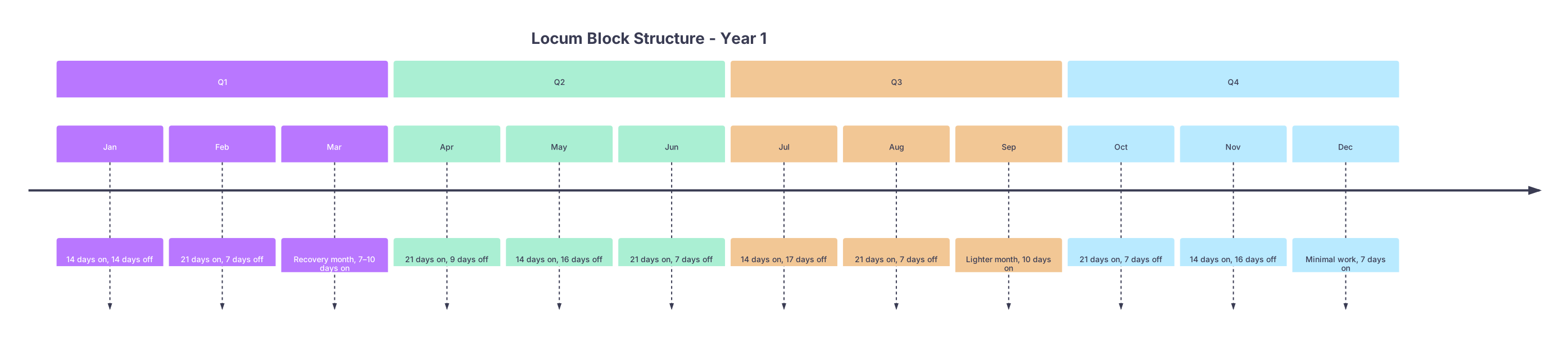
| Period | Event |
|---|---|
| Q1 - Jan | 14 days on, 14 days off |
| Q1 - Feb | 21 days on, 7 days off |
| Q1 - Mar | Recovery month, 7–10 days on |
| Q2 - Apr | 21 days on, 9 days off |
| Q2 - May | 14 days on, 16 days off |
| Q2 - Jun | 21 days on, 7 days off |
| Q3 - Jul | 14 days on, 17 days off |
| Q3 - Aug | 21 days on, 7 days off |
| Q3 - Sep | Lighter month, 10 days on |
| Q4 - Oct | 21 days on, 7 days off |
| Q4 - Nov | 14 days on, 16 days off |
| Q4 - Dec | Minimal work, 7 days on |
You will not accidentally stumble into a smart work pattern. You choose it.
Step 3: Lock in a Financial System So the Money Doesn’t Leak
Big mistake I see: people work insane blocks, see huge deposits, and… their spending rises with it. Private chefs of DoorDash, luxury rentals, constant flights, big toys.
You need a simple, boring system:
- Separate “Locums Income” account where checks land
- Automatic transfers:
- X% to taxes (or pay estimated quarterlies)
- Y% to debt paydown
- Z% to emergency/savings
- Fixed “salary” you pay yourself monthly for your basic life—regardless of how big the locums checks are
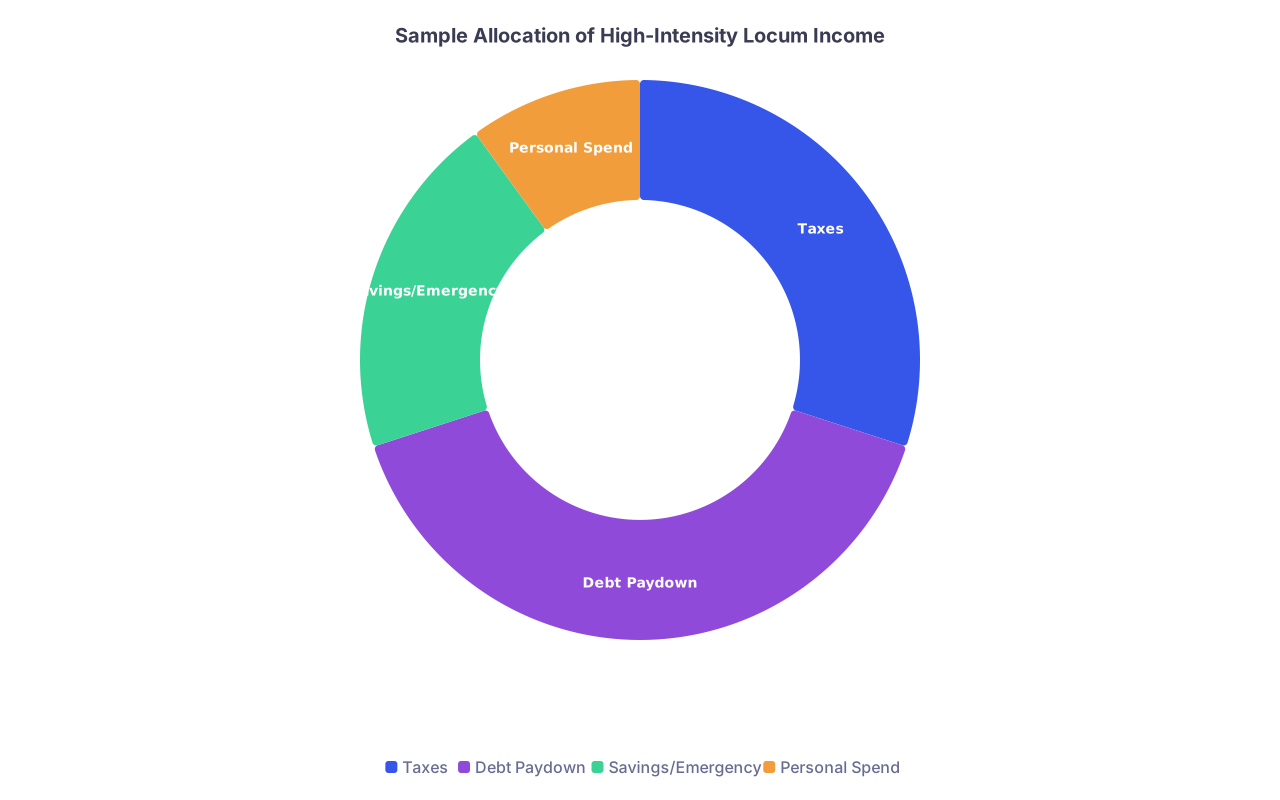
| Category | Value |
|---|---|
| Taxes | 30 |
| Debt Paydown | 40 |
| Savings/Emergency | 20 |
| Personal Spend | 10 |
You don’t grind crazy hours just to create a more expensive version of being broke.
5. When You Should Not Use High-Intensity Locum Blocks
Let me be blunt: some of you are not built for this style of work. That’s not a moral failing. It’s just matching tool to person.
Red flags that high-intensity blocks may be the wrong choice—or need serious limits:
Unmanaged mental health issues
If you’re already barely holding on emotionally, throwing yourself into 21-day blocks in unfamiliar systems is like pouring gasoline on a grease fire. Stabilize first.Young children and an already-fragile family system
If your partner is burnt out solo-parenting and you propose “Good news, I’ll be gone 3 weeks at a time but the money will be great!”—don’t be surprised when that goes sideways. You can still do locums, just probably not extreme blocks.You want mentorship and skill growth
High-intensity locums is not where you go to be nurtured. It’s where you go to produce. If you’re in a procedural field or need structured development, a solid employed job plus side gig locums is often smarter.You’re clearly on a PSLF track
As I said earlier, cranking your income for a decade while on IDR often just hands money back to the government when your loans are forgiven. Run the math before you burn yourself out for nothing.You have no tolerance for chaos
If new EMRs, new call structures, and poor orientation cause you actual panic, repeated high-intensity assignments will chew you up.
6. How To Protect Yourself If You Decide To Go All-In (For a While)
If you read all this and still think, “Yeah, I want to hit it hard for a few years,” here’s how to stay in one piece.
Guardrails on Schedule
- Cap truly brutal months. Example: no more than 3 months per year with >18 shifts.
- Build in at least one low-work month every 6 months (7–10 shifts).
- Avoid stacking multiple new sites back-to-back; alternate a familiar site with new ones.
Non-Negotiables While On Assignment
This is where most people cut corners and then wonder why they feel awful.
- Decent housing, near food and some way to move your body. Pay extra for this.
- A simple, repeatable routine: wake time, quick breakfast, same grocery staples.
- Strict phone/social media limits after shifts when you’re fried—doomscrolling kills sleep.

Protecting Your License and Sanity
High-intensity + unfamiliar systems = more risk. So:
- Do not let a site bully you into unsafe volumes or impossible call structures; walk away if needed.
- Be maniacal about documentation—especially when you’re tired.
- Build a relationship with 1–2 mature colleagues you can text/call for clinical backup when something feels off.
7. A Simple Decision Framework: Should You Do High-Intensity Locum Blocks?
Let’s compress this into something you can actually use.
Answer these:
Are your student loans mostly private or high-interest with no realistic forgiveness path?
- Yes → +1 toward high-intensity
- No → 0
Is your current or offered W-2 income clearly insufficient to both live modestly and make real progress on debt/savings?
- Yes → +1
- Borderline → +0.5
- No → 0
Do you personally tolerate long blocks of work and travel without spiraling (based on residency, rotations, prior jobs)?
- Yes → +1
- Maybe → +0.5
- No → 0
Are you free of immediate family crises or partner ultimatums about time at home?
- Yes → +1
- Complicated → +0.5
- No → 0
Are you willing to make a 2–4 year written plan, with target numbers and scheduled throttling-down later?
- Yes → +1
- Honestly not → 0
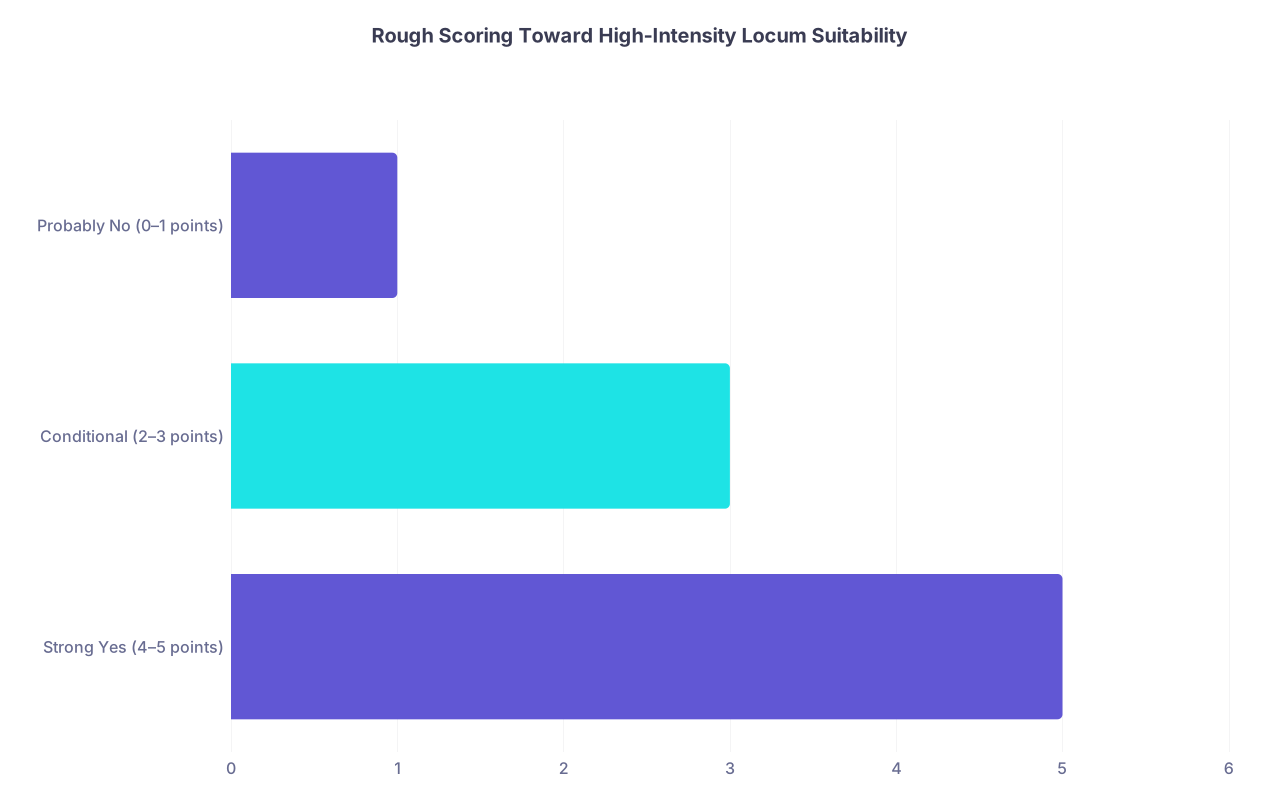
| Category | Value |
|---|---|
| Strong Yes (4–5 points) | 5 |
| Conditional (2–3 points) | 3 |
| Probably No (0–1 points) | 1 |
If you:
- Score 4–5: High-intensity locum blocks are likely a very strong tool for you—if paired with a strict financial plan.
- Score 2–3: Consider a hybrid approach: moderate locums, occasional heavy months, not a full send.
- Score 0–1: You probably should not lean on high-intensity locums as your main strategy. Focus on stable employment and lighter side-gig work.
8. How To Exit The Grind (Do Not Skip This Part)
Most people who do high-intensity locums fall into one of two traps:
- They never start. They talk about “doing a year of grind” and then just accept lifestyle creep on a normal job.
- They never stop. The money hits, they upgrade everything, and suddenly they “need” $40k/month.
The exit plan is as important as the entry plan.
You should know before you start:
- At what debt balance will you shift down to moderate workload?
- At what net-worth level (or emergency fund amount) will you prioritize life stability over extra shifts?
- What your next phase looks like: permanent job, part-time locums, academic role, etc.

Write this down. Literally.
“Once I:
- Have $XX,000 in cash savings, and
- Have paid my loans down to $YY,000, and
- Have at least one good W-2 or 1099 part-time option lined up,
…I will reduce my work hours to Z shifts/month max, with at least 10 days off at home each month.”
If you do not set that line, someone else (recruiters, your bank account, your ego) will keep moving it for you.
9. Bottom Line: When Heavy Locum Blocks Are The Right Move
You’re not a bad doctor if you chase money hard for a few years. You’re also not a genius if you wreck your health and relationships for an extra $150k that didn’t actually change your trajectory.
High-intensity locum blocks make sense when:
- Your debt is big, expensive, and not heading for forgiveness
- You have the psychological and family stability to tolerate 2–4 years of churn
- You have a written, numbers-based plan for how that extra income will kill debt and build a safety net
- You’ve already decided when and how you’ll throttle down
They make less sense when:
- You’re PSLF-bound or on a smart IDR strategy
- Your main problem is lifestyle expectations, not brutal math
- You crave mentorship, continuity, and long-term career growth more than cash
If you are sitting there with heavy debt and no savings, you do need to do something aggressive. That might be high-intensity locum work—or it might be a solid employed job plus lean living and a couple of side shifts.
Just do not drift. Decide on purpose.
Key points:
- High-intensity locum blocks are a tool, not a lifestyle. Use them with a clear, written payoff and savings plan—or skip them.
- Match your debt profile and personal tolerance honestly. Wrong person + right tool = disaster. Right person + right plan = financial freedom in a fraction of the usual time.