
You’ve got a staff job. Benefits, W-2, regular colleagues, the same EMR you can use half-asleep. But you’re also watching colleagues stack extra cash with locums. Or you’re worried your current job isn’t forever and want options. Or your admin just reminded you, not so subtly, that you’re “lucky to have this job.”
And you’re thinking: I want a part-time locum portfolio on the side—but I do not want to blow up my primary position, burn out, or get sued for breaching my contract.
Good. That means you’re still thinking clearly.
Here’s how to build a part-time locum setup while keeping your main staff role solid.
1. First: Can You Even Legally Do Locums On The Side?
Start here. Not with recruiters. With your contract.
Step 1: Pull out your employment contract
You’re looking for 3 landmines:
- Non-compete / restrictive covenant
- Non-moonlighting / exclusivity clause
- Duty hour / conflict-of-interest language
The exact wording matters more than whatever HR casually told you on orientation day.
Common phrases I see:
- “Physician shall devote full professional time and attention to Employer.”
- “Physician shall not engage in the practice of medicine outside of Employer facilities without prior written consent.”
- “Physician shall not provide clinical services within a X-mile radius of Employer facilities for Y months after termination.”
You need to know:
- Can you moonlight at all?
- If yes, do you need written approval? From whom? CMO? Chair? Credentialing?
- Are there geographic or system-wide restrictions? (A lot of systems claim every zip code in a 50-mile radius.)
If there’s a non-compete that effectively blocks local locums, you still have:
- Telemedicine locums in other states
- Out-of-region / out-of-state work
- Weekend-only assignments far enough away
But do not guess. If the language is muddy, spend 30–60 minutes with a healthcare attorney. Not your cousin who does real estate. Someone who reads physician contracts for a living.
Step 2: Decide how much you’re going to tell your employer
Two options, realistically:
Full transparency (best when allowed by contract)
- You say: “I’m considering occasional external shifts for loan payoff/experience. I’ll ensure no interference with my obligations here. Is there a formal moonlighting policy?”
- Pro: Less risk if they find out from credentialing or a colleague
- Con: They might try to control or limit you more than the contract actually allows
Contract-compliant but quiet
- If your contract clearly allows outside work without approval, you don’t have to broadcast it.
- But you still must:
- Never let locums interfere with your primary schedule
- Never compete directly (e.g., working at the rival hospital across town when your non-compete forbids it)
- Never use employer time/resources for locums admin work
If your contract requires written consent: get it. Email is fine. But get something in writing that says you may engage in outside clinical work so long as it doesn’t conflict with your obligations.
2. Get Clear On Why You Want Locums (Because That Dictates Everything)
“Extra money” is too vague. You need specifics because that will decide how aggressive your locum portfolio should be.
Common real motivations I see:
- “I need $4–5k/month extra for 2 years to crush loans.”
- “I want multiple hospitals on my CV in case I need to exit quickly.”
- “I’m trying to test drive different practice settings (rural/urban, academic/community).”
- “I want a partial ramp-out from full-time in the next 3–5 years.”
Write down your primary goal and a hard limit:
- Primary goal: e.g., “$60k extra per year for 3 years”
- Hard limit: e.g., “No more than 5 extra shifts/month or 2 weekends/month”
If you don’t set the limit now, you will absolutely overschedule yourself the first year. Recruiters make everything sound easy; your body will disagree.
3. Build a Realistic Time and Energy Budget
You don’t build a “portfolio” first. You build your capacity first.
Step 1: Map your core job
Look at your current schedule for the next 3–6 months:
- Clinic / OR / call days
- Required meetings, admin days
- Academic duties if you’re faculty (clinic precepting, lectures)
Highlight:
- Guaranteed off weekends
- Light clinic days that could tolerate a post-call brain
- Vacation blocks (these are gold for locums—but don’t give all of them away)
Step 2: Decide your true locum capacity
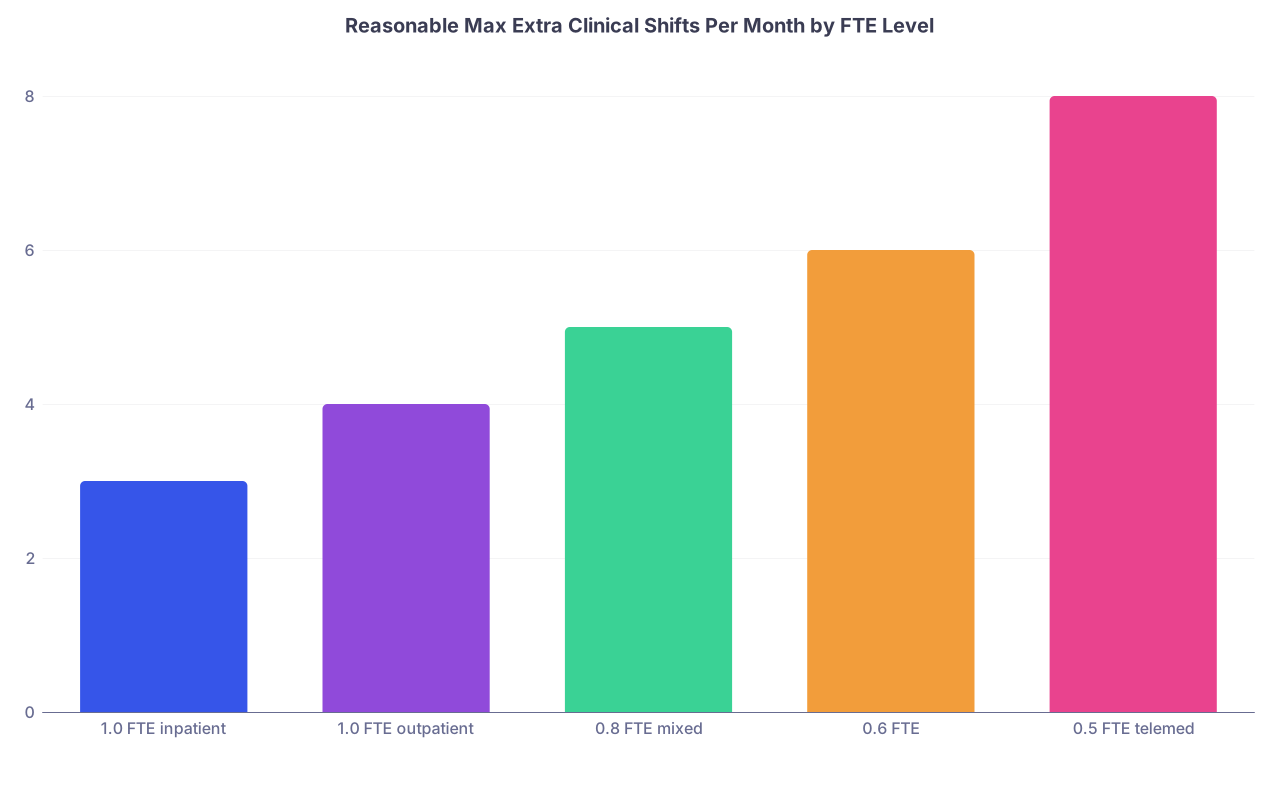
Here’s a rough sanity check:
| Category | Value |
|---|---|
| 1.0 FTE inpatient | 3 |
| 1.0 FTE outpatient | 4 |
| 0.8 FTE mixed | 5 |
| 0.6 FTE | 6 |
| 0.5 FTE telemed | 8 |
That’s my “you’re pushing it but okay” range. More than that for longer than 6–9 months and you’re flirting with burnout.
Now ask:
- How many extra nights/weekends can you tolerate without wrecking your main job performance?
- How much commute + travel are you willing to add? 1–2 hours each way versus flying somewhere?
If you’re fresh out of residency and used to 60–80 hours/week, you’ll be tempted to say, “I can handle a ton.” Believe me: once you’ve had 3–6 months of normal-ish hours, your baseline moves. Don’t plan your life as if you’re still an intern.
Start small. You can always add more contracts later. Backing out of a disastrous first locums commitment is much worse than doing too little.
4. Choosing the Right Kind of Locums To Pair With a Staff Role
Not all locum setups work well with a regular job. Some are perfect. Some are poison.
Best fits with a staff position
Weekend-only local/regional shifts
- Hospitalist doing 1–2 weekend blocks/month elsewhere
- ED physician picking up one Saturday each month at a smaller site
Vacation-block assignments
- 5–7 day blocks during your scheduled vacation, especially in low-volume rural settings
- Works well if your main job gives you 2–3 weeks of contiguous time
Remote / telemedicine
- Urgent care, psych, IM subspecialties, dermatology follow-ups, etc.
- Can often be done in 4-hour blocks in the evenings
Seasonal surge work
- Flu/COVID season for ED/urgent care
- OB coverage in months with high delivery volumes
What usually does not pair well:
- High-acuity, high-volume sites where you leave crushed every time
- Cross-country jobs that require 1–2 travel days for short blocks
- Anything with complex EMR + slow onboarding that you only work at sporadically
For a staff physician, think “low friction, predictable, repeatable.” Not “new adventure every time.”
5. Assembling Your Portfolio: 2–3 Anchors, Not 10 Random Gigs
A portfolio that works long-term usually looks like this:
- 1 main staff job (your W-2)
- 1–2 stable locum relationships (“anchors”) that you return to regularly
- Optional: 1 “experimental” or backup site you try for a limited time
Step 1: Pick your anchor profile
You want at least one of:
- Local/regional site within driving distance
- Or a telehealth role that can fill last-minute gaps
This anchor should:
- Have a straightforward EMR (or the same one as your main job)
- Offer repeating shifts (e.g., every 3rd weekend, one Thursday/month)
- Treat you decently—responsive medical staff office, sane nursing culture
You don’t need the highest hourly rate. You need the highest “net sanity” after factoring in travel, charting, bureaucracy, and volume.
Step 2: Add one “stretch” or strategic site
This might be:
- A rural critical access hospital that pays well per shift
- A large academic center where you gain CV value
- A site in the region you might move to in 2–3 years
You use this to:
- Keep options open
- Build relationships
- See different practice patterns
But you don’t tie half your life to it at the start. Maybe 3–6 shifts scattered over 6 months.
6. Handling Licensing, Credentialing, and Malpractice Like a Pro
Here’s where part-timers either get smart or drown in paperwork.
Stack your licenses strategically
You don’t need 10 state licenses. You want 2–4 high-yield states that:
- Have relative physician shortages (better rates)
- Are compact (for NPs/APPs) or have reciprocity benefits
- Host systems that are heavy locums users
Examples often used: TX, AZ, WA, OR, CO, NC, etc. (This varies by specialty.)
Stagger applications:
- Year 1: Maintain your home state + 1–2 extra states
- Year 2+: Add another if you see consistent opportunities
Do not open a license in a state you have zero realistic chance (or desire) to work in within 12–18 months. Licenses cost money and time to maintain.
Credentialing checklist system
Start a folder (digital, obviously):
- Updated CV (month/year format, no unexplained gaps)
- Copies of: licenses, DEA, board cert, ACLS/BLS/ATLS/etc
- Immunization records, TB, flu/COVID docs
- NPI, tax ID if you’re 1099
- Reference list with updated contact info
Keep all this in one place so when a new hospital sends you their 40-page packet, you’re not digging through email hell.
Malpractice alignment
Most locum agencies and hospitals provide occurrence or claims-made coverage for the shifts you work. You still must:
- Confirm what type (occurrence vs claims-made)
- Confirm tail coverage responsibility if claims-made
- Make sure your primary employer’s malpractice is okay with you doing external work (read the policy or ask, in writing)
Don’t double-bill coverage, but do make sure there’s no “only covered if working for Employer” clause that could bite you for outside work.
7. Protecting Your Main Job While You Grow Your Locum Side
This is the part people underestimate. Your staff job funds your benefits, your 401k match, and your baseline sanity. You protect it.
Non-negotiables
Your primary schedule always comes first
- Never accept locum shifts that might conflict with your core job.
- When your staff schedule changes last minute, you adjust locums, not the other way around.
Never show up to your main job post-call from a locums shift
- If you’re doing that, you’re being unsafe. And you will eventually slip.
Keep your fatigue invisible to your primary team
- If colleagues start saying, “Hey, you look wrecked—are you overdoing it?” you’re already too far.
Manage the optics
If your employer knows you’re doing locums:
- Do not complain about being tired from “that other gig.”
- Do not brag about how much more you’re paid at your locums site. (Guaranteed way to trigger admin hostility.)
- Frame it as: “Paying down loans” or “maintaining skills in a different setting,” not “because our pay sucks.”
If they don’t know:
- Same rule: no complaining about fatigue from outside work.
- Keep locum email/phone calls off your employer’s devices and time.
8. Money, Taxes, and Not Getting Blindsided in April
Locums = usually 1099. Your staff job = W-2. That combo is powerful if you treat the 1099 like a business, not tip money.
At minimum, do this:
- Open a separate high-yield savings account or business checking just for locum income.
- Every locum payment that hits that account:
- Immediately move 25–35% to a tax sub-account (federal + state).
- Keep another slice (10–20%) for business expenses / cushion.
- Live on your W-2. Use locums intentionally (debt, savings, specific goals).
You’ll have deductible expenses:
- Licensing fees, DEA in some setups
- Travel, lodging (if not reimbursed)
- CME related to your work
- Some equipment / software
If your locums income is more than trivial (> $20–30k/year), get an accountant who’s comfortable with physician 1099 work. They’ll pay for themselves.
9. Burnout, Boundaries, and Knowing When You’re Overdoing It
Let me be blunt: The first year you do this, you will probably overshoot your limits. Everyone does.
Watch for:
- You’re short-tempered with staff at your main job
- Charting backlog grows because your “off” days are now travel/chart catch-up days
- You stop doing any non-work things (gym, family time, hobbies all vanish)
- You start fantasizing about getting sick to force a break
Locums should give you options and leverage, not just more grind. If your life feels worse, you’re doing it wrong.
Signs you’ve got the balance roughly right:
- You can say no to a locum offer without financial panic
- You maintain some actual non-medical life
- Your main job performance hasn’t slipped
- You’re progressing toward your core financial or career goal
10. A Sample Part-Time Locum Portfolio For a Full-Time Staff Doc
Let’s put this together so you can see what “reasonable” looks like.
Say you’re a full-time hospitalist, 7-on/7-off, at a mid-sized community hospital.
A sane first-year portfolio might be:
| Component | Details |
|---|---|
| Main Job | 7-on/7-off community hospital (1.0 FTE) |
| Anchor Locum Site | Regional rural hospital, same EMR |
| Frequency | 1 weekend block per month (Sat–Sun) |
| Telemed Role | 1 evening tele-urgent session / week |
| Annual Extra Shifts | ~24 in-person + ~40 short telemed |
That’s:
- Enough to add substantial income
- Not so much that your 7 days “off” are fully obliterated
- Diversified settings (local rural + remote) without 5 different EMRs and onboarding hell
As you see how your body and brain tolerate this, you can scale up or down.
FAQ (Exactly 4 Questions)
1. Won’t my employer be angry if they find out I’m doing locums on the side?
Sometimes. Sometimes they won’t care at all. The real question is: what does your contract say? If your agreement allows outside clinical work (with or without notice) and you’re not directly competing or missing shifts, their feelings don’t override the contract. Practically, frame the locums as debt repayment, skill maintenance, or exposure to different settings—not as “I hate it here.” And absolutely make sure your performance and availability at your main job stay bulletproof.
2. Should I work with agencies or try to get locum shifts directly with hospitals?
Early on, agencies are fine and often easier. They handle credentialing, travel, and malpractice. You’ll pay for that via lower hourly rates, but the friction is lower. Once you know a region and some medical directors, you can negotiate direct PRN or locum deals that pay better. For someone with a full-time staff job, a hybrid approach works well: one or two agency-managed sites plus one direct relationship you cultivate over time.
3. How long does it actually take to get credentialed for a new locum site while I have a full-time job?
Plan on 60–120 days, sometimes more, from “I’m interested” to “you are on the schedule.” That’s why a portfolio built on 1–2 good anchor sites is so valuable—you don’t want to be constantly re-credentialing. If you line up your licenses and documents now and respond quickly to credentialing requests, you can be on the faster end of that range. Slow responses on your side = delays. Slow hospitals = unavoidable.
4. What if I start locums and realize I took on too much—how do I back down without burning bridges?
First, stop accepting new shifts immediately. Then, honor what you’ve already signed up for unless there’s a genuine emergency. After that, be direct but professional: “I’ve realized I need to scale my external commitments back to protect my primary role. I’d like to stay on your roster for occasional future shifts, but I can only commit to X per month/quarter.” Most sites would rather keep you at a lower volume than lose you entirely. If a site is toxic and you never want to go back, finish what you’ve agreed to and then simply don’t re-up.
Today’s concrete next step: pull your employment contract and find every clause related to outside employment, non-compete, and conflict of interest. Highlight them. If you can’t clearly explain to yourself what they allow and forbid, schedule a 30-minute review with a physician contract attorney before you talk to a single locums recruiter.