
Locum work does not “kill” your academic career. The belief that a year or two of locums after residency makes you radioactive to academic medicine is mostly fiction, propped up by people who have never hired anyone and by residents repeating hallway gossip.
The reality is more uncomfortable: locum experience is neither automatic gold nor automatic poison. It amplifies whatever story your CV is already telling—good or bad.
Let me unpack that without the usual fluff.
The Myth: “If You Do Locums, You’ll Never Get an Academic Job”
I’ve heard this one verbatim from program directors: “If you leave and do locums, you won’t come back to academics.” Usually said to a PGY-3 who just mentioned burnout or debt.
Here’s what’s actually going on.
Academic hiring committees look at three buckets:
- Can you do the work we need right now?
- Can you help us meet our academic missions (teaching, research, quality)?
- Does your CV tell a coherent story, or does it look like chaos?
Locums affects all three, but not in the simplistic “locums = bad” way people assume.
Let’s start with evidence and real hiring behavior, not folklore.
What the Data and Patterns Actually Show
There is no randomized trial of “locums vs straight-to-academics.” But we do have:
- Hiring patterns from academic institutions
- Surveys on physician mobility
- The painfully obvious logic of incentives
Academic centers need:
- Clinical workhorse faculty to cover service
- A smaller subset of heavily scholarly faculty to bring in grants and prestige
- A constant stream of “warm bodies” who can teach, see patients, and not implode
Locums can affect you differently depending on which lane you’re targeting.
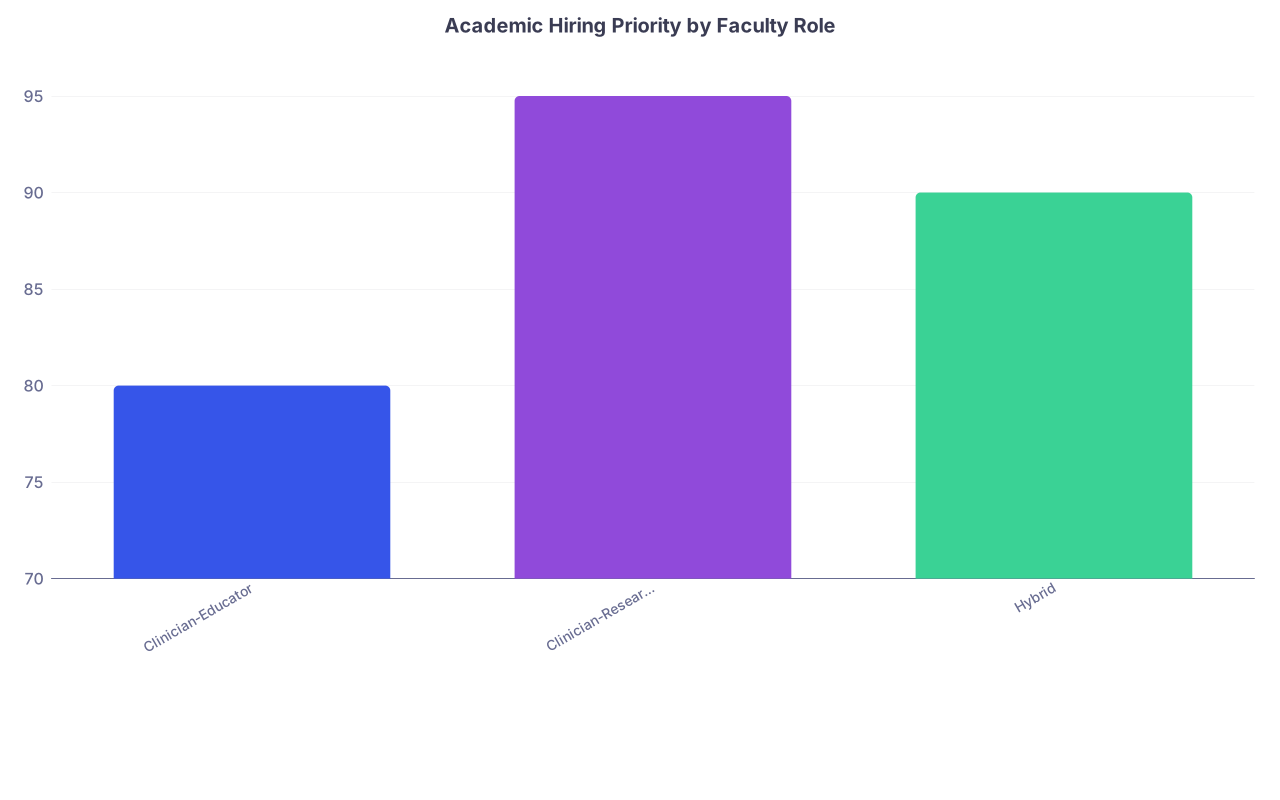
| Category | Value |
|---|---|
| Clinician-Educator | 80 |
| Clinician-Researcher | 95 |
| Hybrid | 90 |
Interpretation (based on actual job descriptions and hiring criteria, not fantasy):
- Clinician-educators: 80% of the decision is “Will this person reliably see patients and teach well?”
- Clinician-researchers: Upwards of 90–95% of the real leverage is research productivity and funding trajectory; everything else is background noise.
- Hybrids: You’re being judged on both, and there’s less margin for gaps.
In this context, locums isn’t a binary good/bad. It’s evaluated as:
- A neutral or even positive clinical signal if you maintained or expanded skills
- A concerning academic signal if your research or teaching output flatlined and your story is incoherent
The problem is not “locums.” The problem is: what disappears from your CV while you’re doing locums.
When Locum Experience Helps an Academic Career
Let’s start with the contrarian part: there are clear, repeatable scenarios where locums actually strengthens your academic pitch.
1. You’re Clinically Strong but Burned Out, and Locums Buys You Sanity
I’ve seen this play out:
- Resident wants academic job
- Training was malignant, they’re exhausted
- They take a 12–18 month locums stretch: do 0.8 FTE, pay off some debt, regain sleep, remember they like medicine
- Then they apply to academic positions with their exam scores intact, strong letters, and no evidence of a meltdown
Program directors are not stupid. They can tell the difference between:
- “I did locums to escape all work” vs
- “I used locums to avoid signing a desperate, bad first job and to stabilize”
If your narrative is: “I chose a temporary locums role to give myself flexibility while I continued teaching, publishing a small paper, and exploring academic subspecialty options,” that is not a liability. That’s agency.
2. You Want to Be a Clinician-Educator, Not a Grant Chaser
For clinician-educator roles, the bar for research is modest in many departments. What they want:
- Evidence of teaching ability
- Good clinical judgment
- A reasonable, plausible interest in education projects
Locums can elevate your clinical credibility:
- High-acuity coverage (trauma hospitals, safety-net systems)
- Exposure to different EMR systems, patient populations, workflows
- Demonstrated adaptability and low drama
If, during locums, you:
- Precepted medical students or residents at locums sites
- Gave CME talks, M&M presentations, or local education sessions
- Participated in quality projects (sepsis bundle, stroke door-to-needle time, etc.)
Then your locums year looks like an applied clinical-education year, not a “lost” year.
3. You Use Locums to Move Closer to Your Target Institution
Academic jobs are often regional. If your dream is a faculty job in Boston, but you trained in Texas and grew up in Seattle, the committee is always silently wondering: “Will this person stay, or are we a layover?”
Locums can close that gap.
For example:
- Take locums assignments in the same state or region as your target academic center
- Build a track record with local clinicians who might know people at that institution
- Demonstrate that you’ve lived in the area and want to stay
I’ve watched candidates get hired at large academic centers because a local section chief had heard, “Yeah, she’s been covering at our affiliate hospital for a year—reliable, solid, no drama.”
That’s not theory. That’s how real hiring conversations sound.
When Locum Experience Hurts an Academic Career
Now for the part people don’t like to hear: locums is not a magic shield. It can absolutely damage your academic prospects if you sleepwalk through it.
1. You Want a Research Career but Stop Producing
If you want clinician-researcher or heavily scholarly roles, locums is usually a net negative unless you have a very specific, disciplined plan.
Research committees care about:
- First-/senior-author publications
- Funded or fundable projects
- Clear continuity of scholarly work
If your CV shows:
- Research through PGY-3 → nothing for 2–3 years of locums → application to Assistant Professor, research track
You look like you left the field. Harsh, but accurate.
It’s not the locums that’s the problem. It’s the unexplained disappearance of output.
Could you still make it work? Yes, but you’d need:
- Ongoing remote collaboration with your prior research group
- Manuscripts submitted or accepted during your locums period
- A coherent explanation: “I shifted to flexible clinical work to focus on completing X and Y projects without taking on a 70% clinical role too early.”
That’s uncommon. Most people don’t do this. So they blame locums, when the problem was losing the research thread.
2. Your Locums Looks Like Chaos
Academic committees hate chaos on paper:
- 5 locums gigs in 9 months
- Multiple short contracts without clear reason
- Gaps in employment that are poorly explained
- No continuity in teaching or projects
This screams, “I am difficult or unstable,” regardless of what actually happened.
Again, it’s not that you did locums. It’s that you did locums in a way that makes your life look like a series of impulsive decisions and exits.
3. You Let Your Letters and Reputation Rot
In academics, letters of recommendation are currency. If you go off and do locums but:
- Never stay long enough anywhere to get a meaningful letter
- Let your residency PD lose track of you
- Fail to maintain relationships with your mentors
Then when you apply back to academics, your letters say: “Strong resident, last seen 3 years ago, not sure what they’ve been doing since.”
That’s deadly.
If instead you:
- Keep your PD updated once or twice a year
- Ask a locums site leader to write a “clinical excellence” letter
- Maintain a connection with any research or education mentor
Then your locums period is contextualized. With evidence.
What Academic Hiring Committees Actually Ask Themselves
When they see “Locum Tenens Physician” on a CV, they’re not clutching pearls. They’re asking three questions:
- Did this person maintain (or improve) clinical competence?
- Does this person have any real engagement with teaching, scholarship, or quality?
- Does the story make sense?
That’s it. That’s the whole game.
To make this clear, here’s the comparison you should actually care about:
| Aspect | Locums Year Done Well | Straight to Academic Job |
|---|---|---|
| Clinical Volume | Often high, varied, adaptable | Moderate, in one system |
| Teaching Signal | Needs to be created intentionally | Built-in with residents and students |
| Research Signal | Must be maintained remotely or off-hours | Easier to embed in job description |
| Narrative Coherence | Requires deliberate story and documentation | Often “expected” and self-explanatory |
| Red-Flag Risk | High if chaotic/multiple short stints | High only if performance issues |
Locums isn’t an automatic downgrade. It’s just less self-explanatory, so you have to do more narrative work.
How to Do Locums Without Torching Academic Options
If you’re even thinking about an academic future, here’s how to structure your locums time like someone who understands how this game works.
1. Make Teaching a Real, Documented Part of Your Locums
Most locums companies are clinically focused. They don’t care about teaching. But many of the hospitals they staff do have learners.
So you:
- Choose sites that are affiliated with a medical school or residency
- Volunteer to give case conferences, journal clubs, or short teaching sessions
- Ask chiefs or education leaders to briefly document your teaching role in an email or letter
Then, in your CV, your locums entry doesn’t read “Hospitalist, 7 on/7 off.” It reads:
“Hospitalist, Locum Tenens – Provided inpatient care at regional teaching hospital; supervised internal medicine residents on ward service and delivered monthly case-based teaching sessions.”
Different universe.
2. Maintain One Thread of Scholarship or Quality Work
You don’t need ten papers. You need continuity.
Options that actually work in the real world:
- Finish and submit a manuscript from residency data
- Collaborate remotely on a prior project as co-author
- Lead a quality improvement effort at a locums site and present it as a poster or local talk
If you can mark even one scholarly output during your locums year, your research line is not “dead.” It’s just “lean.”
3. Keep Your References Alive
Before you leave residency:
- Get direct contact info for: PD, APD, at least one research/education mentor
- Tell them honestly: “I’m likely doing a year of locums but I’m interested in academic positions afterward; I’d like to keep you updated.”
During locums:
- Send a short update email once or twice a year: “Here’s where I’m working, here’s what I’m doing, a small teaching thing I did, a project I’m touching.”
- When ready to apply, give them at least 4–6 weeks notice and a short summary of your locums work.
This way, their letter can say: “Since graduation, she’s worked at X and Y hospitals as a locums hospitalist, remained engaged in teaching, and completed a manuscript from our prior project.” That changes everything.
The Hard Truth: What You Actually Trade When You Choose Locums
Let me be blunt.
Locums is primarily a trade of:
- More money
- More location flexibility
- Less administrative overhead
in exchange for:
- Less built-in academic structure
- Less mentorship
- More responsibility to self-manage your academic trajectory
If your primary goal is a high-end research career (NIH grants, tenure-track, major lab), then stepping off the train for a generic locums year is usually a bad move. You’re giving up momentum in a race where time really does matter.
If your primary goal is a clinician-educator or clinical faculty role with some teaching and light scholarship, then a locums year is perfectly compatible—as long as you’re not lazy about the academic side.
The idea that “any locums = academic death” is lazy thinking. But the idea that “locums is totally neutral” is also wrong. The system is biased toward people who stay inside it.
You can step out. You just have to step back in with evidence, not vibes.
FAQs
1. Will a 1–2 year locums gap after residency automatically disqualify me from academic jobs?
No. It will trigger questions, but it will not automatically disqualify you. If you can show solid clinical work, some teaching or quality involvement, and at least a thin thread of scholarship or engagement, you’re very much still in play—especially for clinician-educator roles.
2. Is locums a bad idea if I want a research-heavy or NIH-funded career?
Generally yes, unless you have an unusually strong, protected research arrangement during locums. Research careers are highly path-dependent. Stepping away from structured research support and mentorship right after training usually hurts your trajectory and your competitiveness for grants and mentored awards.
3. How long can I do locums before academics starts to get suspicious?
Around 1–2 years is usually explainable. Beyond 3–4 years, you need a much stronger story. At that point, many committees start assuming you chose a non-academic path and might struggle adjusting back to lower pay, more meetings, and more non-clinical obligations.
4. Do academic hiring committees look down on locums compared to community jobs?
Not inherently. A stable, well-documented community job with clear teaching or leadership roles can be easier to read than fragmented locums work. But a well-structured locums year at teaching hospitals is viewed more favorably than a chaotic or toxic community job with no growth or references. They care about the story and the evidence, not the billing mechanism.
5. What’s the single most important thing to preserve during locums if I might want academics later?
Continuity of relationships and output. Keep mentors and references alive, and produce at least one tangible academic or educational product (paper, poster, QI project, curriculum, recurring teaching). That preserves your academic “signal” far more than any specific locums site or contract details.
Key points: Locums isn’t academic poison; it’s an amplifier. It magnifies whether you’re intentional or drifting. If you want an academic door open later, design your locums time like someone who plans to knock on it—because committees can tell the difference.