
Locums are not “inherently” disconnected from patients. That’s a lazy story hospitals tell, and burned‑out attendings repeat, to justify a system built on overwork and control.
Let me be direct: the idea that full‑time employed docs have some magical monopoly on continuity and relationship, and locums can only “parachute in and out,” is wildly overstated. Sometimes flat‑out wrong. When you actually look at how modern practice works—shift work, hospitalist models, massive group practices—the locums stereotype collapses pretty fast.
You’re post‑residency, staring down a job market that feels rigged: RVU traps, non‑competes, “partnership tracks” that look suspiciously like golden handcuffs. And in the background you hear it:
“If you do locums, you’ll never build real relationships with patients.”
“Continuity is impossible if you’re not permanent.”
I’ve heard it in resident workrooms, credentialing meetings, and from senior docs who haven’t seen a modern EMR in 10 years.
Let’s dismantle this with facts, not folklore.
The Myth: “Locums Means No Continuity, No Connection”
The standard narrative goes like this: patients need “their doctor,” and only a stable, full‑time, long‑term clinician can provide that. Locums are “temps,” interchangeable bodies filling schedule gaps. Therefore, by definition, locums physicians are less connected, less invested, and less capable of longitudinal care.
That story depends on three assumptions:
- That most permanent jobs actually deliver continuity.
- That continuity only lives in multi‑year, single‑site relationships.
- That patients care most about the name on the badge, not the quality of the interaction.
All three are, at best, partially true. Often, they’re just wrong.
Look at how much of medicine is already inherently discontinuous:
- Hospitalist shifts with 7‑on/7‑off models and “whoever’s on takes the list.”
- ED care: essentially zero traditional longitudinal continuity.
- Large multispecialty groups where patients see “next available,” not “their” doctor.
- Academic training hospitals where residents cycle every 2–4 weeks and attendings rotate constantly.
Yet no one runs around saying, “Hospitalists can’t connect with patients” or “ED docs can’t form therapeutic alliances.” Funny how the “no continuity” criticism lands hardest on the group that happens to have the most autonomy.
What the Data Actually Shows About Continuity
Let’s talk evidence, not vibes.
Continuity of care does matter. There’s robust literature showing that higher continuity is associated with:
- Reduced mortality
- Lower hospitalizations and ED use
- Better chronic disease control
- Higher patient satisfaction
But here’s the twist: those studies mostly measure continuity at the practice or system level, not “did you see the exact same physician for 10 years straight.”
Continuity has at least three layers:
- Relational continuity – the felt relationship with a person (or small, consistent team).
- Informational continuity – your story, data, and context follow you in a usable way.
- Management continuity – your plan makes sense over time and is not randomly reset.
Locums can absolutely contribute to the second and third. And they can build the first more often than people admit, especially in longer assignments.
The bigger continuity killers today are:
- High staff turnover in employed positions (docs leaving after 1–3 years).
- Corporate reshuffling and “panel redistribution.”
- Overbooked schedules that force 7‑minute visits.
- Fragmented IT systems that don’t talk to each other.
Locums did not create any of that.
A More Honest Comparison: Real Continuity vs. Mythical Continuity
Let me show you how the picture actually looks in practice.
| Aspect | Typical Employed Position | Typical Locums Role |
|---|---|---|
| Job duration | 2–4 years before turnover | 3–12+ month assignments common |
| Panel ownership | Increasingly pooled / team-based | Often pool- or service-based |
| Informational continuity | EMR-based, dependent on documentation | Same EMR, same dependency |
| Relationship depth | High if doc stays long-term | Moderate to high on longer locums stints |
| Relationship risk | Panel disrupted when doc burns out/leaves | Panel disrupted when contract ends |
In other words: the difference is smaller than people pretend. A 9‑month locums hospitalist who returns twice a year can offer more real‑world continuity than an employed doc who quits in 14 months and moves states.
And that turnover? It’s not hypothetical.
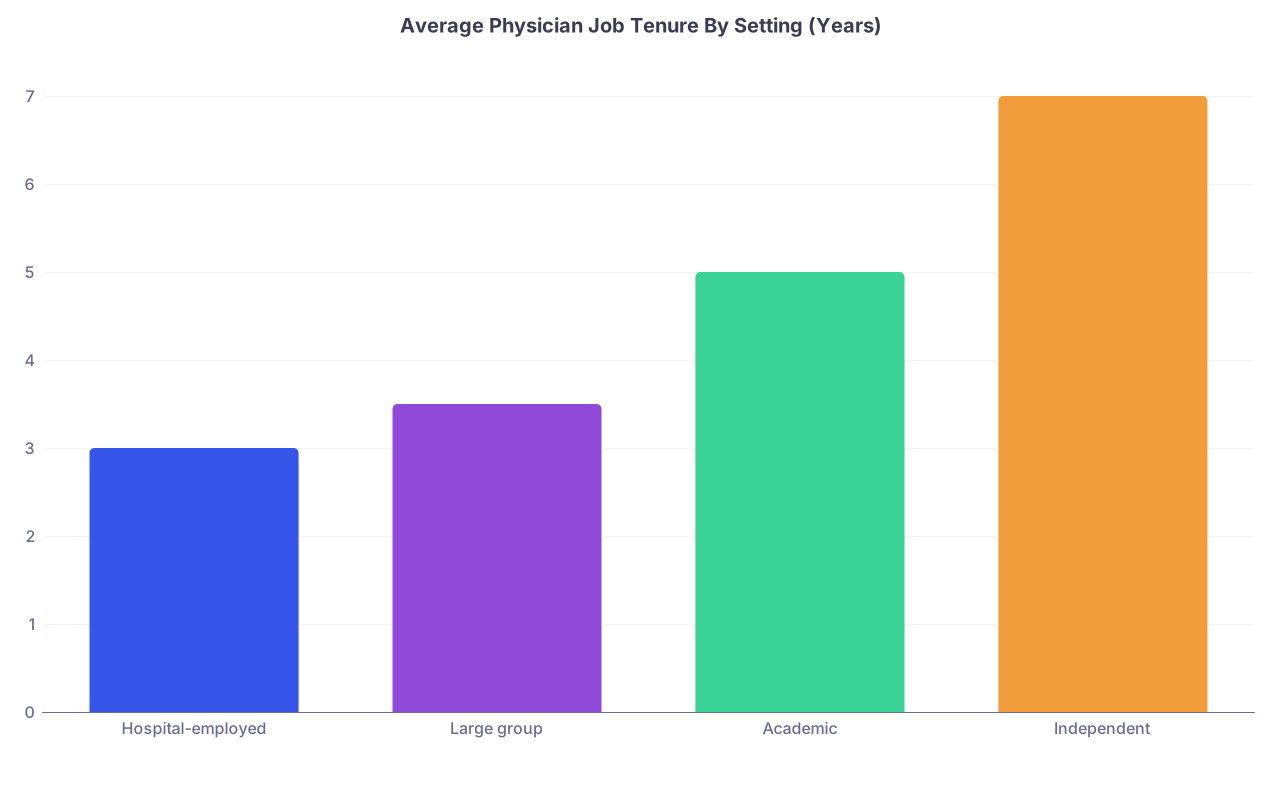
| Category | Value |
|---|---|
| Hospital-employed | 3 |
| Large group | 3.5 |
| Academic | 5 |
| Independent | 7 |
Most “permanent” doctors aren’t staying 10–15 years anymore. They’re cycling through systems, often for the same reasons people choose locums: schedule control, geographic freedom, and trying to dodge toxic leadership.
So when an administrator claims “we need a permanent hire to guarantee continuity,” what they often mean is: “we want someone easier to control and cheaper over time, then we’ll pretend that’s about patient relationships.”
What Locums Actually Looks Like Longitudinally
I’ve watched this pattern repeat in multiple specialties: IM, EM, anesthesia, psych, even FM.
The serial returner
You work 10–14 day blocks at the same rural hospital every month or every other month. Same unit, same EMR, same nurses, often the same frequent‑flyer patients.
Does Mrs. S with CHF care that your paycheck comes through a locums agency instead of the health system? No. She cares you remember her last admission, that her granddaughter is in community college, and that you notice when she looks more short of breath.
Relational continuity? Check.
Informational continuity? Same EMR, same hospital.
Management continuity? You’re the one making sure her diuretics and follow‑up make sense across admissions.
The “temporary” who stays
Common scenario: clinic or hospital hires a locums doc for “3 months while we recruit.” Fast-forward 18 months, three failed “permanent” candidates, and the locums doc is effectively the senior clinician.
Patients do not care what HR calls you. They care that you kept coming back.
I’ve seen locums in critical access hospitals who had deeper relationships with their community than the employed subspecialists rotating through once a week from the big city.
The short‑term fixer
Yes, there are 2‑week gigs where your role is strictly acute: clear the backlog, staff a surge, cover a maternity leave. Continuity is mostly informational and management: you prevent harm, avoid duplicating work, and hand off cleanly.
Is that “less connected”? Sometimes, yes. And that’s fine. Not every clinical interaction needs to be a 10‑year arc. The myth is that all locums work looks like this.
Why the “Disconnected Locums” Myth Persists
The myth survives because it’s useful—to employers, and to docs who want to believe they’re morally superior for staying put.
Three main drivers:
Economic incentive for systems
Permanent hires are usually cheaper over the long term and easier to tie down with non‑competes and restrictive contracts. Painting locums as bad for patients is a handy moral cudgel to pressure you into employment.Identity bias among physicians
There’s a deep, almost nostalgic image of “my patients, my panel, my community.” Nothing wrong with that. But many attending jobs today simply do not resemble that Norman Rockwell fantasy, yet we still use that story to judge colleagues who choose flexibility.Misunderstanding what continuity even means now
People equate continuity with ownership: “these are my patients.” But in a team‑based, EMR‑driven reality, continuity is more of a distributed property. You, as a locums physician, can be one of the most stabilizing pieces of that system—if you work intentionally.
How Locums Can Build Real Longitudinal Value
This is where you separate the pros from the warm bodies.
Locums who act like tourists—minimal notes, no interest in local workflows, shrugging at follow‑up—absolutely reinforce the stereotype. And yes, they exist. They also exist among permanent staff.
The difference is that as a locums doc, you have to be more deliberate about continuity because the default structure doesn’t hand it to you.
Some patterns I’ve seen work well:
1. Favor repeat and longer assignments
If you’re serious about connection, don’t randomly bounce every month. String assignments together in the same region, hospital, or system.
A 6‑month clinic assignment, extended twice, creates more meaningful continuity than many “permanent” jobs that implode in a year.
2. Become viciously good at informational continuity
Most patients experience continuity not as “same person” but as “no one made me repeat my story for the fifth time.”
Locums who:
- Write clear, future‑facing notes
- Use consistent problem lists and med reconciliation
- Flag landmines and complex social situations in a readable way
…leave behind continuity others can build on. That’s not theoretical; it’s the difference between “Oh good, Dr. X was on, I know exactly what’s happening” and “Who wrote this garbage? I have to start over.”
3. Anchor yourself to a few “home bases”
Many post‑residency docs use locums not as permanent vagabond life, but as a flexible framework.
One hospitalist I know does:
- 10 shifts/month at the same community hospital (locums)
- 4–5 shifts/month floating in another system for variety
Guess where her strongest relationships live? The place she returns to every month. Her “locums” base is more stable than half the full‑time FTEs there.
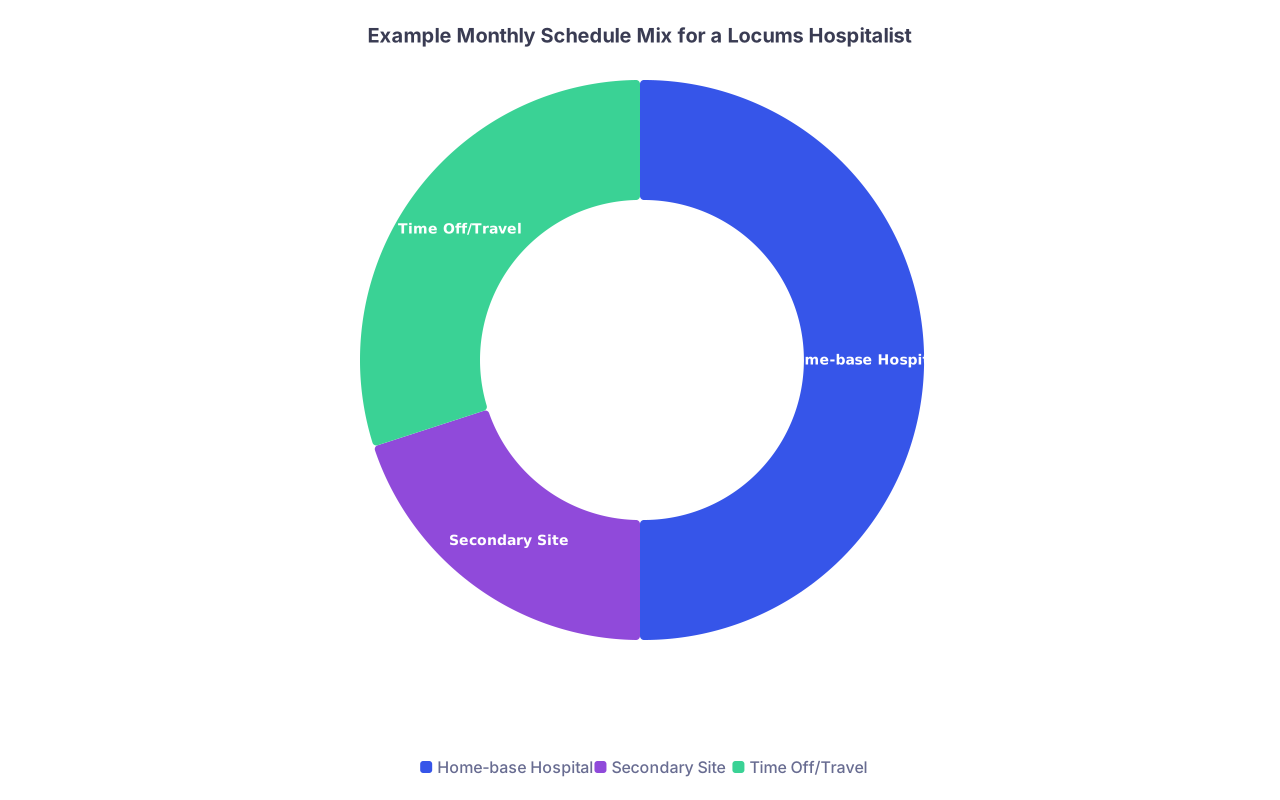
| Category | Value |
|---|---|
| Home-base Hospital | 50 |
| Secondary Site | 20 |
| Time Off/Travel | 30 |
Patients Care Less About Your Contract, More About Your Presence
I’ve sat in rooms where patients say, almost verbatim:
“I don’t care what group you’re with, you’re the only one who actually listens.”
“Are you going to be here next time? If not, fine, just write it where the next person can see it.”
The emotional “continuity signal” for patients is pretty simple:
- Does this doctor remember enough about me to not feel like a stranger?
- Do I feel safe handing them my story and my fear today?
- When I come back, is the system around this doctor coherent?
None of those require you to be a W‑2 lifer with the logo fleece quarter‑zip.
Locums physicians can hit all three. Where they fall short, it’s usually due to:
- Bad onboarding by the site (thrown into chaos with no orientation).
- Short, one‑off gigs where there truly is no way to ensure follow‑up.
- Their own attitude: “I’m just here for two weeks, don’t care what happens after.”
The first two are structural. The third is on us as clinicians, not on the concept of locums.
When Locums Is a Bad Fit for the Relationship‑Driven Doc
I’m not going to pretend locums is perfect for everyone who craves longitudinal primary care in the classic sense.
If your deep professional joy is:
- Managing a panel of diabetics for 15 years and going to their kids’ graduations
- Being the named PCP that every specialist writes back to
- Building a practice in one town where you’re “the doc”
…then some locums setups will frustrate you. Short‑term primary care coverage gigs, high‑turnover urgent care shifts, or pure ED work will not magically morph into old‑school family medicine continuity.
But that’s not because you’re locums. It’s because the model of practice itself has shifted. Plenty of employed PCPs now have:
- Huge panel churn
- Team‑based care where NPs/PA’s and virtual visits fragment relationships
- Corporate pressure to see more new patients and fewer follow‑ups
Blaming “locums” for that is like blaming the stethoscope for the RVU system.
Where locums shines for the relationship‑driven doc is:
- Rural or underserved communities that beg you to keep coming back.
- Long‑term coverage for leaves, retirements, or slow hiring processes.
- Hybrid lives where you mix one “home” site with some adventurous assignments.
The Longitudinal Truth
So, are locums always disconnected from patients?
No. That’s a myth propped up by nostalgia, economics, and a poor grasp of how continuity really functions in 21st‑century healthcare.
Three core truths to walk away with:
Continuity is already fragile in modern medicine, even for “permanent” docs.
Short job tenures, team-based care, and corporate churn mean long-term one‑to‑one relationships are the exception, not the rule. Locums isn’t uniquely guilty here.Locums can deliver real longitudinal value—when structured intentionally.
Repeat assignments, home‑base sites, meticulous documentation, and a non‑tourist mindset let you create both relational and informational continuity that rivals many staff positions.Patients judge you by presence, memory, and coherence—not your contract type.
They care that you show up, you remember them (or at least their chart does), and the plan makes sense over time. Locums can absolutely do that. Many already are.
The question isn’t “Does locums destroy continuity?”
The real question is: “In a system built to fragment care, how are you going to practice so that your patients still feel seen?”