Most physicians do locums like they are renting an Airbnb—and then act surprised when no one offers them the house.
If you want a permanent job out of a locum tenens assignment, you cannot behave like a short‑term contractor. You have to quietly, consistently operate like future core faculty or long‑term staff from day one.
This is not mysterious. Hospitals and groups convert locums to permanent when three things line up:
- You solve their real pain points.
- You are low hassle and high trust.
- You make it obvious that keeping you is easier than starting over.
I am going to walk you through exactly how to do that, step by step.
Step 1: Choose the Right Locum Assignment If You Want It to Convert
You cannot turn every locum into a permanent position. Some are structurally temporary. Some are financially doomed. Some are political minefields.
You need to be selective on the front end.
Know which assignments are actually convertible
Ask your recruiter or scheduler direct, specific questions. If they dance around these, that is a red flag.
| Question Type | Exact Question to Ask |
|---|---|
| Position reality | "Is this backfill for someone on leave, or a true vacancy?" |
| Timeline | "How long has this position been open?" |
| Conversion history | "Have you ever had a locum convert to permanent here?" |
| Decision-maker | "Who ultimately decides on permanent hires for this service?" |
| Contract status | "Is there an employed role or group slot already budgeted?" |
If the answer sounds like:
- “We just need coverage while Dr. X is on sabbatical” → very low conversion chance.
- “We have two unfilled FTEs budgeted and can’t recruit” → strong signal this could convert.
You are looking for:
- Chronic vacancy, not a temporary gap.
- A history of converting locums, or at least an explicit openness.
- An identified service line lead or CMO who aches for stability.
Understand their real problem
Every locums need is actually one of a few core problems:
- Volume outstripped staff (growth problem).
- Someone left and they cannot backfill (recruitment problem).
- Toxic culture or leadership churn (retention problem).
- Coverage for new service line (strategy problem).
You want growth or recruitment problems. Those are fixable and usually come with budget.
Retention and toxicity can still work, but be realistic: you might get a job offer in a place you do not actually want to stay. So be honest with yourself on what you are willing to tolerate long term.
Step 2: Show Up Like a Long‑Term Colleague, Not a Temp
You are on stage the second you walk into orientation. Leadership is quietly asking: “Would I be happy seeing this person’s name on our call schedule for the next five years?”
Day 1–7: Build trust faster than everyone expects
Your first week is where most locums either win or lose their shot at staying.
Focus on these behaviors:
Master the basics quickly
- Learn the EMR workflows that matter: orders, notes, messaging, discharge.
- Ask the “power user” nurse or PA to show you 3–5 key time‑saving tricks.
- Create 2–3 note templates that match their style so your documentation does not scream “locums.”
Ask the right people the right questions
- Instead of randomly asking everyone, find:
- Charge nurse on your main unit.
- Most senior MA or tech.
- The “unofficial chief” physician—there is always one.
- Say this explicitly: “I want to make things easier here, not harder. Tell me how you like things done on this unit.”
- Instead of randomly asking everyone, find:
Signal reliability immediately
- Be early. Not on time—early. At least for the first two weeks.
- Close your charts the same day unless clinically impossible.
- Return calls and messages promptly. Admins notice this more than your RVUs.
The unwritten rules that matter more than your CV
You already know the medicine. What decides conversion is behavior.
- Do not speak badly about your prior organizations in your first month. It reads as “future problem.”
- Do not start all your sentences with “At my last place, we did it this way.” Save that for month 2–3, and only with context.
- Learn names. Quickly. The unit secretary, radiology tech, pharmacist. Those people absolutely influence whether leadership wants you back.
I have watched more than one brilliant clinician lose a permanent offer because staff said, “Great doctor, but no one wants to work with them.”
Step 3: Make Yourself Operationally Indispensable
Hospitals do not convert you because you are nice. They convert you because losing you would hurt.
You create that dynamic by quietly becoming a “go‑to” for messy, annoying, and high‑value work.
Start with call and coverage
You can buy a lot of goodwill with call—even if you hate it.
- Take a slightly worse call assignment without complaining. Once. People remember who did not whine.
- Offer to help with a messy sign‑out or an overflow clinic session when things are bad.
- Do not martyr yourself. You are not trying to be exploited. You are simply building a track record of “when we are in trouble, this doc steps up.”
Fix one concrete pain point
Do not promise to change the world. Fix one thing that tangibly makes the team’s life easier.
Pick something small but annoying:
- A broken admission workflow for a common condition.
- A discharge summary template that no one uses correctly.
- A pre‑op or pre‑procedure checklist that constantly leads to delays.
Then:
- Ask: “What is the most annoying recurring problem on your service?”
- Listen without arguing.
- Work with one nurse or one APP to tweak the process.
- Try the new version for one week.
- Bring that back to the medical director: “Here is what we tried. Here is what staff thought. Here is the result.”

| Category | Value |
|---|---|
| Baseline Delays | 12 |
| After 2 Weeks | 7 |
| After 1 Month | 4 |
Do that once, successfully, and you are no longer “the locums doc.” You are the physician who improves the machine. Those are the ones leadership keeps.
Step 4: Build Allies in the Right Places
Converting to permanent is not just about the CMO liking you. It is about multiple people with influence all saying the same sentence: “We would be stupid to let this one go.”
You need three classes of allies:
- Nursing and front‑line staff – they determine your reputation.
- Physician peers – they determine your clinical credibility and culture fit.
- Leadership – they sign the contract.
Nursing and staff: Your daily reputation engine
You do not need to be everyone’s best friend. You do need to be known as:
- Respectful
- Predictable
- Not dismissive
Do the following consistently:
- Ask charge nurses, “Is there anything I am doing that is making your day harder?” Then actually change something small based on their answer.
- Put in orders before you walk away from a bedside when possible. Nurses remember who leaves a trail of “verbal orders pending” chaos.
- Say thank you by name. Publicly. “Sarah saved us an hour on that admission.” That stuff spreads.
Physician peers: Avoid two classic mistakes
Mistake 1: Hiding in the workroom and never talking.
Mistake 2: Coming in blazing with “improvements” and sounding like a consultant on day 3.
Aim for this balance:
- Attend at least some staff meetings, even as locums. You are showing investment.
- Ask 1–2 senior physicians: “If someone wanted to be here long term, what would they need to do?” Then shut up and listen.
- Join a case discussion, but do not dominate. Offer one good, thoughtful contribution instead of five competing takes.
Leadership: Make yourself visible, but not needy
You want the medical director, service chief, or CMO to know:
- You exist.
- You are stable and professional.
- You are open to more.
But you do not want to be the person cornering them weekly asking, “So… any permanent jobs yet?”
Instead:
- Schedule a brief check‑in at 4–6 weeks: “I would love 15 minutes to hear how things are working from your perspective and how I can align better with your goals.”
- Prepare 2–3 concrete positives you have noticed (“Your throughput times are better than my prior place”) and 1–2 suggestions worded as questions (“Have you all considered X for the weekend admissions bottleneck?”).
- At the end, say this once, clearly: “If a permanent opportunity opens here, I would be very interested in hearing about it.”
That sentence plants the seed without being pushy.
Step 5: Time Your Interest and Negotiation Properly
Let me be blunt: telling people on day 3 of your assignment that you want a full‑time job there is premature and a bit desperate. On the other side, waiting until your final week to ask is also a mistake.
You want to hit the middle window: when they know your value, but before they have mentally moved on.
The right timeline to signal interest
Use this rough framework for a 3‑month assignment:
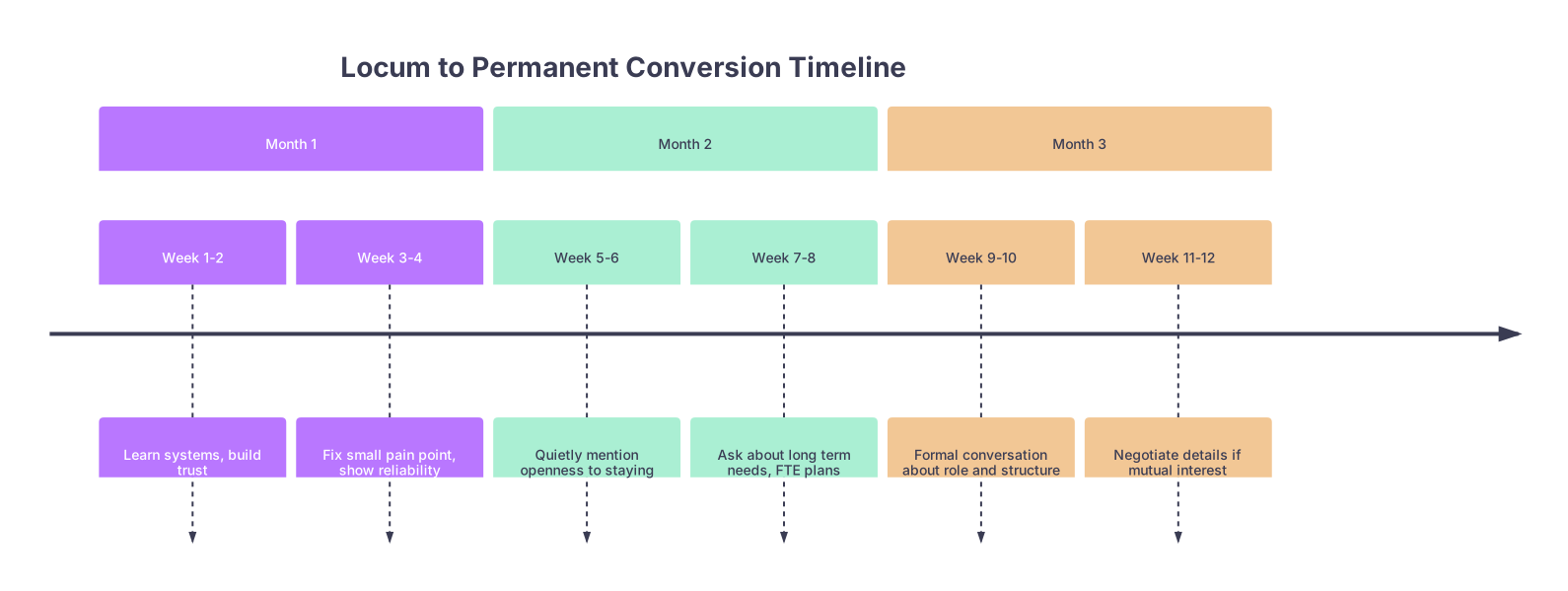
| Period | Event |
|---|---|
| Month 1 - Week 1-2 | Learn systems, build trust |
| Month 1 - Week 3-4 | Fix small pain point, show reliability |
| Month 2 - Week 5-6 | Quietly mention openness to staying |
| Month 2 - Week 7-8 | Ask about long term needs, FTE plans |
| Month 3 - Week 9-10 | Formal conversation about role and structure |
| Month 3 - Week 11-12 | Negotiate details if mutual interest |
Reality: For longer contracts (6–12 months), push this pattern out, but keep the sequence. Establish value before asking for commitment.
How to have the “I’m interested” conversation like an adult
You want something like this with the service chief or medical director:
“I have really enjoyed working with this team. Clinically and culturally this feels like a strong fit. If you have or expect to have a permanent FTE here, I would very much like to be considered. What would that process look like?”
Then stop talking. Let them respond.
Possible answers and what they mean:
“We would love that. Let us talk to HR.”
Translation: Green light. You are in the game.“We do not have a budgeted slot right now, but we are trying to get one approved.”
Translation: Possible, but not guaranteed. Keep performing well, but do not stop exploring other options.“We only use locums for this service.”
Translation: Low probability. Assume this will not convert and treat it as such.
Step 6: Convert Locum Leverage into Contract Leverage
If they are interested in hiring you, you have leverage that a cold external applicant will not have:
- They already know you fit.
- You are already covering their shifts.
- Replacing you means re‑recruiting, retraining, and more locums fees.
Use that leverage intelligently. Not by making demands, but by being clear and specific.
Know what matters before you negotiate
Your priorities probably fall into four buckets:
- Schedule
- Compensation
- Support resources
- Scope of practice / autonomy
Rank them. Literally, on paper. Decide before you talk numbers which two you will fight hardest for.
| Priority | Example Focus |
|---|---|
| #1 | Predictable schedule with no more than 1:4 weekends |
| #2 | Compensation at or above 50th percentile MGMA |
| #3 | Protected admin or teaching time |
| #4 | Limited non-clinical call or remote call only |
If schedule is non‑negotiable for you, say so clearly and early:
“Long‑term, I can commit to one weekend a month and one major holiday per year. I cannot sustainably do more than that while maintaining the quality you have seen from me.”
Use your current performance as currency
You are not just “a candidate.” You are someone they have already seen do the job.
You can say, calmly:
- “Over the last three months, my average daily census and discharge volume has matched or exceeded the group median.”
- “I have had positive feedback from nursing leadership about communication and responsiveness.”
- “I am willing to continue to help with the high‑acuity cases and complex call schedules we have managed so far, within X boundaries.”
Then: tie that to your ask.
“Given this level of contribution, I am looking for a compensation package in the X–Y range with Z schedule and A support. How close can we get to that?”
That is a professional ask, not a demand.

| Category | Value |
|---|---|
| Gross Pay (per year equivalent) | 130 |
| Benefits Value | 40 |
| Stability | 90 |
(Think of “stability” here as a relative index: locum high pay, lower stability; permanent slightly lower pay, higher stability and benefits.)
Step 7: Handle Politics, Red Flags, and “Almost” Offers
Not every place that likes you is a place you should join. You will see things as a locum that a candidate on a choreographed interview day never sees.
Use that access.
Watch for these patterns
These are not “minor annoyances.” These are structural problems that often get worse, not better:
- Constant leadership churn (new CMO every 18 months).
- Open hostility between administration and medical staff.
- High turnover of nurses and APPs.
- Chronic understaffing that is treated as “the new normal.”
If you see two or more of those, slow down. A “good locum gig” (because you are temporary) can turn into a bad permanent job very fast.
Ask blunt questions:
- “How many people have left this group in the last two years?”
- “What are the biggest challenges keeping physicians here long term?”
If you get vague, PR‑style answers, interpret that accordingly.
If you get an offer that is almost good enough
You will often get an offer that is 80–90% there. One piece is off: salary, call, non‑compete, something.
Do not just say yes or no. Counter once, clearly, with your priorities:
“I appreciate the offer and I would like to make this work. The only barriers for me are the non‑compete radius and the holiday call expectations. If we can adjust those two items as follows, I am ready to sign.”
Be specific:
- Non‑compete: Narrow it to a shorter time period or smaller radius.
- Call: Cap the number of nights/weekends, or clarify remote vs in‑house.
- Salary: Aim for a reasonable bump, not a 30% jump.
If they will not move on anything meaningful, that tells you how they will treat you later.
Step 8: Protect Yourself During the Transition
You are not done when someone verbally says, “We would love you to stay.” That is the moment people make sloppy, expensive mistakes.
Coordinate end of locum and start of permanent carefully
Common pitfalls:
- You stop other job searches based on “strong interest” but no written offer.
- You assume your locums agency is fine with you converting, then discover a buy‑out clause no one mentioned.
- You line up housing and schools based on an unsigned contract.
Do this instead:
-
- Look for conversion / buy‑out clauses.
- Some agencies require the facility to pay a fee to hire you; you cannot control that, but you should know it exists.
Do not stop other interviews until you see a written offer
- Verbal enthusiasm is not a contract.
- Keep your options alive until you are holding real terms in writing.
Clarify credentialing and start date
- Confirm who pays for licensing, DEA changes, and any additional privileges.
- Get a realistic timeline from HR/medical staff office—these delays can stretch.
Make your last weeks as a locum your strongest
People have short memories. They will remember:
- How you handled your last complex cases.
- Whether you left clean or messy handoffs.
- Whether you mentally “checked out” once you knew you were staying (or leaving).
Even if you ultimately decline the permanent offer, your reputation as a professional who finishes strong will follow you to your next opportunity. This field is smaller than it looks.
A Quick Reality Check: Why This Strategy Works
Hospitals convert locums for one reason: risk reduction.
Permanent hires are risky. CVs can be polished. References can be handpicked. Interviews are theater.
Locums give organizations a live‑fire trial period. They see:
- Your clinical judgment under pressure.
- Your behavior when the shift goes sideways.
- Your interactions with difficult staff or demanding families.
If during that trial you:
- Show up like an owner, not a renter.
- Fix at least one operational problem.
- Build genuine goodwill with nursing and peers.
- Communicate your interest clearly but professionally.
…then converting you is the low‑risk, high‑reward move for them.
You are not begging for a job. You are offering to continue a working relationship that already proves itself daily.

Today’s Action Step
Do not wait until your assignment is half over to think about this.
If you are already in a locum role and you might want it to become permanent, do three things today:
- Ask one senior nurse or APP, “What is one thing I could do differently that would make your day easier?” Implement that change this week.
- Identify one small but recurring operational pain point and sketch a simple, realistic tweak you could pilot with the team.
- Email or message your service chief to set up a 15–20 minute check‑in within the next two weeks—frame it as wanting feedback and aligning with their goals.
If you are planning your next locum assignment, tell your recruiter on your next call: “I am specifically interested in assignments with realistic potential for permanent conversion. Show me only those, and I will show up like a long‑term colleague from day one.”
Then hold yourself to that.