
The usual “locum vs employed” advice is dangerously shallow. “Locums pays more, employed is stable” is not a decision framework. It is a slogan. And slogans are how physicians end up trapped in bad jobs or bouncing between contracts.
You need a system. A brutal, honest, numbers-and-reality-based way to pick your first job out of residency.
This is that system.
Step 1: Get Rid of the Myths First
There are a few half-truths that poison this decision. Clear them out now.
Myth 1: Locums is only for older docs or burnouts.
Wrong. I have seen fresh grads use 12–24 months of locums to:
- Crush six-figure loans faster than any “standard” job could
- Test 3 different practice settings before committing
- Negotiate 20–40% higher salaries later because they actually knew their worth
Myth 2: Employed = safe and stable.
Sometimes. But I have also seen:
- New hires “rightsized” when volume dropped
- RVU thresholds quietly raised after year one
- Clinics sold to private equity, followed by schedule bloat and benefit cuts
You can absolutely be fired from an employed job. You can absolutely be left high and dry by a locums agency. Pretend neither is sacred.
Myth 3: Your first job has to be “forever.”
No. Your first job needs to be survivable, financially rational, and aligned with how you want to practice for the next 2–3 years. Long term comes later.
Your real question is not “locum vs employed.”
Your real question is: “What do I need my first 2–3 years out to do for me?”
Step 2: Define Your Non‑Negotiables (Before Anyone Dangles Money)
If you start with pay, you are easy to manipulate. Start with reality.
Sit down and answer, in writing, these five:
Debt and cash goals (first 24 months)
- How much do you need to knock off loans?
- How much emergency fund do you want? (bare minimum: 3–6 months of expenses)
- Any big purchases coming? House, car, childcare?
Geography constraints
- Do you absolutely need to be in a specific city or region right now?
- Are you tied by partner’s job, kids’ school, visas, or family caregiving?
Lifestyle boundaries
- Max hours per week you are willing to tolerate for at least a year
- Max nights/calls per month
- Do you care about predictable schedule vs “I just want more days off”?
Career trajectory
- Academic vs community vs rural?
- Do you want teaching, research, or leadership opportunities in the near term?
- Are you planning a fellowship switch or subspecialization requiring a certain setting?
Burnout status coming out of residency
- Be blunt. If you are barely crawling across the finish line, a brutal RVU sweatshop may break you.
- If you still have gas in the tank and want a financial sprint, you might choose differently.
Once you have these, you can start matching them to the strengths of each path.
Step 3: Know What Locums Is Actually Good At (And Bad At)
Locum tenens is not “freedom and money” in the abstract. It does a few things extremely well, and a few things terribly.
Where Locums Tends to Win
- Raw earning potential, fast
High-demand specialties (EM, anesthesia, hospitalist, psych, some IM subspecialties) can easily see:
- $250–$350/hr in many markets
- Overtime or holiday multipliers
- Travel and housing covered

| Category | Value |
|---|---|
| Locum (in-demand) | 275 |
| Locum (average) | 210 |
| Employed (base+RVU) | 150 |
| Academic | 120 |
You are not taking home every dollar (taxes, travel gaps, unpaid time off), but your ceiling is higher in the short term.
- Control over volume and schedule
You choose:
- Which contracts you accept
- Whether you are willing to take nights/holidays for premium pay
- When you take weeks off without begging for vacation approval
- Test‑driving practice environments
You get a crash course in:
- Different EHRs
- Different staffing levels and support
- Rural vs urban vs suburban
- How different groups run their culture and politics
That experience makes you much harder to fool later.
- Negotiation leverage for future employed jobs
When you can honestly say, “I make $X per shift doing locums and work Y shifts per month,” it changes the dynamic at the bargaining table. You have a real BATNA (best alternative to a negotiated agreement), not an imaginary one.
Where Locums Is Weak
- Benefits and long‑term financial scaffolding
You usually get:
- No employer retirement match
- No paid CME (occasionally a stipend, but smaller)
- No paid parental leave
- You buy your own health, disability, life insurance
This can be fixed. But only if you plan for it. I will walk you through how.
- Predictability of income
Census drops. A new hire arrives. Admin reworks coverage. Suddenly your “guaranteed” shifts shrink.
Agencies will tell you it rarely happens. I have seen it happen multiple times in a single year to the same physician.
- Professional isolation
You are the outsider. People are polite, but you are not “their” doc.
If you thrive on:
- Long‑term patient relationships
- Being embedded in a team
- Formal mentorship and committees
You will feel the difference.
- Credentialing and admin grind
Every new site:
- New credentialing packet
- New privileging forms
- Different EHR, different workflows
Agencies help, but it is still a tax on your time and attention.
Step 4: What Employed Positions Actually Offer (And Take)
Again, strip the marketing. Focus on mechanics.
Where Employed Tends to Win
- Benefits and structure
Typical package:
- Health, dental, vision
- 401(k)/403(b) with match after year 1
- CME money and days
- Paid time off and sick days
- Parental leave
- Malpractice with tail (sometimes)
This matters a lot if you have a family, chronic health issues, or you want a boring, predictable base on which to build.
- Predictable baseline income
You often get:
- Salary or base+RVU floor for 1–3 years
- Guaranteed stipend while ramping up volume
- Some protection from short‑term census swings
Not always. Read the contract. But more than with locums.
- Future options: leadership, teaching, subspecialty
You are in the system:
- Department committees
- Medical staff offices
- Quality initiatives
- Medical student and resident teaching
- Research infrastructure in academic settings
If you want to be chief, PD, or hold a hospital leadership role, this path is simpler.
- Geographic and social stability
You can actually:
- Buy a house and know you will still be there in 3–5 years
- Put kids in schools without annual moves
- Build community, outside of medicine too
Where Employed Jobs Hurt
- Loss of control over workload
I have seen this exact sequence too many times:
- Year 1: “We value work‑life balance.”
- Year 2: “Volumes are up, we need everyone to pitch in.”
- Year 3: “We are adjusting RVU thresholds to align with national benchmarks.”
You have limited leverage if they own your schedule and your referral base.
- Pay compression
New grads and 10‑year veterans sitting in the same salary band. RVU bonuses that look good on paper but are unreachable without burning out.
You will often earn less per unit of work than locums. Sometimes a lot less.
- Limited negotiating power after signing
Once you sign, you are:
- Tied to non‑competes
- Tied to call schedules
- Tied to productivity formulas you cannot change
Exiting can cost you tail coverage, relocation clawbacks, even repayment of sign‑on bonuses.
Step 5: A Simple Framework – The 4 Quadrants
Stop thinking “locums or employed.” Think: Which quadrant am I in?

Two axes:
- Axis 1: Need for maximum income in first 2–3 years (debt, family obligations)
- Axis 2: Need for stability and benefits (health, kids, partner, risk tolerance)
Now the quadrants:
High income need + Low stability need → “Locum Sprint”
- You are single, or have a very flexible partner
- You can tolerate travel and less predictability
- You want loans crushed fast and max savings
Strategy: 12–24 months of heavy locums, then reassess.
High income need + High stability need → “Hybrid or Hard‑Bargained Employed”
- Family, kids, or medical issues
- You still need strong income
Strategy:
- Either: full‑time employed with aggressive negotiation for call pay, RVU bonuses, and extra shifts.
- Or: 0.6–0.8 FTE employed anchor + extra locums shifts a few times a year.
Low income need + High stability need → “Employed Anchor”
- You care most about benefits, location, and predictable days
- You are okay accepting less pay for that
Strategy: traditional employed role, but still negotiated hard (especially on schedule and non‑compete).
Low income need + Low stability need → “Flexible Locum or Part‑Time”
- No debt or minimal
- Strong desire for autonomy and travel
- Willing to self‑build benefits
Strategy: mostly locums, possibly long‑term contracts in desirable locations, maybe 0.5 FTE employed somewhere you like.
This matrix alone clarifies 70% of decisions.
Step 6: Run the Numbers – A 24‑Month Reality Check
Now you match the sentiment to the math. Put two concrete options side by side.
| Item | Heavy Locums Path | Employed Hospitalist Path |
|---|---|---|
| Shifts / month | 15 (12-hr) | 15 (12-hr) |
| Effective rate | $220/hr | $150/hr (salary+bonus estimate) |
| Gross annual | ~$475,000 | ~$325,000 |
| Employer benefits | $0 match | ~$20,000 match + benefits value |
| Time off | Unpaid but flexible | 4–6 weeks PTO |
| 24‑mo loan payoff potential | High (200–300K) | Moderate (80–150K) |
| Schedule control | High (negotiated per contract) | Moderate (subject to group/hospital) |
Then:
Subtract realistic taxes (locums as 1099, employed as W‑2).
Add cost of self‑funded benefits for locums path:
- Health insurance (family: $10–20K/yr)
- Disability insurance (~2–4K/yr)
- Term life (~500–1000/yr for basic coverage)
- Malpractice if not fully covered (varies widely)
Add travel and credentialing “friction” for locums (some uncovered time, flights home, etc.).
For employed, factor realisitic bonus attainment (not the fantasy number HR quotes).
Now calculate 24‑month net savings (after living expenses) for each path. If you do this honestly, the decision often stops being vague.
Step 7: How to Make Locums Actually Work (If You Choose It)
If you lean toward locums, you must treat yourself like a small business, not a highly paid intern.
1. Build a 6–12 Week Runway Before Going All In
Do not finish residency Friday and fly out Sunday with $500 in your checking account.
You want:
- Enough cash to handle a 6–8 week delay in your first paycheck
- Some cushion if credentialing or state licenses are slower than promised
2. Work With 2–3 Agencies, Not 1
You are not “loyal” to an agency. You are loyal to your own interests.
- Register with 2–3 reputable firms
- Be clear that you will not sign exclusivity clauses
- Compare the same hospital’s offers if they are using multiple vendors
If one agency bad‑mouths the others or pushes you to sign quickly “before it is gone,” that is a red flag.
3. Standard Contract Checklist
Every locums contract you sign must be checked for:
- Guaranteed minimum shifts or hours per month
- Cancellation terms (how much notice they owe you, and what they pay if they cancel late)
- Malpractice coverage details (claims‑made vs occurrence, tail responsibility)
- Housing and travel caps (anything you might get stuck paying out of pocket)
- Schedule expectations (nights, weekends, holidays, census expectations)
If they avoid putting guarantees in writing, assume those guarantees do not exist.
4. Self‑Fund the Missing Benefits from Day One
- Open a solo 401(k) or SEP‑IRA as a 1099 contractor
- Set automatic transfers: at least 20–30% of each paycheck into:
- Tax savings account
- Retirement
- Emergency fund
This is non‑negotiable. If you spend like an attending without planning like a business, you will be the broke high earner everyone whispers about.
5. Protect Your License and Reputation Ruthlessly
You do not let a desperate ED director or understaffed ICU push you into unsafe practice:
- Always know backup coverage and escalation paths
- Walk away from persistently unsafe sites; no single contract is worth your license
- Document everything when you are asked to stretch outside comfort or staffing norms
A locums physician with a solid reputation and clean record is in demand. A physician with board actions is radioactive.
Step 8: How to Make an Employed Job Not Suck (If You Choose It)
You can make an employed job tolerable, even excellent, if you are disciplined up front.
1. Value Deal‑Breakers Over Dollars
Ignore “$20K more per year” if it comes with:
- No cap on call frequency
- Brutal non‑compete that locks you out of an entire metro area
- Vague RVU targets that only the senior partner hits
Your key contract clauses:
- Clear schedule and call expectations in writing
- Non‑compete radius and duration that you can live with
- RVU or productivity formulas that you fully understand, with examples
- Tail coverage responsibility spelled out
2. Demand to See Real Data
During interviews, ask for:
- Average patient volume per day per physician
- Current staffing and open positions
- Historical turnover in the group
- How many new hires in the last 3–5 years and how many left
If they dodge, change the subject, or say, “We do not really track that,” assume the numbers are bad.
3. Negotiate More Than Money
Often you cannot move base salary much as a new grad. Fine. Move things that matter:
- Fewer clinic sessions with the same salary for year one
- Protected admin or academic time
- Early eligibility for bonuses
- Moving stipend, sign‑on bonus forgiveness schedule
- Clear path to part‑time or flexible schedule later
You trade leverage now for quality of life later.
Step 9: Hybrid Strategy – The Underused Power Move
You do not have to marry one model forever. A lot of smart new physicians do some version of this:
Option A: Locum Sprint → Employed Anchor
Year 1–2:
- Heavy locums, aggressive saving and loan payoff
- See different practice styles and locations
- Build real negotiation leverage
Year 3+:
- Choose an employed job with eyes wide open
- Bring your locums numbers to salary talks
- Use your savings cushion as real walk‑away power
Option B: Employed Anchor + Occasional Locums
- 0.6–0.8 FTE employed for stability and benefits
- A few locums weeks per year in high‑pay settings to:
- Boost savings
- Fund extra loan payments
- Keep your options open
This works well for hospitalists, EM, anesthesia, and some surgical subs who can do discrete blocks.
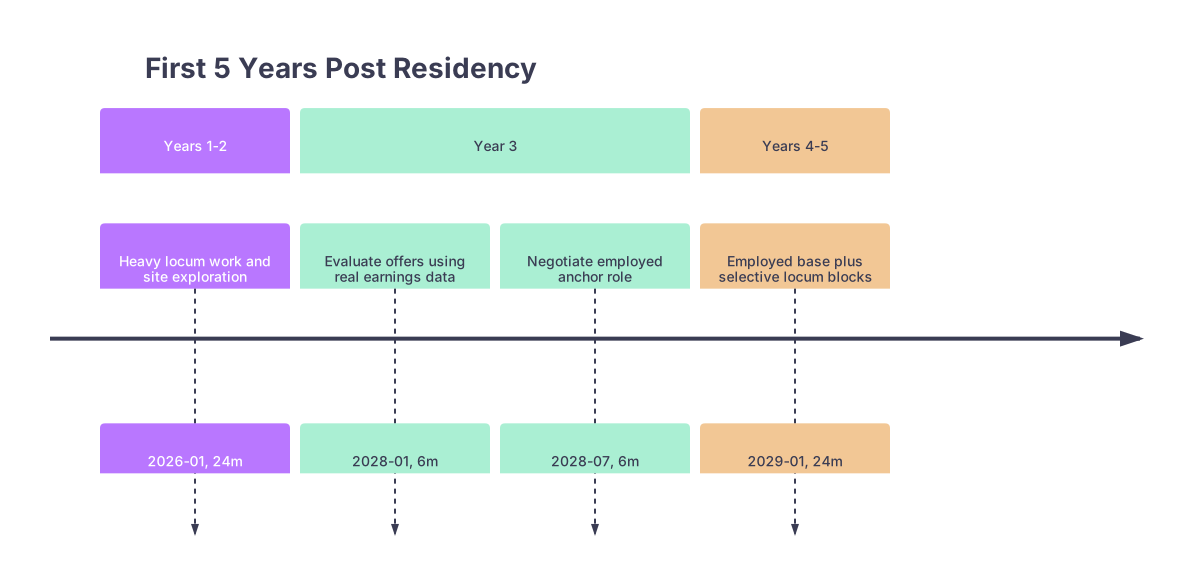
| Period | Event |
|---|---|
| Years 1-2 - Heavy locum work and site exploration | 2026-01, 24m |
| Year 3 - Evaluate offers using real earnings data | 2028-01, 6m |
| Year 3 - Negotiate employed anchor role | 2028-07, 6m |
| Years 4-5 - Employed base plus selective locum blocks | 2029-01, 24m |
Step 10: A Concrete Decision Protocol You Can Use This Week
Here is the “do this, then this” version.

| Step | Description |
|---|---|
| Step 1 | Finish Residency |
| Step 2 | Define 24 month goals |
| Step 3 | Assess income need |
| Step 4 | Assess stability need |
| Step 5 | Consider locum sprint or hybrid |
| Step 6 | Consider employed anchor |
| Step 7 | Prioritize benefits and geography |
| Step 8 | More flexibility for locum heavy |
| Step 9 | Talk to 2-3 locum agencies |
| Step 10 | Interview 3-5 employers |
| Step 11 | Run 24 month financial comparison |
| Step 12 | Choose primary path plus backup |
| Step 13 | High income need |
| Step 14 | High stability need |
Step‑by‑step:
Write your 24‑month financial and life goals. In plain language.
Place yourself in the 4‑quadrant matrix. Be honest.
Collect 2–3 real offers in each category (locums contracts and employed contracts).
Model 24‑month net savings and lifestyle for each path. Not theoretical. Using actual contract numbers.
Choose a primary path AND a backup plan. For example:
- Primary: 18 months of locums
- Backup: If locums volume dries up, shift to an employed job in City X
Reassess at 12–18 months.
- Are you on track with debt and savings?
- Is burnout worse or better?
- Do you still like the work environment?
That is it. Not sexy. But it works.
Quick Reality Checks Before You Decide
Ask yourself these without sugar‑coating:
- If my first locums contract vanished next month, how long could I pay my bills?
- If my first employed job turns toxic, can I leave without being financially cornered?
- Do I actually know what a “good” offer is in my specialty, or am I just flattered anyone wants me?
- Am I choosing this path for me, or because a co‑resident, mentor, or recruiter said it was “the way”?
You are not a victim of the job market unless you act like one.
FAQs
1. Is it a mistake to start with locums right out of residency?
No, but it is a mistake to start locums unprepared. Locums right out of residency works well if:
- Your clinical skills are solid and you are comfortable handling patients with limited backup
- You have a cash cushion for gaps and slow credentialing
- You are disciplined about saving and not inflating your lifestyle too fast
If you still feel shaky clinically or you rely heavily on your residency program’s infrastructure, a structured employed job for 1–2 years may be safer while you build confidence. The “mistake” is not locums itself. It is using locums as an escape hatch without a plan.
2. How long should I stay in my first employed job before leaving?
Ignore the guilt trips about “loyalty.” Stay as long as:
- The job is compatible with your physical and mental health
- You are being paid fairly relative to your value and workload
- You are still learning or gaining something (skills, connections, credentials)
If a job is clearly toxic or exploitative, leaving after 12–18 months is reasonable. Just do it professionally:
- Give appropriate notice (often 60–90 days per contract)
- Avoid burning bridges unless there is serious misconduct
- Have your next step (locums or another employed role) lined up before you resign
Your obligation is to your patients and your own life, not to a system that would replace you in a month if it suited them.
Key points to remember:
- Do not let slogans (“locums = freedom”, “employed = stability”) make your decision; use a 24‑month, numbers‑based framework tied to your real life.
- Both paths can be excellent or miserable, depending on how you structure contracts, protect yourself, and enforce your own non‑negotiables.
- You are allowed to use hybrid strategies—locum sprint, then anchor; employed base, plus periodic locums—to get exactly what you need from your early attending years.