
The way most physicians “evaluate” locum offers is wrong. They skim the rate, glance at the location, and decide in under five minutes. Then they discover the trap doors: unpaid travel days, hidden call, impossible productivity expectations.
You need a system. A 30‑minute, repeatable checklist that lets you shred bad offers fast and flag good ones for deeper review.
This is that system.
The 30‑Minute Locum Offer Playbook (Overview)
Here is how you are going to use your half hour:
- Minute 0–3 – Snapshot: Extract the non‑negotiable basics.
- Minute 4–10 – Money Reality Check: Convert the shiny “$X/hour” into a real effective rate.
- Minute 11–17 – Workload & Safety: Decide if you can practice safe medicine under these terms.
- Minute 18–24 – Logistics & Lifestyle: Decide if this fits your actual life, not fantasy‑you.
- Minute 25–30 – Deal‑Breaker Audit & Next Steps: Use a hard “no” list and a short script for recruiter follow‑up.
You will not fully negotiate a contract in 30 minutes. You will decide whether it deserves more of your time.
Step 1: Pull Out the Essentials in 3 Minutes
Do not read every word. You are hunting for eight key data points.
Create a quick one‑page “locums intake” template and fill it in as you read the offer or recruiter email. Something like this:
- Facility:
- Location (city, state, rural/urban):
- Dates:
- Shift type and hours:
- Compensation (hourly/daily; overtime rules):
- Call requirements:
- Travel/housing details:
- Malpractice (claims‑made vs occurrence; tail):
If the offer or recruiter cannot answer any of these in writing, you already have a yellow flag.
The Minimum Intel You Need
You are looking for:
Setting
- Hospital vs clinic vs ED vs urgent care.
- Academic vs community.
- Trauma level (for ED), bed size (for hospital‑based specialties).
Schedule Basics
- Exact shift times (e.g., 7a–7p, 8a–5p, 24‑hour in‑house call).
- Days per week.
- Is call in‑house or from home, and how often.
Compensation Skeleton
- Rate type: hourly, daily, per shift, per wRVU.
- Overtime trigger: after 8/10/12 hours? After 40 hours per week? Never?
- Pay cycle: weekly, biweekly, net‑30?
Coverage
- Malpractice carrier and policy type.
- Are you covered for all sites/services you are expected to perform?
Do this quickly. You are just populating your snapshot so you have something concrete to analyze in the next steps.
Step 2: Destroy the Illusion Rate (Money Check: Minutes 4–10)
Locums companies sell you the “headline rate.” Your job is to convert that into effective hourly compensation. Then compare it to your threshold.
Use this structure:
- Start Rate: The advertised hourly/day rate.
- Add/Remove Time: Include call, meetings, travel days that are effectively work.
- Subtract Costs: Unpaid time, travel gaps, housing hassles, uncovered expenses.
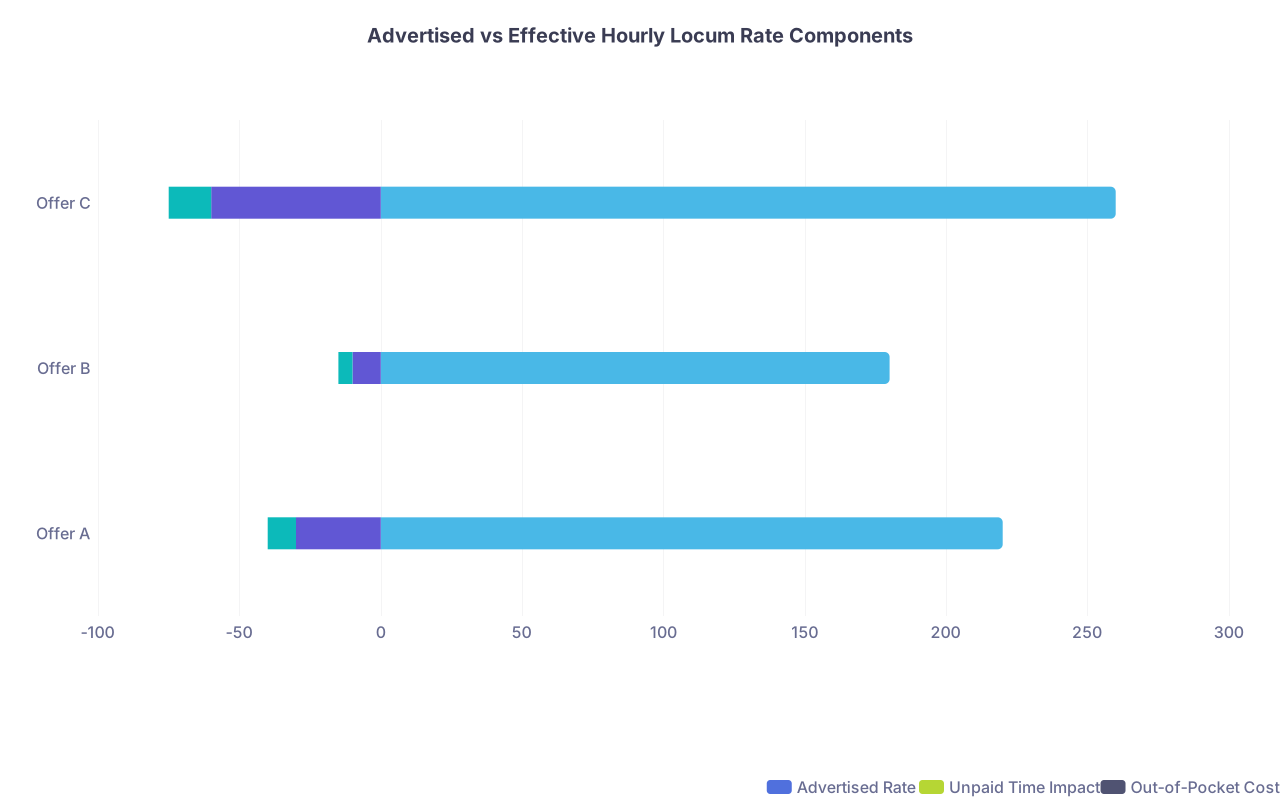
| Category | Advertised Rate | Unpaid Time Impact | Out-of-Pocket Costs |
|---|---|---|---|
| Offer A | 220 | -30 | -10 |
| Offer B | 180 | -10 | -5 |
| Offer C | 260 | -60 | -15 |
Quick Effective Rate Calculation
Use this back‑of‑the‑envelope formula:
Effective hourly rate = (Total pay for assignment – your out‑of‑pocket costs) / total hours you are truly committed
Total hours includes:
- Clinical hours.
- In‑house call.
- Expected late stays (if “until work is done”).
- Paid but mandatory orientation.
- Days you must be on‑site but not fully paid.
Example 1: Hospitalist
Offer email says:
- $200/hour
- 7a–7p
- Average 7 on / 7 off
- One hour unpaid “handoff” most days
- No overtime after 12 hours “unless pre‑approved”
Reality:
- Many hospitalist gigs routinely run 13 hours.
- If the contract says 7a–7p but culture is 7a–8p, you are working 13 hours for 12 hours pay.
Approximate effective rate:
- Paid: 12 hours × $200 = $2400
- Actual: ~13 hours
- Effective hourly: $2400 / 13 = ~$185/hour before any travel, lodging annoyances.
Now stack this against similar hospitalist locums rates. If that $200/hr is in a low‑cost midwestern town, maybe acceptable. If it is in coastal California with expensive flights and a brutal commute, no.
Example 2: “High Rate” With Punishing Call
- $240/hour, 10‑hour OR shifts, plus Q2 home call most weeks.
- Home call pays a flat $250/night, 10‑mile radius, must respond in 20 minutes.
If call is light, maybe fine. But if you get called in 3–4 times a night, you will be sleep‑deprived and your effective per‑hour rate tanks.
The point: you should be able to say by minute 10:
- “This is > $X/hour effective for me” or
- “This does not clear my minimum.”
Set your personal walk‑away effective rate. Maybe:
- New grad hospitalist: $190–220/hr minimum.
- ED: $250–300/hr minimum depending on acuity.
- Anesthesia: $250–350/hr with call paid separately.
The actual numbers will vary by specialty and region. The discipline is what matters: convert to effective rate, compare to your floor, and do not pretend a $260 card trick is “great” if the structure guts it.
Step 3: Workload, Safety, and Scope (Minutes 11–17)
Money without safe conditions is not a win. You do not want your name tied to a dumpster‑fire chart that ends up in a lawsuit because you were covering 35 patients alone.
Here is the seven‑minute clinical sanity check.
A. Patient Volume and Acuity
You want clear answers to:
- How many patients per shift is expected, not just “average”?
- What is the documented cap? (For hospitalists, you want a hard cap in writing.)
- ED: annual volume and acuity mix (trauma, STEMI center, stroke center).
- Clinic: patients per day, new vs follow‑up, procedures expected.
| Specialty | Green Zone Example | Red Zone Example |
|---|---|---|
| Hospitalist | 14–18 pts, cap at 18 | 24+ pts, no cap, frequent cross-cover |
| EM | 1.8–2.2 pts/hr, scribe support | 2.8+ pts/hr, no scribe, high acuity |
| Outpt IM | 14–18 pts/day, 30‑min new | 24–28 pts/day, 15‑min everything |
If the recruiter gives vague answers (“Docs usually see around 18–22”) and cannot give a cap, assume the worst.
B. Support and Staffing
You are asking:
- Are there NPs/PA support? What is their scope and supervision expectation?
- Nursing ratios?
- Are there residents? Who admits at night?
- Is there in‑house anesthesia, surgery, OB, etc. if relevant?
For example: inpatient pediatrics locums with no PICU, limited subspecialty backup, and you covering the newborn nursery plus ED calls alone at night? That is a giant red flag unless the volume is tiny and clearly defined.
C. Scope Creep Traps
You want scope in writing. Typical traps I have seen:
- Hospitalist ad says “no procedures,” but culture expects you to do central lines and paracenteses when IR is “unavailable.”
- ED contract says “adults only” and then you get a barrage of peds because “our pediatrician retired.”
- Outpatient IM gig quietly expects you to cover inpatient call “occasionally.”
Ask for a summary in writing:
“Please confirm: my responsibilities are [X, Y, Z] and I am not expected to perform [list of procedures or services] unless mutually agreed.”
If the answer is fuzzy or they dodge, you already know the answer.
Step 4: Logistics, Lifestyle, and Hidden Time (Minutes 18–24)
This is where many residents and new attendings get blindsided. The offer looks good until you realize travel and orientation eat days that do not pay, or you will be flying across the country on your only day off.
A. Travel Structure
You need to know:
- Who books flights and when.
- Are travel days paid? (Most are not. That still matters.)
- How often you will have to travel: once per block, weekly, every single shift?
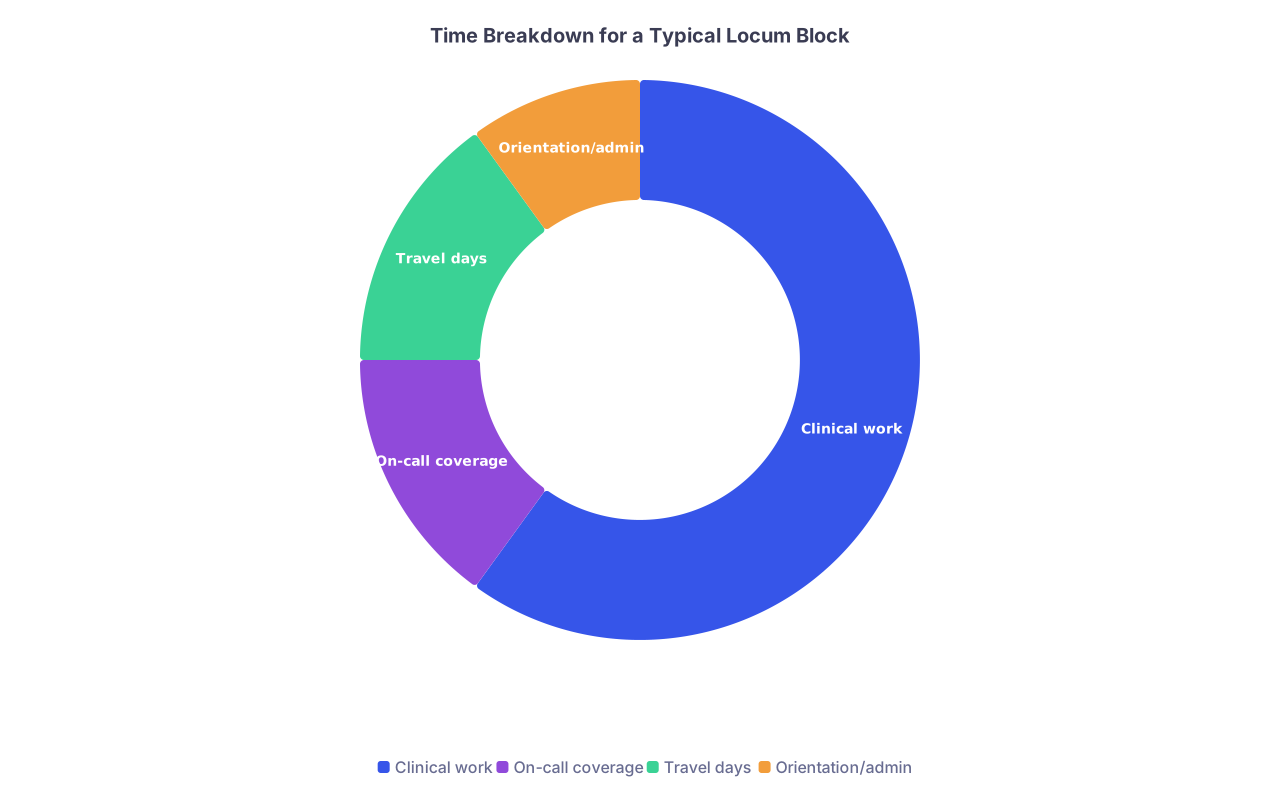
| Category | Value |
|---|---|
| Clinical work | 60 |
| On-call coverage | 15 |
| Travel days | 15 |
| Orientation/admin | 10 |
A “7 on / 7 off” that requires you to:
- Fly in the night before (unpaid).
- Fly out the morning after (unpaid).
- Lose half your first “off” day to travel stress.
…is actually more like 7.5 working days and 6.5 recovery days. That is different from driving 45 minutes to a nearby community hospital.
B. Housing
Ask plainly:
- Is housing provided, stipend, or you handle it?
- If provided, is it:
- Hotel (which brand, distance from hospital)?
- Apartment (shared vs private)?
- Is transportation included (rental car) or are you expected to use rideshare?
The difference between:
- A safe, quiet hotel 5 minutes from the hospital.
- A questionable motel 30 minutes away in a rough area.
…is massive at 3 a.m. after a brutal call night.
C. License and Credentialing Time
For a quick 30‑minute evaluation, you are asking a binary:
- Is this a state where you are already licensed or IMLC eligible?
- What is their typical credentialing timeline?
If the answer is “we usually get people through in 60–90 days” for a one‑week block three months from now, that is borderline. Long credentialing for tiny commitments is rarely worth it early on unless the rate or experience is exceptional.
Step 5: Deal‑Breaker Audit and Next Steps (Minutes 25–30)
Now you have most of the critical data. Time to apply a hard filter.
This is where you stop hand‑waving and start using rules.
A. Build Your Non‑Negotiable List
You need two short lists:
- Automatic No
- Needs Clarification / Negotiable
Examples.
Automatic No items (customize for you):
- No malpractice tail coverage on a claims‑made policy.
- No cap on patient volume for your specialty.
- Mandatory unpaid call with high expected volume.
- Required non‑compete that would lock you out of an entire region.
- Rates below your floor effective hourly rate.
Negotiable/Clarify items:
- Slightly lower rate but great location and reasonable volume.
- Longer shifts with strong support staff.
- Travel days unpaid but simple, direct flight and low stress.
If the offer hits any Automatic No item, you are done. You can politely decline and move on.
If it passes the hard filter, it moves into a “serious contender” bucket for deeper contract review (where you slow down and maybe loop in an attorney).
A Simple Flow You Can Reuse
This is the logic you will run on every offer.

| Step | Description |
|---|---|
| Step 1 | Receive Locum Offer |
| Step 2 | Fill Snapshot |
| Step 3 | Calculate Effective Rate |
| Step 4 | Reject Offer |
| Step 5 | Assess Workload and Safety |
| Step 6 | Review Logistics and Lifestyle |
| Step 7 | Apply Deal Breaker List |
| Step 8 | Shortlist for Detailed Review |
| Step 9 | Above Rate Floor |
| Step 10 | Safe and Reasonable Volume |
| Step 11 | Any Automatic No |
You can literally print this and keep it next to your laptop.
Practical Scripts and Questions to Use With Recruiters
You are not trying to be adversarial. You are trying to be efficient and get everything in writing.
Here are some short, effective lines:
For Volumes and Expectations
“Can you send me in writing the typical patient volume, and any hard caps you use for [hospitalists/ED/clinic]?”
“If there is no cap, what has been the highest census your locums see?”
For Scope Creep
“I want to make sure we are aligned. Are there any procedures or responsibilities that have informally become part of the role that are not listed in the job description?”
“Am I ever expected to cover other services, such as [ICU, nursery, ED backup]?”
For Coverage and Tail
“Please confirm the malpractice coverage is [claims‑made/occurrence] and whether tail coverage is included at the end of the assignment.”
If they say “you can buy your own tail,” that is basically a rate cut. Calculate that in.
For Non‑Competes
“Is there any non‑compete, non‑solicitation, or restriction on working directly with this facility in the future? If so, over what radius and for how long?”
If they try to downplay it (“We never enforce those”), ask for modification in writing or assume it is enforceable.
Comparing Multiple Offers Quickly
Once you use this system on a few offers, you can start putting them side by side.
| Factor | Offer 1 | Offer 2 | Offer 3 |
|---|---|---|---|
| Effective $/hr | |||
| Setting | |||
| Patient Volume | |||
| Call Requirements | |||
| Travel Complexity | |||
| Housing Quality | |||
| Tail Coverage |
Fill this out after your 30‑minute pass on each. You will see very quickly which ones are actually competitive.
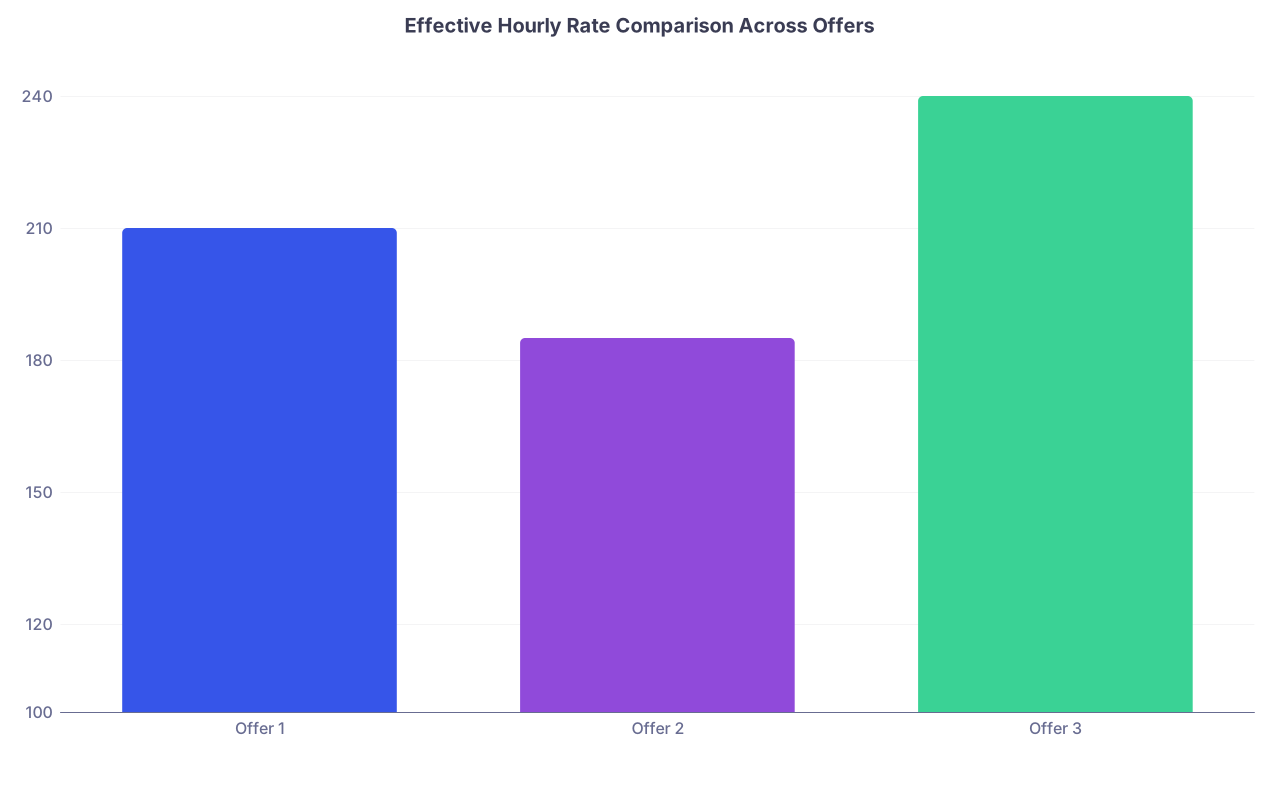
| Category | Value |
|---|---|
| Offer 1 | 210 |
| Offer 2 | 185 |
| Offer 3 | 240 |
It is not always about the highest rate. A slightly lower rate in a low‑stress setting with excellent support can be smarter for your sanity and long‑term career.
Red Flags You Should Treat as Stop Signs
You will encounter these often. Do not convince yourself they are fine “just this once.”
- Vague answers about volume, caps, or support despite repeated questioning.
- No clear plan for malpractice tail on a claims‑made policy.
- Pressure to sign quickly (“We need an answer today; we have three other docs interested”) before they provide details in writing.
- Non‑compete that is broad in geography and duration for a short locums assignment.
- Pay tied entirely to wRVUs without a strong base guarantee, especially in a struggling hospital or rural area.
- Orientation that is unpaid and expected to be extensive (multiple days) for a short assignment.
If two or more of those show up in a single offer, I would bin it. There will be other offers.
How to Turn a “Maybe” Into a Stronger Offer
Once an offer passes your 30‑minute screen, you can actually try to improve it before investing hours in credentialing.
Here is where being concise helps.
Focus on 2–3 key levers:
Rate
Schedule and Volume
- “I am comfortable with up to [X] patients/shift. Can we set that as a cap in the agreement?”
Call Compensation
- “If call is Q2 and there is a high chance of being called in, I would need [increased call stipend / separate pay for call‑backs] to move forward.”

You will be surprised how often agencies move on at least one of these if they know you are serious and not wasting time.
A Sample 30‑Minute Session, Minute by Minute
Let me lay out a realistic run‑through.
Minutes 0–3: Snapshot
- Skim recruiter email + attached summary.
- Fill in your template: location, dates, rate, shift, call, housing, malpractice.
Minutes 4–10: Money
- Estimate clinical hours, call, and travel days.
- Rough effective hourly rate. Compare to your floor.
- If it is far below floor, stop here.
Minutes 11–17: Clinical Reality
- Note stated volume, caps, acuity.
- Note staffing (NPs/PAs, residents, subspecialty backup).
- Ask yourself: “Can I practice safe medicine here without constant anxiety?”
Minutes 18–24: Logistics & Lifestyle
- Identify travel: how often, how long, paid/unpaid.
- Housing: quality, distance, safety.
- Credentialing/license: realistic timeline vs dates.
Minutes 25–30: Decision and Communication
- Apply your Automatic No list.
- Outcome:
- Reject immediately, or
- Shortlist and send 3–5 clarifying questions / negotiation points.
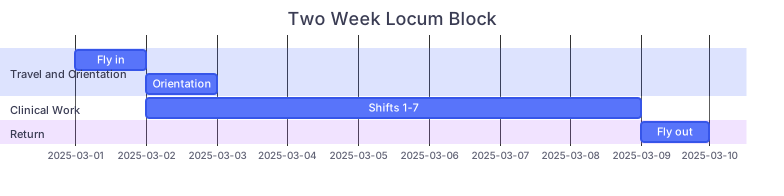
| Task | Details |
|---|---|
| Travel and Orientation: Fly in | a1, 2025-03-01, 1d |
| Travel and Orientation: Orientation | a2, 2025-03-02, 0.5d |
| Clinical Work: Shifts 1-7 | a3, 2025-03-02, 7d |
| Return: Fly out | a4, 2025-03-09, 1d |
This is how you prevent those “how did I end up here” moments halfway through a miserable assignment.
Post‑Residency Reality Check: Why This Matters More Than You Think
As a new attending, locums can look like a cheat code:
- High pay.
- No office politics.
- Flexible schedule.
All of that can be true. It can also be a shortcut to burnout if you let agencies and hospitals dictate the terms while you are starved for cash after residency.
I have watched brand‑new attendings take:
- A “$270/hour” ED gig that, after unpaid call and brutal volumes, functioned like $180/hour.
- A rural anesthesia job with “light call” that turned into being the only doc overnight for OB, trauma, and ICU vent management.
- A hospitalist role advertised as “stable census, great support” that routinely pushed them to 24+ patients and demanded cross‑cover for the ICU off‑hours.
Every single one of those would have been obvious on a 30‑minute review using the checklist you now have.
You are not powerless in this process. Agencies need you more than you need any one particular assignment.
Final Tight Summary
Three points to keep:
- Convert the offer into a real effective hourly rate including all hidden time and costs. If it does not clear your floor, walk away.
- Interrogate workload and safety: patient volume, caps, call, and support. If you cannot practice safe medicine, the rate is irrelevant.
- Use a hard deal‑breaker list and a 30‑minute structured review so you can rapidly discard bad offers and only invest energy in the few that deserve a deeper dive.
Run this playbook a few times and you will start spotting good locum opportunities in minutes—and avoiding the traps that burn out a lot of new attendings before they even get started.