
You are three hours into your first night as a hospitalist locum at a community hospital you have never seen before. The ED attending calls: “We are boarding eight admits. Can you just take cross-cover for ortho and neuro tonight too? Our usual guy called out.”
Your badge still says “Visitor.” You have no idea where the crash cart is. You have not met a single orthopedist. But you hear yourself say, “Sure, I can try.”
That is how locums go bad.
This is the gap nobody really trains you for: as a locum, you are the easiest person in the building to push. You are new. You are temporary. You do not know the politics, and everyone assumes you will “be flexible.” If you do not have a concrete playbook for boundaries, you will end up unsafe, burnt out, or both.
This is that playbook.
1. Understand the Game You Are Actually Playing
Before you can set boundaries, you need a blunt understanding of the power dynamics.
Locum work looks like this on paper:
- You are an independent contractor (or W2 through an agency)
- You fill temporary coverage gaps
- You are “valued” because they need you
In reality, on the ground:
- You do not control the schedule the way you think you do
- You are the easiest person to dump extra tasks on
- You are the least protected when something goes wrong
I have seen the same pattern across dozens of hospitals:
- The locum gets floated to the worst units
- The locum gets the heaviest patient load
- The locum gets asked to cover “just this one thing” outside scope
- The locum gets blamed quietly when systems fail
You are not paranoid. You are simply miscast if you think you are coming in as a “guest specialist.” You are coming in as a pressure valve.
So your boundary strategy has to be built for that reality. That means:
- Getting very specific in your contract
- Having pre-scripted “no” responses
- Knowing exactly when to escalate and to whom
- Being willing to walk away from unsafe assignments
No, this is not about being difficult. This is about being professionally intact in a system that will not protect you by default.
2. Lock in Non‑Negotiables Before You Ever Step On Site
If you wait until you are on the floor to define your limits, you are already behind. Your real leverage is before the first shift is scheduled, when they still need you.
2.1. Write Your Boundary List
You need a written list of non‑negotiables. Not in your head. On paper (or in a note on your phone).
Examples:
- Maximum number of patients per shift (by setting and acuity)
- Procedures you are comfortable performing solo
- Codes you will lead vs codes you will assist
- Types of consults you will accept
- Call responsibilities you will not take (e.g., unassigned surgical patients)
- Settings you will not work (e.g., solo ICU coverage in unfamiliar hospital)
Get specific. “Reasonable workload” is meaningless. “Max 14 patients on solo night hospitalist shift” is enforceable.
2.2. Bake It Into the Contract, Not the Email Thread
If a boundary matters, it belongs in the contract or credentialing forms, not just in a casual conversation with a recruiter.
At minimum, for clinical workload, your contracts should include language along these lines (adjust to your specialty):
- “Hospitalist will be responsible for care of no more than 16 inpatients per shift, excluding cross-coverage on overflow units.”
- “Locum physician will not provide solo ICU coverage or manage ventilated patients outside of step-down setting.”
- “Emergency department physician will not be responsible for boarding inpatient codes once patient has been assigned an inpatient team.”
Then, when someone says, “We always do it this way,” you are not just being “difficult.” You are referencing an agreed‑upon document.
| Boundary Type | Weak Wording | Strong Wording Example |
|---|---|---|
| Patient Load | Reasonable census | Maximum 14 adult inpatients per solo night shift |
| Procedures | As needed | No central lines, LPs, or intubations will be performed |
| ICU Coverage | May assist in ICU | No primary responsibility for ICU or ventilated patients |
| Call Duties | Call as assigned | No unassigned surgical or OB call |
| Extra Shifts | May pick up additional shifts | Additional shifts only by mutual written agreement |
If the hospital or agency refuses to specify anything concrete, that is data. They want flexibility. Flexibility usually means “no limits.”
3. The First 24 Hours: How You Set the Tone On Site
Your first day (or first night) determines what people think they can ask you to do. You cannot control everything, but you can script the first impressions.
3.1. Have a 10‑Minute Boundary Conversation with Someone Who Matters
As soon as you arrive and find the right person (medical director, lead APP, charge nurse), you need a short, clear conversation:
- “Can you walk me through standard patient volumes today?”
- “Who usually handles ICU or step-down patients?”
- “If a nurse or ED tries to add on additional services to my plate, who do I loop in?”
Then you state your own constraints calmly, without apology:
- “Just to be clear – I am not credentialed for central lines or intubations here. I will assist, but I am not the proceduralist.”
- “My understanding from the contract is that the typical night census is around 12–14. If there is a surge, I will need help mobilizing backup.”
This is not confrontational. It is expectation‑setting. If you skip it, people will improvise using you as the plug for every gap.

3.2. Clarify Two Critical Operational Details
You must know, by name and direct number:
Who is your immediate clinical backup?
- The person you call when you hit unsafe volume or acuity.
- The person who signs off if you refuse an unsafe assignment.
Who runs the schedule in real time?
- Scheduler, house supervisor, staffing office.
- The one who can say “no, we will divert” or “we are calling in backup.”
If you do not know these two people, your “boundaries” are theoretical. In practice, you will get cornered and agree to things because there is nobody else in the room to back you.
4. Saying No Clinically: Scripts You Can Use Tomorrow
You need pre‑built sentences. Under pressure, you will default to people‑pleasing if you do not.
Here is the rule:
Your “no” is clear, brief, and framed around patient safety and policy, not your feelings.
4.1. When They Try to Expand Your Scope
Scenario: ED asks you to accept unsupervised ICU admits even though you are hired as a floor hospitalist.
What you say:
- “I am not the ICU team. I can admit these patients to the floor once they are appropriate for that level of care. For now, they need ICU coverage. Who is the intensivist on call?”
If pushed:
- “I want to be very clear: I am not comfortable providing ICU‑level care without the standard ICU support. That would be below the standard of care and unsafe. We will need to involve the medical director or house supervisor to sort this out.”
No arguing about your skills. No detailed justification. Straight to standard of care and chain of command.
4.2. When They Load You Beyond Safe Volume
Scenario: You already have 16 patients on a solo night. ED calls with “just one more” and implies you are the only option.
Step 1: Name the limit
- “I am at 16 active inpatients currently, which is already at the upper safe limit for overnight coverage.”
Step 2: Redirect to system solution
- “For any additional admits, we need to either call in backup or discuss diversion with the house supervisor. Who is the house supervisor tonight?”
Step 3: Document
After the call, you send a brief message in the EMR or email (whatever is standard):
- “At 23:15, census at 16 inpatients on solo night coverage. Informed ED and house supervisor that further admits without additional coverage would be unsafe. Requested backup or diversion.”
That single note has saved more than one locum when hospitals later tried to claim “the doctor accepted the assignment.”

| Category | Value |
|---|---|
| Ideal | 12 |
| Common | 18 |
| Locum Reports | 20 |
4.3. When They Ask for Procedures Beyond Your Comfort or Credentialing
Scenario: Nurse: “Can you just place this central line? Our usual person is off.”
You:
- “I am not credentialed here for central lines and will not perform them. We need to call the on‑call proceduralist or transfer if that resource is not available.”
If they say “But we do not have anyone else”:
- “Then we have a systems problem, not a locum solution. I am happy to help with medical management while we arrange appropriate procedural care, but I am not the proceduralist tonight.”
4.4. When They Try to Assign You to an Entirely Different Role
Scenario: You are a locum psychiatrist brought for inpatient coverage. They ask you to start seeing ED psych consults for free “while you are here.”
You:
- “My assignment and contract are for inpatient unit coverage only. ED consults require dedicated time and resources and are not part of my current role. If the hospital wants to expand my coverage area, that needs to be negotiated through my agency with adjusted terms and schedule.”
Said calmly. No apology. Just a statement of scope.
5. Handling Schedule Abuse, Last‑Minute Changes, and Guilt Trips
Clinical boundaries are one thing. Schedule boundaries are where locums get bled dry.
You will see:
- “We already put you on for those extra two nights, can you just confirm?”
- “The permanent doc is out sick, there is literally no one else.”
- “If you do not help us this time, administration may not extend your contract.”
Here is how you protect yourself.
5.1. Have a Hard Cap on Shifts and Consecutive Days
Decide before each assignment:
- Max number of shifts per month
- Max consecutive days/nights
- Minimum time off between stretches
Example: “No more than 7 consecutive days. No more than 4 consecutive nights. Minimum 2 days off after a night block.”
When they ask for more:
- “I cannot safely add additional shifts that week without violating my duty hour and rest requirements. If coverage is needed, we will have to find another provider.”
Locums are not formally under ACGME duty hour rules. You should still use that safety standard for yourself.
5.2. Respond to Last‑Minute Add‑Ons With One Line
Recruiter texts you the day before: “Hospital wants to add two more nights, you available?”
You respond:
- “I am not available for additional shifts this block. Please keep my schedule as previously confirmed.”
No explanation. No “I would love to but.” You are not asking for permission. You are informing.
If they push:
- “To maintain safe practice, I do not exceed my pre‑agreed shift limits. We can discuss future blocks, but this one is set.”

| Step | Description |
|---|---|
| Step 1 | Request for More Work |
| Step 2 | Consider if You Want It |
| Step 3 | Say No - Unsafe or Against Policy |
| Step 4 | Negotiate Pay and Terms |
| Step 5 | Use Scripted No and Document |
| Step 6 | Within Pre set Limits |
| Step 7 | Worth It? |
5.3. Deal with Guilt and Threats Directly
Common line: “If you are not flexible, they might not renew your contract.”
Your mental response needs to be: Good. Unsafe environments should not be retained.
Your actual response, when someone says something like that:
- “My first obligation is to safe patient care and sustainable practice. If this assignment requires routinely exceeding those limits, it may not be a good long‑term fit. For now, I am holding to the agreed schedule and scope.”
Translation: I will not be blackmailed with renewal threats.
6. Documentation: Protecting Yourself When You Do Say No
Saying no is step one. Making it defensible is step two.
6.1. What to Document, and Where
You do not need a manifesto. You need a pattern of brief, factual notes.
Document when:
- You decline an unsafe patient load
- You refuse a procedure outside your scope
- You escalate a safety concern (e.g., no backup, no ICU coverage)
Where:
- In the EMR: short note in a non‑clinical, but visible communication area (e.g., “provider communication,” “handoff,” or similar)
- In email: to your recruiter and/or medical director after a major incident
Examples:
- “On 1/7/26, at 22:30, informed house supervisor that adding further admissions to current census of 18 would be unsafe for solo night coverage. Requested backup or diversion. Awaiting response.”
- “Declined to perform central line on patient X due to lack of credentialing for procedures at this facility. Requested on‑call proceduralist activation.”
This is not about being litigious. It is about showing that when systems failed, you raised the flag.
6.2. When to Escalate Formally
There are three escalation thresholds:
Unsafe recurring practices
- Example: routinely assigning you ICU‑level patients when that is not your role.
- Action: Email your agency and site medical director summarizing pattern and linking it to patient safety.
Retaliation for setting boundaries
- Example: punitive scheduling changes after you refuse unsafe work.
- Action: Document specifics, then call your recruiter’s manager. Make them choose between that hospital and their physician pipeline.
Near‑miss or actual harm due to refused boundary
- Example: You refused an unsafe admission; patient stayed in ED and had a bad outcome.
- Action: Write a short, factual incident report. You do not speculate; you simply record what you saw, what you said, and when.
When you are the only person documenting, you are the only person not being rewritten later.
7. Internal Work: Managing the Instinct to Say Yes
The biggest problem is not the hospital. It is your training.
You were trained to:
- “Be a team player”
- “Do what needs to be done for the patient”
- “Never leave your colleagues hanging”
Locum work breaks these scripts. You are not part of a cohesive, long‑term team. You often do not even know the other clinicians’ names. You are a resource. Nothing more, nothing less.
You have to actively retrain three habits.
7.1. Build a One‑Minute Pause Before Agreeing to Anything New
When someone asks for more — patients, shifts, procedures — your default response is:
- “Let me check something quickly and get back to you.”
Then you:
- Check your current load against your written limits
- Ask: “If this goes badly, would I be okay standing in front of a review board explaining why I agreed?”
- Only then answer.
That 60 seconds kills at least half of your reflexive yeses.
7.2. Separate “Patient Care” From “System Failure”
Hospitals will wrap system problems in moral language:
- “We have to do this for the patient.”
- “There is no one else, you are it.”
Your internal translation should be:
- “The hospital has not staffed appropriately. They are asking me to personally absorb that risk.”
You absolutely advocate for the patient. But you do it by:
- Refusing unsafe assignments
- Forcing activation of backup systems (on‑call coverage, diversion, transfers)
That is better patient care than pretending you can safely do three people’s work.

7.3. Give Yourself Permission to Walk Away
Some assignments are simply not fixable. The staffing is too thin. The culture is too toxic. The boundaries are not respected.
You need a hard rule:
- One serious safety violation with no corrective response = finish the block, do not re‑sign.
- Two serious violations with active pushback against your concerns = consider early exit if contract allows.
You are not obligated to be the hero who fixes their broken system. You are obligated to practice safely and ethically.
8. How to Evaluate New Sites Fast So You Need Fewer “No’s”
Once you have worked a handful of locum sites, you start to see red flags before you arrive. That is the real win: choosing environments where your boundaries are respected from the start.
8.1. Questions to Ask Before You Accept Any New Assignment
Ask your recruiter, and if possible, a clinician already on site:
- “What is the typical patient census for my role?”
- “What is the highest census in the last 3 months?”
- “Who covers ICU? Are locums ever expected to be default ICU coverage?”
- “What is the call structure? Any cross‑coverage expectations?”
- “Have locums left early? Why?”
If the answers are vague (“Depends,” “We all just pitch in”), that is a problem.
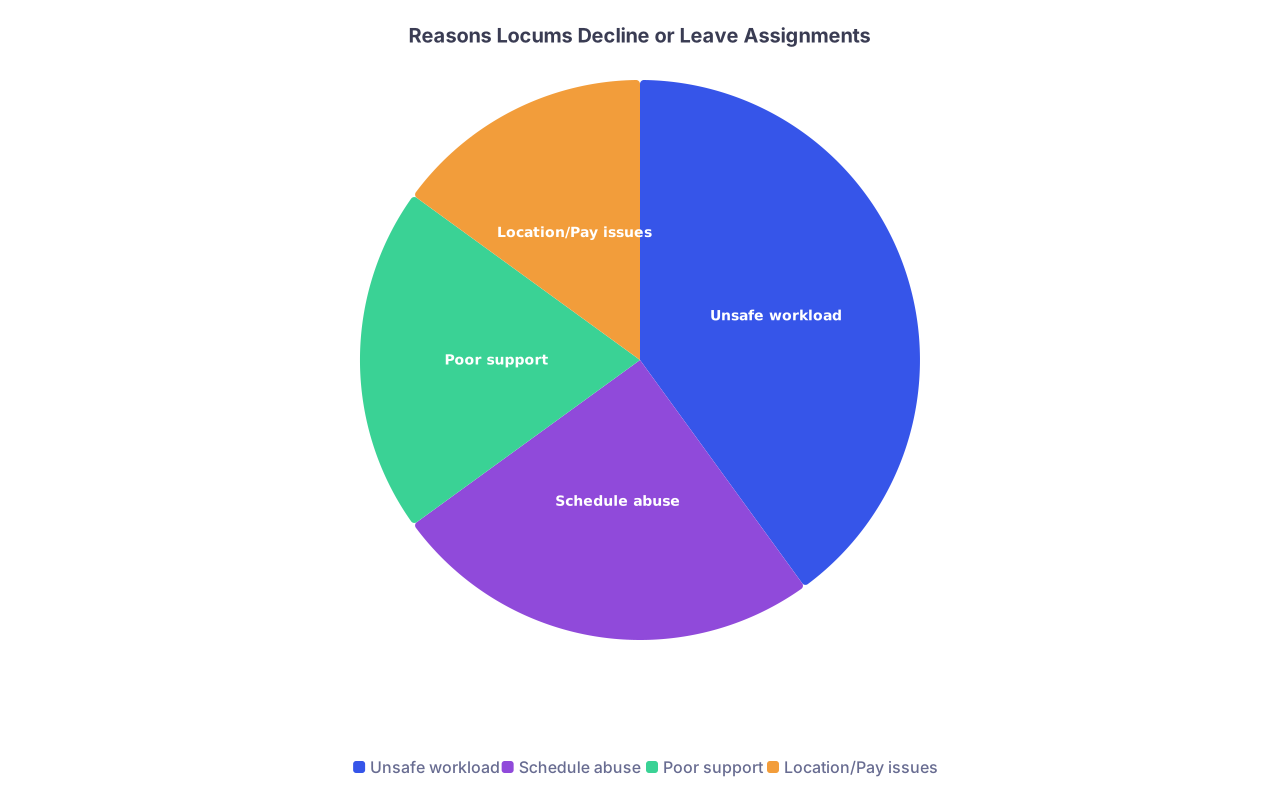
| Category | Value |
|---|---|
| Unsafe workload | 40 |
| Schedule abuse | 25 |
| Poor support | 20 |
| Location/Pay issues | 15 |
8.2. What You Can Learn in the First 2 Shifts
Once you are there, watch for:
- How many times does someone ask you to “just do one more thing” outside initial scope?
- Do nurses and staff seem accustomed to dumping on the locum, or do they treat you like any other attending?
- When you raise a small boundary (e.g., “I cannot safely take a 19th patient”), do they work with you or roll their eyes and push anyway?
Two bad shifts can be random. But if the pattern is “we solve problems by leaning harder on the locum,” you are seeing their operating system.

9. Long‑Term Strategy: Designing a Locum Career With Boundaries Built In
Boundaries are not just a set of phrases. They are a career architecture.
Over a couple of years, a well‑run locum life can look like:
- 2–4 trusted hospitals that know your limits and respect them
- Clear specialty scope (you are the ICU person, or the ED doc, or the psych inpatient doc — not “whatever we need”)
- Pre‑negotiated census limits that no one questions anymore
- Enough financial stability that you can walk away from bad fits
To get there:
Keep a running log of your best and worst assignments.
- Who respected boundaries? Who did not?
Stay loyal to sites that treat you like a colleague, not a disposable plug.
- Even if the pay is slightly lower, safety and sanity are worth more.
Use your agency strategically.
- Good agencies will quietly steer you away from the dangerous places.
- Bad agencies will keep trying to send you back into the same mess because it pays well.
Build a locum peer network.
- Other locums will tell you in one sentence what no brochure will: “That place will eat you alive,” or “They are busy but fair.”

Key Takeaways
Boundaries start before you arrive. Put your limits in writing, in the contract, with specific numbers and scope; vague “reasonable” language is how you get abused.
Your “no” needs a script. Keep responses short, calm, and framed around safety and policy, not your personal comfort, then document when you refuse unsafe work.
Your power is your ability to walk. Choose assignments carefully, leave bad ones, and build a stable set of sites and relationships where your boundaries are respected by default.