
The story you’ve been told about locums “ruining your record” or employed jobs “looking more stable” is oversimplified—and sometimes flat-out wrong.
What credentialing committees really notice is much more specific, much more pattern-based, and much less about the label “locums vs employed” than you think. I’ve sat in those rooms where your file is open, the committee is half‑caffeinated, and someone says, “Okay, what’s the story with this one?”
Let me walk you through what actually triggers scrutiny, what passes with a shrug, and how to play this game so your future hospital privileges and job options stay wide open—whether you go all‑in on locums, strictly employed, or bounce between the two.
How Credentialing Really Works (Not the Brochure Version)
Forget the polished HR explanation. Credentialing is part bureaucracy, part risk management, part politics.
In almost every hospital, the process looks roughly like this:
- Medical Staff Office (MSO) does the grunt work: verification, references, gaps, NPDB, OIG, state boards, DEA, etc.
- Your packet goes to a Credentials Committee (a small group of physicians plus MSO staff).
- Then to MEC (Medical Executive Committee).
- Then to the Board for rubber stamping.
The key step is that middle one: Credentials Committee. That’s where “locums vs employed” shows up as a pattern, not a headline.
Here’s what they’re really scanning for when they flip through your work history:
- Does this story make sense?
- Are there red flags that make us regret bringing this person in?
- If something goes wrong, can we defend our decision to grant privileges?
And this is where your locums or employed choices either look totally benign… or start raising eyebrows.
What Committees Actually Notice About Locums Work
Locums itself is not the problem. Unexplained chaos is.
I’ve been in multiple committees where the chair literally said, “Ah, locums person—okay, that’s fine. Any malpractice? Any board issues? No? Alright.” Five seconds.
But the pattern matters. Here’s what gets attention.
1. The “Too Many Jobs” Locums Pattern
If your CV reads like this:
- 2020: Locums – Hospital A
- 2020: Locums – Hospital B
- 2021: Locums – Hospital C
- 2021: Locums – Hospital D
- 2022: Locums – Hospital E
- 2022: Locums – Hospital F
And none of it is clearly explained as structured assignments, that’s when someone says, “Why are they bouncing so much?”
What they’re asking themselves:
- Is this someone who can’t keep a job?
- Are they difficult to work with?
- Is there a string of quiet non‑renewals behind this?
If the explanation is obvious—“Full‑time locums hospitalist doing short‑term regional contracts through X agency”—most sane committees move on. The problem is when you look like you’re fleeing places.
2. Unexplained Gaps Between Locums Assignments
Locums by nature has gaps. That’s fine. But six‑month voids without explanation? Committees hate that.
You know what makes it go smoothly? One line on your CV or application:
- “02/2022–08/2022: Sabbatical – cared for ill parent, no clinical practice”
- “03/2023–07/2023: Board study / relocation, no clinical work”
If you leave that blank and they have to drag the answer out of you with emails, they start to wonder what else you’re hiding.
3. Fragmented References
Here’s a dirty little secret: when you’re pure locums, reference fatigue is real—for you and for them.
Hospitals want:
- At least one recent department chair or medical director
- At least one colleague who’s actually seen you work clinically
- People who’ve known you more than two weeks
A Locums CV built on 13 short ER contracts, none longer than 8 shifts, makes that hard. When the MSO has to chase down three different ED directors just to get a sense of you, they start asking, “Why was nothing longer term?”
I’ve seen applications stall for months because a locums doc never thought ahead and didn’t cultivate two or three “anchor” references from longer assignments.
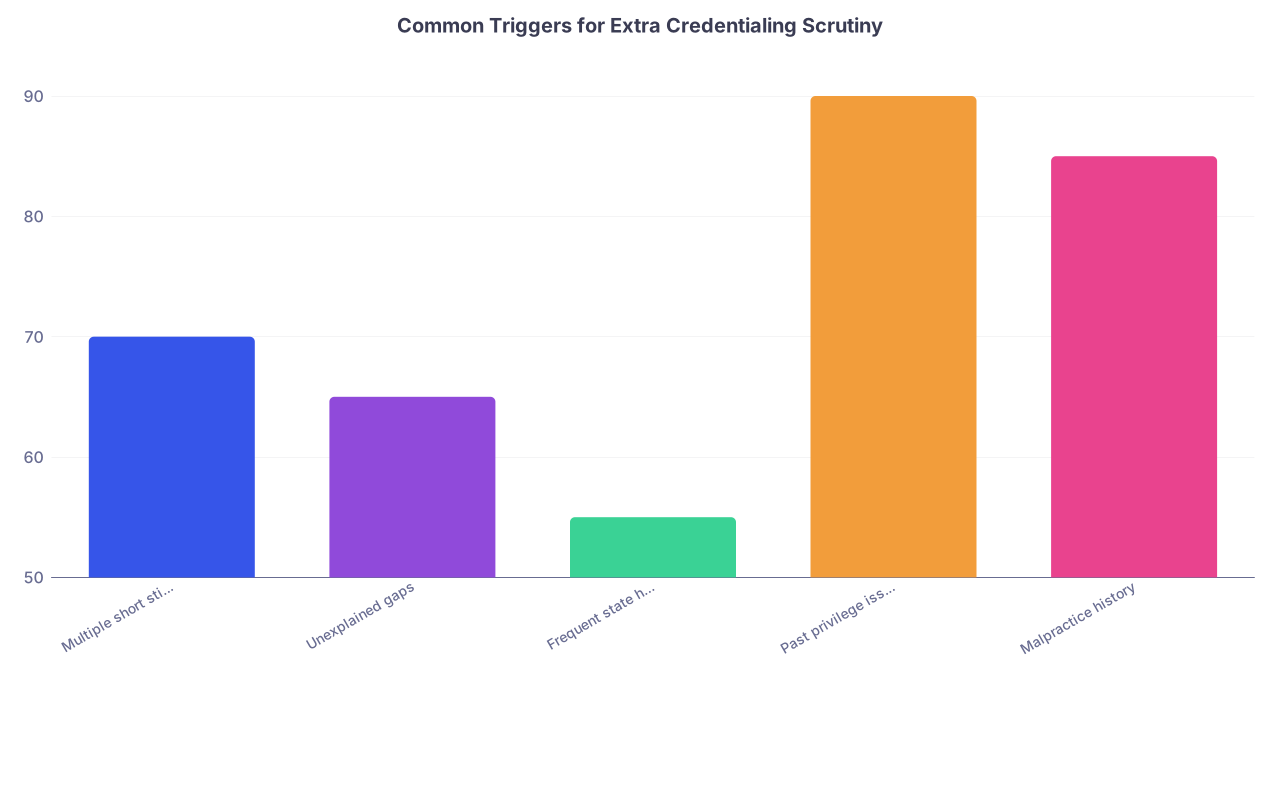
| Category | Value |
|---|---|
| Multiple short stints | 70 |
| Unexplained gaps | 65 |
| Frequent state hopping | 55 |
| Past privilege issues | 90 |
| Malpractice history | 85 |
4. State Hopping and License Volume
If you’re doing national locums and hold 8–10 licenses, that can look impressive… or messy.
What committees look for:
- Any pattern of board complaints or consent orders across states
- Licenses allowed to lapse shortly after an incident
- Suspicious timing: board action in State A, quick move to State B
They aren’t mad you have many licenses. They’re worried a past problem is buried in another jurisdiction and they’ll be blindsided.
5. Privileging History: Were You Ever Denied or Restricted?
Locums physicians are statistically more likely to get “quietly not renewed” than outright terminated. Hospitals like to avoid fights.
Credentialing committees know this, and they’re suspicious of any vague explanation like “contract ended” x 7 with no clear story. They will drill references with:
- “Would you reappoint this physician?”
- “Any concerns about clinical competence or professionalism?”
If even one medical director hedges, committees slow down hard. Not because you did locums. Because there’s smoke.
What Committees Notice About Employed Jobs
On the flip side, employed positions are not some magical stamp of safety. Employed patterns raise a different set of concerns.
1. Short Employed Stints Look Worse Than Short Locums Gigs
Here’s the insider truth: a six‑month employed job looks worse than a six‑month locums assignment.
Locums = assumed temporary.
Employed = assumed long‑term relationship.
So when a CV reads:
- 2020–2021: Employed – Community Hospital X
- 2021–2022: Employed – Hospital System Y
- 2022–2023: Employed – Group Practice Z
Every committee member thinks the same thing: “What keeps going wrong?”
Locums? You can reasonably say, “I chose to do assignment‑based work.” Employed carousel? Much harder to spin.
2. Termination vs “Resignation” Language
Behind closed doors, Credentialing and HR people use very particular phrases. If your previous HR or department chair ever documented “not eligible for rehire,” it will surface in references.
No committee cares whether your business card said “hospitalist employed” or “locums contractor” when:
- You were put on a performance improvement plan (PIP)
- Your contract was “mutually terminated” two years in
- You resigned “in lieu of termination”
Employed jobs create more documentation around those events. Committees know how to read between those lines.
3. Productivity and Behavioral Red Flags
Employed systems track everything: RVUs, late notes, patient complaints, peer reviews. When they’re asked for references, they sometimes overshare.
I’ve seen:
- Employed doc with one job in 6 years get more scrutiny than a locums doc with 10 clean contracts—because the employer buried issues in peer review but hinted heavily on the reference call.
- Another case: employed surgeon, left after “administrative disagreements.” Credentialing called the CMO; what they heard was, “Good technically, but multiple professionalism issues, chronic conflict with staff.” That application did not sail through.
The jacket “employed” doesn’t protect you from that. In some ways, it documents it more thoroughly.

| Step | Description |
|---|---|
| Step 1 | Physician Work History |
| Step 2 | Multiple short contracts |
| Step 3 | Employed positions |
| Step 4 | Low concern |
| Step 5 | Extra questions |
| Step 6 | Reference deep dive |
| Step 7 | Conditional approval |
| Step 8 | Delay or denial |
| Step 9 | Locums? |
| Step 10 | Pattern clear and explained |
| Step 11 | Short tenures or terminations |
| Step 12 | Serious red flags |
Locums vs Employed: What Actually Shows Up in Your File
Let’s be very concrete. This is the stuff that actually lands in front of committees and colors their thinking.
| Item | Locums Physician | Employed Physician |
|---|---|---|
| CV Pattern | Many hospitals, short intervals | Fewer sites, longer intervals |
| References | Multiple site directors needed | Fewer, deeper references from leadership |
| HR Records | Often minimal, agency as buffer | Detailed HR and performance documentation |
| Privilege History | Many initial grants, reappointments | Fewer but longer privilege periods |
| Red Flag Visibility | Scattered, may be subtle | Centralized, sometimes very obvious |
Committees don’t care that you “did locums.” They care:
- How clean the trail is
- How coherent the narrative looks
- Whether anyone, anywhere, seems relieved you left
That’s it.
How Locums Can Look Better on Paper Than Employed
Here’s the part no one tells residents: a well‑managed locums career can actually make your credentialing life easier down the road than two messy employed jobs.
But you have to be intentional.
1. Anchor Sites and “Home Bases”
Purely random, 3‑shift locums here and there will paint you as a drifter. But if you can show:
- 18–24 months of recurring shifts at one or two core hospitals
- Plus a few supplemental assignments
Then you look stable and flexible. Credentialing loves that. They can call one medical director who has known you for years and get a real picture.
If you’re doing locums full‑time, always cultivate at least:
- One anchor reference (department chief or medical director)
- One peer reference (colleague who works closely with you)
And keep those relationships warm even after leaving. Those people will carry you through multiple future applications.
2. Clean, Structured CV Formatting
Most locums docs submit CVs that look disastrous: random dates, no clarification of FTE vs per diem, vague labels.
You want your CV to scream, “This was deliberate.” For example:
- 07/2021–Present: Full‑time Locums Hospitalist, various sites via ABC Agency
- Primary site: Regional Med Center, Springfield, 7 on / 7 off (average 10 shifts/month)
- Secondary site: County Hospital, Capital City, 3–4 shifts/month
And then break out the hospital affiliations in the privileging section. When committees see the phrase “Full‑time locums,” a lot of their job‑hopping anxiety goes away.
3. Keep Your NPDB and Malpractice Story Boring
Universal truth: committees hate surprises from the NPDB.
If you’ve had a malpractice case, they don’t care that you were locums or employed. They care:
- Number of cases
- Severity (death vs nuisance claim)
- Pattern (same error type repeatedly?)
- Your explanation
Locums can protect you a bit here if you avoid toxic hospitals that are lawsuit factories. Employed work can offer more systemic defense. Either way, boring is your friend.
If you do have a reportable event, own it in your application with a brief, clear explanation. When they see that you’re straightforward and your explanation matches the NPDB report, they relax.
When Employed Work Is Clearly Safer (From a Credentialing Lens)
There are scenarios where an employed job really does look cleaner:
- You’re in a niche specialty with procedures and long‑term outcomes (oncology, transplant, complex surgery). Committees like seeing continuity, tumor boards, team‑based practice.
- You’ve had a rocky early career. Sometimes one stable, multi‑year employed job can “reset” perceptions.
- You’re in a highly scrutinized market (big academic centers, high‑litigation regions). They’re more conservative, period.
In those settings, a CV that reads:
- 2019–2024: Employed – University Hospital, Assistant Professor
- Clean references from division chief and chair
- No gaps, no privilege issues
…will get waved through faster than a chaotic locums‑heavy path.
But notice: that’s about stability and story, not simply “employed good, locums bad.”
The Stuff That Freaks Credentialing Out (Regardless of Locums vs Employed)
Here’s what really makes the room go quiet during a Credentials Committee meeting. None of this cares about your employment model.
Undisclosed prior privilege actions
They find out from NPDB or reference calls, not from you. Instant trust problem.Conflicting stories
You say “left for family reasons,” your former CMO says, “performance problems.” That mismatch is worse than the problem itself.Pattern of complaints
Not one cranky patient, but a string of issues around communication, behavior, or documentation.Big gaps with vague excuses
“Took time off.” For what? Boards? Family? Burnout? Rehab? They will speculate if you don’t clarify.Board or license issues across multiple states
One minor thing managed honestly is survivable. A breadcrumb trail of quiet “agreements” is not.
Locums vs employed is the wrapper. Committees are reading the contents.
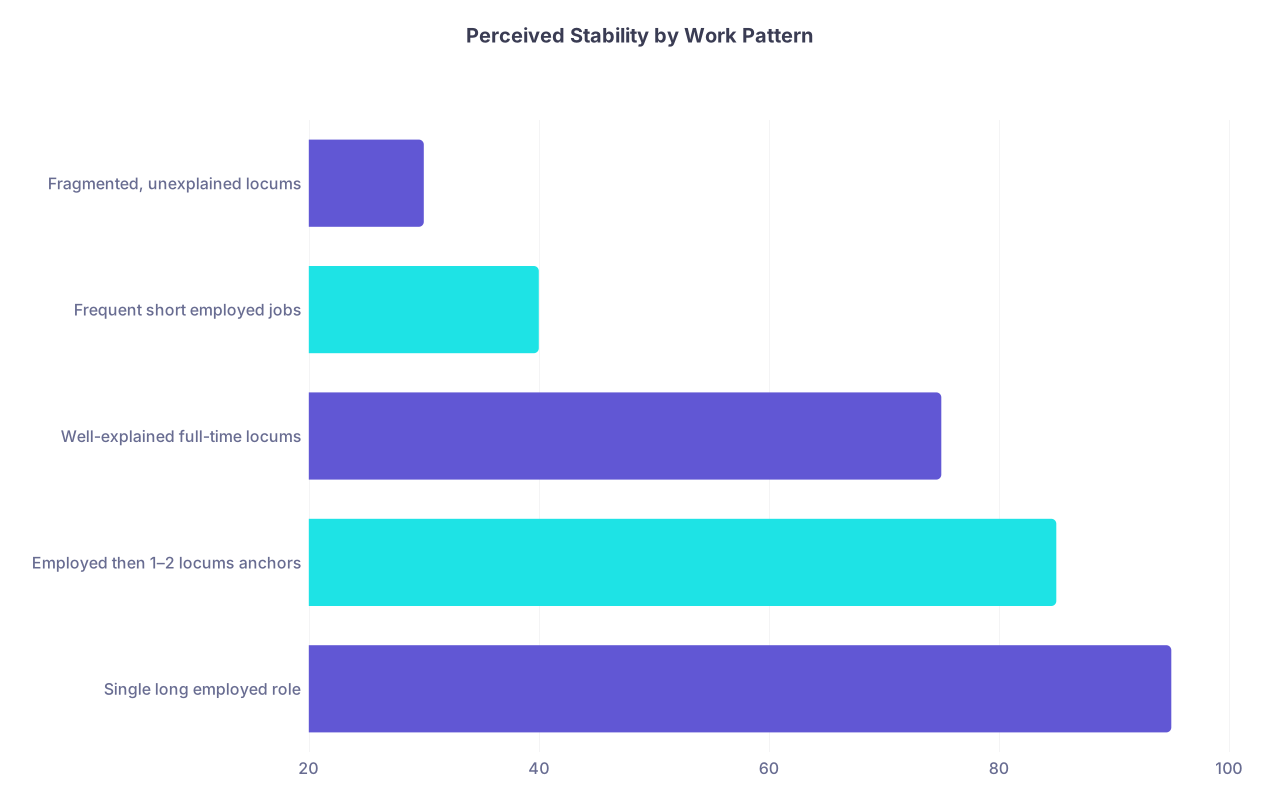
| Category | Value |
|---|---|
| Single long employed role | 95 |
| Employed then 1–2 locums anchors | 85 |
| Well-explained full-time locums | 75 |
| Frequent short employed jobs | 40 |
| Fragmented, unexplained locums | 30 |
How to Future‑Proof Your Credentialing Profile (Whatever You Choose)
Let me be blunt: you’re not planning for your next job. You’re planning for your reputation as it will look 5–10 years from now when someone you’ve never met is skimming your life in 7 minutes.
Here’s how to not shoot yourself in the foot.
If You’re Leaning Locums‑Heavy
- Decide upfront if you’re going to be “full‑time locums” vs “patchwork until I find a permanent job.” The former is easier to explain.
- Build depth at a few sites. Do not collect dozens of 3‑shift gigs just to sample everything. That looks unstable later.
- Tell your agencies you care about future references. Ask to be placed in environments with stable leadership and decent systems, not just highest‑pay chaos shops.
- Every time you leave a site, ask yourself: “Who here can be my department‑level reference?” Then keep that relationship.
If You’re Going Mainly Employed
- Avoid serial short contracts. If you’re unsure about a job, negotiate locums‑to‑perm or a trial period instead of burning another employed line on your CV.
- When leaving, negotiate clean separation language when possible. “Resigned in good standing” beats “not eligible for rehire.”
- Do not assume a toxic employed job “won’t follow you.” It will at least halfway follow you in references.
For Everyone
- Keep your own running log: exact dates, contacts, department chairs, medical directors, HR contacts. Four years later, you’ll never remember the name of that interim CMO from your third hospitalist job. Credentialing offices will ask.
- Keep your story consistent. Whatever you write in your application about why you left Job X, make sure it matches (or at least doesn’t contradict) what your references will say.
FAQs
1. Will doing locums right out of residency hurt me when I apply for a permanent job later?
Not inherently. What hurts you is looking directionless or unstable. If you do 1–3 years of clearly structured, full‑time locums with one or two anchor sites and solid references, most committees accept that as a deliberate career choice or exploration phase. Where you get burned is bouncing through a dozen random assignments, no anchor relationships, and no coherent explanation. Program directors and chairs I’ve worked with are much more comfortable saying “Yes” to a former locums doc whose pattern is tight and deliberate than to someone with multiple short employed jobs that ended awkwardly.
2. Do committees secretly prefer employed physicians over locums?
They prefer low‑risk physicians with clean stories. They assume employed usually means more stable, but that assumption vanishes the second they see short tenures, messy references, or prior actions. I’ve personally watched committees approve locums‑heavy candidates in minutes and get stuck for half an hour arguing over an employed doc with a vague “resigned during peer review process” note. If you manage your locums career intelligently, you’re not at a disadvantage.
3. How bad is it to have multiple state licenses if I’m doing national locums?
Multiple licenses are neutral until there’s a problem. Then they all get scrutinized. Committees will look for patterns: board reprimands, consent agreements, or complaints popping up in different states. If everything is clean, having 8 licenses doesn’t hurt you. But if you’ve had formal board issues, hopping states and collecting licenses looks like you’re running from your past, and that absolutely raises eyebrows.
4. What’s the single biggest mistake locums docs make that hurts credentialing later?
They fail to cultivate long‑term, senior references. They treat each assignment like a transaction, rotate through a dozen hospitals, and then discover they have no one who’s known their work for more than a month. Committees worry when they can’t find a stable witness to your practice. If you commit to locums, you must intentionally build those anchor relationships at one or two core sites. That, more than anything, is what convinces credentialing committees you’re a real clinician with a stable track record—not just a name moving through their system.
Key points: Committees don’t care about “locums vs employed” as a moral category. They care about patterns, red flags, and whether your story makes sense. If you keep your path coherent, your references strong, and your explanations honest, you can do locums, employed, or a mix—and still slide through credentialing with minimal drama.