
The harsh truth is this: whether you get invited back as a locum has very little to do with how smart you are, and almost everything to do with how easy you are to plug into a messy system.
I’ve watched this play out in real time. Same hospital. Same service. Two locum physicians. One gets an email from the scheduler every time there’s a hole: “Hey, can you come back? We loved having you.” The other never hears from them again. Clinically? Both solid. The difference was everything no one talks about in contracts or recruiter calls.
You want to be in the first group. The ones whose names get circled on the whiteboard in the staffing office with a note: “Call them first.”
Let’s walk through how that actually works behind the scenes.
How Sites Really Decide Who Gets Asked Back
There’s a fantasy that chief medical officers sit down, pull up your metrics, patient satisfaction, quality reports, and make a rational staffing decision.
That’s not what happens.
In reality, the decision is made by a messy combination of:
- The nurse manager who vents to the staffing coordinator.
- The lead scheduler who remembers who blew up her phone with constant texts.
- The medical director who hears one or two pointed complaints and mentally blacklists you.
- The hospitalist or partner who had to cover your patients post‑call and either said, “They were great,” or “Never again.”
Let me be even more blunt: many renewal decisions are made based on two to three anecdotes, not a data report. And the anecdotes are almost never about pure medical knowledge.
What they’re asking in the hallway, when you’re not there, is simple: “Was this person low‑maintenance or high‑maintenance?”
The locums who get invited back are consistently low‑maintenance in five key domains:
- Orientation and onboarding
- Daily workflow and communication
- Culture and politics
- Reliability and schedule flexibility
- Clinical judgment at the edges
If you’re good enough clinically (and you probably are if you’re working), the tie‑breaker is always: do you make our lives easier or harder?

| Category | Value |
|---|---|
| Ease of working with nurses/staff | 90 |
| Reliability & schedule flexibility | 85 |
| Clinical competence | 80 |
| Speed of onboarding | 70 |
| Fit with local culture | 65 |
1. The Orientation Test: How You Handle Day One
Your first 24 hours at a new site silently decide 70% of your future with them. Nobody says that out loud, but that’s how people think.
I’ve sat in those morning huddles.
Two new locums starting. By lunchtime, the charge nurse has already categorized you. She’ll use phrases like:
- “They’re rolling with it, they’ll be fine.”
- “They seem a little… high‑strung.”
- “They’re gonna need a lot of hand‑holding.”
- Or the kiss of death: “I don’t think they’re used to working like this.”
Here’s the part nobody told you in residency: they expect you to be slightly lost. What they’re really judging isn’t your knowledge. It’s your tolerance for chaos and your emotional footprint while you’re finding your footing.
The locums who always get invited back do a few specific things in orientation:
They don’t confuse questions with complaints.
They ask, “How do you usually like this done here?” rather than, “Why do you do it this way?” That tiny shift matters. The first shows respect for local norms. The second sounds like judgment.
They announce their learning curve out loud—but in a confident way.
I’ve seen this work incredibly well: “Today I’ll be a bit slower finding things in the EMR, but I don’t let that get in the way of safety. If something looks off, I’ll ask. By tomorrow I should be up to full speed.”
COMPLETELY different vibe from, “This EMR is awful, I can’t find anything,” which is what too many locums say within the first hour.
They take notes like a professional, not a student.
The people who get remembered positively always have a small notebook or a running note on their phone with stuff like:
- Local chemo or insulin protocols
- How to reach radiology after hours
- Which surgeon will actually take the appy at 3am
And they don’t ask the same logistical question three times. That’s what drives staff nuts.
You want the nurse manager to say after day one: “They asked good questions but didn’t need their hand held.” That sentence might be the difference between a renewal and a silent no‑thanks.

2. How You Treat Nurses and Staff When No One Is “Watching”
This is where a surprising number of locums get themselves permanently blacklisted.
Here’s the uncomfortable truth: at many sites, the medical director will quietly side with the nursing leadership every time. If the nurses decide you’re a problem, you’re done. I’ve watched it happen in surgery, hospital medicine, EM, OB, you name it.
What nurses actually care about with locums isn’t complicated:
- Do you call them to the room for something trivial every ten minutes?
- Do you respond to pages reasonably fast?
- Do you talk to them like peers, or like disposable help?
At one mid‑size community hospital, there were two regular locum hospitalists. Clinical skill roughly equal. One was extremely “efficient,” prided himself on not “bothering” nurses. He’d put in orders and assume things happened. When they didn’t, he’d get snippy.
The other one? He’d walk to the nurses’ station once or twice a shift and say, “Anything you’re worried about I haven’t heard about yet?” Ten seconds, simple question. That guy was always booked a year in advance at that site. The other disappeared after three months.
There’s also the overnight factor. If you are a night locum, understand this: whatever you do at 3:30am gets amplified. That’s the story that gets retold at 7am huddle.
If the story is, “We called her twice about a crashing patient and she seemed annoyed and said, ‘Okay, just hang a bolus, I’ll get there,’ and then took 20 minutes”—you are done. I don’t care how good your note looked.
If the story is, “We called and he was in the room before we hung up, didn’t yell at anyone, just took control and thanked everyone afterward,” you’re golden.
The locums who get invited back understand that the nursing staff is their real evaluation committee. They protect that relationship ruthlessly.
3. Culture Fit: You Don’t Have to Be Like Them, But You Do Have to Read the Room
This is one you almost never hear from recruiters, because they don’t see it. But program directors and department chairs talk about it all the time:
“Are they a good fit here?”
That phrase is very imprecise—but very real. And it’s not about being fake. It’s about knowing where you’ve landed.
You drop a super academic, rounds‑for‑90‑minutes, quote‑the‑latest‑trial hospitalist into a rural shop where the day shift habitually signs out by 5pm? They’ll hate you. Not because you’re wrong, but because you’ve created friction with their reality.
On the flip side, you bring a “we just do what we always do” doc into a highly protocolized stroke center that lives and dies by its metrics? The neurologist will quietly tell admin, “Please don’t bring that person back.”
The repeat locums are chameleons in the best way. They figure out three things in the first 48 hours:
- What’s the pace and documentation culture? Are notes novels or Post‑its?
- How aggressively do we admit vs. discharge? Who gets admitted here that might go home somewhere else?
- Where are the “religious wars”—aspiration pneumonia treatment, DKA protocols, sepsis bundles—and what’s the local dogma?
You do not need to agree with everything. But you have to know when to push and when to let it go. The worst locums are missionaries. They come in trying to “fix” a system during a 7‑shift block.
I watched a locum in EM at a busy suburban site pick a fight about the triage protocol on day two. Not because it was dangerous, but because it wasn’t what he was used to. He wasn’t wrong about the guidelines. He was wrong about his role. The nurses decided he was arrogant. He never saw that facility again, even though his metrics were fine.
Remember this: you are a guest consultant. Not the new medical director. The ones who get invited back act like it.

| Step | Description |
|---|---|
| Step 1 | Locum completes first block |
| Step 2 | Not invited back |
| Step 3 | Top of call list |
| Step 4 | Backup only |
| Step 5 | Nurse manager feedback |
| Step 6 | Medical director opinion |
| Step 7 | Scheduler experience |
4. Reliability and Schedule Flexibility: The Staffing Office Memory Is Long
You think your main relationship is with the CMO or chair. It isn’t.
Your survival as a locum lives and dies with two people most physicians barely think about:
- The scheduler / staffing office
- The credentialing / medical staff office
If those people like you? They move mountains to get you in. If they don’t? Your emails mysteriously go unanswered.
The locums who are always back do a few unglamorous but critical things:
They answer emails and calls quickly.
Staffing lives in chaos. When they have three open ICU shifts next month and they email five people, the first one to respond politely and clearly gets the pick of the litter. If that’s you—consistently—you become the default.
They do not nickel‑and‑dime every minor ask.
I’m not saying work for free. I am saying: at many sites, they remember the doc who refused to stay an extra 45 minutes to disposition a single complex patient because “my shift ends at 7.” Especially if that happened more than once.
On the other hand, they never forget the doc who said, “I can stay until 8 to help you out, but I can’t do a whole extra shift.” That’s a grown‑up boundary with a collaborative tone.
They don’t blow up schedules at the last minute.
Life happens. Illness, family emergencies, travel problems are real. Everyone gets that. But they absolutely track who cancels with “travel issues” three times a year and who doesn’t.
I sat in a staffing meeting where the director literally said: “I know Dr. X is good, but they’ve canceled day‑of twice. I’d rather bring back Dr. Y who’s just slightly slower but never flakes.” That’s the calculus.
If you want the insider trick: be the person who occasionally offers a solution when saying no.
“Can’t do those three days, but I could do the two weekends afterward if that helps.”
That one sentence signals: I care about your problem, even when I can’t fix it fully.
| Behavior Type | Staff Interpretation |
|---|---|
| Late email responses | Unreliable / disorganized |
| Occasional extra coverage | Team player |
| Frequent last‑minute cancels | High risk / do not trust |
| Respecting hard boundaries | Professional, predictable |
| Constant schedule drama | High maintenance |
5. Clinical Judgment: Not Perfection, But How You Handle the Edges
Here’s the part everyone expects me to say: “The best clinicians always get invited back.” That’s not actually true.
Plenty of superb clinicians don’t get invited back because they’re a pain in the ass to work with. And some very average but safe and easy locums are booked solid for years.
But clinical judgment does matter in a very specific way: at the edges of safety.
Sites are terrified of one kind of locum: the cowboy. The one who sends clearly sick people home. The one who refuses to transfer a patient who obviously needs a higher level of care. The one who’s callous with goals‑of‑care and ends up with families calling Risk Management.
I’ve watched internal QA on locums. The charts they pull for review are always the same:
- Low‑risk chest pain discharged who bounces back with an MI
- Borderline sepsis sent to the floor that codes in two hours
- OB patient who should’ve been transferred earlier
- Pediatric fever where nobody documented a proper safety net
You don’t need to be the smartest doc in the building. You need to be the one who is clearly safe and humble about what you don’t know.
The locums who get invited back consistently do three things when things get murky:
They ask for help early—and document it.
“Yes, I called the intensivist.” “Yes, I discussed with the surgeon.” That’s catnip for medical directors. It screams: this person uses the system.
They over‑communicate disposition risk.
The note says: “Discussed return precautions for worsening pain, fever, SOB; family verbalized understanding.” They don’t write four‑word dispo notes and assume no one will ever care.
They don’t casually bad‑mouth local consultants in the chart.
Nothing tanks your invite‑back chances like a note saying, “Cardiology refused to see patient.” That becomes a political problem they don’t want back in the building.
Your goal clinically is to be boring in the QA meeting. Safe, steady, predictable. That’s who gets quietly renewed.
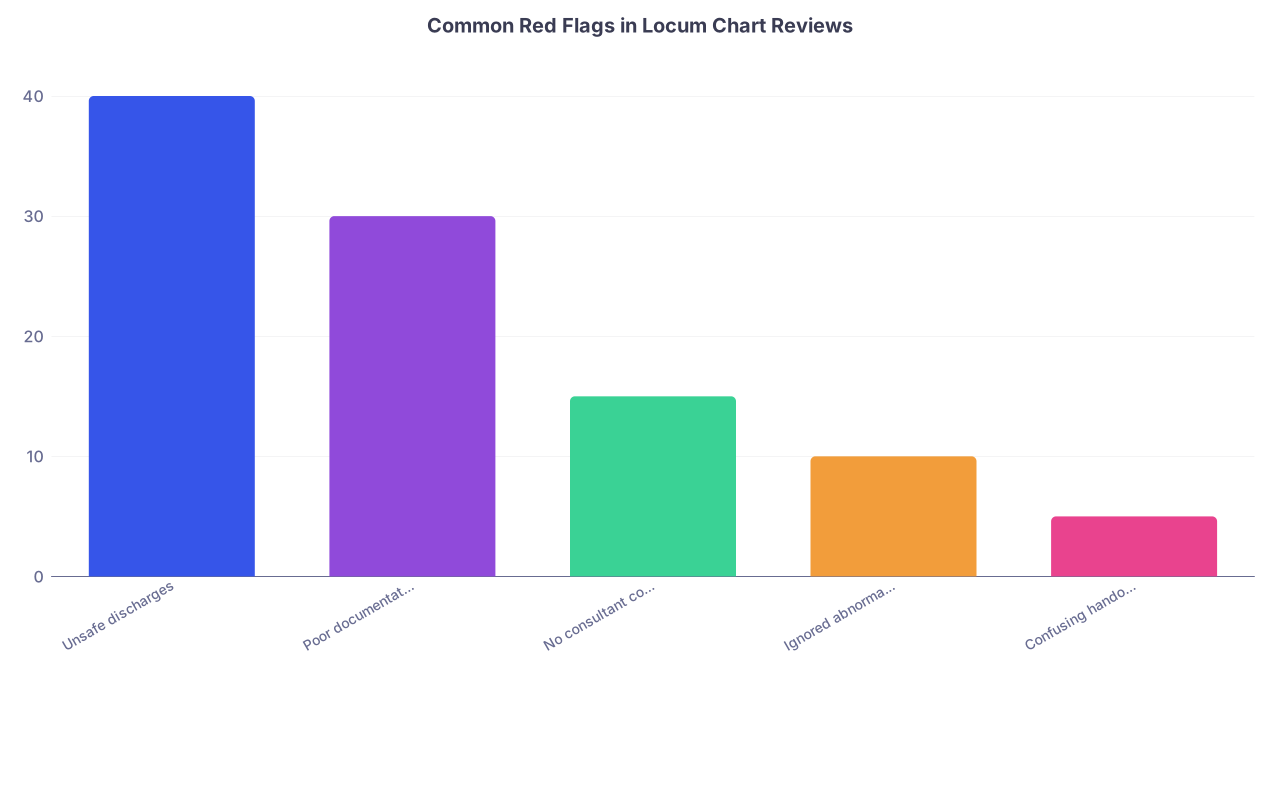
| Category | Value |
|---|---|
| Unsafe discharges | 40 |
| Poor documentation | 30 |
| No consultant contact | 15 |
| Ignored abnormal labs | 10 |
| Confusing handoffs | 5 |
6. The Politics No One Tells You About: Turf, RVUs, and “Stealing” Cases
Here’s the part you do not hear in recruiter webinars.
You might be clinically excellent, beloved by nurses, on time, and efficient—and still not get invited back. Why? Because you stepped on someone’s financial or political landmine.
Typical examples I’ve seen:
- A locum surgeon aggressively books elective cases that local partners wanted.
- A locum hospitalist moves too many admissions under their own name, starving others of RVUs.
- A locum proceduralist takes every scope or line instead of asking how cases are usually distributed.
Medicine is not just patient care. It’s a business with fragile egos attached. If the permanent docs feel like you’re “stealing” from them, they’ll smile to your face and then tell the scheduler, “Let’s try someone else next time.”
The repeat‑invite locums are not naive about this. They ask questions like:
“How do you all usually divvy up consults/procedures?”
“Is there anyone I should be looping in on borderline admits?”
“Any sensitivities about who does what here that I should know about?”
That doesn’t make you weak. It makes you situationally aware.
And when you inevitably step on a toe—because you will—they handle it directly. A quiet hallway conversation. “Hey, I heard yesterday I might’ve taken a case you usually do. That wasn’t my intent. How do you usually handle those so I don’t repeat it?”
You’d be shocked how often that one conversation flips someone from opponent to ally. And allies are exactly who you need when the “Should we bring them back?” question comes up.

7. The Subtle Signals That You’re “One of Us” (Even When Everyone Knows You’re Not)
At every site, there’s a mental dividing line between “us” and “them.” Full‑time versus locum. You’ll never be fully “us,” and that’s fine—you’re not trying to be.
But the locums who are always invited back manage to signal just enough alignment that people forget, in the day‑to‑day, that they’re temporary.
They do small, unglamorous things:
- Help move a patient bed when transport is backed up instead of disappearing.
- Refill a printer with paper when it’s out.
- Learn people’s names—nurses, secretaries, techs—and use them.
- Say “we” more than “you” when talking about the hospital.
And they avoid the classic locum mistake: constantly comparing.
“Well, at my main site we…”
“At the place I usually work, they don’t make us…”
“Back in my training program, we never…”
You say that too often, and people stop hearing your point. All they hear is: You think you’re better than us.
The repeat‑invite docs flip the script. They say things like, “I like how you all handle X here, I might steal that.” You’d be amazed how disarming that is. Suddenly you’re not an outsider criticizing. You’re a colleague appreciating.
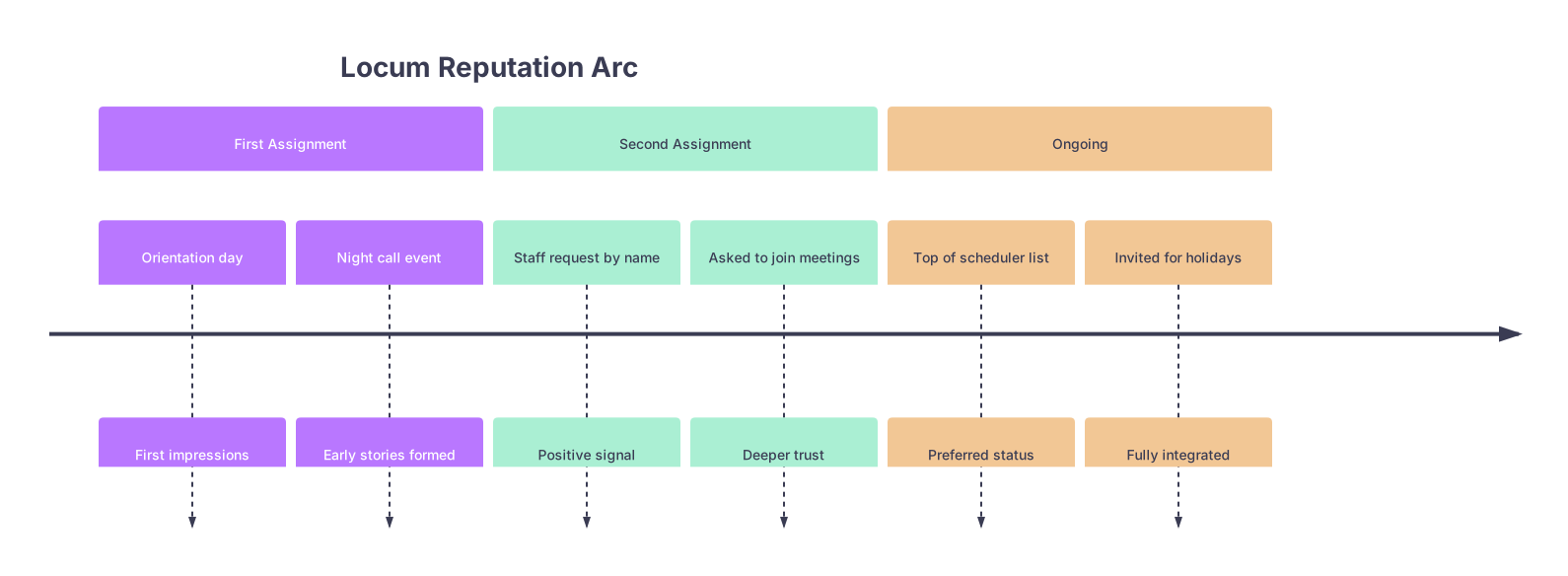
| Period | Event |
|---|---|
| First Assignment - Orientation day | First impressions |
| First Assignment - Night call event | Early stories formed |
| Second Assignment - Staff request by name | Positive signal |
| Second Assignment - Asked to join meetings | Deeper trust |
| Ongoing - Top of scheduler list | Preferred status |
| Ongoing - Invited for holidays | Fully integrated |
8. Why Some Solid Docs Never Get Asked Back (and Don’t Realize Why)
I want to talk directly to the group that frustrates medical directors the most: clinically strong, objectively safe, but mysteriously “not a good fit.”
These docs almost always have one or more of these blind spots:
They externalize everything.
Every problem is the EMR. Or the nurses. Or the administration. Or the call schedule. They don’t see their part in the friction. So they keep repeating the same patterns, wondering why they’re not booked solid.
They think “just doing my job” is enough.
They crush the medicine. They don’t miss diagnoses. But they ignore the relational side completely. No eye contact at sign‑out. No brief hello to the unit clerk. Never saying “thanks” for the 3am blood draw on a crashing patient. Their charts are great. Their vibe is cold. People don’t want them back.
They treat locums as purely transactional.
“I show up. I get paid. I leave.” They’re not wrong from a contract standpoint. But that attitude leaks. People feel it. They can tell you don’t care whether the place thrives; you’re just there for your shift. And that’s fine—if you’re okay never being top choice.
You can be better than that without selling your soul to any particular hospital.
The locums who are always in demand understand that each site is a little ecosystem you either harmonize with or irritate. They choose harmony—not out of weakness, but out of strategy.

If You Want to Be the Locum They Call First
Here’s what it boils down to.
You don’t need to be the smartest physician on the ward. You need to be the least disruptive competent physician in the building.
That means:
- Nail the first 24 hours: ask questions without complaining, adapt visibly, and own your learning curve.
- Treat nurses and staff like the real decision‑makers they are, because they are.
- Read the culture fast, flex your style, and stop trying to fix a system in a week.
- Be ruthlessly reliable and only as “difficult” as you absolutely need to be over schedule and logistics.
- Aim for safe, boring charts, and good judgment when things get weird—not heroics.
If you do that consistently, here’s what happens behind closed doors: when staffing panics about next month, someone says, “What about that locum who was here in May? They were great. See if they’re available.”
And your phone keeps ringing. While others, just as smart and just as trained, quietly stop getting emails and have no idea why.