
You just finished residency six months ago. You picked up a couple of locums assignments to “keep things flexible” while you figure out your long‑term job. Money is finally decent. You are bouncing between a hospitalist gig in one state and urgent care shifts in another.
Then someone casually says, “You know you’re going to get crushed at tax time if you do not set this up right, right?”
They are not wrong.
Most first‑year locum physicians do not get burned because they are lazy. They get burned because they treat locums like a W‑2 job with some extra forms. It is not. The IRS treats you as a small business. If you keep thinking like an employee, the tax system will quietly punish you.
Let me walk you through the mistakes I see over and over with new locums, and how to avoid donating an unnecessary five figures to the IRS.
Mistake #1: Treating Locums Like a W‑2 Job
Locums is almost always 1099 income. That means:
- No taxes withheld.
- No employer paying half your Social Security/Medicare.
- No built‑in retirement plan.
- No automatic benefits.
Yet I routinely see first‑year locums physicians do this:
- Spend every check like a paycheck.
- Assume “my accountant will fix it later.”
- Be shocked by a $40,000+ tax bill the following April.
Here is the blunt truth: when you sign that independent contractor agreement, you are not “just moonlighting.” You are a business. A one‑person practice without walls.
The core mistake: not changing your mental model from “employee” to “business owner.”
You must start asking:
- What is my profit after taxes, not just my gross rate?
- What are my business expenses?
- How much should I set aside for taxes every single month?
If you keep behaving like a hospital-employed attending but with locums pay, you will create a completely preventable cash‑flow crisis.

| Category | Value |
|---|---|
| Gross Pay | 100000 |
| After Est. Taxes | 70000 |
| After Retirement Savings | 55000 |
Interpretation: On $100k of 1099 income, it is very easy to end up with only ~$55k of “real” take‑home if you pay appropriate taxes and save properly. If you live like you make the full $100k, you are setting yourself up for pain.
How to avoid this:
- Stop thinking “hourly rate.”
- Start thinking “after‑tax, after‑overhead income.”
- Build a simple monthly pro forma: projected income, projected taxes, projected savings.
Mistake #2: Not Making Quarterly Estimated Tax Payments
This is the big one. The one that ruins people’s first year.
Physicians coming out of residency are used to:
- W‑2 income
- Taxes automatically withheld
- A small refund in April if they are lucky
Locums flips this. You may owe:
- Federal income tax
- State income tax (in multiple states)
- Self‑employment tax (both halves of Social Security and Medicare)
If you do not make quarterly estimated payments, the IRS can hit you with underpayment penalties. States can as well.
Dead giveaway you are walking into this trap:
Your first year of locums you say, “I will just see what I owe at the end of the year.”
No. That is what people say right before a $60,000 bill and a payment plan.

| Step | Description |
|---|---|
| Step 1 | Start Locums |
| Step 2 | W2 Only - Normal Withholding |
| Step 3 | Calculate Expected Income |
| Step 4 | Estimate Annual Tax |
| Step 5 | Divide Into 4 Payments |
| Step 6 | Pay IRS and States Quarterly |
| Step 7 | Avoid Penalties |
| Step 8 | Any 1099 Income? |
How to avoid this:
Get a rough estimate early.
Before your first assignment, have a CPA or tax‑savvy planner run projections based on:- Expected total locum income
- State locations
- Any W‑2 income you still have
Set calendar reminders for quarterly deadlines:
- April 15
- June 15
- September 15
- January 15 (of the following year)
Overpay slightly at first.
Being off by a few hundred is fine. Being off by $20,000 is not.
If you do nothing else from this entire article, do this: start estimated payments in your first year.
Mistake #3: Failing to Separate Personal and Business Finances
This one sounds small. It is not.
Common rookie move: you run all locums income and expenses through your personal checking and a random credit card. Then, come tax time, you hand a chaotic stack of statements to your CPA and hope for magic.
What you are really doing is:
- Missing legitimate business deductions.
- Creating a mess if you are ever audited.
- Making yourself too overwhelmed to track your real profit.

The IRS does not require an LLC or corporation to treat you as a business. But they expect you to behave like one.
How to avoid this:
Set this up before or right when you start:
- A dedicated business checking account (even if you are a sole proprietor).
- One credit card used exclusively for locums‑related expenses.
- Direct all 1099 deposits into that account.
- Pay business expenses from that account or that card.
Now:
- Your business income and expenses are cleanly separated.
- Your accountant can actually do their job.
- You have a clear picture of what you are really earning.
Mistake #4: Ignoring Deductible Business Expenses (Leaving Money on the Table)
Physicians are notorious for overpaying taxes because they under‑deduct. Locum physicians have even more legitimate deductions, yet many use virtually none of them.
I see people miss:
- Travel: flights, rental cars, gas, hotels for assignments.
- Licensing: new state licenses, renewals, DEA, board fees.
- Professional fees: malpractice (if you pay it), society dues, UpToDate or similar.
- Home office: if you legitimately use a part of your home exclusively and regularly for admin/locums work.
- Phone and internet: reasonable business portion.
- Equipment: stethoscope, laptop, iPad, scrubs, CME materials.
| Category | Examples |
|---|---|
| Travel | Flights, mileage, hotels, rental cars |
| Licensing/Fees | State licenses, DEA, board cert fees |
| Professional | Malpractice, society dues, CME courses |
| Office/Tech | Laptop, tablet, printer, EHR subscriptions |
| Communication | Business portion of phone, internet |
The mistake is not “forgetting receipts.” The mistake is not even knowing what you are allowed to deduct. So you never capture them in the first place.
How to avoid this:
- Keep a simple running log (spreadsheet, app, or even a note on your phone) for:
- Date
- Description
- Amount
- Category
- Use one card for all business expenses (as above).
- Ask your CPA early: “What exactly counts as a deductible expense in my situation?” and write it down.
Do not get cute and start deducting your entire life. But do not donate $10,000+ to the IRS by “being conservative” because you are too busy to track anything.
Mistake #5: Doing Nothing About Entity Structure (or Doing the Wrong Thing Too Fast)
You will hear this at least once at a locums-heavy conference:
“You NEED an S‑Corp. It will save you so much in taxes.”
Sometimes that is true. Sometimes it is completely wrong for your first year.
Two opposite mistakes:
Never thinking about entity structure at all.
You stay a default sole proprietor for years when an S‑Corp or LLC taxed as S‑Corp would meaningfully reduce self‑employment taxes once your income is high and stable.Rushing into an S‑Corp immediately.
You form an S‑Corp because someone said it was smart:- Without understanding reasonable salary requirements.
- Without stable income.
- Without admin support to handle payroll, filings, and corporate formalities.
Result:
- You either get no real tax savings.
- Or you create compliance headaches that cost more than they save.
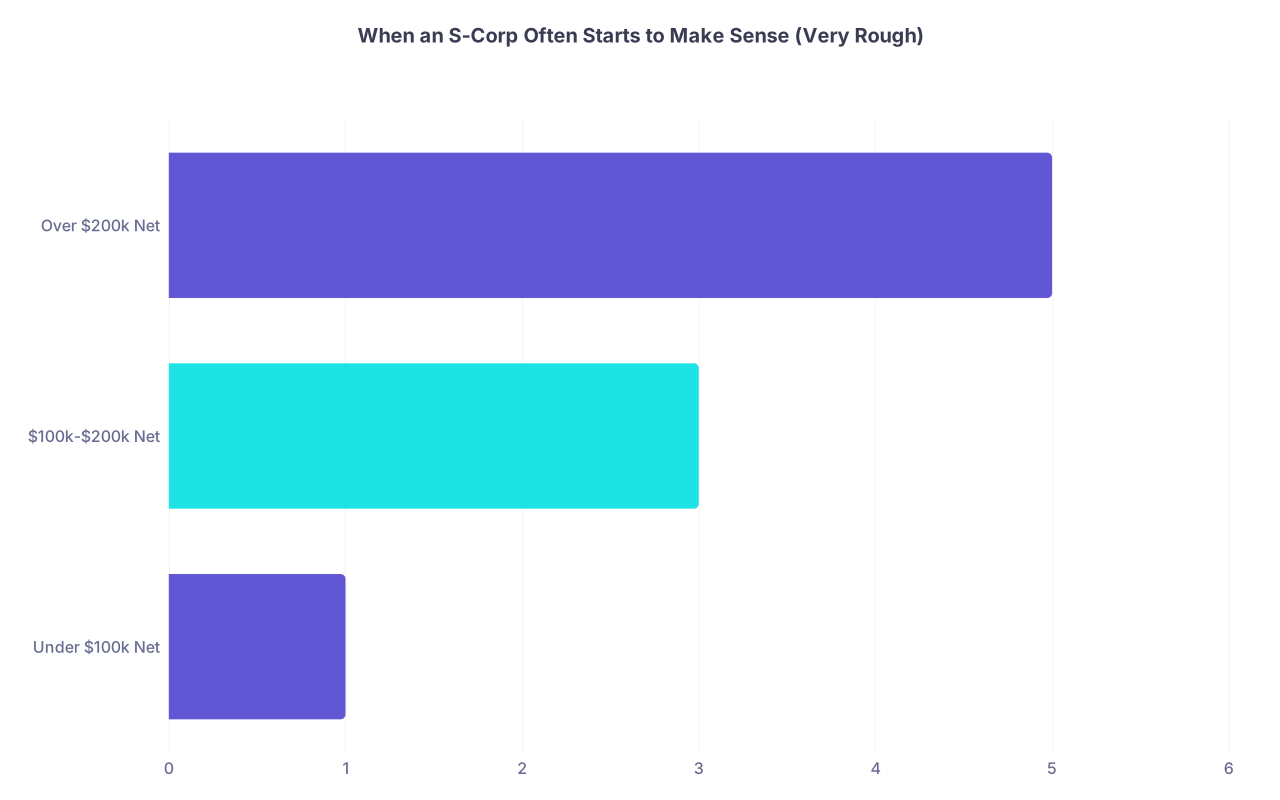
| Category | Value |
|---|---|
| Under $100k Net | 1 |
| $100k-$200k Net | 3 |
| Over $200k Net | 5 |
(Scale 1–5: 1 = rarely worth it, 5 = often worth looking at. This is conceptual, not a rule.)
How to avoid this:
Year 1: Often fine to start as a sole proprietor if:
- You are still figuring out if you like locums.
- Your income is unpredictable.
- You have multiple states and payers and want to keep structure simple.
Have a CPA run a specific comparison for you:
- “If I remain a sole proprietor with $X net income vs S‑Corp with $X net income, after payroll, compliance costs, and their fee, what is my actual after‑tax difference?”
If they cannot or will not quantify this, find someone else.
Do not blindly form entities because someone “heard from their buddy” it helps. But do not ignore structure once your locums income stabilizes above low six figures.
Mistake #6: Mismanaging Multi‑State Taxes
Locums almost guarantees one headache: multiple states.
Common disaster patterns:
- Working in State A, living in State B, with a primary W‑2 job in State C.
- Assuming “I will only pay tax in my home state.” Wrong.
- Ignoring state filing requirements for “just a few shifts” in another state.
Some states are aggressive. If you had income sourced there, they expect:
- A nonresident return.
- Their share of tax on that income.
You then typically get a credit in your home state for taxes paid elsewhere, but the mechanics are not simple.

| Category | Value |
|---|---|
| 1 State | 35 |
| 2 States | 45 |
| 3+ States | 20 |
I have seen smart people miss a state return for three years in a row. Then get a letter. With penalties and interest.
How to avoid this:
- Keep a running list of:
- Each state you physically work in.
- The dates.
- Approximate income earned there.
- Ask your CPA, explicitly:
- “Which states do I need to file in based on this list?”
- “How does my home state handle credits for tax paid elsewhere?”
If your tax preparer acts annoyed by multi‑state questions, they are the wrong person for a locums physician. This is not exotic. This is the job.
Mistake #7: Not Planning for Self‑Employment Tax and Retirement
Regular W‑2 attendings complain about taxes. Locums physicians often pay more, if they do not plan correctly.
Why? Self‑employment tax.
On 1099 income, you pay:
- Employer half of Social Security + Medicare.
- Employee half of Social Security + Medicare.
That adds an extra ~7.65% on top of your income tax, up to the Social Security wage base, and 2.9% Medicare (plus 0.9% extra at higher incomes).
Many new locums physicians:
- Do not run the numbers.
- Do not use any available retirement structures to reduce taxable income.
- End up with a higher effective tax rate than they needed.
On top of that, you lose:
- Automatic 401(k) through the hospital.
- Employer match.
But you gain the ability to:
- Set up a Solo 401(k) or SEP‑IRA.
- Potentially contribute much more pre‑tax, depending on income.

| Step | Description |
|---|---|
| Step 1 | 1099 Locum Income |
| Step 2 | Calculate Net Profit |
| Step 3 | Solo 401k or SEP IRA Only |
| Step 4 | Coordinate with Employer Plan |
| Step 5 | Maximize Pre Tax Contributions |
| Step 6 | Reduce Taxable Income |
| Step 7 | Calculate Self Employment Tax |
| Step 8 | Any W2 Job? |
How to avoid this:
- In year 1, at minimum:
- Understand how much of your tax bill is income tax vs self‑employment tax.
- Ask about a Solo 401(k) if you have only 1099 income, or coordination if you also have W‑2.
- Be realistic about what you can actually contribute.
No point in setting up a fancy plan you never fund.
Ignoring this is how you end up paying a huge tax bill and saving nothing for retirement your first few years as an attending.
Mistake #8: DIY Taxes Your First Locum Year (Or Using the Wrong Professional)
I have nothing against doing simple W‑2 taxes yourself. For residents, it is often fine. But first‑year substantial locums with:
- Multiple 1099s
- Multiple states
- New business accounts
- Possible entity questions
…should not be handled with a $50 DIY software run half‑asleep in March.
The other flavor of this mistake: using the cheapest tax preparer available who normally does standard W‑2 returns and small local businesses. They may be excellent at that and completely out of their depth with locums‑specific issues.
Red flags in a tax professional for locum physicians:
- They do not ask detailed questions about where you worked, how often, and how you were paid.
- They never discuss estimated taxes with you.
- They say “we will just see what happens at the end of the year.”
- They dismiss entity and retirement structure questions with “you do not need to worry about that” without explanation.

How to avoid this:
- For your first substantial locums year, hire someone who:
- Works with physicians regularly.
- Understands locum tenens and multi‑state filing.
- Can walk you through estimated payments and basic planning.
- Ask specific questions before you engage:
- “How many locum tenens or physician‑contractor clients do you have?”
- “How do you handle multi‑state filings?”
- “What entity structures do you usually see for physicians at my income level?”
If they cannot answer clearly, move on.
Once your system is built, you can consider simplifying or even partially DIY with review. Year 1 is not the place to experiment.
Mistake #9: No Cash Reserve for the Inevitable Surprise
Even with good planning, your first year of locums will not be perfectly predictable. Shifts get canceled. You say yes to a higher‑paying assignment late in the year. A state comes back wanting more.
The worst mistake is to run your lifestyle right up against your income and leave no room for tax surprises.
I have watched people:
- Take on consumer debt.
- Take bad locums gigs under pressure.
- Delay retirement savings for years.
All because they scrambled to cover an avoidable tax shortfall in year one.
How to avoid this:
- Treat your first 12–18 months as a data‑gathering and system‑building phase, not a lifestyle upgrade phase.
- Keep a separate “tax + buffer” savings account.
After every locums payment:- Move a fixed percentage (e.g., 30–35%) into that account automatically.
- Do not touch that account except for:
- Quarterly estimated payments.
- Final April settlement.
If there is extra after April? Great. Then you can reward yourself. Not before.
FAQ (Exactly 3 Questions)
1. Do I really need to make quarterly estimated tax payments in my very first year of locums if I also have a W‑2 job?
Yes, in most cases you do. Your W‑2 withholding only covers taxes on that W‑2 income, not your extra 1099 money. You can sometimes increase your W‑2 withholding enough to cover your locums income, but that requires careful calculation and usually still benefits from estimated payments. The “I will just let my employer withhold more and hope it is enough” strategy is how you end up underpaid and penalized.
2. Is it a mistake to form an LLC automatically when I start locums?
It can be. An LLC by itself does not magically lower your taxes. It usually just changes legal structure and where payments go. The tax treatment of a single‑member LLC is the same as a sole proprietor unless you elect S‑Corp status. Forming an LLC solely because “everyone says you should” without a clear legal or tax reason adds complexity, fees, and administrative work you may not need in year one.
3. How much should I set aside from each locums check for taxes?
As a rough starting point, many first‑year locum physicians set aside 30–35% of gross 1099 income into a dedicated tax savings account. That is not a precise number, just a safe buffer until you or your CPA run actual projections based on your filing status, other income, and deductions. The real mistake is not the exact percentage; it is not setting aside anything, then hoping your April tax bill is magically affordable.
Key takeaways:
- Locums = business, not side‑shift. Treat it like one from day one: separate accounts, real bookkeeping, and quarterly payments.
- Do not sleepwalk into a multi‑state, multi‑form tax mess. Get a competent, locums‑literate CPA for your first year and listen when they talk about estimates and structure.
- Protect yourself: over‑save for taxes, track your legitimate expenses, and resist the urge to upgrade your lifestyle before your systems (and your tax plan) are proven.