
The Instagram version of the “travel lifestyle” in locums is a lie. Not exaggerated. Not slightly idealized. Flat-out incompatible with how real locum tenens work actually functions once you look at contracts, call schedules, and tax returns instead of hashtags.
Let’s dismantle the fantasy and replace it with what mobility really looks like when you do locums after residency.
The Travel Lifestyle Myth vs. How Locums Actually Move
The myth is simple and seductive: finish residency, sign with an agency, “live out of a suitcase,” hop from coastal city to national park town every few weeks, and somehow stack big money while treating it like an endless working vacation.
Here is the problem: hospitals do not build schedules around your desire to hit 12 national parks in 12 months. They build around coverage gaps, RVUs, and budgets. Their goal is stability, not your personal itinerary.
Most real locums “mobility” looks like one of these patterns:
- One primary site you keep going back to every few months
- A regional circuit (three or four hospitals within one or two states)
- Rare true “gypsy” hopping (short stints, many sites) — and higher burnout
The more you try to act like a tourist, the less you function like a professional. And facilities will quietly stop calling you.
How Often Locums Actually Change Locations
Let’s talk frequency, not vibes.
From agency and group data (CompHealth, Global, smaller firms, plus what I’ve seen reviewing actual CVs):
- Many full-time locums physicians stay at a given site for 3–12 months, often extended multiple times.
- True 1–2 week stints, constantly rotating to new systems, are rare as a full-year lifestyle. People usually do that short-term, then settle into repeat sites for sanity and continuity.
- Hospital credentialing alone punishes high-velocity movement.
You are not “country-hopping.” You are usually:
- Airport → hotel/short-term rental
- Hospital → grocery store → maybe one decent restaurant
- Repeat for weeks
- Then home. Or to the next contract, sometimes in the exact same town.
Here’s roughly how it shakes out for people doing locums as their primary work:
| Mobility Pattern | Approx % of Full-Time Locums | Typical Assignment Length |
|---|---|---|
| One main site (plus occasional PRN) | 35–45% | 3–12+ months |
| 2–3 repeat sites | 30–40% | 2–6 months each |
| 4+ different sites, no repeats | 10–20% | 1–8 weeks |
| Constant short stints (≤2 weeks) | <10% | 3–14 days |
The “I never know where I’ll be next month” lifestyle does exist. It’s just not the norm among people who stay in locums more than one or two years. Because it’s exhausting, administratively painful, and financially inefficient.
The Credentialing Reality: Your Biggest Travel Anchor
The single biggest myth-buster for “pure freedom” is credentialing. Everyone glosses over this in the sales pitch.
Privileging and onboarding often take:
- 60–120 days for a new hospital
- 30–60 days for payors if they need to enroll you
- 30–90 days for new state licenses (can be faster with good support, but not magic)
So if you think you’ll do 6–8 totally different sites in 12 months, understand what that actually means:
- You’re constantly filling out 30–60 page packets.
- You’re doing background checks, immunization records, NPDB queries, PCE forms. Again and again.
- You’re doing EMR training videos repeatedly. Every. Single. System.
Real talk: the physicians who move the most are almost always those who:
- Commit to a couple of states (often contiguous)
- Build a repeat relationship with a few health systems
- Let agencies recycle existing credentialing wherever possible
The “mobility” is more about the ability to leave a bad fit or change your work/home base, not endless new stamps in your passport.
How Much of Locums Travel Is Actually “Travel”?
Let’s separate three different types of movement, because people conflate them.
- Geographic relocation
- Weekly commuting
- Actual leisure travel
Most of what gets marketed as “travel” locums is really #2: you commute by plane instead of car.
You fly in Sunday night or early Monday. Work a 5–7 day block. Crash in a hotel or extended-stay. Fly home. Recover. Maybe repeat.
Here’s what the time breakdown really looks like for a typical full-time road-warrior locums physician:
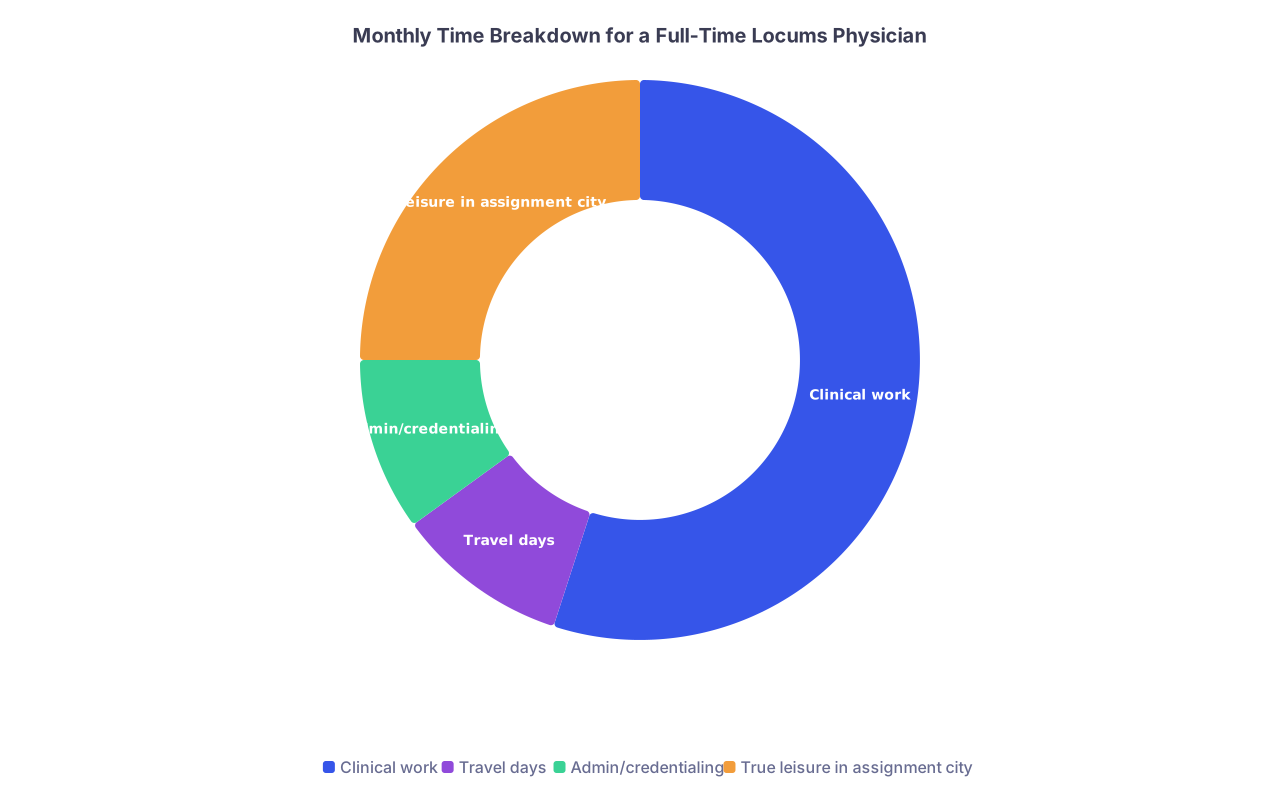
| Category | Value |
|---|---|
| Clinical work | 55 |
| Travel days | 10 |
| Admin/credentialing | 10 |
| True leisure in assignment city | 25 |
That 25% “true leisure” during assignments is generous. Plenty of folks spend that chunk sleeping, calling airlines, or arguing with credentialing about some missing TB test from 2014.
Yes, some physicians structure it better. Work 7-on/7-off, then spend an extra 3–4 days in the assignment city hiking or exploring. But they’re the minority, and they usually share three traits:
- Very organized with scheduling far in advance
- Either no kids/partner constraints, or a very flexible partner
- Financially comfortable enough not to chase every available shift
The Money vs. Mobility Tradeoff
Another uncomfortable truth: the more you prioritize frequent movement and scenic locations, the less you tend to make.
High-paying locums usually share these characteristics:
- Less desirable locations (rural, rust belt, off-season towns)
- Higher acuity or tougher workloads
- Less “sexy” departments (night hospitalist, no procedures, or conversely all procedures)
- Expectation you’ll stay for a while and be reliable
If you insist on rotating through:
- San Diego for three weeks
- Then Seattle
- Then Boston
- Then Denver ski town in winter
…you’ll quickly run into lower rates, stricter scheduling constraints, and more competition from other physicians trying to do the exact same thing.
Meanwhile someone else is quietly sitting in a “boring” Midwest community hospital, working 7-on/7-off, flying home on off weeks, and absolutely printing money.
Mobility isn’t free. You pay for it in:
- Lower average hourly rates when you only accept “destination” sites
- Unpaid travel days
- Gaps between contracts
- More uncompensated admin and setup time for each new facility
Tax Home, “Per Diem,” and the IRS Reality
This is the part social media almost never mentions, because it is boring and complicated and ruins the fantasy.
To get non-taxable stipends (housing, meals, incidentals), you generally need:
- A legitimate “tax home”
- To be “away from home” for work
- Temporary assignments (usually <12 months at a single location)
If you’re wandering the country with no real home base, the IRS may treat you as an itinerant worker. Translation: those stipends become taxable. And now your wandering lifestyle is not just exhausting, it’s expensive.
A realistic snapshot:
- If you keep a true home (rent/mortgage, regular returns, financial ties) in City A, and work locums in City B for 6 months, you’re usually fine for stipends.
- If you bounce around indefinitely with no real home, your agency’s “per diem” numbers stop being magic free money.
I’ve watched more than one early-career doc stunned by a tax bill because they listened to “travel lifestyle” hype and never got a real tax home strategy.
If you want to be mobile and not get wrecked:
- Establish and maintain a tax home.
- Don’t let a single site quietly become your permanent job over 12+ months with “temporary” stipends.
- Work with someone who actually understands locums taxation, not a generalist who files W-2s for your uncle’s dental office.
What “Freedom” in Locums Actually Looks Like
Now for the part that rarely gets phrased honestly: locums really does offer freedom. Just not the postcard version you were sold.
The real freedoms are:
- You can walk away from toxic leadership. No multi-year contract chaining you to a malignant group.
- You can trial regions or hospitals before deciding where to settle.
- You can ramp hours up/down faster than in a traditional employed job.
- You can say no. To specific shifts, to certain call burdens, to EMR conversions, to poorly staffed units.
That’s not romantic. But it’s powerful.
True freedom in locums is:
- Being able to tell a nightmare CMO “I’m not renewing” and actually mean it.
- Building a schedule with 6–8 heavy work blocks, then taking an entire month to travel on your own terms — not between shifts, but off the clock.
- Moving your professional “home base” from state to state over years, without begging for releases from non-competes.
I’ve seen people use locums to:
- Relocate families in stages (kids finish school in one state, spouse job-hunts in another).
- Test living in coastal vs. inland vs. mountain regions before buying a house.
- Take 3–6 month sabbaticals abroad because they’re not locked into one employer’s staffing model.
Those are real, serious forms of mobility. They just don’t look like forever-vacation van life.
The Emotional Side of Constant Mobility
Everyone talks about income, almost nobody talks about isolation.
Short version:
- New environment repeatedly = constant adjustment cost
- New teams = repeated “prove yourself” cycles
- Rotating call numbers, workflows, and EMRs = background cognitive load
There’s a honeymoon phase. First site or two, you feel adventurous. By your fifth new EMR this year, the thrill is gone.
Balancing travel with a life:
- Partners and kids complicate itinerant patterns. Somebody’s missing events, or everyone is living in a weird half-here-half-there zone.
- Friends become harder to maintain when you’re gone 2–3 weeks at a time.
- “I’ll work hard now, travel later” gets inverted — people travel constantly for work and then are too tired to travel for themselves.
Most long-term locums docs I respect eventually converge on:
- A home base they like
- 1–3 consistent hospitals
- Occasional “adventure contracts” sprinkled in intentionally, not constantly
That model is sustainable. The endlessly-mobile-every-month-a-new-city narrative usually burns people out or quietly collapses into something much more stable.
What Smart Mobility Actually Looks Like in Locums
If you want to use locums to have a more mobile life — and not get crushed by logistics, taxes, and fatigue — here’s what actually works.
First, you think in seasons, not weeks.

| Step | Description |
|---|---|
| Step 1 | Choose Tax Home |
| Step 2 | Target 2-3 States |
| Step 3 | Secure 1 Primary Site |
| Step 4 | Add 1-2 Backup Sites |
| Step 5 | Work 3-6 Month Blocks |
| Step 6 | Take Dedicated Travel Time |
| Step 7 | Reassess Sites and Regions |
The sustainable pattern usually looks like this:
- Pick a tax home and 2–3 target states.
- Get licensed and credentialed there.
- Land one primary site that gives you enough volume.
- Add one or two backup sites for variety or leverage.
- Schedule dedicated off-blocks for real travel — not squeezed between shifts.
- Reassess annually, not weekly.
Second, you treat leisure travel like what it is: optional, separate from work, and best done when you are rested and not on call.
If you insist on sightseeing after 12-hour shifts in a new hospital with unsafe staffing, you won’t remember the city anyway. Just the pager noise.
Where the Locums Travel Myth Came From — And Why It Persists
The “travel lifestyle” framing didn’t come from nowhere. It came from:
- Agencies needing an emotional hook to market what is essentially flexible contract labor
- Early success stories (single, no kids, adventurous, EMR-tolerant docs) getting amplified
- Social media’s love for aspirational content over spreadsheets
Nobody is posting:
- “Here’s my 118-page credentialing packet.”
- “I spent my off day arguing with a hotel desk about my long-stay rate.”
- “I just realized my stipends may be taxable because I effectively have no tax home.”
You see the mountain hikes. Not the three Q4 call weekends in a row you traded for them.
The myth persists because it sells. To residents who are exhausted. To attendings who feel trapped. It tells you that you can escape and turn your life into a montage.
You can escape. You can rebuild your career and your geography on your own terms. But it will not feel like a perpetual vacation. It will feel like work with more levers you control.
And that’s actually the better deal — once you stop chasing the postcard version and start designing a life you can stand to live for more than one Instagram story.
Years from now, you will not romanticize how many airports you sprinted through. You’ll remember whether you used your mobility to build a life that felt like yours, instead of just a job in a different zip code.