
What happens if your highest-paying locums contract suddenly ends… and you don’t see another paycheck for 3 months?
If that question makes your stomach drop, you don’t have a big enough emergency fund to go full-time locum. Let’s fix that.
I’m going to give you a clear number, a simple formula, and a step‑by‑step way to build an emergency fund that actually protects you in the real locums world—not some fantasy where every contract renews and recruiters always call back.
The Short Answer: Your Baseline Emergency Fund Number
Let me give you the punchline first.
Before going full-time locum, most physicians should have:
6–12 months of total living expenses in a readily accessible emergency fund.
Here’s how I actually break that down if you’re post-residency and relying on locums as your primary income:
- Absolutely minimum: 3 months of bare-bones expenses (you’re taking real risk here)
- Reasonable / what I recommend for most: 6–9 months of normal expenses
- Conservative / ideal if you have dependents, big fixed costs, or visa issues: 12 months of normal expenses
And yes, that’s months of expenses, not months of income. Your income as a locum may be high, but it’s also unstable and chunky. Your expenses are the thing you must protect.
Let’s make that concrete.
If your monthly expenses are $9,000:
- Bare minimum (3 months): $27,000
- Recommended (6–9 months): $54,000–$81,000
- Conservative (12 months): $108,000
That’s the scale we’re talking about. Not $5k in a savings account and hope.
Step 1: Figure Out Your Real Monthly Burn Rate
You can’t set an emergency fund target if you’re guessing your expenses.
And no, your residency budgeting app from 3 years ago doesn’t count. Your life post-residency is different: higher income, higher lifestyle temptation, and sometimes higher fixed costs (mortgage, daycare, loans coming off forbearance).
You need two numbers:
- Normal monthly spending – what you realistically spend right now
- Bare-bones monthly spending – the “we cut everything nonessential” version
Do this on paper or in a spreadsheet. Don’t overcomplicate it.
Start with your normal monthly spending:
- Housing (rent/mortgage, HOA, property tax escrow if not in payment)
- Utilities (electric, gas, water, internet, phone)
- Food (groceries + eating out)
- Transportation (car payment, gas, insurance, maintenance)
- Insurance (health, disability, life, malpractice gap if any)
- Debt payments (student loans, credit cards, personal loans)
- Childcare / school costs
- Subscriptions and recurring stuff (Netflix, gym, apps)
- Miscellaneous (clothes, gifts, travel, random “Target runs”)
Total that. That’s your normal monthly number.
Then build your bare-bones version:
- Keep: housing, utilities, basic food, transportation, insurance, minimum loan payments
- Slash or pause if possible: dining out, travel, nonessential shopping, subscriptions, extra loan prepayments, luxury services
That second number is the “if things go sideways, we switch to this” plan. It’s good to know you could drop from, say, $12k/month to $7.5k/month if you had to.
Most people never do this exercise. The ones who do sleep better when they go all‑in on locums.
Step 2: Understand Why Locums Needs a Bigger Emergency Fund Than W‑2
If you were taking a stable employed position with a signed contract, guaranteed base, and benefits, I’d be fine with 3–6 months saved, especially if you’re single and flexible.
Locums is not that.
Here’s what’s different (and why I push 6–12 months for full-time locums):
Income gaps are real.
Credentialing takes longer than recruiters promise. Start dates move. A “sure thing” contract falls through when a new permanent hire appears. I’ve seen physicians go 2–4 months between meaningful paychecks despite “being booked.”Cancellations happen.
A hospital gets bought. Volumes drop. A new medical director wants more full-time staff. Locums are the first to go.You front-load a lot of work and time.
You spend weeks or months credentialing, arranging travel, maybe even relocating temporarily. You don’t get paid for that time.Benefits are on you.
Health insurance, disability, retirement contributions—none of that is “free” anymore. Those are real expenses, even if they’re paid annually or quarterly.Travel and housing volatility.
Flights change. Short-term housing can fall through. You may have to absorb unexpected costs up front and fight for reimbursement later.
A W‑2 doc can often get away with a smaller emergency fund because their income is relatively predictable. A full‑time locum without savings is just one delayed payment away from panic.
If you want the freedom of locums, you need the buffer too. Otherwise it’s not freedom; it’s just chaos.
Step 3: Set Your Actual Target Number (With a Simple Formula)
Here’s a simple framework that works well for post‑residency doctors moving to full-time locums:
Base formula:
Emergency fund target = 6–12 × “normal monthly expenses”
Where you fall in that range depends on your risk factors:
Lean toward 12 months if:
- You have dependents
- You’re the primary or only income
- You own a home with a big mortgage
- You’re on a visa tied to work
- You have significant ongoing medical expenses in the family
- You’re in a more volatile specialty or narrow niche
Lean toward 6–9 months if:
- You’re single or have a dual‑income household
- You rent and can move easily
- You’re in a high‑demand specialty with broad options (EM, anesthesia, hospitalist, psych, etc.)
- You’re willing to take less desirable assignments if needed (location, schedule, pay)
If you want a brutally simple shortcut and you’re early in attending life:
PGY3 finishing residency, going straight to locums, no dependents:
Target 6 months of expenses before you quit your W‑2 or residency paycheck.Mid‑career, dependents, mortgage, going from stable W‑2 to full locums:
Target 9–12 months of expenses. Don’t play games here.
Step 4: Where To Keep Your Emergency Fund (And What Not To Do)
Your emergency fund is not an “investment.” It’s insurance in cash form.
So no, it doesn’t belong in 100% stocks or some complex investing strategy. That defeats its purpose.
Here’s a sane approach:
- Primary home: High‑yield savings account or money market account at a reputable bank or brokerage. FDIC/NCUA insured. Easy transfers.
- Secondary layer (if 9–12 months):
- First 3–6 months: instant-access savings or money market
- Remaining 3–6 months: short‑term Treasuries or a Treasury money market fund (still very low risk, but slightly better yield)
What I’d avoid for your core emergency fund:
- Individual stocks
- Long-term bond funds with big interest rate risk
- Crypto (obviously)
- Real estate that’s not easily sellable or borrowable against
- Locked-up investments where you can’t access money quickly without penalties
If you can’t get to it within a few days without worrying about price swings, it’s not emergency fund material.
Step 5: Don’t Forget Two Other “Mini” Emergency Funds Locums Need
Locum tenens has two extra cash buckets most people completely forget to plan for:
1. Tax Reserve
Locums income is usually 1099. No one is withholding taxes for you. If you get paid $40,000 for a month of work and don’t peel off the tax piece immediately, you’ll get crushed later.
As a rough starting point:
- Set aside 25–35% of your gross locums income into a separate “tax” savings account
(higher end if you’re in a high-tax state or already in a high bracket)
This is separate from your emergency fund. Don’t mix them unless you like pain.
2. Business Buffer
As a 1099, you’re a mini-business. That business has costs:
- Malpractice coverage gaps (tail, if needed)
- Licensing fees, DEA, hospital credentialing fees (if not covered)
- CME
- Travel costs before reimbursement
- Health insurance premiums if you’re buying your own
- Legal/accounting/bookkeeping help
I like having 1–2 months of your typical business expenses in a business checking/savings account to handle these without touching your personal emergency fund.
Step 6: Adjust For Your Specialty And Reality
Not all locums situations are equal. Your specialty and market really do change the risk profile.
Here’s a rough sense of risk by specialty, and how I’d tilt your emergency fund:
| Risk Level | Example Specialties | Suggested EF Multiple |
|---|---|---|
| Lower | Hospitalist, EM, Psych | 6–9 months |
| Medium | Anesthesia, IM subspecialties | 6–12 months |
| Higher | Derm, ENT, certain surgical | 9–12 months |
“Lower risk” here doesn’t mean safe. It just means there are usually more contracts and more geographic demand, so gaps are easier to fill if you’re flexible.
If you’re in a niche field where locums options exist but are sparse, I’d absolutely stay closer to 12 months before depending on it full‑time.
Step 7: How To Build The Fund If You’re Not There Yet
You might be thinking, “I’m just finishing residency. I don’t have $60k–$100k lying around.”
Fine. Lots of people don’t. You still have options.
Here’s a practical build‑up path:
Lock down your first 1–2 contracts before jumping
Don’t quit your residency or W‑2 without at least one signed locums contract and another in active negotiation/credentialing.Use your early higher-paying months to front-load savings
First 3–6 months of locums? Pretend you’re still a resident. Keep lifestyle creep on a leash and push 40–60% of take-home into:- Emergency fund
- Tax account
- Business buffer
Automate transfers
Every time you get paid:- X% straight to tax account
- Y% straight to emergency fund until you hit your target
- Only the remainder to checking/spending
Consider a transitional hybrid year
If you can, do:- 0.5–0.7 FTE W‑2 + locums on top
Use the locums income almost entirely to build the emergency fund, instead of living off it right away.
- 0.5–0.7 FTE W‑2 + locums on top
Delay big life upgrades until the fund is built
New house, luxury car, private school—those can wait a year. You want freedom and control over your work? Buy that first by building the fund.
Step 8: Common Mistakes Physicians Make With Locums Emergency Funds
I’ve seen the same bad patterns over and over:
“My line of credit is my emergency fund.”
No. A HELOC or credit card is not an emergency fund. In a real crunch, lenders can cut credit limits or change terms. Also, borrowing at 15–25% interest to cover basic expenses is how high-income people feel broke.Underestimating irregular expenses.
You remember your rent and groceries. You forget:- Annual insurance premiums
- Car repairs
- Replacing a laptop
- Credentialing/licensing oddities Then you raid your emergency fund for predictable but poorly planned things.
Calling an investment account an emergency fund.
“I’ve got $80k in a brokerage, that’s my safety net.” Then the market drops 25% right before your contract falls through. Great.Not recalibrating after lifestyle increases.
As your spending creeps up, your emergency fund target should too. If your monthly expenses jump from $7k to $11k, your 6-month fund suddenly needs to go from $42k to $66k. Most people never adjust.
Step 9: Put It All Together With a Quick Example
Let’s walk through a realistic scenario.
You’re a new hospitalist, just finished residency, going full-time locums.
You run the numbers and find:
- Normal monthly expenses: $8,500
- Bare-bones monthly expenses: $6,000
- Single, renting, no kids, no big medical issues
Reasonable emergency fund target: 6–9 months of normal expenses
So: $51,000–$76,500. Let’s say you pick $60,000 as your first goal.
You also decide:
- Tax reserve: 30% of gross locums income in a separate high-yield savings
- Business buffer: $8,000 to cover licensing, CME, etc.
Month 1–6 of locums, you average $25,000/month net pay (after taxes are set aside):
- You live on $8,500
- You save $10,000–$14,000/month toward emergency + business buffer
- By month 5–6, you’ve:
- Hit your $60,000 emergency fund target
- Built a $8,000 business buffer
- Built the habit of not spending everything you make
Now if a contract ends abruptly, you’re not scrambling. You can say no to bad offers. You can choose where and how you want to work. That’s what this is about.
A Simple Visual: How Big Should Your Fund Be?
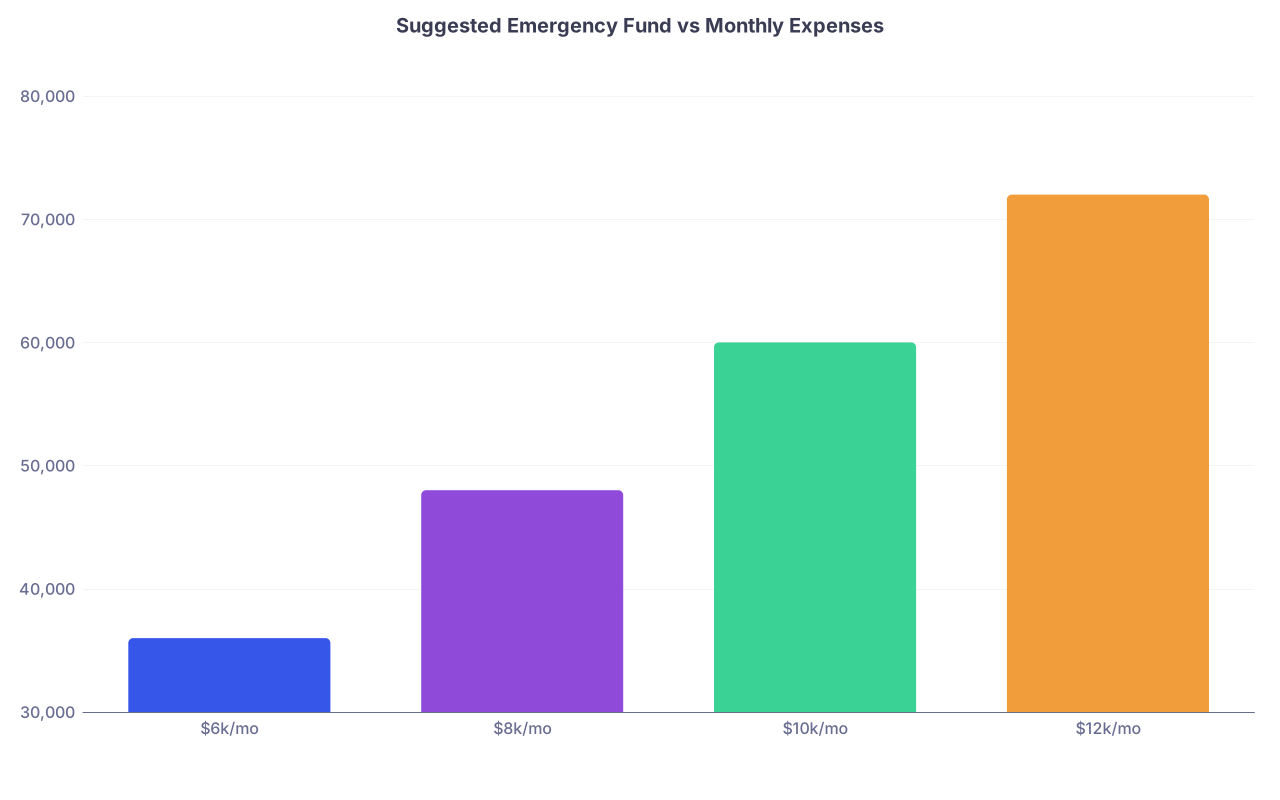
| Category | Value |
|---|---|
| $6k/mo | 36000 |
| $8k/mo | 48000 |
| $10k/mo | 60000 |
| $12k/mo | 72000 |
(That chart assumes a 6‑month emergency fund. Double the numbers for 12 months.)
What To Do Today
Don’t overthink this. Do one concrete thing:
Right now, open your bank or budgeting app and calculate your actual last 3 months of spending. Take the average. Multiply it by 6. That number?
That’s your initial emergency fund target before you go all-in on full-time locums.
Write it down. Then start building toward it on purpose, not by accident.