
The obsession with collecting as many state licenses as possible is hurting a lot of locum physicians.
The blunt answer: how many licenses do you actually need?
For most locum tenens physicians, 3–5 strategically chosen licenses are enough to stay busy year‑round and get good rates.
Not 1. Not 15. Usually 3–5.
But there are exceptions:
- If you only want occasional locums around your home: 1–2 licenses.
- If you want locums as your primary career with maximum flexibility: 5–7, chosen wisely.
- If you’re in a very in‑demand specialty (anesthesiology, EM, radiology, psych, critical care): you can get away with fewer and still do well.
The right number isn’t about bragging rights. It’s about:
- How often you want to work.
- How far you’re willing to travel.
- Your specialty.
- How picky you are about setting, schedule, and pay.
Let me walk you through how to decide your number—and which states are actually worth the hassle.
The trap: why “more licenses = better” is bad advice
I’ve watched more than one new locum doc light $5,000–$10,000 on fire chasing licenses they never use.
Three common mistakes:
Getting licenses before talking to agencies.
They assume “If I have 10 licenses, the offers will flood in.” What actually happens: agencies still push them toward their usual markets, which may only use 3–4 of those states.Chasing “cool” states instead of “high‑demand” states.
People grab California, New York, Florida purely for lifestyle reasons, then discover:- Long credentialing
- Painful bureaucracy
- Extra hoops (fingerprinting, in‑person notarization, mandatory CME types) And then they do one assignment every 18 months there. If that.
Underestimating maintenance pain and cost.
Licensure isn’t a one‑time project. It’s:- Initial fees
- Renewals
- State‑specific CME
- Verifications
- Keeping addresses and practice locations updated
One license is trivial. Eight licenses is a part‑time admin job.
You’re not trying to “collect” states. You’re building a small portfolio that reliably gets you solid work without draining your time and attention.
Step 1: Decide your locums strategy first, licenses second
Here’s the order smart physicians use. Licenses come last, not first.

| Step | Description |
|---|---|
| Step 1 | Define locum goals |
| Step 2 | Pick work volume |
| Step 3 | Choose travel radius |
| Step 4 | Talk to 2 to 3 agencies |
| Step 5 | See which states have real jobs |
| Step 6 | Apply for 1 to 3 key licenses |
| Step 7 | Work first locum assignments |
| Step 8 | Add more licenses only if needed |
Ask yourself:
- Do you want locums as a side gig or your main career?
- Are you okay with flights, or do you want driving distance only?
- How flexible are you on setting? Rural, critical access, community hospital, big academic center?
Then talk to multiple agencies (not just one):
- “Here is my specialty. Here is how often I want to work. Which 3–5 states would give me the best pipeline of opportunities?”
If two different agencies both say the same three states are hot for your specialty, that’s a clue.
Step 2: Use a simple framework to pick your number
Here’s a straightforward way to decide how many state licenses you need, based on your situation.
| Situation / Goal | Recommended # Licenses | Comment |
|---|---|---|
| Occasional extra shifts near home | 1–2 | Home state + 1 neighbor |
| Transitioning between full‑time jobs | 2–3 | Home state + 1–2 high‑demand |
| Primarily regional locums (driveable) | 3–4 | Cluster of neighboring states |
| Full‑time national locums career | 4–7 | Mix of regional + high‑pay |
| Ultra‑niche or very in‑demand specialty | 2–4 | Can be pickier and use fewer |
Let’s break these down quickly.
1–2 licenses: “Side‑gig” or hyper‑local strategy
Who this fits:
- Hospitalist willing to pick up shifts at nearby hospitals.
- EM doc doing extra weekends or filling gaps.
- Outpatient psych or primary care doc covering telehealth or local clinics.
This usually means:
- Your home state.
- Maybe 1 neighboring state where agencies consistently have contracts.
This is low hassle, low risk, and enough for many physicians who don’t want locums as their main job.
3–4 licenses: regional workhorse
This works well if:
- You prefer driving to most assignments.
- You like staying 1–3 weeks at a time instead of months.
- You’re okay with community and rural sites, not just major metros.
You build a “region” around your home base—say:
- Texas + Oklahoma + New Mexico + Louisiana
or - Illinois + Wisconsin + Indiana + Michigan
You’ll see a surprising amount of work just in that footprint.
4–7 licenses: full‑time, high‑flexibility locums
This is the sweet spot for many full‑time locum docs. You deliberately blend:
- Region where credentialing is easier and travel is simpler.
- 1–2 high‑pay or high‑demand states (where rates are stronger or coverage gaps are chronic).
Going beyond 7 licenses?
You better be:
- Very organized.
- Actually accepting assignments in those states.
If you hold 10 licenses and only work in 4 of them, you’re donating money to state medical boards.
Step 3: Which states are “worth it” for locums?
I’m not going to pretend there’s a universal “Top 5 States” list. Demand varies by specialty and year.
But there are patterns I keep seeing.
| Category | Value |
|---|---|
| Home State | 1 |
| Neighboring 1 | 1 |
| Neighboring 2 | 1 |
| High-Pay 1 | 1 |
| High-Pay 2 | 1 |
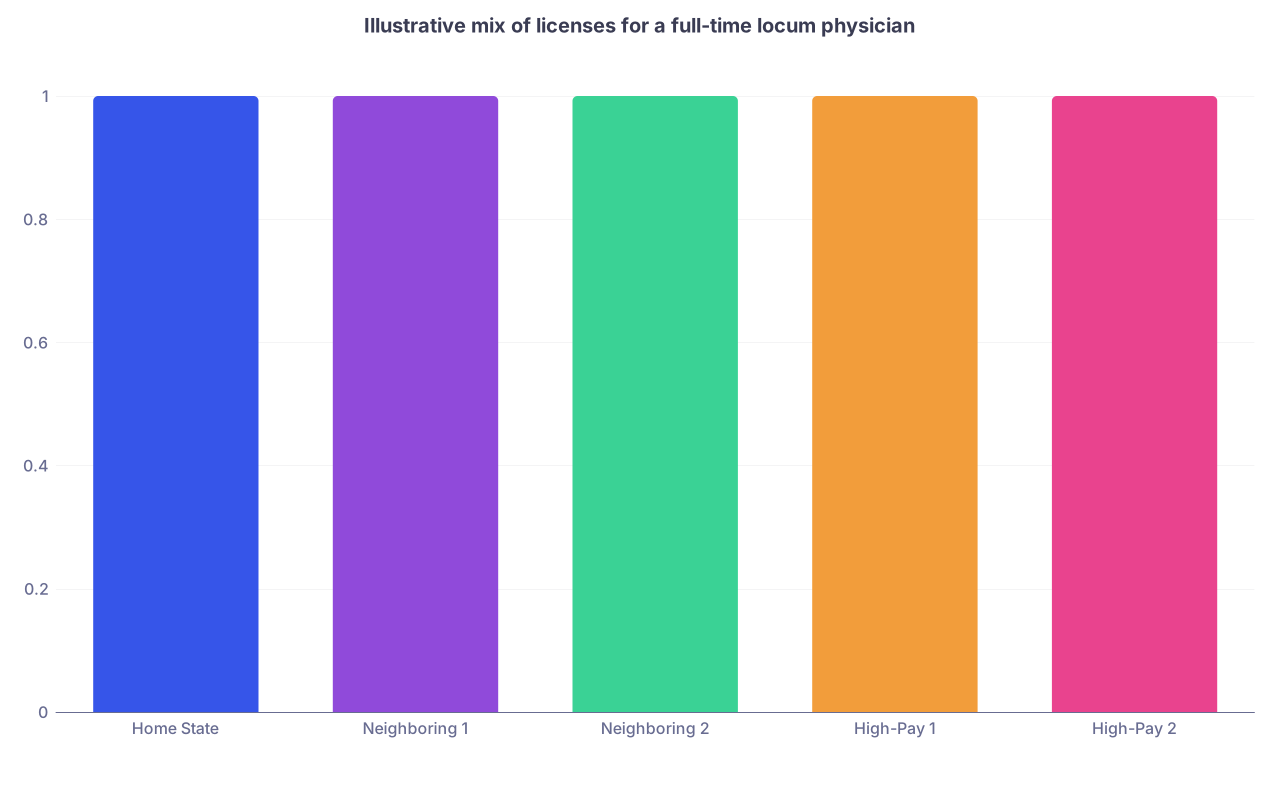
The smart pattern looks like this:
- One “home base” state – where you already live or trained.
- One or two neighboring states – easy travel, similar practice style.
- One or two “high‑leverage” states:
- Either consistently short‑staffed
- Or higher pay
- Or lots of your specialty’s demand
Instead of guessing, ask multiple recruiters:
- “Which 3–4 states give you the most trouble finding coverage in my specialty?”
- “If I added only one new state license right now, which would you push me toward and why?”
- “Which states do your long‑term locums almost always keep active?”
You’ll hear the same names repeatedly. Those are the ones worth your time.
Step 4: Use the IMLC to avoid license‑hoarding pain
If you’re eligible for the Interstate Medical Licensure Compact (IMLC), it changes the game.
You can go from 1–2 licenses to 5–6 licenses in a much more controlled, lower‑friction way.
How to think about IMLC:
- It’s best for expansion, not your first license.
- Use it to add licenses only when:
- A real assignment exists.
- The client is serious.
- There’s a signed or near‑signed agreement.
Do not mass‑apply to 10 compact states just because you can. You’ll drown:
- Initial fees x 10
- Renewal fees x 10
- CME tracking x 10
- Address updates x 10
You want the optionality IMLC gives you, not a collection of unused credentials.
Step 5: How many licenses by specialty?
Here’s a rough, experience‑based guide. Not gospel, but directionally accurate.
Emergency Medicine:
3–5 licenses works very well. EM demand is broad. Full‑time locum EM docs often sit comfortably at 4–6.Hospitalist / Internal Medicine:
3–6 licenses. Hospitalist work is everywhere, but competition is higher in some metro regions. You benefit from having a few more states as backup.Anesthesia / Critical Care:
2–4 licenses. Shortage is real. You can be choosier, and hospitals will wait a bit longer.Psychiatry:
2–4 licenses. Psych demand is massive. Even with telepsych trends, in‑person and hybrid roles are plentiful.Radiology / Pathology:
Often 3–6, especially if you do telerad/teleresp. But you need to be very organized about compliance and jurisdiction issues.Outpatient Primary Care:
2–4 licenses. Locums roles exist, but rate and volume are more variable. Stronger need in rural and FQHC settings.
If you’re niche (pediatric subspecialist, certain surgical fields), talk to multiple agencies. They’ll tell you quickly whether they’re starving for your skillset or not.
Costs, time, and maintenance: the part most people ignore
You don’t just ask “How many licenses do locum physicians need?” in theory. You should also ask, “How much admin overhead am I willing to tolerate every single year?”
Here’s what you’re really signing up for with each new license:
- Application fee: often $300–$800
- Federation of State Medical Boards (FSMB) profile fees, verifications
- Fingerprinting, notarization, background checks
- Time: 1–4+ hours of your own paperwork per state
- Renewal cycles: usually every 1–3 years
- State‑specific CME requirements (pain management, opioids, ethics, etc.)
With 2 licenses, none of this is a big deal.
With 7 licenses, you will:
- Have some license expiring every few months.
- Spend a few days a year doing nothing but forms and CME tracking.
- Run into random annoyances—lost checks, “we never received your transcript,” etc.
So if you’re going above 4–5 licenses, you need a system. Not a vague promise to “stay on top of it.”
Practical tips that actually help:
- Keep a single spreadsheet with:
- License number
- Issue and expiration dates
- Login info (stored securely)
- CME requirements
- Contact emails
- Set 90‑day and 30‑day calendar reminders for each license renewal.
- Offload what you can:
- Many agencies will help with licensure logistics if they know they’ll place you.
- Some physicians pay a credentialing service when they cross the 5–6 license threshold.
When should you not add another license?
You probably should NOT get another state license if:
- You still haven’t worked a single day of locums on the licenses you already have.
- The only justification is “nice place to visit.”
- An agency says, “Get this license and we might have work,” but can’t:
- Name a specific hospital.
- Estimate realistic start dates.
- Tell you typical shift structures and rates.
I’ve seen too many physicians pick up, say, an Alaska or Hawaii license purely for “someday” and end up never actually going. That’s a vacation fantasy, not a career strategy.
Add new licenses when one of these is true:
- You have an offer pending or a near‑guaranteed pipeline in that state.
- Two or more agencies independently say they’re desperate for your specialty there.
- Your current 3–4 states are saturated and you’re regularly turning down lower‑pay, undesirable shifts, but can’t get enough of the good ones.
Putting it all together: a simple decision rule
Here’s the practical, no‑nonsense rule I’d use if I were starting fresh as a post‑residency locum:
- Start with your home state (or wherever you’re licensed now).
- Talk to 2–3 agencies and ask: “If I added 1–2 more states, which would you beg me to get first?”
- Add only 1–2 more licenses and actually work locums in those states.
- Once you’ve done:
- At least 2–3 assignments, and
- You understand travel, pay, and credentialing timelines THEN decide if you want to grow to 4–6 licenses for full‑time flexibility.
You’re better off being fully utilized in 3 well‑chosen states than scattered and over‑licensed in 9 you barely touch.
FAQ (5 questions)
1. Is one state license enough for a full‑time locum career?
It’s possible but limiting. If you’re in a very high‑demand specialty (anesthesia, EM, psych), you might be able to piece together full‑time work in a single busy state, but you’ll be at the mercy of that state’s market and seasons. Having at least 3 licenses usually smooths out dry spells and gives you leverage on rates and schedule.
2. Should I wait for a confirmed assignment before applying for a new state license?
You rarely get a fully signed contract first, but you should have more than vague interest. At minimum, you want a specific facility that’s actively credentialing locums, a realistic start window, and multiple open shifts or FTE coverage needs. If all you have is “we might get something there,” that’s not enough reason to pay and wait for a new license.
3. Are compact (IMLC) states automatically the best choice for locums?
No. The compact makes licensing easier, not necessarily more valuable. Some IMLC states are great for locums, others are quiet in your specialty. Use IMLC to accelerate getting into states where you already know there’s strong demand, not as an excuse to grab every compact state just because you can.
4. How many licenses do telemedicine locum physicians need?
If you’re doing telehealth across states, it’s easy to overdo it. Many telemedicine companies will push for “as many licenses as possible” because it benefits them, not you. Often 3–6 strategic states that match their highest‑volume regions is enough. Ask for hard data: “Which 5 states generate the most visits per physician in my specialty?” Then license accordingly.
5. When is it worth paying a service or agency to manage my licenses?
Once you cross about 5–6 active licenses and plan to maintain them long‑term, outsourcing some of the grunt work starts to make sense. If you’re spending hours every month on renewals, verifications, and tracking CME instead of working paid shifts—or enjoying your time off—the cost of a licensing/credentialing service is often justified.
Key points: Most locum physicians do very well with 3–5 strategically chosen state licenses. Add states only when real work exists, not just because you can. Beyond 5–6 licenses, you need systems—or support—to avoid drowning in maintenance.