
The worst letters of recommendation are not written by people who dislike you. They are written by people who barely know you and feel vaguely awkward around you.
If you have an attending or mentor relationship that feels strained right before LOR season, you cannot just “hope it works out.” You fix it. Deliberately. Systematically.
I am going to walk you through exactly how.
1. Diagnose the Problem Fast (Before You Ask for the Letter)
You cannot repair what you will not name. Awkward mentor situations in residency applications usually fall into a few predictable buckets.
| Type of Problem | Typical Signs |
|---|---|
| Low-Contact / Distant | Polite but minimal interaction, generic feedback |
| Mild Tension / Misstep | One bad case, awkward comment, visible coolness |
| Style Mismatch | Different communication styles, frequent small friction |
| Role Confusion | You thought mentor; they think casual supervisor |
Step 1: Classify what you are dealing with
Ask yourself, bluntly:
Is this person neutral or actually negative toward me?
- Neutral: short feedback, little small talk, but no clear criticism.
- Negative: has given you direct or indirect negative feedback, seems annoyed, has corrected you sharply multiple times.
Is there a specific “bad moment”?
- You interrupted them on rounds.
- You pushed back too hard on a plan.
- You were late, unprepared, or missed something important one day.
- You sent an email that landed wrong (too casual, too demanding, poorly timed).
Are they even a real “mentor,” or just an attending you hope will write for you?
This matters. You repair differently if this was supposed to be a longitudinal mentor vs a single-rotation attending.
If you cannot answer those questions honestly, ask a trusted resident or co-rotator:
“Hey, can I sanity-check something about my relationship with Dr. X? Does it seem off or is it just me?”
You are not looking for therapy here. You are looking for data.
2. Decide If This Person Is Salvageable As a Letter Writer
Not every awkward relationship should be “repaired” for a letter. Some should be gracefully downgraded.
Use this simple rule:
- Pursue repair + letter if:
- They have seen you do substantial clinical work.
- They are in your chosen specialty or an important core field (IM for cards, surgery for surg onc, etc.).
- The issue is distance, minor awkwardness, or one isolated misstep.
- Repair the relationship but skip the letter if:
- There has been serious conflict, professionalism concerns, or documented issues.
- They have openly questioned your reliability, integrity, or clinical judgment.
- You feel dread, not just awkwardness, imagining them writing about you.
You can still fix the interpersonal dynamic for your own reputation and sanity, then not ask them for a LOR. That is a win too.
3. The 7‑Day Reset: A Structured Repair Protocol
Use this if you are still rotating with them or will see them again soon. Think of it as a focused, one-week “relationship rehab” sprint.

| Step | Description |
|---|---|
| Step 1 | Notice Awkwardness |
| Step 2 | Classify Problem |
| Step 3 | 7-Day Reset Protocol |
| Step 4 | Repair for Reputation Only |
| Step 5 | Clarify Expectations Meeting |
| Step 6 | Visible Performance Wins |
| Step 7 | Follow-up + Ask for LOR |
| Step 8 | Polite Closure |
| Step 9 | Letter Worthwhile? |
Day 0: Reset your own mindset
Stop rehearsing how unfair or confusing this is. That mental loop will leak into your body language.
Instead:
- Assume they are busy, distracted, and imperfect at communication.
- Assume at least some piece of the awkwardness is fixable on your side.
- Assume they would rather have a competent, proactive learner than more tension.
You are not begging. You are doing professional damage control. Big difference.
Day 1–2: Increase structured contact
You are going to create opportunities for decent interactions that are not socially weird.
Concrete moves:
Pre-round / pre-clinic micro-brief
- Script:
“Dr. X, for today I planned to focus on [specific skill: admissions, presenting succinctly, procedures]. I will make sure [specific behavior]. Anything else you want me to prioritize?” - This does three things:
- Signals initiative.
- Gives them permission to direct you.
- Subtly says “I am engaged and coachable.”
- Script:
End-of-day check‑in (60 seconds)
- Script:
“Dr. X, before I head out—was there anything today you thought I could improve on for tomorrow? I appreciate direct feedback.” - Do not argue with whatever they say. Nod, maybe ask one clarifying question, and implement it the next day.
- Script:
Be visibly over-prepared on something that matters to them
- If they love guidelines, be the guideline person.
- If they care about flow, be the discharge and note-completion machine.
- If they love teaching, prepare one high-yield teaching slide or 3-minute chalk talk.
You are giving them new, positive data to overwrite “this feels off.”
Day 3–4: Directly but briefly address any obvious past misstep
If there was a clear bad moment, you need a short, clean repair statement. Not a monologue.
Template:
- “Dr. X, I wanted to quickly acknowledge something from earlier in the rotation. When I [specific behavior: interrupted you on rounds / pushed back abruptly about the plan / was late that morning], I realize that may have come across as [rude / unprofessional / not fully prepared]. That was not my intention, and I have been working on [concrete change]. I appreciate your teaching and I wanted to make sure I said that.”
Keep it under 30 seconds. Say it once. Do not re-litigate the event.
Most attendings will respond with some variant of “Thanks for saying that,” then mentally reset you a bit upward.
Day 5–7: Ask for targeted feedback that aligns with letter-writing
Now you pivot from “please do not dislike me” to “here are the strengths you can see and later write about.”
Ask things like:
- “If you had to describe my strengths so far on this rotation, what would they be?”
- “If I were applying to [specialty], what would you say I still need to work on this year?”
- “Are there one or two things I could do in the next week to function more like an intern on the team?”
Then do two things:
- Write down their feedback the same day.
- Explicitly act on it and make sure they see that you did.
Example:
- They say: “You are solid clinically, but your presentations could be more concise.”
- Next day, you preface: “For the next patient, I am going to keep the presentation focused on changes and assessment, like you suggested yesterday.”
Now they not only see improvement, they remember they shaped it. Mentors like that.
4. How to Have the “Repair + Ask” Conversation When Time Is Short
Sometimes you are at the end of a four-week rotation, it has felt off, and LORs are due in a month. You cannot run a long campaign. You need one precise conversation.
Structure it into three parts: acknowledgment, update, ask.
Step 1: Request a brief meeting (10–15 minutes)
- “Dr. X, could I grab 10 minutes sometime this week for feedback and to discuss residency applications?”
That phrase signals: this is about my future, not a complaint.
Step 2: Acknowledge the awkwardness only if there is a clear issue
If things were just distant, skip this. If there was a specific friction, use a brief, non-dramatic acknowledgment.
Example script:
“Thank you for meeting with me. I also wanted to briefly acknowledge that earlier this month, when I [specific event], I realized that might have affected your impression of me. I have been focusing on [specific improvement]. I appreciate your patience and teaching, and I want to make sure I am finishing strong on this rotation.”
Stop. Let them respond. Do not overshare.
You are not trying to extract absolution. You are trying to show maturity and self-awareness.
Step 3: Get real-time feedback that doubles as letter content
Next line:
“I would really value your perspective on how I have grown this rotation—both strengths and where I should focus before residency.”
Take notes. Ask one or two clarifying questions. Thank them.
Step 4: The actual LOR ask
If their feedback is:
- Mostly positive, even with some “work on X” → green light to ask.
- Lukewarm or vague, with no clear positives → consider this a yellow or red flag. You might repair the relationship but not request the letter.
If green light, say:
“I am applying in [specialty], and I am hoping to work with patients similar to what we see here. You have seen me improve in [a strength they mentioned: presentations, clinical reasoning, patient communication]. Would you feel comfortable writing me a strong letter of recommendation for residency?”
The word “strong” is non-negotiable. It gives them the out to say no and saves you from a lukewarm, damaging letter.
If they hesitate or say anything like “I could write you a letter” but avoid “strong,” back off:
“I appreciate your honesty. In that case, I will plan to ask some others who know my work a bit better. I am still grateful for your feedback and teaching.”
This is how you avoid mediocre letters that quietly sink applications.
5. Email Scripts to Clean Up & Follow Up
You will need at least two emails during this repair process: one to initiate or follow a brief repair, and one to formalize the LOR request.
A. Brief relationship-reset email (after a misstep conversation)
Send within 24 hours if you had a direct “I messed up” talk.
Subject: Thank you
Body:
Dear Dr. [Last Name],
Thank you for taking a moment today to give me feedback about my performance on the rotation. I appreciated your candor about [presentations / preparedness / communication], and I am actively working on [specific change you mentioned].
I have really valued the opportunity to learn from your approach to [clinical reasoning / patient communication / procedure X], and I am committed to finishing the rotation as strongly as possible.
Best regards,
[Your Name], MS4
Short, adult, non-dramatic. That is the tone.
B. LOR request email after partial repair
Only send this if:
- You have had at least a few good days post-repair.
- You got reasonably positive feedback.
- They did not clearly refuse or hesitate when asked in person. (Ideally you asked in person first.)
Subject: Letter of Recommendation Request – [Your Name]
Body:
Dear Dr. [Last Name],
Thank you again for the teaching and feedback during my [service / elective] on [rotation name] this month. I especially appreciated your guidance on [specific: managing complex patients, structuring assessments, etc.].
I am applying to residency in [specialty] this cycle and would be very grateful if you would consider writing a strong letter of recommendation on my behalf. I learned a great deal from working with you, and I believe you have seen my growth in [one or two areas they actually saw—clinical reasoning, efficiency, communication].
If you feel comfortable supporting my application in this way, I can send you my CV, personal statement draft, and a short summary of cases and responsibilities from the rotation to make the process easier.
Thank you again for your time and consideration.
Best regards,
[Your Name], MS4
[AAMC ID if relevant]
If they say yes, follow up with those materials and your ERAS waiver info immediately. Do not make them chase you.
6. What If You Already Left the Rotation And It Was Awkward?
This is where most students panic. You finished a rotation 2–6 months ago, it was soft-weird, and now you realize you need that letter.
You still have options.
Step 1: Re-establish contact with a specific anchor
Do not send a vague “Hi, hope you are well, I am applying” email. That reads as generic and transactional.
Use something specific you did together:
- A complex case you managed.
- A teaching session they gave.
- A feedback conversation that led to your improvement.
Email template:
Dear Dr. [Last Name],
I hope you have been well. I was one of your students on the [service] rotation in [month, year], and we worked together on [brief reminder: “the patient with severe pancreatitis who required multiple family meetings,” etc.]. I have often thought about your approach to [specific teaching point].
Since that rotation, I have [updates: completed sub‑I in X, continued working with similar patients, taken on more responsibility in Y]. Your feedback about [presentations / efficiency / communication] has been very useful; I have been focusing on [concrete improvement].
I am now applying to residency in [specialty], and I wanted to ask if you would feel comfortable writing me a strong letter of recommendation based on your experience working with me on that rotation. I recognize that some time has passed, but I believe you saw me [strengths they actually saw].
If you are open to this, I can send my CV, personal statement, and a short summary of my work on your service as a reminder.
Thank you again for your teaching.
Best regards,
[Your Name]
This does three things:
- Signals you remember their teaching (flattering, but also real).
- Builds a narrative of growth since the rotation.
- Acknowledges the time gap without sounding desperate.
Step 2: If the relationship was actively strained
If there was a true conflict and you left with bad vibes, you have two choices:
Repair for reputation, skip the letter.
- Send a short note:
“I wanted to thank you for the feedback you gave me on the [month] rotation. Since then, I have been working on [X and Y], and it has significantly improved my performance. I appreciate your directness at the time.” - Do not ask for anything. You are cleaning your name in their mental file cabinet. That is all.
- Send a short note:
If they are a critical faculty in a small specialty and you cannot avoid them:
- Schedule a brief meeting.
- Use the same structure: acknowledge one specific misstep, describe what you changed, ask for current feedback.
- Then get letters from others.
- Your goal is that if your name comes up, they say, “They were rough at first but really improved and handled feedback well,” instead of “Unprofessional” or “Would not work with again.”
7. Build an Insurance Policy: Multiple Strong Letter Options
Do not stake your entire application on a single repaired relationship. That is reckless.
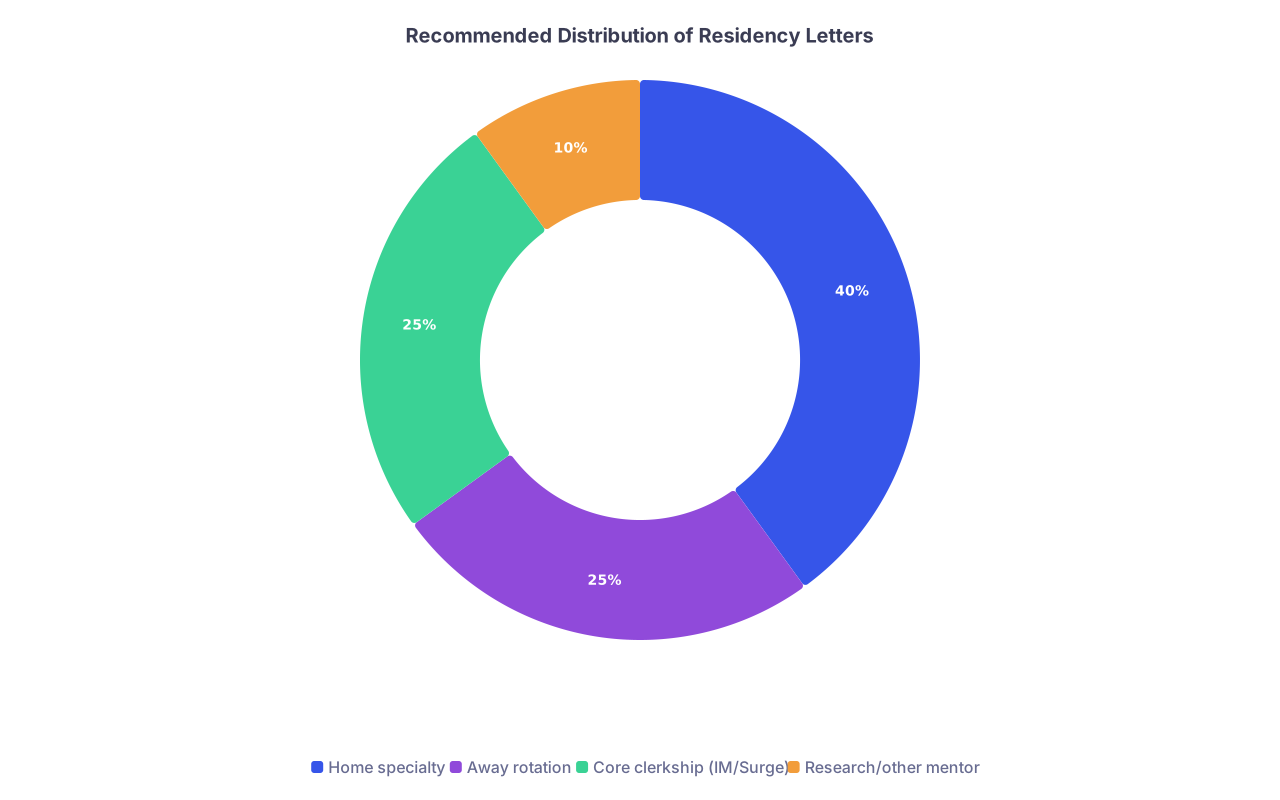
| Category | Value |
|---|---|
| Home specialty | 40 |
| Away rotation | 25 |
| Core clerkship (IM/Surge) | 25 |
| Research/other mentor | 10 |
Your target mix (for most specialties):
- 1–2 strong letters from your chosen specialty (home + away if possible).
- 1 letter from internal medicine or surgery (depending on specialty and program norms).
- 1 from a research PI, longitudinal mentor, or other faculty who knows you well.
If one mentor relationship is fragile, you should:
- Strengthen at least two others aggressively.
- Ask early, while they remember you at your peak.
- Give them specific bullet points to highlight (based on what they actually saw).
You want redundancy. If the repaired mentor writes a mediocre letter, the others can blunt the damage.
8. How To Handle It If The Repair Fails
Sometimes you do everything right and it still feels off. Or they decline the letter. Or they accept and you feel sick about what they might write.
Here is how to limit the fallout.
A. If they decline the letter
Accept this as a gift. Truly. A weak “yes” is worse than a clear no.
Your response:
“Thank you for your honesty and for considering it. I appreciate the time you took to teach me during the rotation and the feedback you provided.”
Then:
- Pivot to other mentors immediately.
- Consider doing an additional elective or sub‑I to generate another strong letter if timeline allows.
B. If they agree but you remain uneasy
Reduce risk by:
- Sending them a short “highlights” document of what you learned and achieved with them. Not fake, just curated.
- Ensuring your other letters are from very strong advocates who know you well.
- Double-checking your personal statement, CV, and MSPE to make sure they tell a consistent positive story.
Programs look at the whole pattern:
- If 3 letters are glowing and 1 is bland or slightly cool, many will assume personality or style mismatch.
- If they are all lukewarm, that is a pattern. That is your real problem.
So stack the deck: make this one letter one data point, not the whole story.
9. How To Avoid Awkward Mentor Situations Next Time
Since you are in repair mode now, you may as well learn how to prevent this from happening again.
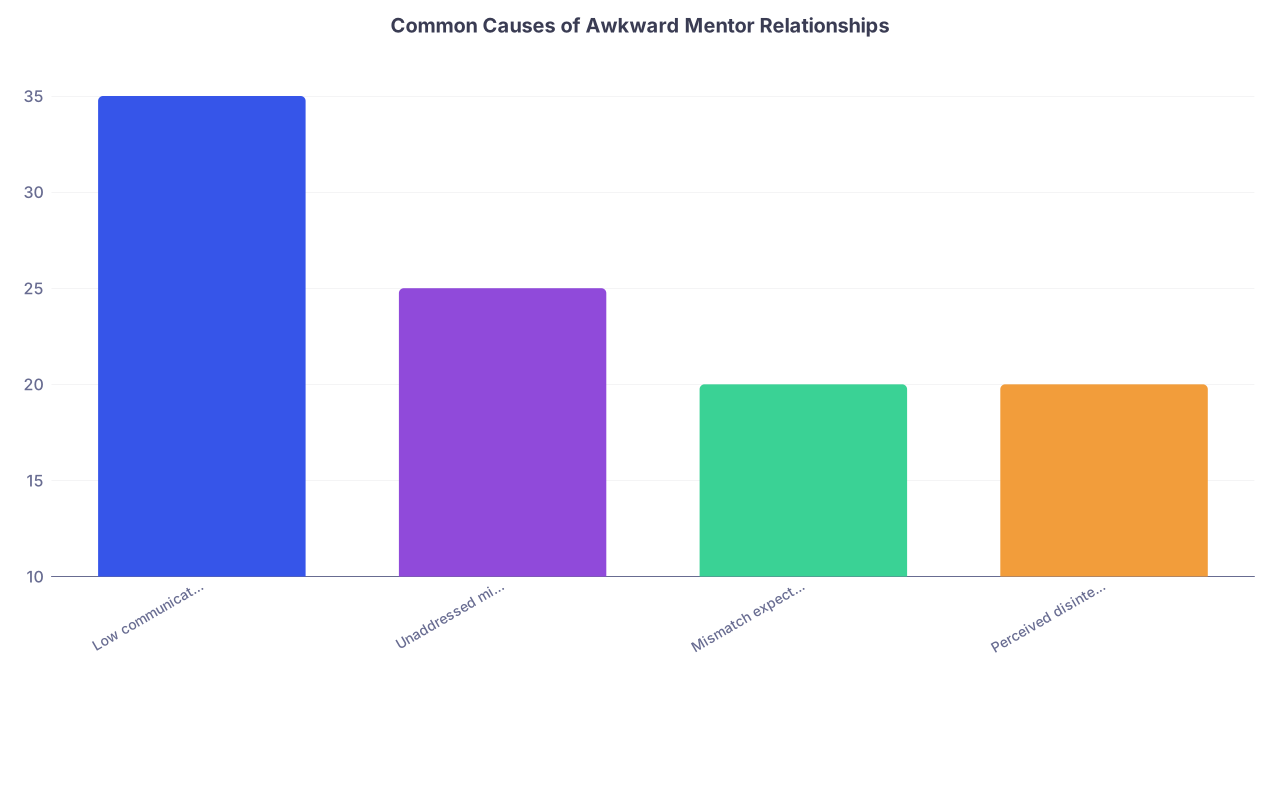
| Category | Value |
|---|---|
| Low communication | 35 |
| Unaddressed misstep | 25 |
| Mismatch expectations | 20 |
| Perceived disinterest | 20 |
Three habits prevent 80% of these messes:
Day‑1 expectation check with any potential letter writer
- “I am excited to work with you this month. I am hoping to grow in [specific area], and I know letters are coming up this year, so I want to make sure I am performing at the level you expect.”
- This sets you as deliberate and aware from the start.
Mid‑rotation feedback checkpoint every time
- “We are halfway through—how am I doing compared to where a strong student at this level should be?”
- Most attendings never volunteer big concerns unprompted. You have to pull it out of them while there is time to fix it.
End-of-rotation closure
- “Thank you for working with me this month. Your feedback about [X] has been particularly helpful. I have already started doing [Y] differently. If you ever think of additional ways I could improve before residency, I would value your thoughts.”
- You leave them with “teachable, grateful, improving,” not just “quiet student #7.”
These are small, boring phrases that quietly change how attendings talk and write about you.

Quick Summary: What Actually Works
If you skimmed everything, here is the distilled playbook:
Name the problem type
Distant, mildly tense, style mismatch, or serious conflict. You cannot fix what you refuse to define.Run a focused repair protocol
- Increase structured contact and feedback.
- Acknowledge specific missteps once if necessary.
- Demonstrate visible change in ways they actually value.
Ask directly for a “strong” letter or none at all
Protect yourself from vague, lukewarm recommendations. A clear “no” is better than a quiet application killer.
FAQ
1. What if the attending barely remembers me but I need another letter from that specialty?
Then you do not “repair”; you rebuild from scratch. Send a concise email reminding them who you are, what you did on their service, and how you have grown since. Offer a one-page summary of specific patients, tasks, and feedback you received from them. Ask explicitly if, given that context, they would feel comfortable writing a strong letter. If there is any hesitation or they say they “can write something,” thank them and move on. You are better off doing another short elective or sub‑I and earning a fresh, detailed letter than dragging a half-forgotten, generic one into ERAS.
2. How many “repaired” relationships is too many to rely on for letters?
If one of your four letters comes from a relationship you had to actively repair, fine. That is normal. If two, you are pushing it but still manageable if the others are very strong and unambiguous. If three or more of your potential writers come from awkward or conflicted relationships, your problem is bigger than LOR strategy. That pattern suggests chronic communication or professionalism issues you must address directly—ideally with a trusted advisor, dean, or senior resident who will give you blunt feedback and help you change specific behaviors before residency.