
What do you do when you change schools right before residency applications and suddenly realize: “My best letter writers are 500 miles away, and no one here even knows my name”?
You’re not the first person in this mess. And yes, it is a mess. But it’s fixable if you’re deliberate and a little aggressive about it.
This is the playbook I’d use if you’re starting MS4 (or about to) at a new med school and you need strong residency letters on a short clock.
1. Get Real About Your Timeline And Constraints
First, let’s be blunt: you’re on a compressed schedule.
You’re dealing with:
- New school
- New system, new EMR, new hierarchy
- No existing reputation
- Residency apps and ERAS deadlines that do not care about your transition
You can’t operate with the usual slow-burn approach of “I’ll impress people over time.” You need intentional, front-loaded relationship building.
Understand your actual deadlines
Most people underestimate how early this needs to move. Rough guideline:
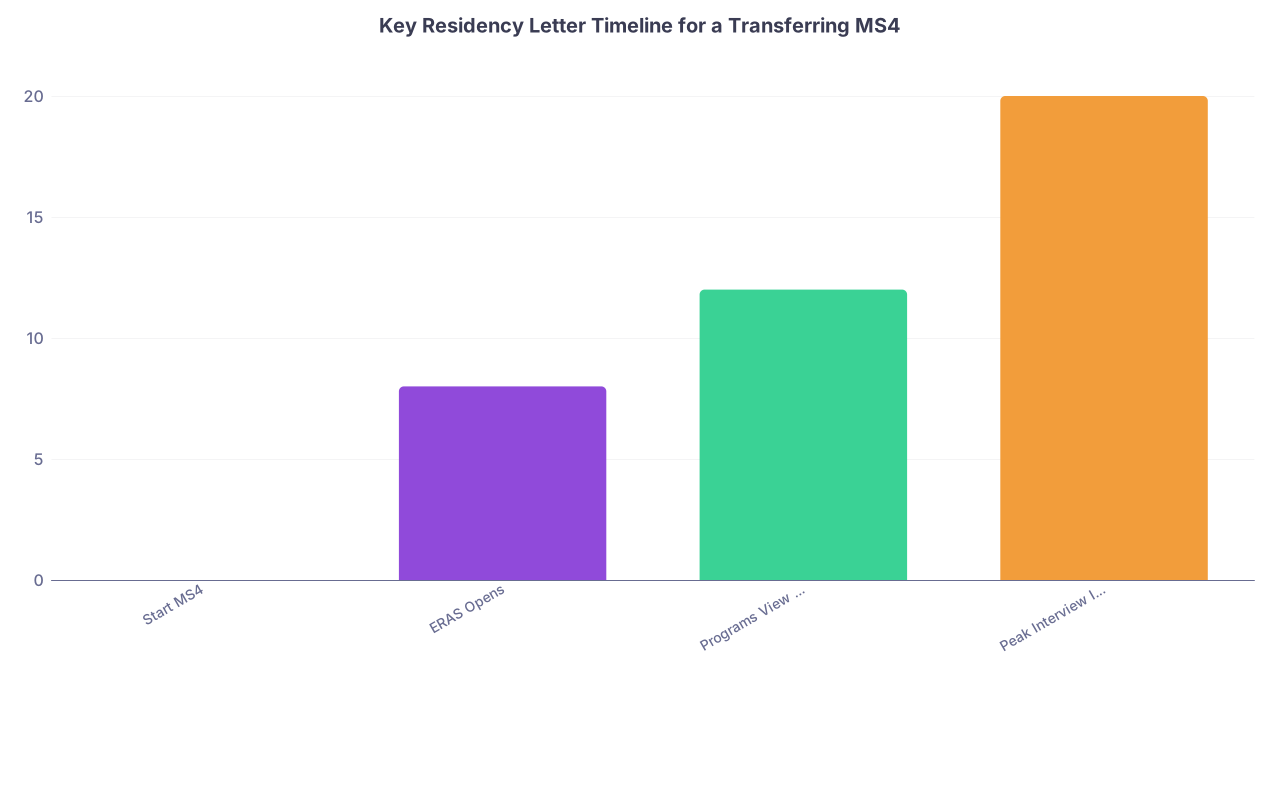
| Category | Value |
|---|---|
| Start MS4 | 0 |
| ERAS Opens | 8 |
| Programs View Apps | 12 |
| Peak Interview Invites | 20 |
- MS4 start (Month 0): You arrive at the new school.
- ERAS opens for editing (around early June).
- Programs can see applications (around mid-September).
- Most interview invites go out September–October.
So if you show up in May/June/July, you have somewhere between 4–10 weeks on early rotations to:
- Get noticed
- Get trusted
- Get someone to commit to writing you a letter
- Give them time to actually write it
That’s tight. So you can’t just “see how things go” on rotations. You need a plan before Day 1.
2. Decide: Old School Letters vs New School Letters
This is the first strategic decision you have to make: how much can you lean on letters from your old institution vs how much must you build at the new place?
The mix that usually works
For most transferring MS4s, the ideal mix looks like:
| Letter Type | Source | Priority |
|---|---|---|
| 1 Specialty letter (strong) | Old or New | High |
| 1 Specialty letter (recent) | New school | High |
| 1 Department chair/SLOR (if req) | New school | High |
| 1 Additional strong clinical | Either | Medium |
Why this matters:
- Programs want to know you can perform well in their current environment (recent, local letters).
- But if your best, most detailed letters are from your old school, you absolutely still use them.
Do not throw away excellent letters from your previous institution just because you transferred. That would be dumb.
When old letters are gold
Keep using old letters when:
- You had a longitudinal relationship (sub-I, research, multiple rotations).
- They can comment on growth, judgment, reliability, and teamwork.
- The writer is known in the field (big-name faculty, program director, chair).
I’ve seen applicants match with:
- 2 letters from old institution
- 1–2 from new institution
- A standardized department letter from the new place
The key is: at least one strong letter that’s recent and clearly from the new program’s environment.
3. Lock Down Your Old-School Letters Immediately
If you’re reading this and you haven’t yet left your original school: pause, and get your letters set up before you go.
If you’ve already left: you’re not doomed, but you’ll need to be smart and respectful when asking.
Before you transfer (ideal scenario)
You want:
- 1–2 specialty letters (ideally from sub-I or home rotation attendings)
- 1 additional clinical letter from someone who really knows your work
- Possibly a research letter if you have serious output in that field
What to do practically:
- Identify your best three potential writers.
- Email them with a clear subject line:
“Request for Strong Residency LOR – [Your Name], Transferring to [New School]” - Ask explicitly if they can write a “strong, positive letter” for residency.
- Explain the transfer briefly: one sentence, no drama.
- Offer a meeting or Zoom to review your plans and keep the relationship warm.
Do not over-explain your transfer. You’re not on trial.
If you’ve already left
You can still do this. The longer you wait, the weaker the letter will be, because memory fades.
Email template structure (adjust to your personality):
- Remind them who you are and what you did together.
- Mention the transfer as a factual update.
- Clarify your target specialty and application year.
- Ask for a strong letter and offer an updated CV and personal statement draft.
- Offer a quick Zoom/phone catch-up.
If they say yes, follow with:
- CV
- Step scores
- Short brag sheet: 4–6 bullet points of specific cases/qualities they saw in you
- Your specialty and why you’re going into it
- Deadline you’re aiming for (give them at least 3–4 weeks)
Then back off. Don’t nag every 3 days. One polite follow-up a week before your soft deadline is fine.
4. Hit the Ground Running at the New School
Now the harder part: building new LOR relationships fast.
You essentially need to condense what most people do over a year into 4–8 weeks.
Strategy: front-load your “letter-earning” rotations
You want your first 1–2 rotations at the new school to be:
- In your target specialty, or
- In a closely related, high-intensity setting (ICU, inpatient wards, ED – depending on specialty)
Because if you wait until October to take your home specialty rotation, you’ve already submitted ERAS with mediocre or old letters.
If scheduling isn’t set yet, you fight (respectfully) for:
- An early sub-I in your desired field, or
- At minimum, an early audition-type rotation with faculty who write letters
If scheduling is already locked and not ideal, you adjust by:
- Identifying which rotation has the highest faculty contact and continuity
- Finding out in advance which attendings are known to write good letters
Email the clerkship director or coordinator:
- “I recently transferred to [School] and am applying in [Specialty]. On [Rotation], are there particular faculty who commonly write residency letters for students?”
You’re not the first person to ask that, and good coordinators will tell you.
5. How to Make Yourself “Letter-Worthy” Fast
Here’s the part people hate: you can’t just “be a good student” and hope an attending reads your mind. You must be intentional.
Day 1–2: State your goals out loud
Yes, this feels awkward. Do it anyway.
On the first or second day with an attending or senior resident:
- “I’m a new transfer student, applying in [Specialty] this cycle. I’m really hoping to get to know a few faculty well enough for letters, so I’d love any feedback on how I can be most useful and improve quickly.”
That does a few things:
- Explains your urgency.
- Signals that you’re serious.
- Gives them permission to be honest with you.
Most attendings respect that transparency. Some will ignore it. That’s fine; those are not your letter writers.
Weeks 1–2: Behave like a sub-I, not an observer
You need to be the student they remember months later when they’re writing letters. That means:
- Owning patients (as much as you’re allowed)
- Following up lab/imaging results without being asked
- Writing solid notes (ask for feedback early, then clean it up)
- Pre-rounding like you’re the only one who cares about the patient
You’re not shooting for “no one complains about you.” You’re aiming for “if I had a position, I’d take this student as a resident tomorrow.” That’s a different bar.
Feedback loop: aggressively seek critique
Once a week, pick 1–2 attendings or seniors and ask:
- “Do you have any specific feedback on how I’m doing or anything I should change to be closer to intern level?”
You will not like all the answers. Take them, implement them fast, then circle back:
- “You mentioned last week that my plans were too broad. I’ve tried to be more specific the last few days. Any better?”
That’s what builds a narrative they can later use in a letter: actual, observed improvement.
6. When and How to Ask New Faculty for Letters
Timing matters. Ask too early, you get vague fluff. Ask too late, they’re gone or overbooked.
Usually best window
- Toward the end of a high-contact 2–4 week rotation
- After you’ve had at least 1–2 direct feedback conversations
- After you’ve done something substantial they’ve seen (good presentation, key patient, call performance, etc.)
Who to target:
- Attending you worked with ≥ 5–7 days and directly presented to
- Maybe a second attending if you split a month but had repeated contact
- Occasionally a senior resident or fellow can co-write with faculty (depends on department culture)
How to ask without sounding desperate
You are desperate, but we don’t lead with that.
In-person, near the last few days:
“Dr. X, I’ve really appreciated working with you this month and your feedback. I’m applying into [Specialty] this cycle. Do you feel you know my work well enough to write a strong, supportive letter for my residency application?”
The key words: “strong, supportive.” If they hesitate or say something like “I could write a generic letter” – that’s a no. Take the hint and move on.
If they say yes:
- Confirm their preferred email.
- Ask if they prefer you to send CV / PS / rotation evaluation.
- Clarify timeline: “Would it help if I get you my materials by [date] so you have time before ERAS?”
Then follow up with a concise, organized email.
7. Explaining Your Transfer In Letters And Applications
This is the part everybody obsesses over way too much.
Programs want to know:
- Are you stable?
- Was this transfer for a reasonable reason?
- Is there any academic or professionalism red flag?
Your goal isn’t to tell your life story. It’s to answer “Are you a risk?” with “No” as quickly as possible.
How your letter writers should frame it
For your old-school writers, you can explicitly suggest language (in your brag sheet) like:
- “During his time at [Old School], before transferring to [New School] for family reasons, [Name] consistently demonstrated…”
- “Although she completed MS4 at [New School], I worked with her extensively during MS3 and can speak to her clinical abilities…”
You’re not writing the letter for them, but you can absolutely say:
“I want to be transparent in my application about transferring for [brief reason]. If you feel comfortable, it would help if you could briefly mention that my performance and professionalism at [Old School] were solid and not the reason for my transfer.”
For your new-school writers:
- They don’t need a long explanation.
- A simple one-liner in the letter like: “Despite joining us only for her final year after transferring from [Old School], she quickly integrated into our system and…” is enough.
You do NOT want your letters to sound like they’re defending you from some unknown scandal. Neutral, factual, short.
8. If Things Go Sideways On Your First Rotation
Sometimes you don’t click with anyone on that first rotation. Or the attending is checked out. Or the team is chaos. Or you’re just off your game.
You still have moves.
Back-up strategies
Grab a letter from the least bad attending you worked with consistently, if they can be positive.
On the next rotation, be even more explicit from Day 1 about needing a letter.
Consider:
- Acting internship/sub-I in your specialty ASAP.
- An away rotation at a place that’s used to writing letters for visiting students.
- A research month with a clinically active PI who also works with residents.
One more underused option:
- Ask clerkship or sub-I directors:
“Are there specific attendings known for writing detailed letters if students perform well? I want to make sure I’m working with faculty who have bandwidth to support my application.”
That’s not being demanding. That’s being intentional.
9. Coordinating Old and New Letters in ERAS
When you’re finally uploading letters, you need to be strategic about who sees what.
High-level rule:
- Programs in your new school’s region: prioritize at least one letter from the new institution.
- Programs anywhere: always include your strongest 2–3 letters, regardless of origin.
Most specialties are happy with 3 letters. Some want 4. Check your specialty norms.
If a program wants a chair’s letter or departmental letter from your new place:
- Do not procrastinate on asking the department office how that process works.
- Often, they’ll want:
- Recent rotation evaluations
- CV
- Sometimes input from faculty you’ve worked with
Your job is to make sure those people have something to say about you because you’ve already done the work above.
10. Concrete 4-Week Action Plan
Let’s put this all into a simple, brutal timeline. Assume you’re starting MS4 now and apps go live in ~8–10 weeks.
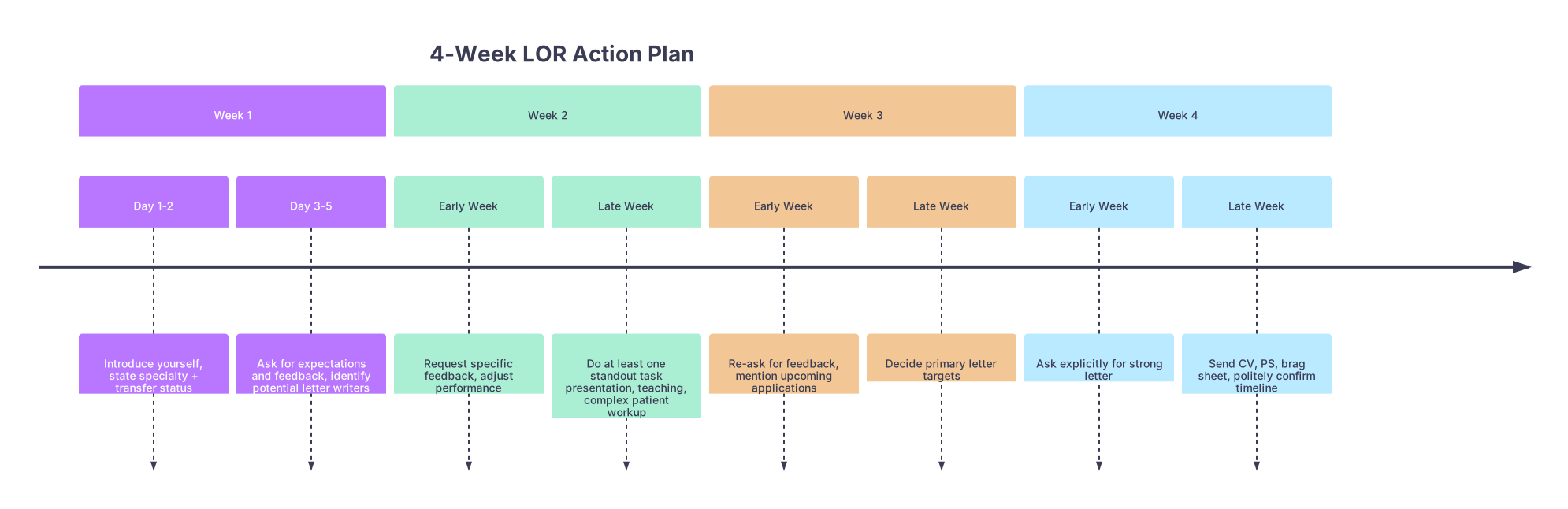
| Period | Event |
|---|---|
| Week 1 - Day 1-2 | Introduce yourself, state specialty + transfer status |
| Week 1 - Day 3-5 | Ask for expectations and feedback, identify potential letter writers |
| Week 2 - Early Week | Request specific feedback, adjust performance |
| Week 2 - Late Week | Do at least one standout task presentation, teaching, complex patient workup |
| Week 3 - Early Week | Re-ask for feedback, mention upcoming applications |
| Week 3 - Late Week | Decide primary letter targets |
| Week 4 - Early Week | Ask explicitly for strong letter |
| Week 4 - Late Week | Send CV, PS, brag sheet, politely confirm timeline |
If you’re reading this later than ideal, compress it. Do Week 1–2 steps in 5–7 days. It’ll feel intense. It is.
11. What Actually Matters Most (And What Doesn’t)
What matters:
- At least one very strong, detailed letter in your specialty (old or new institution).
- At least one recent letter from your new school that says you integrated quickly and performed at an intern level.
- No red flags or weird vibes around your transfer.
What doesn’t matter as much as you think:
- That every letter is from your new school.
- That someone explains your transfer in excruciating detail.
- That your letters come from “famous” people who barely know you. A mid-career, engaged faculty who’s actually watched you work will write a better, more influential letter than a chair who vaguely remembers your name.