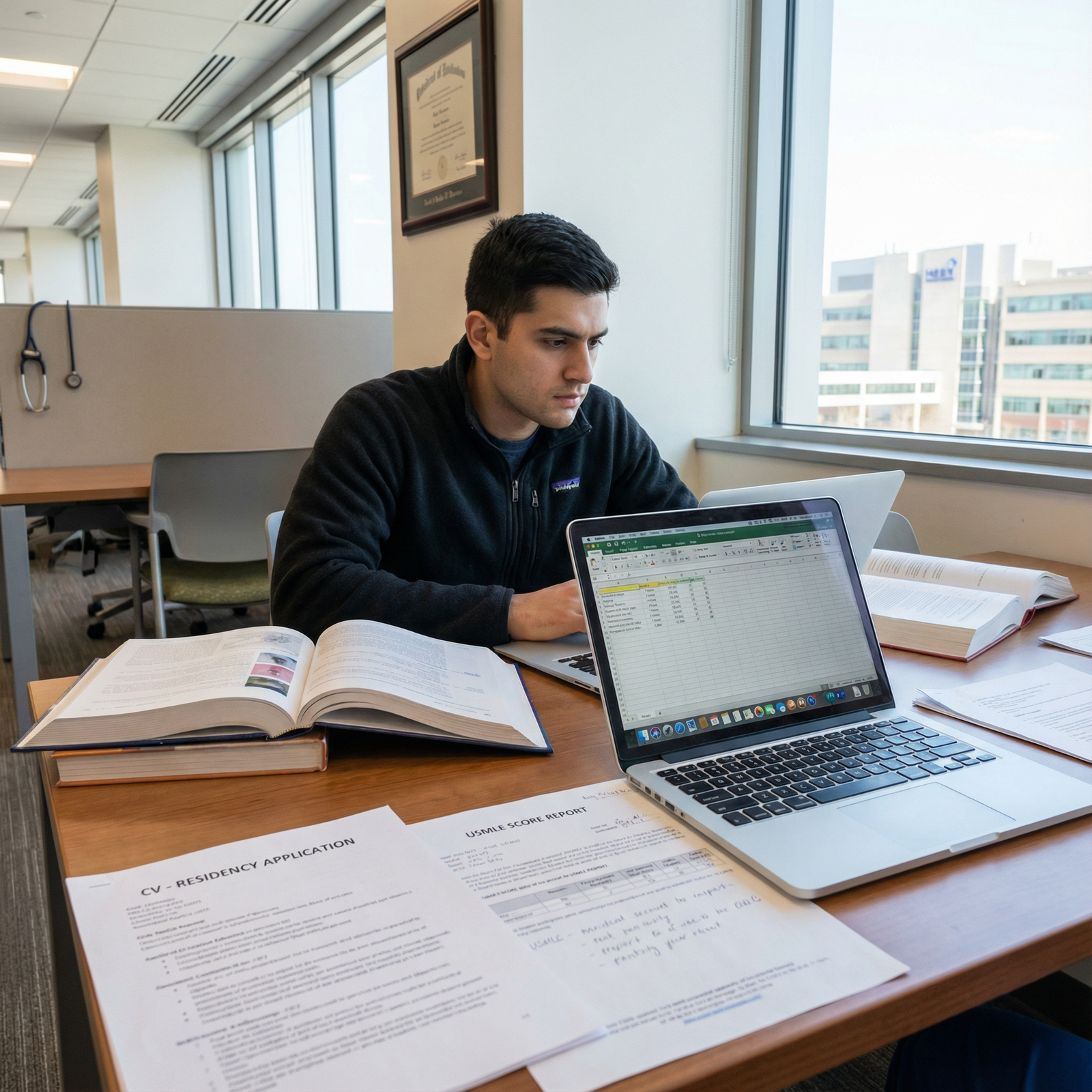
You open the score report. You already know, somehow, before your eyes finish scanning the page. Fail.
And the worst part isn’t even the sting. It’s the immediate second thought: What is this going to do to my Match chances? Not next month. Not abstractly. Right now. To the specialty list you built. To the mentors you were about to email. To the application you thought was finally taking shape.
I’ve seen this moment wreck people for a week straight. The spiral is predictable. First shame. Then panic. Then weird little bargains with yourself—maybe programs won’t care that much, maybe you can just “focus on your strengths,” maybe if the rest of the app is solid this will somehow blur into the background. It won’t.
A failed Step attempt is not the same as a low score. A low score says you performed below average or below your target. A failed attempt says something harsher to a reviewer: this applicant may not have been ready for board-level material at the time of testing. Fair or not, that triggers concern about reliability, risk, future exam performance, and how much support you might need.
That’s why applicants get tempted to hide, delay, avoid, or overcompensate with a flood of excuses. Bad move. Hiding a failure never makes it smaller. It just makes your judgment look worse when the truth inevitably surfaces.
So let’s be direct. A failed attempt can absolutely hurt your Match odds. Sometimes a lot. But it doesn’t have to end them. What matters now is not pretending it’s minor. What matters is understanding exactly how programs read it, where the damage really happens, and how to rebuild your file so the failure becomes one part of your story—not the whole story.
Why a failed attempt hurts more than a low score
Programs don’t read a fail and a low pass the same way. They just don’t.
A low score raises concern about test performance. A failed attempt raises concern about readiness. That difference matters. If you scored poorly but passed, a program may think, “This applicant struggled, but cleared the bar.” If you failed, the thought is more like, “Can this person handle the knowledge base required to progress safely?” That’s a much uglier question.
Here’s what a failed attempt tends to signal to programs:
- You were not ready on test day.
- You may be at risk for another board failure later.
- Your training timeline could become more complicated.
- You might require more oversight than another applicant.
- You are, bluntly, a bigger gamble.
That last one is the real issue. Residency programs hate uncertainty. They want residents who will show up, do the work, pass required exams, and not create preventable problems. A failed Step attempt turns you into a risk-management discussion.
And sometimes the damage happens before anyone even hears your explanation. Screening filters are real. Plenty of programs use hard screens for prior failures, especially when they’re flooded with applications. So the file may never reach the “but I improved later” stage. That’s the cruel part. Your narrative can be excellent and still lose to a checkbox.
Specialty matters too. If you’re aiming at dermatology, orthopedic surgery, ENT, plastic surgery, ophthalmology, or similarly competitive fields, a failed attempt often hits harder because those programs can afford to be picky and usually have stronger exam metrics across the pool. Internal medicine, family medicine, pediatrics, pathology, psychiatry, and some community-based programs may be more forgiving—but “more forgiving” does not mean “doesn’t care.”
If you take one thing from this section, take this: a failed attempt is a risk marker, not just a score problem. If you treat it like a score problem, you’ll make bad decisions.
What to do immediately after the fail
The first 48 hours matter. Not because you need to solve everything instantly, but because this is when people make dumb decisions.
First: stop doom-scrolling Reddit and texting twelve classmates for amateur predictions. You do not need more panic. You need facts.
Here’s what to do right away:
Confirm the official details.
Know exactly which exam, when the failure occurred, when you’re eligible to retake, and how it affects your graduation or application timeline.Figure out whether this is isolated or part of a pattern.
Be honest. Was this a one-off caused by bad timing and poor prep structure? Or does it fit with repeated shelf struggles, delayed exams, weak basic science performance, or chronic test anxiety? Programs notice patterns. So should you.Meet with an advisor fast.
Not just any warm body. Talk to someone who understands residency applications in your field—student affairs dean, clerkship director, specialty advisor, trusted PD mentor. You need a real strategy conversation about retake timing, specialty impact, and whether your current cycle plans still make sense.Build a remediation plan on paper.
Not vibes. Not “I’ll study harder.” A real plan:- dedicated study block
- question bank targets
- content review method
- practice exam schedule
- tutoring or academic support if needed
- mental health or wellness support if burnout, depression, panic, or life stress played a role
Decide whether applying this cycle is still smart.
This is where people get stubborn. Sometimes the correct move is still to apply. Sometimes it absolutely isn’t. Pride is expensive.
A few mistakes to avoid because I’ve watched applicants make them over and over:
- Submitting early with a messy story. Early is not magical if your application looks unstable.
- Writing a dramatic essay about suffering. Programs want accountability and recovery, not a memoir.
- Assuming one great rotation fixes everything. It helps. It does not erase a failed board exam.
- Retaking too fast without changing anything. If your plan is identical, expect identical results.
Right after a fail, your job is not to defend yourself. Your job is to diagnose the problem, fix the process, and build evidence that the problem is actually fixed.
How to rebuild your application so the failure matters less
You do not “spin” your way out of a failed Step attempt. You outgrow it with evidence.
The most important piece is obvious: pass the retake. Strongly. Cleanly. As soon as you can do it safely. A failed attempt followed by another weak or delayed performance keeps the concern alive. A decisive pass starts to change the story.
After that, your application needs to show a pattern of stability and improvement. Programs are trying to answer a simple question: Was that failure a true warning sign, or was it a setback you corrected? Your file needs to scream the second option.
Here’s what actually helps:
1. Put recent proof of competence in the file
That can include:
- better shelf performance
- stronger clerkship grades
- solid sub-I or acting internship evaluations
- good Step/COMLEX follow-up performance
- consistent, on-time, professional behavior
Residency reviewers love recent data. If your failure is old news but your current clinical work is strong, that matters. Not perfectly. But materially.
2. Get letters from people who’ve watched you recover
This is not the time for generic praise. You want letter writers who can say things like:
- this student is coachable
- this student responds well to feedback
- this student functions reliably on the team
- this student’s clinical judgment and work ethic are stronger than one exam suggests
That kind of advocacy helps because it addresses the risk question directly. A strong attending saying, “I would trust this person in residency,” carries real weight.

3. Fix your specialty strategy if your original plan no longer fits
This is where realism beats ego.
If you have a failed attempt and you’re still applying ultra-competitive with no backup, that’s not confidence. That’s denial wearing a blazer.
You may need:
- a broader specialty list
- a wider geographic range
- more community programs
- a parallel plan with prelim or transitional options
- a serious backup specialty
That doesn’t mean “give up on your dream” automatically. It means respect the math. If your profile changed, your application plan should change with it.
4. Address the failure briefly in your personal statement or application only if needed
Don’t make it the center of your identity. Most applicants do this badly. They either ignore it entirely when the file clearly demands an explanation, or they spend four paragraphs trying to sound profound. Both are mistakes.
A good explanation is short:
- what happened
- what you changed
- what the result was
That’s it.
For example:
“I failed Step 1 after taking the exam with an ineffective study structure and inadequate readiness testing. I rebuilt my approach with faculty advising, a dedicated remediation plan, and scheduled practice benchmarks, then passed on retake. Since then, my clinical evaluations and exam performance have been consistently stronger.”
Clean. Adult. No melodrama.
5. Be excellent in boring ways
People underestimate this. When an application has a red flag, every other sign of reliability matters more.
Answer emails. Show up prepared. Be easy to work with. Don’t create professionalism concerns on top of an exam failure. I wish this didn’t need saying, but I’ve seen applicants fail an exam and then become erratic, defensive, or flaky during rotations. That’s how one problem becomes three.
Your goal isn’t to erase the failed attempt. You can’t. Your goal is to make it look old, contained, and no longer predictive.
If you’re applying this cycle, here’s the damage-control strategy
If the cycle is already here, you need a plan that is practical, not pretty.
Start with the hard question: Can you retake and pass in time for programs to see a coherent application? If yes, that’s usually the best path. If no, you need honest advice about whether applying now is worth the cost, energy, and likely outcome.
If you must apply this cycle, do it like this:
Step 1: Finish the retake if at all possible
A failed attempt with no retake result leaves the question open. Programs hate open questions. A passed retake doesn’t solve everything, but it closes the most dangerous gap.
Step 2: Don’t submit a fantasy version of your file
Programs will notice the failure. Stop acting like they won’t. If your app reads like the issue doesn’t exist, you look evasive. That’s worse than the failure itself.
Step 3: Build a sensible program list
This means:
- fewer reach-heavy lists
- more programs with a history of holistic review
- more community and mid-tier options if appropriate
- parallel backup specialties if your target field is highly competitive
You are not weak for adjusting. You are smart.
Step 4: Prepare your interview answer now
You need a 20- to 40-second explanation. Not five minutes. Not tears. Not a courtroom defense.
Use this structure:
- Acknowledge it clearly: “I did fail Step 2 on my first attempt.”
- Take responsibility: “I sat before I was ready and my preparation approach was not effective.”
- State what changed: “I rebuilt my study structure, used faculty guidance, and tracked readiness with practice exams.”
- End with results and readiness: “I passed the retake, and since then my clinical performance has been strong. I’m confident in how I learn and how I’ll function in residency.”
That’s the answer. Short. Steady. Then pivot.
Interviewers are listening for maturity, not perfection. They want to know whether you make excuses, whether you understand what went wrong, and whether the problem is likely to happen again.
Step 5: Expect more scrutiny in competitive fields
If you’re applying anesthesiology, radiology, surgery, OB-GYN at selective programs, or any field where application volume is high and test metrics still matter a lot, the failed attempt may carry extra weight. Don’t wait until October to create backup plans. Build them now.
Step 6: Let your advocates advocate
If a trusted mentor can call a program, email a PD, or write a genuinely strong letter that puts your failure in context and supports your readiness, that can help. Not everywhere. Not magically. But it can help a real file get a real look.

Here’s the confidence part, but the honest version: a failed Step attempt does not end the Match. I’ve seen applicants recover and match well. But the ones who recover don’t do it by minimizing the problem. They do it by responding like professionals—fast, clearly, and with real evidence.
The bottom line: don’t just recover—reposition
A failed Step attempt hurts because it changes how programs assess risk. That’s the truth. It can lower interview volume, trigger filters, and force tougher specialty decisions. Pretending otherwise is dumb.
But this is also true: your response can materially improve your odds.
Your priorities are simple:
- Pass the retake.
- Show improvement everywhere else you can.
- Give a clear, credible explanation when asked.
If you’re staring at this situation right now, here’s what to do today:
- schedule the advisor meeting
- map the retake timeline
- write the remediation plan
- reassess your specialty and program list
- draft and practice your short interview explanation
That’s the work. Not wishing. Not hiding.
If the failed attempt is already on your record, your goal is no longer to erase it. Your goal is to prove it no longer defines your readiness.
FAQ
1. Will one failed Step attempt automatically keep me out of residency?
No. It hurts your odds, but it does not automatically shut the door. Programs vary a lot, and many applicants still match after one failed attempt. The difference is usually what happened next: a solid retake, stronger recent performance, and an application strategy that actually fits reality.
2. Should I still apply this cycle if I failed Step?
Only if the rest of your file can support that decision and your advisors agree the timing is workable. If you can retake and pass before programs seriously review your application, that usually helps. If you can’t, you may need to delay, broaden aggressively, or rethink specialty goals instead of forcing a weak cycle.
3. How do I explain a failed Step in interviews without sounding like I’m making excuses?
Keep it brief and accountable. Say what happened, say what you changed, and say what the result was. Then move on. Don’t give a long emotional backstory, don’t blame the exam, and don’t act offended that they asked. Calm ownership plays much better than self-protection.
4. Does a failed Step matter less if I’m applying to a less competitive specialty?
Usually, yes. But less does not mean little. Programs in less competitive specialties may be more willing to look past one failed attempt if the rest of the file is strong. They still want proof that you can pass licensing exams, function reliably, and not carry unresolved testing problems into residency.