
What if you finish this post-bacc, apply, maybe even reapply… and you’re 30+ and still not in medical school—did you just waste years chasing something you’re already “too old” to start?
That’s the fear, right? Not just “Am I competitive?” but “Am I delusional?”
(See also: What If My Post-Bacc GPA Isn’t a 4.0? How Med Schools Actually See It for more details.)
You’re counting:
- How old you’ll be when you matriculate.
- How old you’ll be when you finish residency.
- How much debt you’ll be in.
- How far “behind” your friends you’ll be.
And then your brain helpfully provides the worst-case montage: everyone else at orientation is 22, you’re the weird old one, adcoms roll their eyes at your age, interviewers silently think “Why now? Why so late?” and the match somehow punishes you for being “older.”
Let me cut through that.
The ugly truth about age and med school (that’s not actually that ugly)
There is age discrimination in medicine. Not the cartoon version where a dean says, “We don’t take anyone over 25,” but more subtle:
- Some people on admissions committees are biased toward the “traditional” timeline.
- Some specialties are more skeptical of older grads (surgery, EM sometimes).
- Some interviewers ask rude stuff like, “So you’ll be… what… 40 when you’re done?” like you haven’t done that math 500 times already.
But the other truth is this: U.S. med schools admit people in their late 20s, 30s, and even 40s every single year. Not one token person. Loads of them.
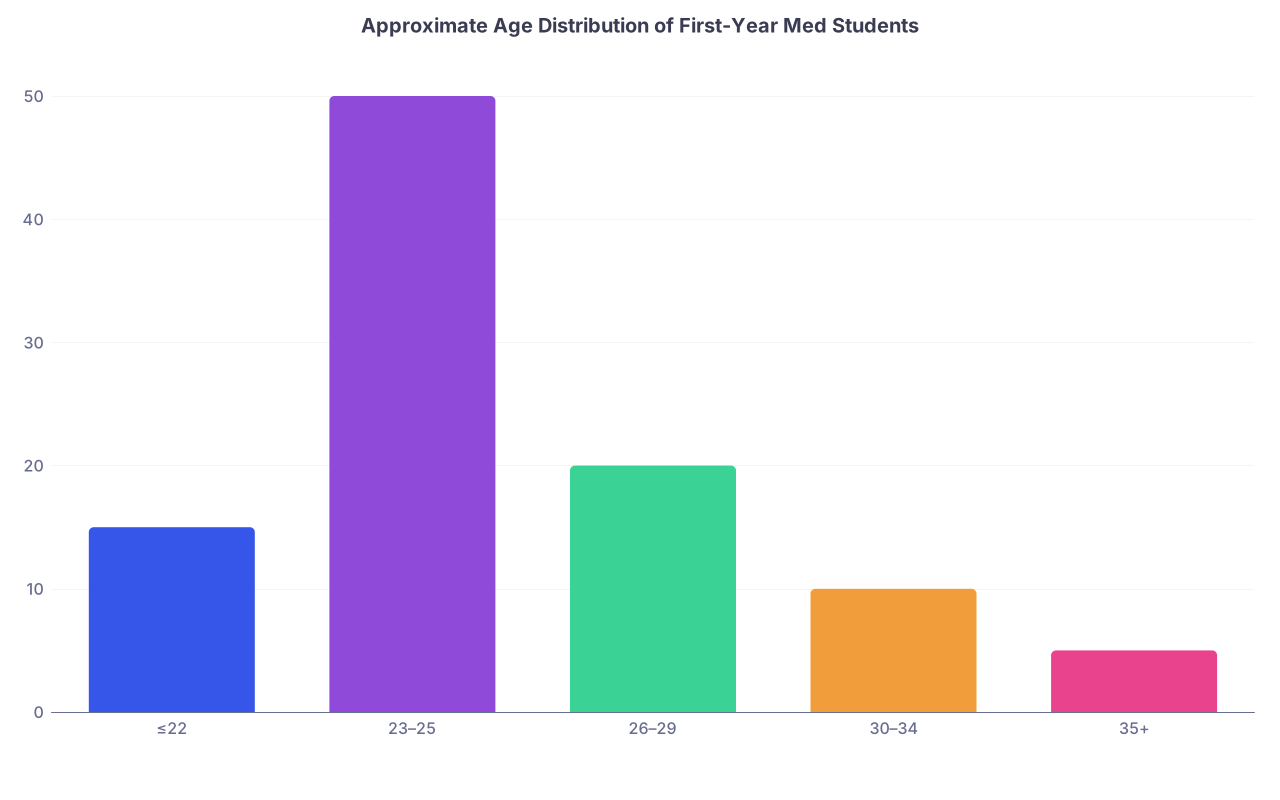
| Category | Value |
|---|---|
| ≤22 | 15 |
| 23–25 | 50 |
| 26–29 | 20 |
| 30–34 | 10 |
| 35+ | 5 |
I’ve seen:
- A 34-year-old former teacher start at a mid-tier MD program after a post-bacc.
- A 31-year-old ex-software engineer start DO school with a 3-year-old at home.
- A 29-year-old bartender-turned-scribe go to a top-30 MD program after a DIY post-bacc.
Not unicorns. Just people who did the unsexy, consistent work and didn’t let the “too old” narrative derail them.
Age is not the main question adcoms are asking.
It’s: “Is this person academically ready?” and “Do they actually understand what they’re getting into?”
If your post-bacc shows you can handle the coursework and your story clearly explains why now in a believable way, your age is context, not a death sentence.
The math spiral: “I’ll be 40 when…”
Let’s walk through the nightmare math you keep doing in your head, because avoiding it doesn’t make it less loud.
Say you’re:
- 26 starting your post-bacc
- 27–28 finishing it
- 29 applying
- 30 starting med school (if all goes reasonably well)
Then:
- 34 when you graduate
- 37–38 finishing a 3-4 year residency
- 40+ if you do fellowship
And you’re thinking: “So I’ll be 40 before I’m finally an attending. That’s insane.”
Here’s the uncomfortable counter-question:
You’re going to turn 40 anyway. Do you want to be 40 and a physician, or 40 still wondering if you blew your one shot because you were afraid of being “behind”?
The whole “behind” narrative is trash, by the way. Behind what? The imaginary schedule where everyone has their life neatly assembled by 28? Go talk to your friends in their early 30s. Half of them are burned out or switching careers or quietly miserable.
Also, medicine is a long game. You’re not doing a 2-year coding bootcamp. You’re committing to a career that lasts decades. Starting at 30 vs 22 feels massive now. At 50, it won’t.
The more serious question isn’t “How old will I be?”
It’s:
- Can I tolerate this training path emotionally and physically at that age?
- Can I accept being in school while peers are buying houses and having second kids?
- Will the trade-off feel worth it for me, not for some hypothetical ideal timeline?
If you’re doing a post-bacc, you’re already saying, “I’m willing to take the hit.” So the real work is not redoing the age math every day. It’s making sure the path you’re setting up is actually competitive, so the sacrifice has a real shot at payoff.
Does a post-bacc make you look older or more serious?
Here’s the good news: a well-executed post-bacc doesn’t scream “late and confused.” It screams “intentional pivot.”
To adcoms, a strong post-bacc says:
- “I know what med school science is like, and I can handle it.”
- “I didn’t just suddenly panic at 28; I built a structured plan and followed it.”
- “I took a risk on myself, and I didn’t half-ass it.”
Where this backfires is when the post-bacc is:
- Scattered (one class at a time, random schools, no rigor)
- Mediocre (lots of B–/C+, no upward trend)
- Unsupported by clinical experience (you did the classes but barely touched a patient)
Then your age + meh post-bacc looks like: “I’ve been trying for years and still haven’t nailed this.”
If you’re older, the bar is slightly higher. Not on GPA numbers necessarily, but on coherence. Your story has to make sense.
You can’t just say, “I realized I wanted to help people.”
At 30, they want to know: Why medicine and not the other careers you already tried? Why now? What changed? And can you show, with receipts (post-bacc grades, clinical work), that this isn’t a midlife crisis impulse?
If your post-bacc performance is strong, you’re actually in better shape than some 21-year-old who slid through undergrad with a 3.7 but never really proved they can handle 18 credits of hard science while working.
The social fear: “I’ll be the weird old one in med school”
There’s a specific humiliation fantasy here: sitting in an anatomy lab surrounded by 22-year-olds who are talking about college frat stories and TikTok trends you don’t understand, while your back hurts and you go home to a partner, a pet, or literal kids.
So here’s what actually happens.
Most med school classes now have:
- A big chunk of “traditional” students (22–24)
- A noticeable chunk of nontrads (late 20s, early 30s)
- A few older folks (mid 30s+)
You won’t be the only one in your late 20s or 30s. You will feel it at times, though. When:
- Everyone’s planning a last-minute night out and you’re like, “I need to call my babysitter.”
- Some 23-year-old is complaining about being “so old already” and you’re internally screaming.
- Group projects reveal wildly different life stages.
But here’s the flip side: older students often become the emotional anchors. You’ve worked real jobs. You know what actual responsibility feels like. You’ve failed at things already and survived.
I’ve heard younger classmates say things like:
- “I want to be in their anatomy group; they’re actually organized.”
- “She used to be a nurse; I trust her instincts more.”
- “He did consulting before this, he’s good with patients and staff.”
You’ll bring something to the class that a 21-year-old straight-through just doesn’t have: perspective. And no, that doesn’t magically cure imposter syndrome, but it helps you matter in ways beyond grades.
The career fear: “Will being older hurt my residency chances?”
Here’s where your anxiety is probably turning into full-on disaster movies:
“I’ll be 36 applying to residency. Will programs assume I’m slower, less flexible, or a flight risk?”
Some blunt truth:
- Age bias exists more in certain specialties. Surgical fields, EM, very competitive subspecialties can be a bit age-skeptical, especially if you’re 35+ at graduation.
- Community and primary-care oriented programs (FM, IM, psych, peds) are much more open to older grads, especially those with strong life experience and people skills.
But the thing residency directors actually care about most:
- Will you do the work?
- Will you pass your boards?
- Will you not be a nightmare on call or in the team?
If you’re older and:
- You have a strong Step 2 / Level 2 score
- Solid clinical evaluations
- Good letters
- A coherent story
…your age is again context, not a red flag.
I’ve seen older grads match:
- 37-year-old former EMT into EM
- 35-year-old ex-engineer into anesthesia
- 33-year-old teacher into peds
Were they fighting some invisible bias? Probably. Did it stop them? No, because their file didn’t give anyone an excuse to write them off.
If you’re worried about this, your strategy should be:
- Crush your post-bacc, then your med school preclinicals
- Pick a specialty where your age + prior experience is an asset, not a liability
- Get mentors early who know your age situation and can advise realistically
You can’t control every bias, but you can absolutely control whether your application looks like “late bloomer finally locked in” or “perpetually unsure career-hopper.”
When “too old” might actually be the wrong question
There are times when the age worry is a symptom of a deeper problem.
Some red flags where I’d say: pause hard.
- You’re stacking massive debt from post-bacc + future med school, with no realistic plan to manage it, and you’re already financially underwater.
- You keep starting then stopping prep (MCAT, prereqs, volunteering) over and over because you can’t commit. Years pass and nothing truly progresses.
- Your health is fragile enough that the demands of med school and residency are likely to wreck you. Not “I get tired sometimes,” but serious, limiting conditions.
- You don’t actually like clinical work; you just hate your current job.
Those aren’t “too old” problems. They’re “this path might not be aligned with your reality” problems.
Age is easy to obsess over because you can count it. But the questions that really matter are messier:
- Do you light up when you’re in patient care settings, even when it’s exhausting and chaotic?
- Are you willing to tolerate years of being underpaid and overworked for a very delayed payoff?
- Does this still feel like want and not just “I don’t know what else to do”?
If those answers are shaky, then the age question becomes a convenient distraction. Fix the core questions first.
What you can actually do now to make being “older” a non-issue
Let’s say you’re going through with this. You’re in or about to start a post-bacc, and you want to make your age background noise instead of the headline.
Focus on:
Crushing academics in your post-bacc.
Not “solid Bs with a few As.” We’re talking as close to straight As as you can realistically get. You’re trying to prove that whatever happened in undergrad is old news. This is your fresh data set.Lining up real clinical exposure while you’re in the post-bacc.
Scribing, MA work, EMT, hospital volunteering where you’re actually seeing patient care, not filing papers in a basement.Building a story that makes sense.
Write down a brutally honest timeline of your life: what you did, why, what changed, and why medicine emerged out of that—not randomly, but logically. You’ll refine this later into your personal statement, but you need the raw truth first.Talking early to people who’ve done this older.
Not just 24-year-old gunners. Find the 30+ med student, the 40-year-old resident. Ask them what they wish they knew before they started.Getting brutally honest about the finances.
Look up estimated debt loads. Interest. Repayment programs. Don’t flinch. Plan anyway.
You don’t need to fix your age. You can’t.
You need to make your file so solid that your age becomes a flavor, not the entire dish.
FAQ (exactly 6 questions)
1. I’ll be 30+ when I start med school. Is that already “too old”?
No. Late 20s and early 30s are extremely common ages for nontraditional students. Adcoms see this all the time. You are not a freak outlier. Is it “late” compared to the classic straight-through 22-year-old? Sure. Is it disqualifying? Not remotely, if the rest of your application is strong and your story makes sense.
2. Will med schools secretly reject me just because I’m older, even with a strong post-bacc?
They won’t say it out loud, but some individual people on committees probably have age bias. That said, a strong post-bacc, solid MCAT, and good clinical experience carry real weight. Most schools like mature applicants who’ve proven themselves. You’re not trying to convince every single person, just enough of the committee to get through.
3. Does being older hurt my chances at competitive specialties later on?
It can, depending on the specialty and how old we’re talking. If you’re mid-30s at graduation and aiming for something hyper-competitive like derm or plastics, you’re playing on hard mode. Not impossible, but harder. For many specialties—FM, IM, psych, peds, some anesth and path programs—older grads are pretty normal, especially when they have strong clinical performance and good board scores.
4. Will I be socially isolated in med school as a 30-something?
You’ll definitely feel the age gap sometimes. Group chats full of 23-year-old drama can be exhausting. But you won’t be alone. Most classes have a solid handful of older students, and you’ll naturally gravitate toward people—of any age—who share your vibe and priorities. You may not be at every bar crawl, but you’ll find your people.
5. What if I do a post-bacc, apply, and still don’t get in—did I waste crucial years?
That’s the nightmare, isn’t it? Here’s the harsh truth: it can happen, especially if the post-bacc grades aren’t great or you apply too narrowly. That’s why you need a specific, realistic plan: strong performance, broad enough school list, backup strategies (DO, reapplication, MCAT retake if needed). You reduce the risk by treating this as a serious multi-year project, not a “maybe it’ll work out” hope.
6. How do I explain my “late start” in my personal statement without sounding like I woke up at 29 and panicked?
You anchor it in a coherent story. Not “I suddenly realized I like helping people” but “Here’s what I did before, what I learned, where I hit a wall, when medicine started showing up repeatedly in my life, and how I tested that interest through concrete experiences.” Then you connect your post-bacc as proof: “I didn’t just think about it. I went back, took the hard science, and did well. This is a deliberate, tested decision.”
Open a blank document right now and write a brutally honest, no-filter timeline of how you got here—what you did each year since high school, why, and when medicine started to feel real instead of abstract. That messy truth is the foundation of a “late but serious” story that makes your age a strength instead of a silent liability.