You had a medical leave. Now you need to prove you’re not a risk.
You’re staring at your AMCAS draft, stuck on the “Education” and “Disadvantaged / Comments” sections. There’s that ugly gap. One or two semesters of “Medical Leave of Absence.” Or maybe a whole year. Your transcript nosedives right before it. A couple Fs, maybe some withdrawals, then nothing.
Now you’re in — or about to start — a post-bacc or DIY upper-division coursework to claw your way back. And the question in your head is not “Can I do the work?” You’re already doing it.
The question is: Will they trust me?
Will an admissions dean look at your file and think:
- “This student had a health crisis, got treatment, rebuilt, and is now stable,”
or - “This person is a liability who might disappear in the middle of second year when life gets hard”?
Here’s how you use a post-bacc to move them from the second reaction to the first.
Not in theory. Step-by-step, in real life.
Understand what you’re actually up against
You’re not just overcoming a bad semester. You’re overcoming a trust problem.
Here’s what’s sitting in the back of an adcom member’s mind when they see “medical leave” on a transcript:
- Can this person physically/mentally handle the sustained grind of medical school?
- Are their health issues treated and stable or still unpredictable?
- Will they vanish right before Step 1 or during clerkships?
- Are they honest about what happened, or hiding the ball?
They are not looking for perfect health. They are looking for:
- Insight (“I understand what happened and why”)
- Treatment and stability (“I’m actually doing something about it”)
- Proof of function under stress (“I can now perform at a medical-school-adjacent level without falling apart”)
Your post-bacc is where you manufacture that proof.
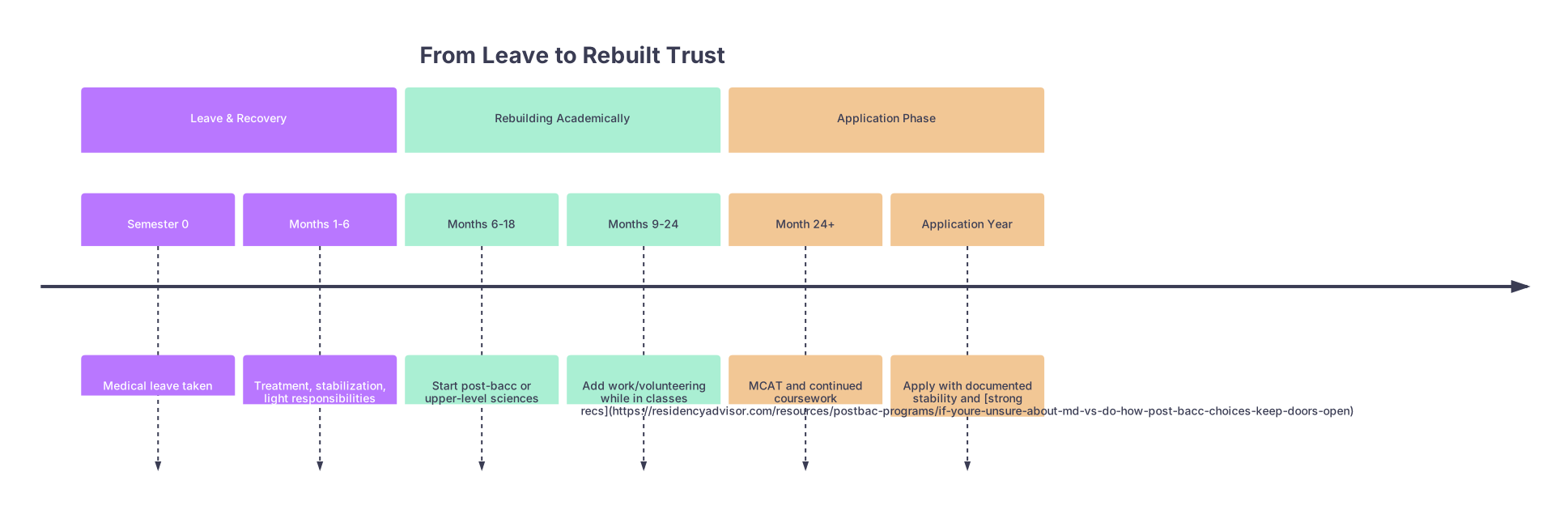
| Period | Event |
|---|---|
| Leave & Recovery - Semester 0 | Medical leave taken |
| Leave & Recovery - Months 1-6 | Treatment, stabilization, light responsibilities |
| Rebuilding Academically - Months 6-18 | Start post-bacc or upper-level sciences |
| Rebuilding Academically - Months 9-24 | Add work/volunteering while in classes |
| Application Phase - Month 24+ | MCAT and continued coursework |
| Application Phase - Application Year | Apply with documented stability and [strong recs](https |
Step 1: Get brutally clear on your story (for yourself first)
Before you write a single sentence for AMCAS or a personal statement, you need your own internal version of the story. Not for them. For you. So you do not ramble, over-disclose, or sound evasive.
Sit down and write this out in a private doc (no one else has to see this version):
What exactly happened before your leave?
- Symptoms or issues (physical or mental)
- How they affected your functioning (class attendance, studying, sleep, etc.)
- What you did poorly: ignoring warning signs, not asking for help, etc.
What you actually did during the leave:
- Treatment: therapy, medication, surgery, rehab, ongoing follow-up
- Support: family, disability office, academic counselor
- Concrete changes: schedule, sleep, nutrition, coping skills, boundaries
How you tested your new baseline:
- Did you return to lighter coursework first?
- Did you hold a job? Volunteer regularly? Take one difficult course and succeed?
What’s different now:
- Systems you’ve built (planner, therapy, support network, exercise, medication adherence)
- What you’ve learned about your limits
- How you recognize and manage early warning signs
That’s the raw material. Most people skip this step and then wonder why their explanation reads vague and unconvincing. You do this properly and the tone of everything else snaps into place.
Step 2: Design your post-bacc to answer one question: “Can I trust you now?”
A post-bacc with a medical leave history is not about “getting more As” in the abstract. It’s about targeted evidence.
You want your record to scream:
- I can handle upper-division science
- I can handle sustained heavy workloads
- I can function while juggling multiple responsibilities, not just “monk-mode” one class at a time
So you structure your post-bacc with that in mind.
1. Take the right kind of classes
You want:
- Upper-division biology/biochem/physiology/neuroscience
- Classes with labs if possible
- Some with reputation for being rigorous, not just fluff
What this looks like in practice:
- Semester 1 back: 9–12 credits of upper-level science (if your health is early in recovery)
- Semester 2+: 12–16 credits, including at least 2 heavy hitters
If you spend three years taking one online course at a time, you’re signaling, “I can function, but only in a protected environment.” That makes adcoms nervous.
2. Build sustained performance
You’re not trying to show them one heroic comeback semester. You’re trying to show a pattern. At least 3–4 consecutive terms of:
- A/A- work, especially in sciences
- No unexplained withdrawals or incompletes
- Consistent enrollment (not vanishing for a term and reappearing with no explanation)
A single good semester says “maybe lucky break.” A sustained trend says “this is the new normal.”
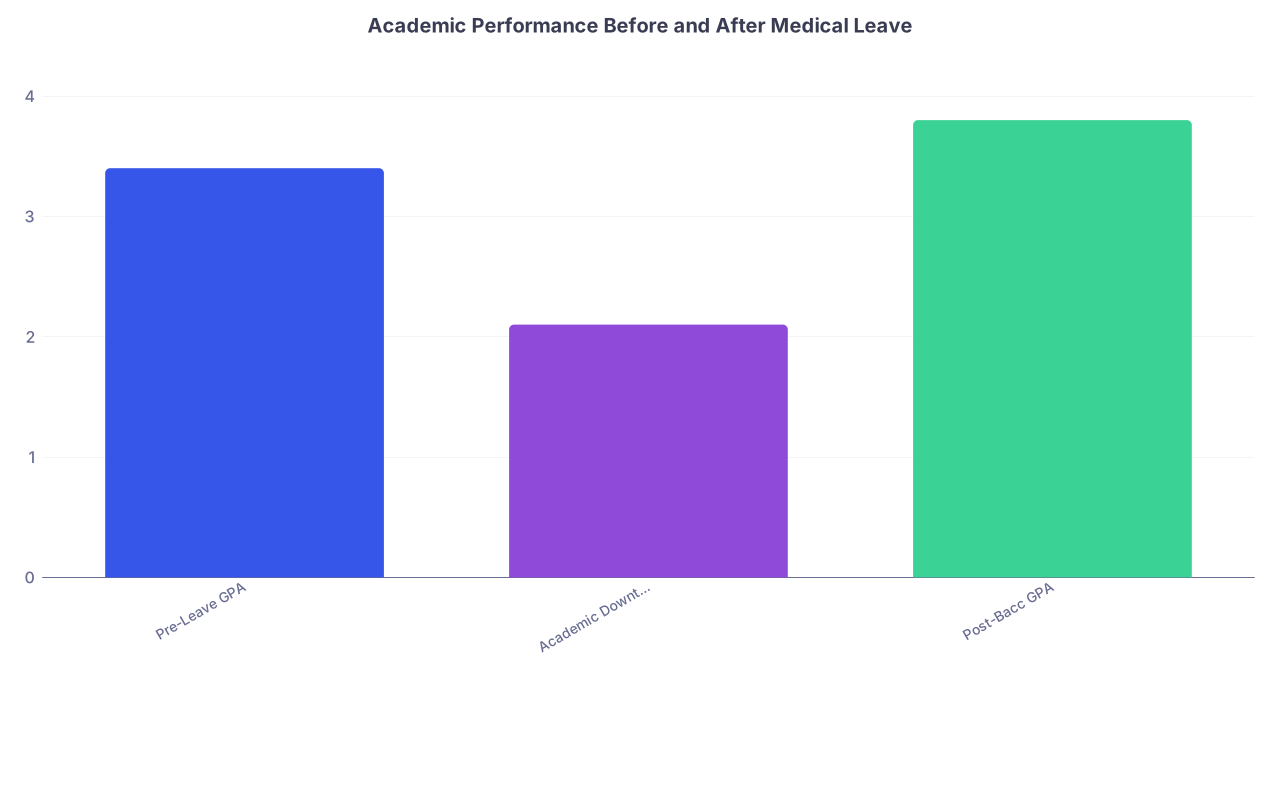
| Category | Value |
|---|---|
| Pre-Leave GPA | 3.4 |
| Academic Downturn GPA | 2.1 |
| Post-Bacc GPA | 3.8 |
Step 3: Prove function outside the classroom too
Here’s the thing adcoms will never write in a brochure: they trust people more when they see successful multi-tasking.
Unfair? Maybe. Real? Definitely.
So during your post-bacc, you want at least one of these running in parallel with your coursework:
- Clinical job (scribe, MA, EMT, CNA, tech)
- Regular clinical volunteering (weekly, not “I did a 2-week trip once”)
- Research position with consistent hours
- Meaningful non-medical work with real responsibility (teaching, tutoring, office job)
The key is consistency over time, not “I shadowed 20 hours once.” They want to see that you can show up, week after week, without imploding.
Example that works:
- 14 credits of upper-level science
- 12–16 hours/week as a scribe
- 1 ongoing volunteering commitment (2–4 hours/week)
for at least 2–3 semesters.
That combination says: my body and mind can handle this. I’m not fragile glass.
Step 4: Use your advisors and disability services strategically
If you took a medical leave, there’s probably paperwork somewhere: withdrawal forms, letters from providers, maybe disability office records.
You don’t need to dump that on adcoms. But you do want:
- A premed advisor who knows your situation and can vouch for your trajectory
- Ideally, some official note in your school’s internal record that your leave was medical, not disciplinary or academic dishonesty
If you used disability services and got accommodations, that’s fine. Many med students do. What adcoms want to see is that:
- You understand your needs
- You use supports appropriately
- You’re not trying to brute-force your way through in denial
If you’re worried about disclosure, this is where talking to your pre-health office or an experienced advisor actually matters. You want to thread the needle between under- and over-sharing.
Step 5: Craft a tight, controlled explanation in your application
You will almost certainly need to address the medical leave in:
- AMCAS “Additional Information” or school-specific secondary questions
- Sometimes in your personal statement (if the experience is central to your path)
- Interviews (when they ask about academic dips or gaps)
The rule: brief, honest, forward-focused.
What you do not do:
- List your diagnoses in graphic detail
- Trauma dump
- Argue with the reader about how unfair everything was
- Sound like the crisis is still active and uncontrolled
You’re not auditioning as a patient. You’re applying to be a physician.
A basic structure that works
3–5 sentences in most written answers. Something like:
- One clear sentence about what happened (without naming every DSM code):
- “During my junior year, I experienced a significant health issue that led to a medical leave of absence for two semesters.”
- 1–2 sentences on what you did to address it:
- “I worked with my physicians and a therapist, adjusted my treatment plan, and took time to focus on recovery and building sustainable habits around sleep, stress management, and academic work.”
- 1–2 sentences on what your post-bacc now shows:
- “Since returning to full-time coursework, I’ve completed 48 credits of upper-division science with a 3.85 GPA while working 15 hours per week as a medical assistant. This period has demonstrated my ability to manage demanding workloads and maintain my health.”
That’s it. Clean, adult, no hedging.
If the medical issue is part of why you chose medicine (e.g., long-term chronic illness, meaningful patient experience), you can expand slightly in your personal statement — but you still keep the tone professional. Focus on insight and growth, not suffering.
Step 6: Engineer your letters of recommendation to back your story
Letters are where trust is either cemented or undermined.
You want at least one or two letters that can quietly, firmly, say:
- This student shows up
- This student doesn’t crumble when stressed
- This student has matured after past difficulty
Where to get those:
Post-bacc science faculty
- They’ve seen you handle dense material, labs, exams
- They can compare you to current premeds: “top 10% of my students,” etc.
- They can mention your reliability, not just your grades
Supervisors in work/clinical roles
- “Shows up on time, takes feedback, handles high-pressure situations, good with patients”
- If you ever had to manage schedule constraints related to health, they can speak to your responsibility and communication
Advisor or mentor who knows the backstory
- They do not need to share your diagnosis
- But they can explicitly say something like:
- “X has demonstrated substantial growth after overcoming significant health challenges earlier in their academic career. Over the past two years, I’ve seen consistent academic excellence, maturity, and stability.”
Give your letter writers a short, factual one-page summary:
- A few bullet points about your medical leave and recovery timeline
- Your post-bacc performance
- Specific things you hope they can comment on (work ethic, reliability, resilience, stability)
Do not assume they remember your whole story. Make it easy for them to write the letter you need.
Step 7: Practice answering this in an interview without flinching
If your leave and GPA dip are obvious, someone will ask.
You cannot look surprised when they do.
The worst responses:
- Nervous word salad
- Oversharing deeply personal details
- Getting defensive or minimizing: “It really wasn’t that bad…” when they’re staring at Fs and withdrawals
You want a rehearsed-but-not-robotic answer. Something like:
“During my junior year, I developed a significant health issue that affected my ability to keep up with coursework. I took a medical leave for the next two semesters to focus on treatment and recovery. During that time, I worked closely with my physicians and therapist, and I learned a lot about my limits and how to manage stress in a healthy way.
Since then, I’ve completed a rigorous post-bacc with upper-division sciences — 40+ credits at a 3.8 level — while working part-time in a clinical role. That experience has shown me that the systems I’ve put in place are working. I’m confident I can handle the demands of medical school, and I’m actually grateful for that period because it forced me to build sustainable habits instead of just pushing through.”
Short, steady, no drama. Then stop talking. Let them ask a follow-up if they want.
Practice this with another human. Out loud. More than once.
Step 8: Be honest about whether you’re actually ready
Here’s the part very few people will say out loud: sometimes you’re not stable yet. You’re in the middle. Rocky post-bacc semesters. Spotty attendance. Ongoing crises.
If that’s you, using post-bacc work to “rebuild trust” is premature. You’re still in the rebuild, not at the “proof” stage.
Trust yourself more than your impatience.
You should not be applying if:
- You’re still changing meds every few months and crashing with each adjustment
- You’ve had multiple recent semesters with withdrawals or incompletes for health reasons
- You’re hanging on by a thread with reduced course loads and no other responsibilities
In that case, the right play is:
- Take an extra year
- Clean up your systems and treatment
- Build 2–3 consecutive terms of strong, uncomplicated performance
Adcoms notice when the “new stability” is actually three months old. They’ve seen what happens when those students hit anatomy and block exams.
Step 9: Pick your school list with your situation in mind
Some schools truly do not care about context. They filter hard on numbers, and any irregularity knocks you out early. Others are more holistic and open to non-linear paths.
You can’t change the rules, but you can choose your battleground.
Look for:
- Schools that emphasize non-traditional students, career-changers, or holistic review
- State schools where your post-bacc is housed — faculty may have pre-existing relationships with the med school
- Programs where you can talk to current students who had leaves, chronic illness, or disability and actually got in
Do not waste your money blanketing ultra-competitive schools that famously cut anyone with a blemish. Yes, one or two moonshots is fine. Twenty is not strategy. It’s denial.
Step 10: Know what “success” actually looks like in your case
For you, success is not “pretend the leave never happened.” That’s impossible. It’s in your transcript.
Success is making that leave look like:
- A contained, time-limited event
- Followed by mature action and treatment
- Followed by years of stability and growth
If an adcom can look at your file and say, “I’d be surprised if this person had a similar collapse in med school,” you’ve done your job.
You do that by:
- Three or more solid post-bacc terms of rigorous coursework
- Meaningful work/volunteering during those terms
- Controlled, professional explanation of your leave
- Strong, specific letters that back up the new you
- A calm, confident interview narrative
None of that is theoretical. It’s all buildable.
Your next step today
Open a blank document and write three headings:
- “What happened before and during my medical leave”
- “What I did to recover and stabilize”
- “Evidence I’m building now (and still need) to show I’m ready”
Fill those in honestly.
Then, under “Evidence I’m building now,” circle the weakest area — maybe it’s sustained full-time coursework, or consistent work experience, or clear letters.
That circled item? That’s your project for the next semester. Fix that, and your medical leave stops being a red flag and becomes a chapter you’ve clearly grown past.